2008 AUDI TT ROADSTER warning
[x] Cancel search: warningPage 247 of 316
________________________________________________ T_ i _r_e _s_ a_n_ d_ w_ h_ e_e _ l_s __ _
•
pressure for a trip - even one that you would not consider to be
"long." See=>
page 246, "Tires and vehicle load limits" for more
important information .
Always use an accurate tire pressure gauge when checking and adjus ting inflation pressures . Check all of the tires and be sure not
to forget the spare tire . If the pressure in any tire is too high when
the tire is "cold," let air out of the tire slowly with the edge of the tire gaug e and keep checking the pressur e until you reach the pressure
that is correct for the load (passengers and luggage) and kind of driving you plan to do.
I f the pressure in any tire is too low, note the difference between the
pressure in the cold tire and the pressure you need and add the air
that you need to reach the correct pressure for the vehicle load
(passengers and luggage) for the tires on your vehicle as listed on
the on your vehicle and in this manual and the kind of driving you
plan to do.
Ne ver e xceed the m aximum inflat ion pre ssure l isted on the tire
sid ewall for any rea son .
Remember that the veh ic le manufacturer, not the tire manufacturer ,
determin es the correct tire pressure for the tires on your vehicle .
It is important to check the tire pressure when the tires are cold .
• Read the required tire pressure from the tire pressure label
located on driver 's side 8 -pillar.
• T urn the va lve stem cap counter -clockwise to remove it from the
tire valve .
• Place the air pressure gauge on the valve .
• The tire pressures should only be checked and adjusted when
the tires are cold. The s lightly raised pressures of warm tir es mus t
not be reduced.
• Adjust the tire pressure to the load you are carrying .
• Reinstall the va lve stem cap on the valve .
When should I ch eck the tir e pr essu re?
The correct tire pressure is especially important a t high speeds . The
pressure should therefore be checked a t least once a month and
a lways before sta rting a journey.
Wh en sho uld I adjust the tire p re ss ure s?
Adjust the tire pressure to the load yo u are carrying . After changing
a wheel
o r replacing wheels you have to adjust the tire pressures on
a ll whee ls . In addition, you must then initia lize the new tire pres
sures in the tire pressure monitoring system=>
page 41.
& WARNING
Incorre ct t ir e pre ssures and /or underinfl ati on ca n lead sudden tire
failure , los s of contro l, colli sion , seriou s per sonal injury or even
death .
• Whe n the w arnin g sy mbol appear s in the instrument
cl uster , sto p and in spe ct the tire s.
• Inco rre ct tire pre ssure and /or underin flati on can cau se
in creased tire wear and can affe ct the ha ndling of the vehicle and
s topping ability.
• Incorre ct t ire pre ssures and /or underinfl atio n c an a ls o le ad to
s udden tire f ailure , including a blowout and sudden deflation ,
ca usi ng loss o f vehi cle co ntrol.
• The driv er i s re sp o nsible for the correct tire p re ss ure s for all
tire s on the vehicle . T he appl icable pre ssure v alu es are lo ca ted o n
a stic ker on th e driver 's side B -pillar.
• Onl y w hen all tire s on th e veh icle a re fi lled to the corre ct pre s
s ure , the tire pre ssure monitor ing sy ste m can work correctly .
• The u se of incorre ct t ire pr essure val ues can lead to accidents
or other d am age. The refo re it is esse ntial th at the dri ver ob serve
the spe cified tire pr essur e value s fo r the t ire s and the correc t pr es
s ures for the function of the tire pr essure monitoring sy stem.
• Always inflate t ires to the r ecom mended and corre ct tir e pr es -
su re bef ore dri ving off.
~
Vehicle care I t •
Page 248 of 316
-~_T_ ir_e_ s_ a_ n_d _ w_ h_ e_e _l_s _________________________________________________ _
& WARN ING (continued )
• Driving with underinflated tires bend more , letting them get
too hot re sulting in t read separation , sudden t ire failure and loss
of control.
• Excessive speed and /overloading can cau se heat bu ild-up ,
sudden tire failure and lo ss of control.
• If the tire pressure is too low or too high , the tires will wear
prematurely and the vehicle will not handle well .
• If the tire is not flat and you do not have to change a wheel
immediately, drive at reduced speed to the nearest service station
to che ck the tire pres sure and add air as required .
0 Note
Driving without valve stem caps can cause damage to the tire
va lves. To prevent this, always ma ke sure that fact ory insta lled valve
stem caps on all whee ls are securely mounted on the valve .
<£> For the sake of the environment
Underinflated tires will also increase the fue l consumption. •
Tires and vehicle load limits
There are limits to the amount of load or weight that any vehicle and
any tire can carry. A vehicle that is overloaded will not handle well
and is more difficu lt to stop. Overload ing can not only lead to loss
of vehicle contro l, but can a lso damage important parts of the
veh ic le an d ca n lead to sudden t ire fa ilu re , inc lud ing a bl owout a nd
sudden deflation that can cause the vehicle to crash.
Yo ur saf ety a nd that of you r passenge rs also de pends on making
sure that load limits are not exceeded . Vehicle load includes every
body and eve ryt hing in and on the vehic le . Th ese load limi ts are technica
lly referred to as the vehicle's
Gross Vehicle We ight Rating
("GVWR").
Th e "GVWR" includes the weight of the basic vehicle, all factory
insta lled accessories, a ful l tank of fuel, oil, coolant and other f luids
p lus max imum load. The ma ximu m load inc ludes the numbe r of
passengers that the vehicle is intended to carry ("seating capacity")
w it h an assu med we ight o f 150 lbs (68 kg) for eac h pass enger at a
designated seating position and the total weight of any luggage in
t he vehicle.
T he
Gross Axle Weight Rating ("GAWR"l is the maximum load that
can be a pplied a t eac h of the vehic le's two a xles .
T he Gross Veh icle Weigh t Rat ing a nd the Gross A xle We igh t R ating
are listed on the safety comp liance stic ker label located on the
dr iver's s ide B -p illar . You r Aud i has 2 sea ting pos it io n s. Eac h seating
posit ion has a safety belt=>
page 137, "Safety belts".
T he fact that the re is a n up per lim it to yo ur vehicle's G ross Veh ic le
We ig ht Rating means that the to tal we ight o f what ev e r is be ing
ca rried in the ve hicle is lim ited. The mo re pas se ngers in the vehic le
or passe ngers w ho ar e heav ier t han th e sta ndard weights assumed
mean that less weight can be carried as luggage.
T he ti re p ress ure labe l on yo ur Aud i al so list s the maxi mum
combined weight of a ll of the occupants and luggage or other cargo
th at the vehicle can car ry. F or the lo ca tio n of t he label =>
page 242,
fig . 160.
& WARNING
Overloading a vehicle can cause loss of vehicle control , a crash or
other accident, serious personal injury , and even death .
• Carrying more weight than your vehicle was des igned to carry
will prevent the vehicle from handling properly and increase the risk of the loss of vehi cle control .
• The brakes on a vehicle that has been overloaded may not be
able to stop the vehicle within a safe distance. .,_
Page 249 of 316
& WARNING (continued)
• Tires on a vehicle that has been overloaded can fail suddenly,
including a blowout and sudden deflation , causing loss of control
and a crash .•
Determining correct load limit
Use the example below to calculate the
total weight of the passengers and
luggage or other things that you plan to
transport so that you can make sure that
your vehicle will not be overloaded.
Steps for Determining Correct
Load Limit
1. Locate the statement "THE COMBINED
WEIGHT OF OCCUPANTS AND CARGO SHOULD NEVER EXCEED XXX KG OR XXX
LBS"on your vehicle 's placard (tire infla
tion pressure label)=;>
page 242, fig. 160.
2. Determine the combined weight of the driver and passengers that will be riding
in your vehicle.
Tires and wheels 1111111
3. Subtract the combined weight of the driver and passengers from
"XXX" kilo
grams or
"XXX" pounds shown on the
sticker =;>
page 242, fig. 160.
4. The resulting figure equals the available amount of cargo and luggage load
capacity. For example, if the
"XXX"
amount equals 1400 lbs. and there will be five 150 lbs. passengers in your
vehicle, the amount of available cargo and luggage load capacity is 650 lbs.
( 1400 -750 (5 x 150) = 650 I bs.)
5. Determine the combined weight of
luggage and cargo being loaded on the
vehicle. That weight may not safely exceed the available cargo and luggage
load ca pa city calculated in Step 4.
6. If your vehicle will be towing a trailer, load from your trailer will be transferred
to your vehicle. Consult this manual to determine how this reduces the avail
able cargo and luggage load capacity of
your vehicle. .,_
Vehicle care I • •
Page 251 of 316
__________________________________________________ T_ ir_e _ s_ a_ n _ d_ w_ h_ e_ e_ls _ ____. 111111
Unbalanced wheels must be rebalanced to avoid excessive wear on
steering, suspension and tires. A wheel must also be rebalanced
when a new tire is installed.
Incorrect wheel alignment
Incorr ect wheel alignment can cause excessive tire wear, impairing
the safety of the vehicle. If tires show excessive wear, have the
wheel alignment checked by an authorized Audi dealer or qualified
workshop.
All Wheel Drive
Vehicles with quattro ® must always have tires of the same size,
construction and tread type. For details see
=> page 191.
& WARNING
Sudden tire failure can lead to loss of control, a crash and serious
personal injury!
• Never drive a vehicle when the tread on any tire is worn down
to the wear indicators .
• Worn tires are a safety hazard, they do not grip well on wet
roads and increase your risk of "hydroplaning" and loss of control .
• Always keep chemicals that can cause tire damage, such as
grease, oil, gasoline and brake fluid away from tires .
• Tires age even if they are not being used and can fail suddenly,
especially at high speeds . Tires that are more than 6 years old can
only be used in an emergency and then with special care and at
lower speeds.
• Never mount used tires on your vehicle if you are not sure of
their "previous history ." Old used tires may have been damaged
even though the damage cannot be seen that can lead to sudden
tire failure and loss of vehicle control. •
New tires and replacing tires and wheels
New tires and wheels have to be broken in.
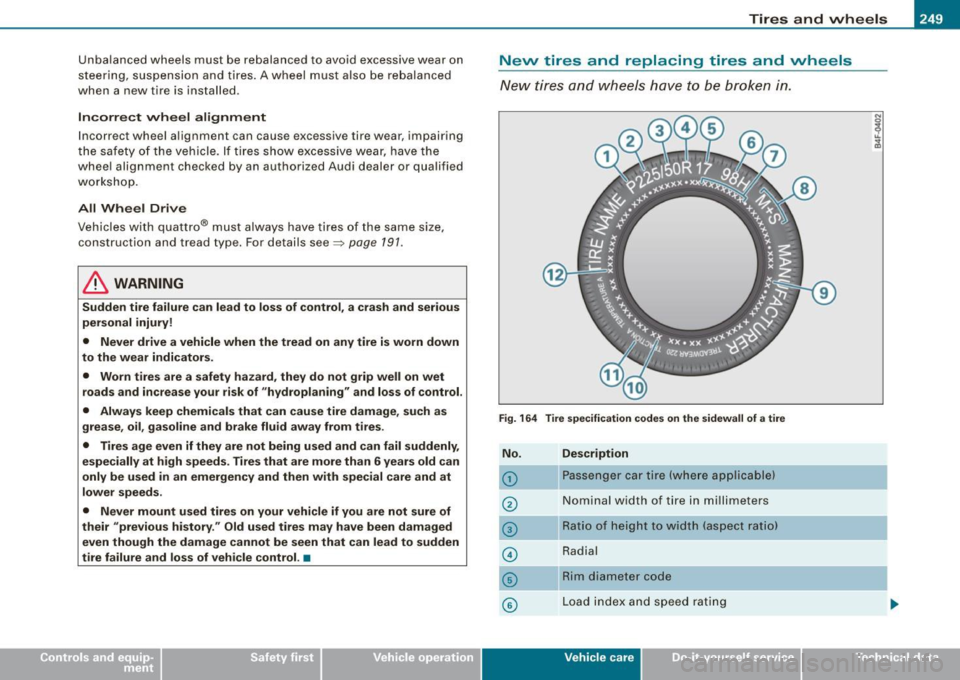
Fig. 164 Tire specification codes on the sidewall of a tire
No.
©
0
©
©
©
©
Description
Passenger car tire (where app licable)
Nominal width of tire in mi llimeters
Ratio of height to width (aspect ratio)
Radial
ii Rim diameter code
Load index and speed rating
Vehic le care
I I irechnical data
Page 254 of 316

-Tires and wheels
P'tr:1-------------------
will not work prope rly . In this case, the tire pressure monitoring
s ys tem would n ot b e ab le to mon itor the tire p ressure or wa rn yo u
if it is necessary .
• The battery inside of the tire pressure sensor has a limited
se rvice life .
• Always d rive with the valve stem caps sec urely mounted . We
recommend using factory insta lled valve stem caps . Ask your au tho
rized Audi dealer to replace lost va lve stem cap s.
The installation o f rep laceme nt tire s wi th steel cor d body p lies in
the tire sidewal l may cause malfunction of the tire pressure moni
t or ing sys tem, a nd is no t re com mended (cord mater ial i nformat ion
in molded on the tire sidewa ll) .
A lw ays check your tire p ressure monito rin g s ystem i ndicator afte r
replacing o ne or mor e tir es o n you r vehi cle. If th e tire p ressu re
monito ring syste m indicat or flashes, o r is on, you r sy stem is not
wo rk in g pr oper ly. Your rep lac em ent ti re mig ht be i nco mpat ibl e wi th
your tir e pressure monitoring syst em , or som e component o f th e
tir e pr ess ure monito ring syste m may be da mag ed.
& WARNING
• Using incorrect or unmatched tires and/ or wheels or improper
tire and wheel combinations can lead to loss of control, collision
and serious personal injury .
• Always use tires , rims and wheel bolts that meet the specifica
tions of original factory -installed tires or other combinations that
have been spe cifically approved by the vehicle manufacturer.
• Tires age even if they are not being used and can fail suddenly ,
especially at high speeds . Tires that are more than 6 years old can
only be used in an emergency and then with special care and at
lower speeds .
• Never mount used tires on your vehi cle if you are not sure of
their "previous history. " Old used tires may have been damaged
even though the damage cannot be seen that can lead to sudden
tire failure and loss of vehi cle control.
& WARNING (continued)
• All four wheels must be fitted with radial tires of the same type,
size (rolling circumference ) and the same tread pattern. Driving
with different tires reduces vehicle handling and can lead to a loss
of control.
• If the spare tire is not the same as the tires that are mounted
on the vehicle -for e xample with winter tires -only use the spare
tire for a short period of time and drive with extra care . Refit the
normal road wheel as soon as safely possible.
• Never drive faster than the maximum speed for which the tires
on your vehicle are rated because tires that are driven faste r than
their rated speed can fail suddenly .
• Overloading tires cause heat build-up , sudden tire failure ,
including a blowout and sudden deflation and loss of control .
• Temperature grades apply to tires that are properly inflated and
not over or underinflated .
• For te chnical reasons it is not always possible to use wheels
from other vehicles -in some cases not even wheels from the
same vehicle model.
• If you install wheel trim discs on the vehicle wheels, make sure
that the air flow to the brakes is not blocked. Redu ced airflow to
the brakes can them to overheat , increasing stopping distances
and causing a collision.
• Run flat tires may only be used on vehicles that were equipped
with them at the fa ctory . The vehicle must have a chassis designed
for run flat tires and a factory -installed tire pressure monitoring
system that indi cate s a loss of tire pressure . Incorre ct use of run
flat tires can lead to vehicle damage or accidents . Check with an
authorized Audi dealer o r tire specialist to see if your vehicle can
be equipped with run flat tires .
If run flat tires are used, they must
be installed on all four wheels . Mixing tire types is not permitted. .,
Page 256 of 316
-~_T_ ir_e_ s_ a_ n_d _ w_ h_ e_e _l_s _________________________________________________ _
Safety Standard No. 109. Grades Band A represent higher leve ls of
performa nce on th e la boratory test w hee l tha n the minim um
requ ired by law .
& WARNING
The traction grade assigned to this t ire is based on straight-ahead
braking traction tests , and does not include acceleration ,
cornering , hydroplaning or peak traction characteristi cs.
& WARNING
The temperature grade for this tire is established for a tire th at is
properly inflated and not overloaded. Exces sive speed , underinfla
tion, or excessive loading, either separately or in combination , can
cause heat buildup and possible tire failure. •
Winter tires
Win ter tires can im prove veh icle ha ndl ing on sno w and
i c e. A t te mp eratu res belo w 4 5 °F (7 ° C) w e r eco mme nd
c ha ng in g to winter tir e s.
In some heavy snow areas, local governments may require true
winter o r "snow" tire s, those with ve ry deeply cut tread. These tires
should only be used in pairs and be insta lled on a ll four wheels .
M ake s ure you p urchase snow ti res that are the same s ize and
construct ion type as the other ti res on your vehicle.
If your vehic le is equipped with al l-wheel drive *, this will improve
t rac tion dur ing winter dr iv in g, eve n with the standard tires .
However, we strongly recommend that you a lways equip all four
whee ls on y our vehicle with correc tly fitted winte r tires or all-seas on
tires, when winter road conditions are expected . Th is a lso improves
t he ve hic le 's brak ing perfo rmance an d reduces s top ping distances .
Summer ti res p rovide less grip on ice and snow. Winter tires (snow tires) must always be fitted on all four whee
ls .
Compatible ti re p ressure monit oring senso rs must be instal led on
a ll four w inter tires for the tire pressure monitoring system to func
tion proper ly :::::> page 251.
Ask your aut hori zed Audi deale r or quali fied w orksho p for perm itte d
winter tire size s. Use only radial winter tires.
Wi nter tires lose thei r effec tiveness when the tread is worn down t o
a depth of 0. 157 inch (4 mm).
On ly drive with winter tires under winter conditions. Summer tires
h an dle better when there is no s now or ice on t he roads a nd th e
temperature is above 45 °F (7 °C) .
I f you have a flat tire, see n otes on spare w hee l :::::> page 249.
Please a lways remembe r that w inte r tires may have a lower speed
r ating than the tires original ly instal led on your vehic le at the time
i t was manu fac tured. Please see:::::> page 251, "Speed rating (letter
code)" for a listing of the speed rating letter codes and the
m ax imum speed at which t he ti res ca n be drive n.
T he speed rating letter code(:::::, page 241) is on the side wa ll of the
ti re :::::> page 2 49. & WARNING
Winter tires have maximum speed limits that may be lower than
your veh icle's ma ximum speed . Always know the maximum speed
before driving off . Never drive faster than the speed permitted for
your specific winter tires . This will cause damage to the tires
leading to an accident and serious personal injury to you and your
pa ssengers.
& WARNING
Driving faster than the ma ximum speed for whi ch the winter tires
on your vehicle were designed can cause tire failure including a
blowout and sudden deflation , los s of control , crashes and serious _.,
Page 257 of 316
Tires and wheels -
----------------
•
& WARNING (continu ed )
personal injur ies . Have worn or damaged tires repl aced immed i
ately.
• Winter tires have ma ximu m speed rating th at may be lower
than your vehicle 's maximum speed.
• Never drive faster than the speed for which the winter or other
tire s installed on your vehicle are rated.
& WARNING
Alway s adjust your driving to the road and traffi c cond it ions .
Never let the good acceleration of the winter tires and all -wheel
drive tempt you into tak ing e xtra ri sks . Always remember :
• When braking , an all -wheel drive vehicle h andles in the same
way as a front drive vehicle .
• Drive carefully and reduce your speed on icy and slippery roads ,
even winter tires cannot help under black ice conditions.
c£> For the sake of the environment
Use summer tires when weather conditions permit. They are
quieter, d o not wear as qu ic kly and reduce fue l con sump tion. •
Snow chains
Snow c ha ins may be fitte d only to t he fr ont w heels , and only to
certain t ire sizes. Ask your authorized Audi dea ler on which tire
s izes snow chains ca n be used .
I f you are going to use snow chains, then you must instal l them on
the front whee ls at least.
The snow chains must have low-pro file l inks and must not be thicker
than 0. 53 inch ( 13 .5 mm), including the lock. Remove wheel center covers and
trim discs before putting snow
chains o n yo ur vehicle ~
(D. For safe ty reaso ns cover caps mus t
then be fitted over the whee l bolts. These are available from autho
r iz ed A ud i deale rs.
& WARNING
Using the wrong snow chain s for your vehicle or installing them
inco rrectly can increase the risk of loss of control leading to
serious personal injury.
• Snow chains are ava ila ble in d ifferent si zes . Always make sure
to follow the instructions provided by the snow chain manufac
turer .
• When driving with snow chain s never drive faster than the
speed permitted for your spe cific snow cha ins .
• Always observe local regulations .
0 Note
• Remove snow chai ns before d riving o n roads not cov ered w ith
snow to avoid damaging t ires and wearing the snow chains down
unnecessar ily .
• Snow chains, which come into direct contact with the wheel rim,
can scratch or damage it. Therefore, make sure t hat the s now c hains
are suitably covered.
[ i ] Tips
Where snow chains are mandatory on certain roads, this normally
a lso a ppl ies to veh ic les w it h All Wheel Dr iv e. •
Vehicle care I t •
Page 258 of 316

_L_T~ir ~e :..:s~ a~n~ d~ w~ h ~e~e~ l~ s '.,_ ______________________________________________ _
Wheel bolts
W heel b olts mus t al wa ys be tigh te n ed to t he cor rect
to rqu e.
The design of wheel bolts is matched to the factory instal led rims . If
d ifferen t rims are fitted, the co rrect w heel bo lts wit h th e rig ht length
and correctly shaped bolt heads m ust be used. This ensures that
w hee ls are fitt ed s ecure ly a nd th at t he brake sys te m funct ions
correctly .
I n certain circums tances, yo u may no t use w heel b olts fr om a
differ ent vehicle -even if it is the same model::::;,
page 296.
&_ WARNING
Improperly tightened or maintained wheel bolts can become loose
causing loss of control , a collision and serious personal injury.
• Always keep the wheel bolts and the threads in the wheel hubs
clean so the wheel bolts can turn easily and be properly tightened.
• Never grease or oil the wheel bolts and the threads in the wheel
hubs. They can become loose while driving if greased or oiled,
even if tightened to the specified torque .
• Only use wheel bolts that belong to the rim being installed.
• Never use different wheels bolts on your vehicle.
• Always maintain the correct tightening torque for the wheel
bolts to reduce the risk of a wheel loss. If the tightening torque of
the wheel bolts is too low , they can loosen and come out when the
vehicle is moving . If the tightening torque is too high, the wheel
bolts and th reads can be damaged and the wheel can become
loose .
0 Note
The specified torque for the wheel bolts is 90 ft lb (120 Nm) with a
t ole ranc e of ± 7,4 ft lb(± 1 0 Nm). To rque whee l bolts diag onally.
After changing a wheel, the torque must be checked as soon as possible with a to
rque wrench -preferab ly by an authorized Audi
dea ler o r qu alif ied wo rksh op.•
Low aspect ratio tires
Yo ur Audi is fac tory-equip ped wi th l ow asp ect rati o tires. Th ese tires
have been thorough ly tested and been selected specifically for your
mod el for thei r su per b p erfo rma nce, road feel an d handl in g u nder
a variety of driving conditions . Ask your author ized Aud i dea ler for
mo re deta ils.
T he low aspec t ra tio o f th ese t ires is ind icate d by a numera l o f 55 or
less in the t ire's size designation. The numera l represents the ratio
of the ti re's s idewa ll height in re la ti on to its tread w idth e xpress ed
in percentage. Conventiona l tires have a height/width ratio of 60 or
mo re .
The performan ce of low -aspect -ratio t ires is part icularly sensitive to
improper inflation pressure . It is therefore important that low
aspect ratio tires are inflated to the specified pressure and that the
inflation pressure is regularly checked and maintained. Tire pres
sures should be checked at least once a month and alway s before a
long trip::::;,
page 244, "Checking tire p ressure".
What you can do to a void tire and rim damage
L ow a spect ratio tires can be damaged more easi ly by impact with
potho les, curbs, gull ies or ridges on the road, particularly if the t ire
is underinflated.
In orde r to minimi ze the occurrence o f im pact da mage to th e tire s
of your vehicle, we recommend that you observe the fo llowing
p reca utions:
• Always ma intain reco mm ende d inflat io n pressu res . C heck your
tire p ressure every 2, 000 miles (3 ,000 km) and add ai r if neces sary .
• D rive car eful ly on roads with potholes, deep gullies or ridges.
Th e impact from d riving th ro ugh o r ove r such o bstac les can
dama ge you r tires . Impact w ith a curb may also cause da mage to
your tires . .,_