2008 AUDI S8 service
[x] Cancel search: servicePage 281 of 404

______________________________________________ D_ ri_v _ i_ n _, g..,_ a_ n_d _ e_ n_ v_i_ro _ n_ m_ e_ n_t __ ffllll
- Lack of proper maintenance as wel l as improper use of the
vehic le will impair the func tion of the emission con tro l system
and cou ld lead to damage .
<£> For the sake of the envir onment
Even when the Emission Control System is operating properly, the
exhaust gas can have a su lfur -like exhaust gas smell under some
operating states . This depends on the sulfur content of the fuel
being used. Using a different b rand of fue l may help, or fil ling the
tank with lead-free super grade gasol ine. •
Avoid damaging the vehicle
When you are driving on poor roads, or over curbs, steep ramps,
etc., make certain that low- lying parts such as spoi lers and exhaust
system parts do not bottom out and get damaged.
T his is especial ly true for vehicles with low -s lung chassis (sports
chassis)* and ful ly loaded vehicles .•
Operate your vehicle economically
and minimize pollution
General
Y o ur personal style of driving will determine the economy
of your vehicle , as well as exhaust and noise levels.
Fuel economy, environmenta l impact, and wear on your engine,
brakes and t ires largely depend on three factors :
• your personal driving style
• operat ing cond it ions
• t echnica l limitations
Controls and equip
ment Safety first Vehicle operation
I
f you anticipate what you need to do next and drive economica lly,
you can eas ily cut your fuel consumptio n by 10 -15 percent . This
section wil l give you some tips on how you can help the environ
ment and your poc ketboo k.
[ i ] Tips
The consumption estimates as published by ENV IRO NME NTA L
PRO TECTION AGENCY (EPA) and Transport Canada may not corre
spond to your actua l consumption on the road, which wi ll vary
depe nding upon veh ic le load and speed, road and weather condi
tions, trip length, etc. •
Drive smoothly and keep a lookout ahead
Vehicles use the most fuel when they ore accelerating .
-Avo id unnecessary accelerat ing a nd braking .
Vehicles use the most fue l when they are accelerating . If you antici
pate what is going to happen
ne xt, you wi ll need to brake less and,
thus, acce lerate less. Let the vehicle coast whenever possib le -for
examp le when you see that the next traffic light is red. •
Avoid full throttle
Driving at moderate speeds saves fuel and improves your
mileage.
- Try and keep we ll below your car 's max imum speed.
Acce lerating gently reduces fue l consumption, engine wear, and
does no t disturb the envir onment.
Fue l consumption, exhaust emissions and engine noise increase
dispropo rtionately at h ig h speeds . If yo u drive at approxi mate ly
three quarters of top speed, fuel consumpt ion wil l be reduced by
~
Vehicle care Do-it-yourself service Technical data
Page 282 of 404

ffl.,__ __ D_r_ i_v _i_n _.g..,_ a_ n_d_ e_ n_v _ i
_ r_o _ n_ m_ e_ n_ t _______________________________________________ _
one half. Never drive faster than the posted speed limit and weather
co nditions permit. •
Reducing unnecessary idling
Even when your car is just idling it burns up fuel.
- Shut the eng ine off when you are not driving the vehicle .
- Do not warm up the vehicle by letting the engine run at
id le .
It makes sense to shut off the engine in traff ic jams, when waiting
for trains to pass at rai lroad crossings, or at traffic lights that have
long waits on red. Turning the engine off for just 30 -40 seconds
saves more fue l than is burned starting the engine again .
It takes a long time for the engine to warm up fu lly when it is
running at idle. However, wear and noxious em issions are espec ially
high when the engine is warming up . So you should drive away as
soon as you start the engine and avoid running at high rpms while
the engine is sti ll warming up.
0 Note
Do not leave engine idling unattended after starting . If warning
lights should come on to indicate improper operation, they would
go unheeded. Extended idling also produces heat, which could
result in overheating or other damage to the vehicle or other
property .•
Regular maintenance
A badly tuned engine unnecessarily wastes a lot of fuel.
- H ave your vehicle serviced at regular intervals .
By having your vehicle regularly serviced by an Audi dealer helps to
ensure t hat it runs properly and economical ly . The condit ion of your
vehic le not only affects its safety and abi lity to hold its va lue, it also
affects
fuel con sumpt ion .
C hec k your oil each time you fill your tan k.
The amount of oil used is related to engine load and speed.
I t is norma l for the oi l consumption of a new engine to reach its
lowest va lue after a certain mileage has been driven.
You must drive your vehicle about 3,000 miles (5,000 kilometers) before you can properly assess oil consumption .
T his also applies to fuel consump tion and engine output .
0 Note
• Have your vehicle maintained properly and in accordance with
t he service recommendat ions in your Warranty
& Maintenance
booklet. Lack of proper ma intenance as well as improper use of the
vehic le wi ll impair the function of the emission control system and
cou ld lead to damage.
• Do not alter or remove any component of the Emission Contro l
System unless approved by the manufacturer.
• Do not alte r or remove any device, such as heat sh ields,
switches, ignition wires, valves, which are designed to protect your
vehic le's Emission Control System and other important vehic le
components .•
Fewer short trips
Fuel consumption will always be relatively high on short
trips.
- Try to avoid driving short dista nces with a cold engine. ~
Page 283 of 404

________________________________________________ D_ r_iv _ in_,... g,_ a_n_ d_ e_n_ v _i _ro _ n_ m_ e_ n_t __ ffllll
T he engine and catalytic converter have to reach their optimal op er
a ting t emp era tur e
to reduce fuel consumption and noxious emis
sions effective ly .
Just after starting, a cold engine in a mid -size car only achieves a
fue l economy of 6-8 m iles per gal lon (30-40 1/100 km). After about a
half a mi le, fue l economy climbs to 12 mpg (201/100 km). After about
2.5 m iles (4 km), the engine is at its proper operat ing temperature
and fuel economy has reached a normal level. So you can see that
you should avo id short tr ips whenever poss ib le .
The
out sid e te mperature is also critical in this regard . Your car
consumes more fuel in the winter than in the summer. •
Controls and equip
ment Safety first Vehicle operation
Vehicle care Do-it-yourself service Technical data
Page 285 of 404
____________________________________________________ T_r_a _i_l e_ r_t_ o _ w_ i
_ n...; g=- -•
Operating instructions
M ax im um tra iler weig ht
A trailer for your vehicle is limited to a typ ical c lass 1 or class 2
trailer.
T ra ile r l oad d is tributi on
Be sure the load in the trailer is he ld securely in place to prevent it
from shifting forward, backward or s ideways .
Never a llow a pass enger to r ide in a trailer:::::, & in "Driving instruc
t ions" .
Engin e coo lin g sys te m
Tow ing a trai ler makes the engine work harder. It is important that
the cooling system's performance is up to the additiona l load. Make
sure that the coo ling system has enough fluid .
Tire press ure
When towing a trailer, inflate the tires of your veh icle to t he co ld tire
pressure listed under "Full load" on the labe l located either on the
driver's side B -pil lar (visible when the door is open) or inside the fuel
filler flap . Inflate trailer tires to trai ler and tire manufacturers' spec
ifications.
L ig ht s
The head light settings should be checked wit h the trai ler attached
before driving off. Check to make sure both vehicle and trai ler lights
are working properly .
Safe ty c ha in s
Be s ure trailer safe ty chains are properly connected from the trailer
to the hitch on the vehicle. Leave enough slack in the chains to
permit turning corners . When yo u insta ll safety chains, make sure
they will not drag on the road when you are driving.
T he chains should cross under the trailer tongue to prevent it from
dropping in case of separat ion from the hitch.
Controls and equip
ment Safety first
Vehicle operation
0 Note
If you are go ing to tow a trai ler, you must activate the tra iler opera
tion
mode :::::, page 189, "Towing a Trailer". •
Driving instructions
Driving with a trailer always requires extra care and
consideration.
To obtain the best possib le handling of ve hicle and trailer,
p lease note t he following :
- Do not tow a loaded trailer when your car itself is not
loaded.
- Be especia lly careful whe n passing other vehic les .
- Observe speed limits .
- Do not drive at the maximum permiss ible speed .
- Always apply brakes early.
- Monitor t he temperature ga uge .
W eight d istr ibu tion
Towing a loaded trailer with an empty car results in a highly
unstable d istribution of weight. If this cannot be avoided, drive at
very low speeds only to avoid the risk of losing steering control.
A "balanced" rig is easier to operate and control. This means that
t he tow vehicle should be loaded to the extent possible and permis
sib le, while keeping the trailer as light as possib le under the circum
stances . Whenever possible, transfer some cargo to the luggage
compartment of the tow vehicle whi le observing tongue load
requirements and vehicle loading considera tions .
.,,.
Vehicle care Do-it-yourself service Technical data
Page 287 of 404

____________________________________________________ T_r_a _i_l e_ r_t_ o _ w_ i
_ n...; g=- -•
-Wit h chocks i n place, slowly release the brakes until the
wheel chocks absorb the load .
-Turn the wheels towards the curb.
-Apply the parking brake.
-Move the selector lever to P.
When rest arting after p arking :
-Apply the foot brake.
-Start the engine.
-Move the se lector lever to D.
-Re lease the parking brake and slowly pull out and away
f rom the whee l chocks .
-Stop and have someone retr ieve the wheel chocks .
[ i] Tip s
If you move the se lector lever of the automatic transmission to P
b efor e applying th e parking brak e and b efor e blocki ng th e wheels ,
you may have to use more force later to move the lever out of the
P
position .•
Controls and equip ment Safety first Vehicle operation
Vehicle care Do-it-yourself service Technical data
Page 304 of 404

Fuel supply and filling your fuel tank
Blend of gasoline and ethanol (grain alcohol or ethyl alcohol}
• Anti -knock index must be 87 AKI or higher.
• Blend must not contain more than 10% ethanol.
Blend of gasoline and MTBE
• Anti-knock index must be 87 AKI or higher.
• Blend must contain not more than 15% MTBE.
Seasonally adjusted gasoline
Many gasoline grades are blended to perform especially well for
winter or summer driving. During seasonal change-over, we suggest
that you fill up at busy gas stations where the seasonal adjustment
is more likely to be made in time.
0 Note
• Methanol fuels which do not meet these requirements may
cause corrosion and damage to plastic and rubber components in
the fuel system.
• Do not use fuels that fail to meet the specified criteria in this
chapter.
• If you are unable to determine whether or not a particular fuel
blend meets the specifications, ask your service station or its fuel
supplier.
• Do not use fuel for which the contents cannot be identified.
• Fuel system damage and performance problems resulting from
the use of fuels different from those specified are not the responsi
bility of Audi and are not covered under the New Vehicle or the
Emission Control System Warranties.
• If you experience a loss of fuel economy or driveability and
performance problems due to the use of one of these fuel blends,
we recommend that you switch to unblended fuel. •
Gasoline additives
A major concern among many auto manufacturers is carbon
deposit build-up caused by the type of gasoline you use.
Although gasoline grades differ from one manufacturer to another,
they have certain things in common. All gasoline grades contain
substances that can cause deposits to collect on vital engine parts,
such as fuel injectors and intake valves. Although most gasoline
brands include additives to keep engine and fuel systems clean,
they are not equally effective.
Audi recommends using TOP TIER Detergent Gasoline. For more
information on TOP TIER Detergent Gasoline, please go to the offi
cial website (www.toptiergas.com).
After an extended period of using inadequate fuels, carbon deposit
build -ups can rob your engine of peak performance.
(D Note
Damage or malfunction due to poor fuel quality is not covered by
the Audi New Vehicle Limited Warranty. •
Fuel tank
Fuel filler neck
The fuel filler neck is located on the right rear side panel behind the
fuel filler flap.
If the power locking system should fail, you can still open the flap
manually - for detailed instructions
see=> page 305.
You can find the fuel tank capacity of your vehicle in Technical Data
=> page 378. ~
Page 312 of 404

___ C_ h_e _c _ k_ i_ n ~g~ a_ n_ d_ f_ i_ll _in _g~--------------------------------------------
to help keep your vehicle's engine running smoothly and help
prevent the formation of harmfu l deposits, sometimes called
"sludge, " that over time can lead to expensive repairs .
At the time of printing, engine oils available in the U.S. and Canada
that meet the exacting specificat ions of Audi oil standard VW 502 00
are synthetic engine oils. This does not mean, however, that every
synthetic engine oil will meet Audi oi l standard VW 502 00. So
a lways b e sur e that you use an approved oil.
To help prevent the formation of harmful deposits use only oi l with
the following specifications printed on the oil container :
Audi oil sta nda rd VW 502 00
Oil container labels may carry the specification singly or in combi
nation with other designations and oil quality standards.
V iscosi ty
Engine oi ls are graded according to their viscosity . The proper
viscosi ty grade oi l for your engin e depends on climactic or seasonal
conditions where you drive . You can use o il with a v iscosity grade of
SAE 5W40 across all temperature ranges for normal driving condi
tions.
However , if eng ine oil viscosity grade SAE 5W40 is not available, you
can a lso use viscosity grade SAE 5W -30 or SAE 0W -40 as long as it
meets Audi oil quality standard VW 502 00 specifications.
B ecause engin e oil that meets the Audi oi l standard may not be
avai lable everywhere when you need it, we strongly recommend
that you a lways carry with you an extra quart !liter) of oil that
express ly conforms to t he VW 502 00 specification, in case you have
to top off the oil while on the road.
Only if th e level of the oil is at or be low the minimum mark on the
oi l dipstick -and no oil that express ly conforms to Audi oi l standard
VW 502 00 specifications is avai lable -may you top off with a high
quality engine oi l, preferably synthetic -based, that meets ACEA A3,
ACEA A5 or ACEA B5, API SL or ILSAC GF -3 specifications , but even
t hen, only in viscosity grades SAE 5W -40, SAE 5W -30, or SAE 0W -40.
However, during the entire time betwe en oil change int erva ls, nev er top off with more than a total of 0
.5 qt/ liter engine oil that does not
conform to Audi oil specifica tion VW 502 00.
For more information about engine oil that has been approved for
your vehic le, please contact either your authorized Audi dealer or
Aud i Customer Relat ions at 1 (800) 822-2834 or v isit our web s ite at
www.audiusa.com or www.audicanada.ca. Here you will also find a
current list of o ils (manufacturers, brand names
etc.I that conform
to Audi oi l standard VW 502 00.
Ch an g in g t he en gin e oil
The engine oil and o il filter must be changed according to the
mileage (ki lometers) and time intervals specified in your vehic le 's
Warranty & Maintenance booklet . Do not exceed these intervals -
harmful deposits from old engin e oil can reduce engin e perfor
mance and can lead to expensive eng ine repa irs.
Changing the oil at the recommended intervals is so very impor tant
because the lubricating properties of oi l decrease gradua lly during
normal vehicle use. If you are not sure when you have your o il
changed, ask your authorized Audi Service Advisor.
Under some circumstances the eng ine oil should even be changed
mor e frequen tly . Change oil more oft en if you drive most ly short
distances, operate the vehicle in dusty areas or mostly under stop
and -go traffic conditions, or when you use your vehicle where
t emperatures stay be low freezing po int for long per iods .
Detergent add it ives in the oi l wi ll make fresh oil look dark after the
engine has be en running for a short time. This is normal and is not
a reason to change the oi l more often than recommended .
Dam age or malfun ction s du e to lack of m aint enan ce
It is essential that you change your oil at the recommended interva ls
using on ly engine oil that complies with Audi oil standard
VW 502 00. Your Limited New Vehicle Warranty does not cover
damage or malfunctions due to fai lure to follow recommended
maintenance and use requirements as set forth in the Audi Owner's
Manual and Warranty
& Maintenance booklet. Your dea ler wi ll have
to deny warranty coverage un less you pr esent to the dea ler proof in
.,_
Page 313 of 404
Checkin g and fillin g 1111
-------------~~~
•
the form of Service or Repair Ord ers that all scheduled maintenance
was perfo rmed in a t imely man ner. •
Engine oil consumption
The engin e in your vehicle d ep ends on an adequate
amount of oil to lubricate and cool all of its moving parts.
In order to provide effect ive lubrication and cool ing of internal
engine components, all internal combustion engines consume a
certain amount of o il. Oil consumption varies from engine to eng ine
and may change significantly over the life of the engine . Typically,
eng ines wi th a specif ied break -in period
(see => page 2771 consume
more oil during the break -in period than they consume after oi l
consumption has stabi lized .
Under normal conditions, the rate of oil consumption depends on
the quality and viscosity of the oil, the RPM (revolutions per minute)
at which the engine is operated, the ambient temperature and road
conditions. Further factors are the amount of oil dilution from water
co ndensation or fue l residue and the oxidation level of the o il. As
any engine is subject to wear as mileage builds up, the oil consump
t io n may increase over time until rep lacement of worn components
may become necessary .
With all these variables coming into play, no standard rate of oil consu mption can be estab lished or specified. T here is no a lternative
to regular and frequent checking of the oil level, see
Note .
If the yellow eng ine o il level warni ng symbol in the instrume nt
cluster ~ lights up, you should check the oil level as soon as
poss ible
with the oil dipstick => page 311 . Top off the oil at your
earliest
convenience=> page 312.
& WARNING
Bef ore you che ck anything in the eng ine comp artment , alw ay s
read and heed all WARNINGS
=> & in "Working in the engine
c ompartment " on
page 307 .
0 Note
Driving with an insuff ic ie n t o il level is l ikely to cause severe damage
to the engine.
[ i ] Tip s
• The oil pr es sure warning displ ay
regular inter vals, preferably ea ch time you refuel , and al ways before
going on a long trip.
• I f you have the impression your engine consumes excessive
amounts of oi l, we reco mmend that you consult your Audi dealer to
have the cause of your concern properly diagnosed . Keep in mind
t hat t he acc urate measureme nt of oil consump tion requ ires g reat
care and may take some time. Your Audi dealer has instructions
about how t o measure oil consumpt ion accurately. •
Checking the engine oil level
Vehicle care
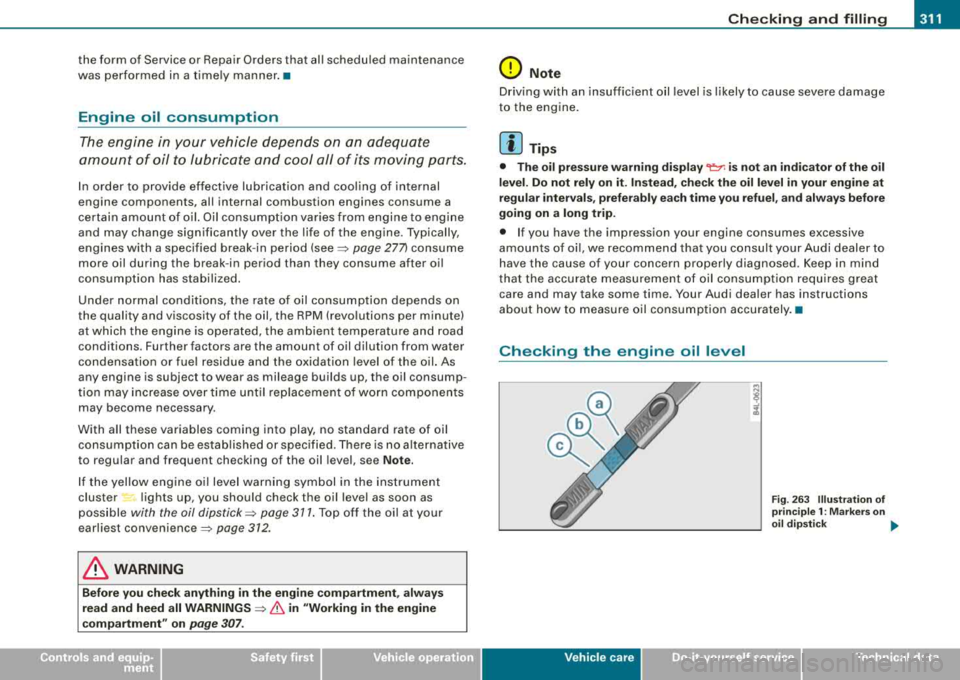
Fig. 26 3 Illu stration of
prin cipl e 1: Mar ker s on
o il dip sti ck ...