2008 AUDI S8 change time
[x] Cancel search: change timePage 304 of 404

Fuel supply and filling your fuel tank
Blend of gasoline and ethanol (grain alcohol or ethyl alcohol}
• Anti -knock index must be 87 AKI or higher.
• Blend must not contain more than 10% ethanol.
Blend of gasoline and MTBE
• Anti-knock index must be 87 AKI or higher.
• Blend must contain not more than 15% MTBE.
Seasonally adjusted gasoline
Many gasoline grades are blended to perform especially well for
winter or summer driving. During seasonal change-over, we suggest
that you fill up at busy gas stations where the seasonal adjustment
is more likely to be made in time.
0 Note
• Methanol fuels which do not meet these requirements may
cause corrosion and damage to plastic and rubber components in
the fuel system.
• Do not use fuels that fail to meet the specified criteria in this
chapter.
• If you are unable to determine whether or not a particular fuel
blend meets the specifications, ask your service station or its fuel
supplier.
• Do not use fuel for which the contents cannot be identified.
• Fuel system damage and performance problems resulting from
the use of fuels different from those specified are not the responsi
bility of Audi and are not covered under the New Vehicle or the
Emission Control System Warranties.
• If you experience a loss of fuel economy or driveability and
performance problems due to the use of one of these fuel blends,
we recommend that you switch to unblended fuel. •
Gasoline additives
A major concern among many auto manufacturers is carbon
deposit build-up caused by the type of gasoline you use.
Although gasoline grades differ from one manufacturer to another,
they have certain things in common. All gasoline grades contain
substances that can cause deposits to collect on vital engine parts,
such as fuel injectors and intake valves. Although most gasoline
brands include additives to keep engine and fuel systems clean,
they are not equally effective.
Audi recommends using TOP TIER Detergent Gasoline. For more
information on TOP TIER Detergent Gasoline, please go to the offi
cial website (www.toptiergas.com).
After an extended period of using inadequate fuels, carbon deposit
build -ups can rob your engine of peak performance.
(D Note
Damage or malfunction due to poor fuel quality is not covered by
the Audi New Vehicle Limited Warranty. •
Fuel tank
Fuel filler neck
The fuel filler neck is located on the right rear side panel behind the
fuel filler flap.
If the power locking system should fail, you can still open the flap
manually - for detailed instructions
see=> page 305.
You can find the fuel tank capacity of your vehicle in Technical Data
=> page 378. ~
Page 312 of 404

___ C_ h_e _c _ k_ i_ n ~g~ a_ n_ d_ f_ i_ll _in _g~--------------------------------------------
to help keep your vehicle's engine running smoothly and help
prevent the formation of harmfu l deposits, sometimes called
"sludge, " that over time can lead to expensive repairs .
At the time of printing, engine oils available in the U.S. and Canada
that meet the exacting specificat ions of Audi oil standard VW 502 00
are synthetic engine oils. This does not mean, however, that every
synthetic engine oil will meet Audi oi l standard VW 502 00. So
a lways b e sur e that you use an approved oil.
To help prevent the formation of harmful deposits use only oi l with
the following specifications printed on the oil container :
Audi oil sta nda rd VW 502 00
Oil container labels may carry the specification singly or in combi
nation with other designations and oil quality standards.
V iscosi ty
Engine oi ls are graded according to their viscosity . The proper
viscosi ty grade oi l for your engin e depends on climactic or seasonal
conditions where you drive . You can use o il with a v iscosity grade of
SAE 5W40 across all temperature ranges for normal driving condi
tions.
However , if eng ine oil viscosity grade SAE 5W40 is not available, you
can a lso use viscosity grade SAE 5W -30 or SAE 0W -40 as long as it
meets Audi oil quality standard VW 502 00 specifications.
B ecause engin e oil that meets the Audi oi l standard may not be
avai lable everywhere when you need it, we strongly recommend
that you a lways carry with you an extra quart !liter) of oil that
express ly conforms to t he VW 502 00 specification, in case you have
to top off the oil while on the road.
Only if th e level of the oil is at or be low the minimum mark on the
oi l dipstick -and no oil that express ly conforms to Audi oi l standard
VW 502 00 specifications is avai lable -may you top off with a high
quality engine oi l, preferably synthetic -based, that meets ACEA A3,
ACEA A5 or ACEA B5, API SL or ILSAC GF -3 specifications , but even
t hen, only in viscosity grades SAE 5W -40, SAE 5W -30, or SAE 0W -40.
However, during the entire time betwe en oil change int erva ls, nev er top off with more than a total of 0
.5 qt/ liter engine oil that does not
conform to Audi oil specifica tion VW 502 00.
For more information about engine oil that has been approved for
your vehic le, please contact either your authorized Audi dealer or
Aud i Customer Relat ions at 1 (800) 822-2834 or v isit our web s ite at
www.audiusa.com or www.audicanada.ca. Here you will also find a
current list of o ils (manufacturers, brand names
etc.I that conform
to Audi oi l standard VW 502 00.
Ch an g in g t he en gin e oil
The engine oil and o il filter must be changed according to the
mileage (ki lometers) and time intervals specified in your vehic le 's
Warranty & Maintenance booklet . Do not exceed these intervals -
harmful deposits from old engin e oil can reduce engin e perfor
mance and can lead to expensive eng ine repa irs.
Changing the oil at the recommended intervals is so very impor tant
because the lubricating properties of oi l decrease gradua lly during
normal vehicle use. If you are not sure when you have your o il
changed, ask your authorized Audi Service Advisor.
Under some circumstances the eng ine oil should even be changed
mor e frequen tly . Change oil more oft en if you drive most ly short
distances, operate the vehicle in dusty areas or mostly under stop
and -go traffic conditions, or when you use your vehicle where
t emperatures stay be low freezing po int for long per iods .
Detergent add it ives in the oi l wi ll make fresh oil look dark after the
engine has be en running for a short time. This is normal and is not
a reason to change the oi l more often than recommended .
Dam age or malfun ction s du e to lack of m aint enan ce
It is essential that you change your oil at the recommended interva ls
using on ly engine oil that complies with Audi oil standard
VW 502 00. Your Limited New Vehicle Warranty does not cover
damage or malfunctions due to fai lure to follow recommended
maintenance and use requirements as set forth in the Audi Owner's
Manual and Warranty
& Maintenance booklet. Your dea ler wi ll have
to deny warranty coverage un less you pr esent to the dea ler proof in
.,_
Page 313 of 404
Checkin g and fillin g 1111
-------------~~~
•
the form of Service or Repair Ord ers that all scheduled maintenance
was perfo rmed in a t imely man ner. •
Engine oil consumption
The engin e in your vehicle d ep ends on an adequate
amount of oil to lubricate and cool all of its moving parts.
In order to provide effect ive lubrication and cool ing of internal
engine components, all internal combustion engines consume a
certain amount of o il. Oil consumption varies from engine to eng ine
and may change significantly over the life of the engine . Typically,
eng ines wi th a specif ied break -in period
(see => page 2771 consume
more oil during the break -in period than they consume after oi l
consumption has stabi lized .
Under normal conditions, the rate of oil consumption depends on
the quality and viscosity of the oil, the RPM (revolutions per minute)
at which the engine is operated, the ambient temperature and road
conditions. Further factors are the amount of oil dilution from water
co ndensation or fue l residue and the oxidation level of the o il. As
any engine is subject to wear as mileage builds up, the oil consump
t io n may increase over time until rep lacement of worn components
may become necessary .
With all these variables coming into play, no standard rate of oil consu mption can be estab lished or specified. T here is no a lternative
to regular and frequent checking of the oil level, see
Note .
If the yellow eng ine o il level warni ng symbol in the instrume nt
cluster ~ lights up, you should check the oil level as soon as
poss ible
with the oil dipstick => page 311 . Top off the oil at your
earliest
convenience=> page 312.
& WARNING
Bef ore you che ck anything in the eng ine comp artment , alw ay s
read and heed all WARNINGS
=> & in "Working in the engine
c ompartment " on
page 307 .
0 Note
Driving with an insuff ic ie n t o il level is l ikely to cause severe damage
to the engine.
[ i ] Tip s
• The oil pr es sure warning displ ay
regular inter vals, preferably ea ch time you refuel , and al ways before
going on a long trip.
• I f you have the impression your engine consumes excessive
amounts of oi l, we reco mmend that you consult your Audi dealer to
have the cause of your concern properly diagnosed . Keep in mind
t hat t he acc urate measureme nt of oil consump tion requ ires g reat
care and may take some time. Your Audi dealer has instructions
about how t o measure oil consumpt ion accurately. •
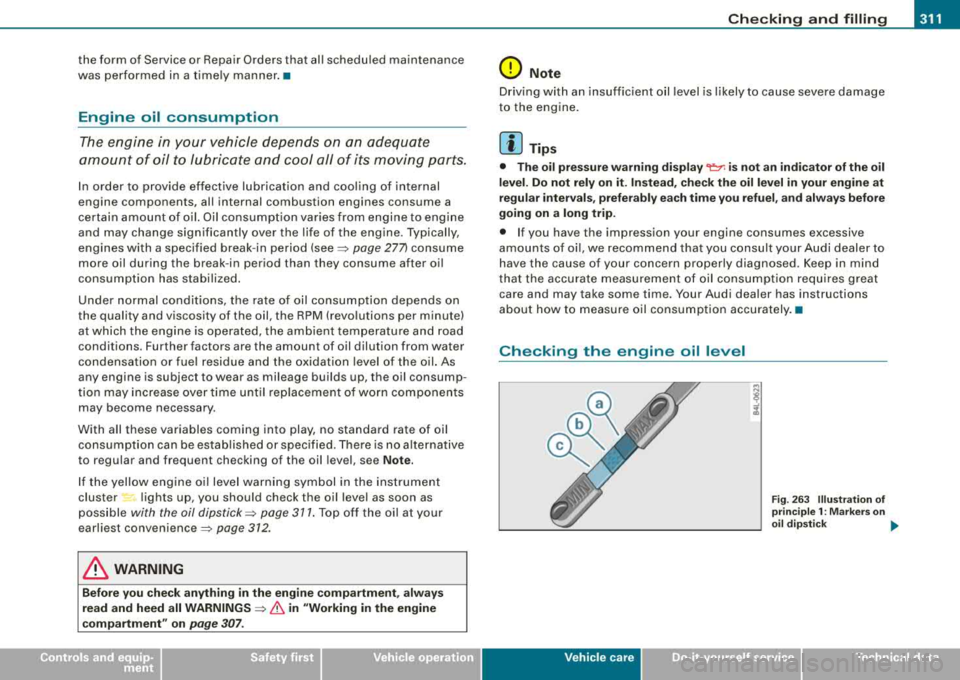
Checking the engine oil level
Vehicle care
Fig. 26 3 Illu stration of
prin cipl e 1: Mar ker s on
o il dip sti ck ...
Page 320 of 404

___ C_ h_e _c _ k_ i_ n ~g~ a_ n_ d_ f_ i_ll _in _g~--------------------------------------------
-Read the brake fluid level from the brake fluid reservoir
=> fig. 268. The brake fluid level must be between the
"MIN" and "MAX" markings.
The brake fluid reservoir is located at the rear partition of the engine
compartment on the left
side~ page 308.
The fluid level may drop slightly after some time due to the auto
matic adjustment of the brake pads. This is not cause for alarm.
If the brake fluid level falls considerably below the "MIN" mark, the
brake warning/indicator light (U.S. models:
BRAKE , Canadian models:
«D>l will come on~ page 22 and~ page 30. Do not continue to
operate the vehicle. The complete brake system should be thor
oughly checked by an authorized Audi dealer or other qualified
facility and the cause corrected. If the brake fluid level is too low, the
brake warning/indicator light will illuminate. Contact an authorized
Audi dealer
immediately. •
Changing brake fluid
Have the brake fluid changed by an experienced techni
cian.
Brake fluid absorbs moisture from the air. If the water content in the
brake fluid is too high, corrosion in the brake system may result
after a period of time. The boiling point of the brake fluid will also
decrease considerably and decrease braking performance.
Therefore, the brake fluid must be changed
every two years. Always
use new brake fluid which conforms to Federal Motor Vehicle Stan
dard "FMVSS 116 DOT 4".
The brake fluid reservoir can be difficult to reach, therefore, we
recommend that you have the brake fluid changed by your autho
rized
Audi dealer. Your dealer has the correct tools, the right brake
fluid and the know-how to do this for you.
& WARNING
• Brake fluid is poisonous . It must be stored only in the closed
original container out of the reach of children!
• Brake failure can result from old or inappropriate brake fluid .
Observe these precautions:
-Use only brake fluid that meets SAE specification J 1703 and
conforms to Federal Motor Vehicle Standard 116. Always check
with your authorized Audi dealer to make sure you are using
the correct brake fluid. The correct type of brake fluid is also indicated on the brake fluid reservoir .
- The brake fluid must be new. Heavy use of the brakes can
cause a vapor lock if the brake fluid is left in the system too
long. This can seriously affect the efficiency of the brakes as
well as your safety . This could result in an accident .
0 Note
Brake fluid will damage the paint of your vehicle .
<£> For the sake of the environment
Because of the problem of proper disposal of brake fluid as well as
the special tools required and the necessary expertise, we recom
mend that you have the brake fluid changed by your authorized Audi
dealer. •
Battery
General information
Under normal operating conditions, the battery in your Audi does
not need any maintenance. With high outside temperatures or long
daily drives we recommend that you have the electrolyte level .,,_
Page 323 of 404

Checking and filling Ill
-------------~~~
•
& WARNING (continued )
• When disconnecting the battery, first disconnect the negative
cable and then the positive cable.
• Before reconnecting the battery, make sure all electrical
consumers are switched off. Reconnect the positive cable first and
then the negative cable . Never interchange the cables -this could
start a fire!
• Never charge a frozen or a thawed-out battery . It could
explode! If a battery has frozen, then it must be replaced . A
discharged battery can freeze over at 32 °F (0
°CI.
• Make sure the vent hose is always attached to the opening on
the side of the battery.
• Never use batteries which are damaged. There is the danger of
an explosion
I Always replace a damaged battery .
& WARNING
California Proposition 65 Warning :
• Battery posts , terminals and related accessories contain lead
and lead compounds, chemicals known to the State of California
to cause cancer and reproductive problems . Wash hands after
handling.
0 Note
• Do not disconnect the vehicle battery when the ignition is
switched on or when the engine is running, otherwise, you will
damage electronic components in the electrical system.
• I f your vehicle is going to stand for a long period of time without
being driven, protect the battery from "freezing", otherwise it will
be damaged and will then have to be replaced .•
Battery charging
Starting the engine requires a well charged battery.
Always read and heed all WARNINGS below ~ & and~ &
in "Working on the battery" on page 319.
-Turn off the ignition and all electrical consumers.
- Make sure the area is well ventilated when you charge
the battery.
- Attach the red (positive
8) clamp of the charging equip
ment to the positive terminal of the battery and the black
(negative(:)) clamp to the jumper terminal.
- Only now plug the mains lead for the charging equip
ment into the wall outlet and turn it
on~ &.
-Make sure the charging rate is not over 30 amps/14.8
Volt.
-When the battery is fully charged: Turn the charging
equipment off and remove the mains lead from the wall
outlet.
- Now remove the clamps for the charging equipm ent.
A discharged battery can freeze at temperatures of only O °C . Allow
a frozen battery to thaw completely before attempting to charge it
=> ,&. . However, we recommend not using a thawed battery again
because the battery casing can be cracked due to ice formation and
can leak battery acid.
Battery charging (Maximum charging rate of 30
amps/14.8 Volt)
When charging at low voltages (e.g . with a trickle charger ), the
battery cab les do not have to be disconnected first. The battery caps
should
not be opened when charging a battery. ~
Vehicle care
Page 324 of 404

-Checking and filling PW~---=---=----------------
It is not necessary to remove the battery from the luggage compart
ment, and it is also not necessa ry t o disco nnec t the cab les.
F a st ch arging th e batt ery ( charging rate above 14 .8
V olts )
For technical reasons do not use a battery charger that uses voltage
greater tha n 14.8 Vo lts to charge your veh ic le's battery.
& WARNING
C harging a b attery can be dangerou s.
• Always follow the operating in structions provided by the
battery charger manufacturer when ch arging your b attery .
• Never charge a frozen battery . It may expl ode because of ga s
t rapped in the ice . Allow a frozen batter y to tha w out fir st .
• Do not reu se batteries which were fro zen. The battery hou sing
m ay have cracked and weakened when the battery froze.
• Charge the battery in a well ventilated are a. Keep aw ay from
open flame or electric al spar k. Do not smoke . Hydr ogen gas gener
ated by the battery i s explosive.
• To reduc e the danger of e xplosion , never conne ct or dis conn ect
charger cable s while the charger i s oper ating.
• Fa st charging a batter y is dangerous and should only be
a ttempted by a competent technician with the proper equipment .
• Battery ac id that may spill during charging should be washed
off with a solution of warm water and b aking soda to neutralize
the a cid .
0 Note
Never use a fast charger as a booster to start the engine. This wil l
ser iously damage sens it ive elect ronic compo nents, such as control
units, r elays, radio , etc ., as wel l as the battery charger. •
Battery replacement
The new batte ry mus t have t he s ame s pecificati ons and
dimensions as the original equipment battery.
I ntel ligent energy management in your vehicle is responsible for
distr ibut ing the e lectr ica l energy throughout your veh icle
~ page 274. The inte lligent energy management system will keep
t he engine ba ttery charged be tter than vehicles without t his sys tem.
T o make sure the add it ional electr ical energy is avai lab le once aga in
after you have changed t he battery, we recommend that you ins tall
batteries of the same type and manufacture only (the same as those
insta lled at the time your vehicle was delivered). Specifications are
listed on the battery housing . Your authorized Audi dea ler wi ll then
code the battery management contro l unit .
The new battery must have the same capacity, voltage (12 volts), amperage, construction and p lug sea ling.
When instal ling the battery, make sure the ign ition and all elect rica l
consumers are turned off .
0 Note
Make sure the ventilation hose on the side of the battery is
connected, otherwise fumes or battery acid can leak out.
'£> For the sake of the environment
Because of the problem of proper disposal of a battery, we recom
mend your authorized Audi dealer change the battery for you.
Batteries contain sulfur ic acid and lead and must always be
disposed of proper ly i n compliance with all environmental regula
tions . Disposing of vehicle batteries improper ly is very dangerous to
t he environment .•
Page 328 of 404

_L--_T_ ir_e_ s_ a_ n_d _ w_ h_ e_e _l_s _________________________________________________ _
Groove
means the space between two adjacent tread ribs.
L oa d r atin g (code)
means t he m aximum load that a t ire is rated to carry for a given
inf lation pressure . You may not find this information on a ll tires
because it is not required by law.
M ax imum l oad r ating
means t he load rating for a tire a t the maximum permissib le infla
tion pressure for that tire.
Maximum l oaded v ehi cle wei ght
means the sum of:
(a) Curb weight
(b) Accessory weight
(c) Vehicle capaci ty weight, and
(d) Product ion options weight
M ax imum (p er mis sibl e) infl ati on pr essure
means the maximum cold i nflation pressure to wh ic h a t ire may be
inflated. Also cal led "maximum inflation pressure."
Normal occ upant we ight
means 150 lbs. (68 ki lograms) times the number of occupants
seated in the veh ic le up to the total seating capacity of your vehicle.
Oc cupant distributi on
means distribution of occupants in a vehicle .
Outer di ameter
means the overal l diameter of an inf lated new tire.
O verall width
means the linear distance between the exteriors of the sidewa lls of
an infla ted t ire, includ ing elevat ions due to labe ling, decorat ions, or
protective bands or ribs .
Ply
means a layer of rubber -coated para llel cords.
P rodu cti on opt ion s we ig ht
means the co mbined weight of those insta lled regular product ion
options weighing over 5 lbs. (2.3 kg) in excess of those standard
items which t hey replace, not previously considered in curb weight
or accessory weight, inc luding heavy duty brakes, ride levelers, roof
rack, heavy du ty bat tery, and special trim .
Rad ia l pl y tir e
means a pneumat ic t ire in wh ich t he ply cords that extend to the
beads are laid at substantially 90 degrees to the centerline of the
t read .
Recomm ended infl ation pres su re
see :::::> page 325, "Cold tire inflat ion pressure".
R einforc ed tir e
means a tire des ign to operate at higher loads and at higher infla
tion pressures than the corresponding standard tire. Reinforced
t ires may be iden tified as
"XL", "xi", "EXTRA LOAD", or "RF" on the
sidewa ll.
Rim
means a metal support for a tire or a tire and tube assembly upon
whic h the t ire beads are seated.
Rim di ame ter
means nominal diameter of the bead seat. If you change your whee l
size, you wi ll have to purchase new tires to match the new rim diam
eter.
Rim siz e design ation
means rim diameter and width.
Rim w idth
means nominal distance between rim flanges .
Page 331 of 404

________________________________________________ T_ i
_ r_e _s_ a_n_ d_ w_ h_ e_e _ l_s __ fflll
•
pressure label lists the recommended cold tire inflation pressures
for the vehic le at its maximum capacity weight and tires that were
on your vehicle at the time it was manufactured .
If yo u w is h to impro ve comfo rt when oper ating the vehi cle at
norm al lo ad (up to 3 occup ants), y ou can adju st tire pre ssure s to
tho se spe cified for norm al v ehi cle lo ad . Before oper ating the vehi cle
a t maximum lo ad , you mu st incre as e the tire pre ssure s to tho se
s p ec ified for m aximum vehi cle lo ad ::::>
& .
Bear in m ind that the tire pressure monito ring system can only
monitor the tire pressures you have stored . The system does not
recognize the load condition of your vehicle .
The effect iveness of the t ire pressure mon itoring system will be
impaired if you store normal load pressures but then operate the
veh ic le at its maximum
load ::::>& .
Engin e II Tire design ati on See the i
llustration::::>
page 328, fig . 272 for the location of the label
e it h er o n driver's side 8 -p illar or inside the fue l fil ler flap (color of
the actual label and exact location on the vehicle will vary slight ly!.
Note that the following tab le is accurate at the time of going to
press and is subject to change . In the event o f discrepanc ies, the t ire
pressure label (On USA vehic les, the tire pressure labe l is located on
the driver's s ide 8 -p illar . On Canada vehicles, the tire pressure label
is located either on the driver's side 8 -pi llar or inside the fuel fil ler
fl ap) always takes precedence .
The table below lists the recommended cold tire inflation pressures
for the Audi mode l covered by your Owner's Literature at the
veh ic le's capacity weight and the tire s izes insta lled on the respec
tive models as original equipment, or as a factory option.
Tire pressure front Tire pressure rear
( displa ce-
normal load
II full load norm
al load
full load
ment in
c ondition al condition condition al condition
liter)
PSI II kPA PSI II kPA PSI I I kPA If PSI IT kPA .,
8-c ylinder 255 /45 R1 8 99H All Sea son
33 230 33 230 30 2
10
33 230
4 .2
255/40 R19100V XL All Sea son 36 250 38 260 33 230 36 250
255 /40 R1 9 1 00 Y XL High P erformanc e 33 230 33 230 30 2 10 33 230
275 /35 R20 102V XL High Performance
33 230 36 250 30 2
10
39 270
8-cylinder 2 55/45 R1 8 99H All Sea son
33 230 35 240 30 2
10
33 230
4 .2 L
255/40 R1 9 100V XL All Sea son 36 250 38 260 33 230 36 250
255 /40 R1 9 1 00Y XL High Perfo rman ce
33 230 35 240
30 2
10
33 230
275 /35 R20 102V XL High Performance 33 230 36 250 30 2 10 39 270
Vehicle care
I