2008 AUDI S6 roof
[x] Cancel search: roofPage 217 of 390

Airbag system -----------------=~-rm-I
as defined in the electronic control unit~ page 224, "PASSENGER
AIR BAG OFF l igh t" .
A lways remember, a chi ld safety seat or infant carrier insta lled on
the front seat may be struck and knocked out of position by the
rap id ly i nfl ating pass eng er's ai rbag in a frontal co llision . The airba g
co uld greatly reduce the effectiveness of the chi ld restraint and
even s erio usly in jure the chi ld du ring infl ation.
F or this reason, and because the bac k seat is the safest place for
c h ildr en -w he n prop erly res trained a cc or ding to th eir age an d size
- w e stro ngly recomm end that c hildren a lwa ys s it in th e back seat
~ page 234, "C hil d Safe ty" .
& WARNING
A child in a rearward -facing child safety seat installed on the front
passenger seat will be seriously injured and can be killed if the
front airbag inflates - even with an Advanced Airbag System.
• The inflating ai rbag will hit the child safety seat o r infant
carrier with great force and will smash the child safety seat and
child against the ba ckrest , center arm rest , door or roof.
• Always install rear-facing child safety seats on the rear seat.
• If you must install a rearward facing child safety seat on the
front pa ssenger seat because of exceptional circumstances and
the PASSENGER AIR BAG OFF light does not come on and stay on,
immediately install the rear-facing child safety seat in a rear
seating position and have the airbag system inspected by your
Audi dealer .
• Forward-facing child safety seats installed on the front
pa ssenger's seat may interfere with the deployment of the airbag
and cause serious personal injury to the child .
& WARNING
If, in exceptional circumstances , you must install a forward-facing
child restraint on the front passenger's seat:
Controls and equip ment Safety first
Vehicle operation
& WARNING (continued)
• Always make sure the forward-facing seat has been designed
and certified by its manufacturer for use on a front seat with a
passenger front and side airbag .
• Never put the forward-facing child restraint up against or very
near the instrument panel .
• Always move the passenger seat into its rearmost position in
the seat's fore and aft adjustment range, as far away from the
airbag as possible before installing the forward-facing child
restraint. The backrest must be adjusted to an upright position .
• Make sure that the PASSENGER AIR BAG OFF light comes on
and stays on all the time whenever the ignition is switched on.
& WARNING
To reduce the risk of serious injury , make sure that the PASSENGER
AIR BAG OFF light
will be displayed whenever a child restraint is
installed on the front passenger seat and the ignition is switched
on.
• If the PASSENGER AIR BAG OFF light does not stay on , perform
the checks described
~ page 223 , "Monitoring the Advanced
Airbag System" .
• Take the child restraint off the front passenger seat and install
it properly at one of the rear seat positions if the PASSENGER AIR
BAG OFF light does not stay on .
• Have the airbag system inspected by your Audi dealer immedi
ately .
• Always carefully follow instructions from child restraint manu
facturers when installing child restraints .
& WARNING
If, in exceptional circumstances, you must install a forward or
rearward-facing child restraint on the front passenger's seat :
Vehicle care Do-it-yourself service Technical data
Page 220 of 390
___ A_ ir_ b_ a-g _ s_y _s_ t_ e_ m _________________________________________________ _
When a person is detected on the front passenger seat, weighing
m ore tha n the to tal weigh t of a c hild that is ab out 1 year old
restra ined in one of the rear -fac ing or forward -facing infant
r es traints (listed in Fede ra l M oto r Vehicle Safe ty S ta ndard
208 with
which the Advanced Airba g System in your ve hic le was certified),
the fro nt airbag on the pas se nge r si de may o r may not dep loy .
The
PASSENGER AIR BAG OFF li gh t com es o n when the elect ro ni c
contro l unit detects a total weight on the front passenger seat that
requ ires th e front ai rbag to be tur ned off. If th e
PASSENGER AIR BAG
OFF
light does not come on, the front airbag on the passenger side
h as not been tu rned off by the c ontrol unit and can depl oy if the
control unit senses an impact that meets the conditions stored in its memo ry .
If t he to tal we ight on the fro nt passen ge r seat is more t han t hat of
a typical
1 year -old, but less than the weight of a small adult, the
fro nt a irba g on t he passen ger side may dep loy (the
PASSENGER AIR
BAG OFF
li ght does not come onl.
For example, the airbag may deploy if:
• a small ch ild that is heav ie r th a n a typ ical 1 yea r-old ch ild is o n
the front passenger seat (regardless of whether the child is in one
o f th e ch ild sa fety seats listed=>
page 236),
• a ch ild wh o ha s ou tg rown chi ld re strain ts is on the fron t
passen ger seat.
If the front passenge r airbag is turned off, the
PASSENGER AIR BAG
OFF
lig ht in the ce nter of t he inst rument panel wi ll co me on a nd stay
on.
The fron t airb ag o n the passenger side may
not deploy (the
PASSENGER AIR BAG OFF lig ht does not i llu m ina te and s ta y lit) i f:
• a small adu lt or teenager is on the front passenger seat
• a passenger who is no t sitt ing up rig ht with the ir back aga inst a
non -reclined bac krest with their feet on the vehicle f loor in front of
t h e seat is on th e fro nt pass enger se at.
If the front passenger airbag deploys, the Federa l Standard requires
t he a irbag to m eet th e "low ri sk" deploy ment criter ia to he lp reduce the risk of injury through interaction with the airbag. "
Low risk"
d eployme nt occ urs in those cras hes that ta ke place a t lower de ce l
e rations as defined in the electron ic contro l unit .=:>
page 223
Always remember : Even though your vehicle is equipped with
A dva nced Air bags , th e sa fes t place fo r chi ldren is properly
r estra ined on the back seat. Please be sure to read the important
i nf orm atio n in t he sect ions t hat follow and b e sur e to hee d all of the
WARN INGS.
& WARNING
To reduce the risk of injury when an airbag inflates, always wear
safety belts properly.
• If you are unrestrained, leaning forward , sitting sideways or out
of posit ion in any way, your risk of injury is much higher.
• You will also receive serious injuries and could even be killed if
you are up against the airbag or too close to it when it inflates -
even with an Advanced Airbag=:>
page 212.
& WARNING
A child in a rearward -facing child safety seat installed on the front
passenger seat will be seriously injured and can be killed if the
front airbag inflates -even with an Advanced Airbag System .
• Although the Advanced Airbag System in your vehicle is
de signed to turn off the front airbag when a rearward -facing child
restraint has been installed on the front passenger seat , nobody
can absolutely guarantee that deployment is impossible in all
conceivable situations that may happen dur ing the useful life of
your vehicle.
• The inflating airbag will hit the child safety seat or infant
carrier with great force and will smash the child safety seat and
c hild against the backrest , center arm rest , door , or roof .
• Always install rearward -facing child restraints in the back seat . ..,.
Page 224 of 390
-L~A:::..:,: ir:....: b:!..::: a~g L.:: s:1y :...:s::..: t~ e:.: m:...:...:.. ________________________________________________ _
or the lower parts of the body. Front airbags only supp lement the
th ree p oint safe ty belts in som e front al co llis ions in which the
vehic le dece leration is h igh enou gh to deploy the a irba gs.
Front airbags will not deploy:
• if the ignition is switched off when a crash occurs,
• i n sid e collis io ns,
• i n rea r- e nd collisi ons ,
• in ro llovers,
• when th e c ras h de celerat io n measur ed by the a irba g system is
less than the minimum threshold needed for a irbag deployment as
r egi stere d by th e ele ctro nic con trol uni t.
The front passenger airbag will also not deploy :
• when th e fr ont pass enger seat is no t occupi ed,
• when the weight on the front passenger seat a s sensed by the
A dvanced A irbag Syste m indica tes tha t the fr ont air bag o n the
passenger side has to be turned off by the e lectronic cont rol unit
(t he PASSENGER AIR BAG OFF li gh t comes o n and s tays o nl.
& WARNING
Sitting in the wrong position can increase the risk of serious injury
in crashes .
• To reduce the risk of injury when the airbags inflate , the driver
and passengers must always sit in an upright position , must not
lean against or place any part of their body too close to the area
where the airbags are located.
• Occupants who are unbelted , out of position or too close to the
airbag can be seriously injured by an airbag as it unfolds with
great force in the blink of an eye=> page
214.
& WARNING
A child in a rearward-facing child safety seat installed on the front
passenger seat will be seriously injured and can be killed if the
front airbag inflates -even with an Advanced Airbag System .
• The inflating airbag will hit the child safety seat or infant
carrier with great force and will smash the child safety seat and
child against the backrest, center arm rest, door or roof.
• Always install rear-facing child safety seats on the rear seat.
• If you must install a rearward facing child safety seat on the
front passenger seat because of exceptional circumstances and
the PASSENGER AIR BAG OFF light does not come on and stay on, i mmediately install the rear-facing child safety seat in a rear
seating position and have the airbag system inspected by your
Audi dealer .
& WARNING
Objects between you and the airbag will increase the risk of injury
in a crash by interfering with the way the airbag unfolds or by
being pushed into you as the a irbag inflates .
• Never hold things in your hands or on your lap when the vehicle
is in use.
• Never transport items on or in the area of the front passenger
seat. Objects could move into the area of the front airbags during
braking or other sudden maneuver and become dangerous projec
tiles that can cause serious personal injury if the airbags inflate .
• Never place or attach accessories or other objects (such as
cupholders, telephone brackets , large, heavy or bulky objects) on
the doors , over or near the area marked "AIRBAG" on the steering
wheel , instrument panel , seat backrests or between those areas
and yourself . These objects could cause injury in a crash , espe
cially when the airbags inflate .
• Never recline the front passenger's seat to transport object s.
Items can also move into the area of the side airbag or the front ..,
Page 233 of 390
& WARNING !continued )
-Never carry any objects or pets in the deployment space
between them and the airbags or allow children or other
passengers to travel in this posit ion .
• Always use the built -in coat hook s only for lightweight
c lothing. Never le ave any heavy or sharp-edged objects in the
pockets that may interfere with side airbag deployment and can
c ause personal injury in an accident .
• Always prevent the side airbags from being damaged by heavy
objects knocking against or hitting the sides of the seatbacks .
• The airbag system can only be triggered once . If the airbag has
been triggered , the system must be replaced by an authorized
Audi deale rship .
• Damage (cracks , deep scratches etc .) to the original seat covers
or to the seam in the area of the side airbag module must always
be repaired immediately by an authorized Audi dealer.
• If children are seated improperly , their risk of injury incre ases
in the case of an accident=:>
page 234, "Child Safety".
• Never attempt to modify any components of the airbag system
in anyway.
• In a side collision , side airbags will not function properly if
sensors cannot correctly measure increasing air pressure inside
the doors when air escapes through larger , unclosed openings in
the door panel .
- Never drive with inter ior door tr im panels removed .
- Never drive when parts have been removed from the inside
door panel and the openings they leave have not been properly
closed.
- Never drive when loudspeakers in the doors have been
removed unless the speaker holes have been properly closed .
- Always make certain that openings are covered or filled if
additional speakers or other equipment is installed in the
inside door panels .
Safety first
Airbag system
& WARNING !continued )
-Always have work on the doors done by an authorized Audi
dealer or qualified workshop . •
Side curtain airbags (SIDEGUAROTM)
Description of SIDEGUARD™ airbags
The SIDE GUARD ™ airba g sy stem c an p rovide supple
m ental pro tecti on to properly re str ained occupant s.
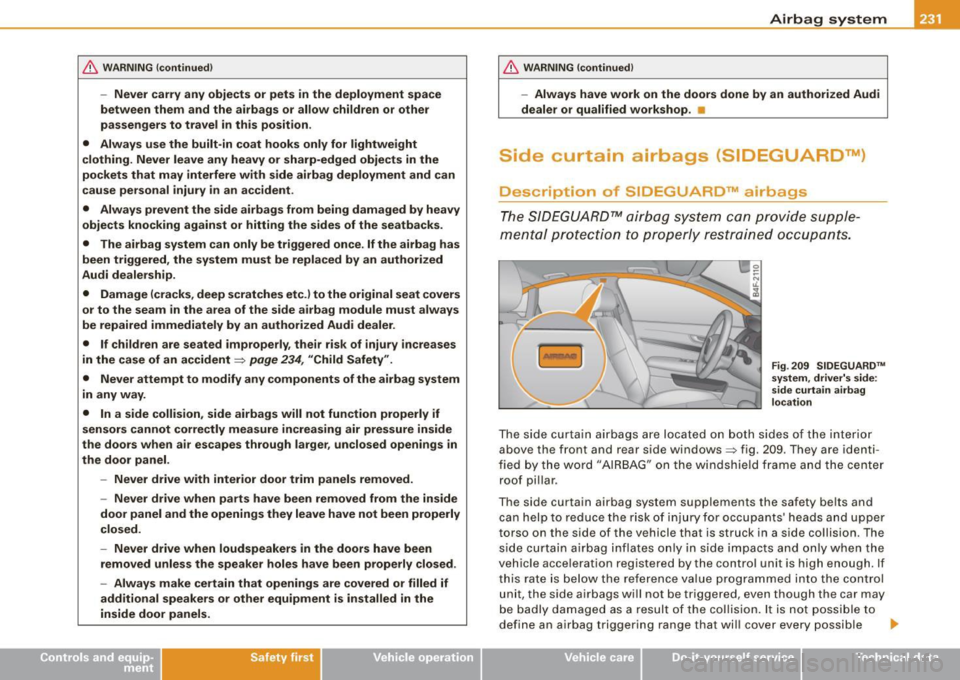
Fig. 209 SIDEGUARD ™
sy stem , drive r's side :
side curtain airbag
lo ca tion
Th e sid e cu rtain ai rbags are loca ted on both sides o f the i nte ri or
above the front and rear side windows=:> fig. 2 09 . They are identi
fied by th e w ord "AIRBA G " o n the w indshie ld frame and the cen te r
roof pi llar.
The side curtain ai rbag system supplements the safety be lts and
ca n help t o reduce t he risk of inju ry for occupants' heads and upper
torso on the side of the vehicle that is struck in a s ide co llision. The
s ide c urtain a irb ag inf lates o nly i n side i mpac ts a nd o nly whe n the
veh ic le acce leration registered by the control unit is high enou gh. If
t his r ate is belo w th e re fer ence va lu e p ro gra mmed i nto t he con trol
un it, the side airbags will not be trigg ered , eve n though the car may
b e badl y da mage d as a r esult of th e collisio n. It is not p ossib le t o
def in e an airbag triggerin g range that wi ll cover every possible ,-
Vehicle care
I I irechnical data
Page 240 of 390
___ C_h_ i_ ld _ S_ a_ f_ e_ t_y ____________________________________________ _
& WARNING
Not using a child safety seat, using the wrong child safety seat or
improperly installing a child restraint increases the risk of serious
personal injury and death.
• All vehicle occupants and especially children must always be
restrained properly whenever riding in a vehicle .
- An unrestrained or improperly restrained child can be injured or killed by being thrown against the inside of the vehicle or by
being ejected from it during a sudden maneuver or impact.
- An unrestrained or improperly restrained child is at much
greater risk of injury or death by being struck by an inflating
airbag.
• Commercially available child safety seats are required to
comply with U.S . Federal Motor Vehicle Safety Standard (FMVSSI
213 (in Canada CMVSS 2131.
-When buying a child restraint , select one that fits your child
and the vehicle.
- Only use child restraint systems that fully contact the flat
portion of the seat cushion . The child restraint must not tip or
lean to either side . Audi does not recommend using child safety
seats that rest on legs or tube-like frames. They do not provide
adequate contact with the seat .
- Always heed all legal requirements pertaining to the installa
tion and use of child safety seats and carefully follow the
instructions provided by the manufacturer of the seat you are
using .
• Never allow children under 57 inches (1 .5 meters) to wear a
normal safety belt. They must always be restrained by a proper
child restraint system. Otherwise, they could sustain injuries to
the abdomen and neck areas during sudden braking maneuvers or
accidents.
• Never let more than one child occupy a child safety seat .
& WARNING (continued)
• Never let babies or older children ride in a vehicle while sitting
on the lap of another passenger.
- Holding a child in your arms is never a substitute for a child
restraint system .
- The strongest person could not hold the child with the forces
that exist in an accident. The child will strike the interior of the
vehicle and can also be struck by the passenger.
- The child and the passenger can also injure each another in
an accident.
• Never install rear-facing child safety seats or infant carriers on
the front passenger seat . A child will be seriously injured and can
be killed when the passenger airbag inflates - even with an
Advanced Airbag System .
• The inflating airbag will hit the child safety seat or infant
carrier with great force and will smash the child safety seat and
child against the backrest , center arm rest, door or roof .
• Always install rear -facing child safety seats or infant carriers on
the rear seat.
• Forward -facing child safety seats installed on the front
passenger's seat can interfere with the airbag when it inflates and
cause serious injury to the child . Always install forward -facing
child safety seats on the rear seat .
• If exceptional circumstances require the use of a forward
facing child restraint on the front passenger's seat , the child's
safety and well -being require that the following special precau
tions be taken:
- Make sure the forward -facing seat has been designed and
certified by its manufacturer for use on a front seat with a
passenger front and side airbag .
- Always carefully follow the manufacturer's instructions
provided with the child safety seat or carrier .
Page 247 of 390

_______________________________________________ C_h _ i_ld _ S_ a_ f_ e_ t..,:c y __ lftlll
& WARNING (continued )
• If the backrest is not securely latched, the child and the child
restraint will be thrown forward together with the backrest and
will strike parts of the vehicle interior . The child can be seriously
injured or killed .
• Never install rear-facing child safety seats or infant carriers on
the front passenger seat. A child will be seriously injured and can be killed when the passenger airbag inflates .
• The inflating airbag will hit the child safety seat or infant
carrier with great force and will smash the child safety seat and
child against the backrest , center arm rest , door or roof.
• Always install rear-facing child safety seats or infant carriers on
the rear seat.
• Forward-facing child safety seats or infant carriers installed on
the front passenger's seat may interfere with the deployment of
the airbag and cause serious injury to the child .
• It is safer to install a forward -fac ing child safety seat on the rear
seat.
• Always read and heed all WARNINGS whenever using a child
restrained in a vehicle is being used
=> page 234 . Special precau
tions apply when installing a child safety seat on the front
passenger seat
=> page 214 , "Child restraints on the front seat -
some important things to know ".
& WARNING
Always take special precautions if you must install a forward or
rearward-facing child restraint on the front passenger's seat in
exceptional situations:
• Whenever a forward or rearward -facing child restraint is
installed on the front passenger seat, the PASSENGER AIR BAG
OFF light must come on and stay on whenever the ignition is
switched on .
Controls and equip ment Safety first
Vehicle operation
& WARNING (continued )
• If the PASSENGER AIR BAG OFF light does not come on and stay
on, perform the checks described
=> page 223, ''Monitoring the
Advanced Airbag System ".
• Take the child restraint off the front passenger seat and install
it properly at one of the rear seat positions if the PASSENGER AIR
BAG OFF light does not stay on whenever the ignition is switched
on .
• Improper installation of child restraints can reduce their effec
tiveness or even prevent them from providing any protection.
• An improperly installed child restraint can interfere with the
airbag as it deploys and seriously injure or even kill the child.
• Always carefully follow the manufacturer's instructions
provided with the child safety seat or carrier.
• Never place additional items on the seat that can increase the
total weight registered by the weight-sensing mat and can cause injury in a crash.
& WARNING
Forward-facing child restraints:
• Always make sure the forward -facing seat has been designed
and certified by its manufacturer for use on a front seat with a
passenger front and side airbag.
• Never put the forward-facing child restraint up, against or very
near the instrument panel .
• Always move the passenger seat into its rearmost position in
the seat's fore and aft adjustment range , as far away from the
airbag as possible before installing the forward-facing child
restraint . The backrest must be adjusted to an upright position .
• Make sure that the PASSENGER
AIR BAG OFF light comes on
and stays on all the time whenever the ignition is switched on . .,,,_
Vehicle care Do-it-yourself service Technical data
Page 248 of 390
•L-----=C::..: h:...:..:..:. il-= d ~S=-= a~fe =-=- ty!.._ _____________________________________________ _
& WARNING
Rearward-facing child restraints:
• A child in a rearward-facing child safety seat installed on the
front passenger seat will be seriously injured and can be killed if
the front airbag inflates -even with an Advanced Airbag System.
• The inflating airbag will hit the child safety seat or infant
carrier with great force and will smash the child safety seat and
child against the backrest, center arm rest, door or roof.
• Always be especially careful if you must install a rearward
facing child safety seat on the front passenger seat in exceptional
circumstances.
• A tight tether strap on a rearward-facing child restraint
attached to the front passenger seat can put too much pressure
on the weight-mat in the seat and register a heavier weight in the
Advanced Airbag System. The heavier weight registered can make
the system work as though an adult were on the seat and deploy
the Advanced Airbag when it must be suppressed causing serious or even fatal injury to the child.
• Make sure that the PASSENGER AIR BAG OFF light comes on
and stays on all the time whenever the ignition is switched on.
• If the PASSENGER AIR BAG OFF light does not come on and stay
on, immediately install the rear-facing child safety seat in a rear
seating position and have the airbag system inspected by your
Audi dealer. •
Activating the convertible locking retractor
Use the convertible locking retractor to secure a child
restraint.
Always heed the child safety seat manufacturer's instruc
tions when installing a ch ild restraint in your vehicle. To
activate the convertible locking retractor: -
Place the child restraint on a seat, preferably on the rear
seat.
- Slowly pull the belt
all the way out.
-Route it around or through the child restraint belt path
=>& .
- Push the child safety seat down with your full weight to
get the safety belt really tight.
- Insert the belt tongue into the buckle for that seating
position.
- Guide the safety belt back into the retractor until the belt
lies flat and snug on the child safety seat.
- You should hear a "clicking" noise as the belt winds back
into the inertia reel. Test the convertible locking retractor
by pulling on the belt. You should no longer be able to
pull the belt out of the retractor. The convertible locking
retractor is now activated.
- Make sure that the red release button is facing away from
the child restraint so that it can be unbuckled quickly.
- Pull on the belt to make sure the safety belt is properly
tight and fastened so that the seat cannot move forward
or sideways more than one inch (2.5 cm).
& WARNING
Using the wrong child restraint or an improperly installed child
restraint can cause serious personal injury or death in a crash.
• Always make sure that the safety belt retractor is locked when
installing a child safety seat. An unlocked safety belt retractor
cannot hold the child safety seat in place during normal driving or
in a crash.
~
Page 270 of 390

___ D_ r_iv _ in_... g"'- a_ n_ d_ e_ n_ v_i_r _o _n_ m_ e_n_ t _______________________________________________ _
New brake pads
--
Remember that new brake pads do not have a full braking
effect during the first 250 miles (400 kilometers) after they
are installed .
New brake pads have to be "burnished in" before they have optimal
grab =>& .
During the break -in period, you should avoid putting severe loads
on the brakes . Severe loads include, for examp le, sudden hard
braking, in particular at very high speeds or, for example, on moun
tain passes.
& WARNING
New brake pads don't have the best stopping power and must be
"broken-in" during the initial 100 to 150 miles (150 to 200 kilome
ters) of normal city driving. You can compensate for this by
pressing the brake pedal more firmly . This also applies later when
new pads are installed.
:J
Catalytic converter
It is very important that your emission control system
(catalytic converter) is functioning properly to ensure that
your vehicle is running in an environmentally sound
manner.
- Always use lead-free gasoline:=> page 291, "Fuel supply".
- Never run the tank down all the way to empty.
- Never put too much motor oil in your engine ==>
page 302,
"Adding engine oil 't=:;r\11
•
Never try to push- or tow-start your vehicle.
The catalytic converter is an efficient "clean-up" device built into the
exhaust system of the vehicle. The catalytic converter burns many
of the po llutants in the exhaust gas before they are released into the
atmosphere.
The exclusive use of unleaded fuel is critically important for the life
of the catalytic converter and proper functioning of the engine.
& WARNING
• Do not park or operate the vehicle in areas where the hot
exhaust system may come in contact with dry grass, brush, fuel
spill or other material which can cause a fire .
• Do not apply additional undercoating or rustproofing on or
near the exhaust manifold, exhaust pipes, catalytic converter or
heat shields. During driving, the substance used for undercoating
could overheat and cause a fire .
0 Note
• Be aware that just one tank filling with leaded fuel will alr eady
seriously degrade the performance of the catalytic converter.
• Do not exceed the correct engine oil level=>
page 302.
• Do not drive until the fuel tank becomes completely empty. The
engine could misfire. Unburned fuel could also get into the exhaust
system and this could cause the catalytic converter to overheat.
• Do not turn off the ignition while the vehicle is moving.
• Do not continue to operate your vehicle under these conditions,
as otherwise fuel can reach the catalytic converter. This could result
in overheating of the converter, requiring its replacement .
• To assure efficient operation of the Emission Control System:
- Have your vehicle maintained properly and in accordance with
the service recommendations in your Maintenance
& Warranty
booklet. •