2008 AUDI S6 check oil
[x] Cancel search: check oilPage 326 of 390

--~_T_ ir_e_ s_ a_ n_d _ w_ h_ e_e _l_s _________________________________________________ _
Tire pressure
Incorrect tire pressure causes premature wear and can cause
sudden tire blow-out. For this reason, tire pressure must be checked
at least once a month~
page 319.
Driving style
Driving fast around curves, heavy acceleration and hard braking
increase tire wear.
Rotating tires for more even wear
For all four tires on your vehicle to have the same service life, we
recommend that the front and rear tires are rotated according to the
tire manufacturer's suggested tire rotation intervals. Please remember the following:
• Tire rotation intervals may differ from the vehicle service inter
vals outlined in your Maintenance and Warranty Booklet.
• The longer one tire is used in one location on the vehicle, the
more it wears at certain points; therefore, we recommend that you
follow the tire manufacturer's suggested tire rotation intervals.
• Vehicles with front-wheel drive experience more tread wear on
the front wheels compared to all-wheel drive (quattro®l .
• Please rotate tires as shown ~
page 323, fig. 243.
• Extra care must be taken when rotating direction -specific tires
~ page 344.
Wheel balancing
The wheels on new vehicles are balanced. However, various situa
tions during everyday driving can cause them to become unbal
anced, resulting in vibrations you can usually feel through the
steering wheel.
Unbalanced wheels must be rebalanced to avoid excessive wear on
steering, suspension and tires. A wheel must also be rebalanced
when a new tire is installed.
Incorrect wheel alignment
Incorrect wheel alignment can cause excessive tire wear, impairing
the safety of the vehicle. If tires show excessive wear, have the
wheel alignment checked by an authorized Audi dealer or qualified
workshop.
All Wheel Drive
Vehicles with quattro® must always have tires of the same size, construction and tread type. For details see~
page 264.
& WARNING
Sudden tire failure can lead to loss of control, a crash and serious
personal injury!
• Never drive a vehicle when the tread on any tire is worn down
to the wear indicators.
• Worn tires are a safety hazard, they do not grip well on wet
roads and increase your risk of "hydroplaning" and loss of control.
• Always keep chemicals that can cause tire damage, such as
grease, oil, gasoline and brake fluid away from tires.
• Tires age even if they are not being used and can fail suddenly,
especially at high speeds. Tires that are more than 6 years old can
only be used in an emergency and then with special care and at
lower speeds.
• Never mount used tires on your vehicle if you are not sure of
their "previous history." Old used tires may have been damaged
even though the damage cannot be seen that can lead to sudden
tire failure and loss of vehicle control. •
Page 333 of 390

Tires and wheels -________________ w-.
•
Remove wheel center covers and trim discs before putting snow
chains on you r veh icle =>
(D. For sa fety reasons c ove r cap s m ust
then be fitted over the wheel bo lts . These are avai lable from autho
r ized Aud i deale rs.
& WARNING
Using the wrong snow chains for your vehicle or in stalling them
incorrectly can increase the risk of loss of control leading to
serious personal injury.
• Snow ch ains are available in different sizes . Always make sure
to follow the instructions provided by the snow chain manufac
turer .
• When driving with snow chains never drive faster than the
speed permitted for your specific snow chains .
• Always observe local regulations .
0 Note
• Remove sn ow chai ns b efore d rivin g on roads not cove red w ith
snow to avoid damaging tires and wearing the snow chains down
u n n ecessa r i ly.
• Snow chains , which come into d irect contact with t he whee l rim,
ca n scratc h or da mage it. T herefore, ma ke sur e tha t th e snow chains
are suitably covered.
• I f the Adaptive Air Suspensio n* shou ld malfunction, do no t
mount or use snow chains because the vehicle will be extremely
l o w. I f yo u do drive w ith snow c hai ns o n w hi le t he ve hicle is a t thi s
level, the snow cha ins might severe ly damage the wheelhouse and
ot her parts o f the vehicle.
[ i ] Tips
W her e sn ow c hai ns are manda tory on certa in roa ds, t his no rm ally
a lso app lies to vehic les with Al l Wheel Drive. •
Wheel bolts
Wheel bo lts must alw ays be t ig hte ned to the correct
to rq ue .
The design of wheel bo lts is matched to the factory instal led rims. If
d iffere nt rim s are fitted, the corr ect w heel bo lts w it h t he rig ht le ngth
and correctly shaped bolt heads must be used. This ensures that
w he els are fitted securely and that the brake sys tem func tions
correctly.
I n certa in c ircums ta nces, you may not use wheel bo lts from
a
different vehicle -even if it is the same model=> page 368.
& WARNING
Improperly tightened or maintained wheel bolts can become loose
causing loss of control , a collision and serious personal injury .
• Always keep the wheel bolts and the threads in the wheel hubs
clean so the wheel bolts can turn easily and be properly tightened.
• Never grease or oil the wheel bolts and the threads in the wheel
hubs. They can become loose while driving if greased or oiled,
even if tightened to the specified torque .
• Only use wheel bolts that belong to the rim being installed .
• Never use different wheels bolts on your vehicle.
• Always maintain the correct tightening torque for the wheel
bolts to reduce the risk of a wheel loss.
If the tightening torque of
the wheel bolts is too low , they can loosen and come out when the
vehicle is moving . If the tightening torque is too high, the wheel
bolts and threads can be damaged and the wheel can become
loose .
0 Note
The specified torque for the wheel bolts is 9 0 ft lb (120 Nm) with a
to lera nce of± 7,4 ft lb(± 10 Nm). Torque whee l b o lt s d ia go nally.
Af ter changing a wheel, the torque must be checked as soon as .,_
Vehicle care I t •
Page 359 of 390

________________________________________________ E _m_ e_r.:g :;,. e_ n_c ...: y:.- s_ i_ t _u _a_ t_ i_ o _ n_ s __ lll
•
& WARNING
• To reduce the risk of serious injury and vehicle damage.
-Always lift the vehicle only at the special workshop hoist and
floor jack lift points illustrated
=> page 356, fig. 267 and
=> page 356, fig. 268.
- Failure to lift the vehicle at these points could cause the
vehicle to tilt or fall from a lift if there is a change in vehicle
weight distribution and balance. This might happen, for
example, when heavy components such as the engine block or
transmission are removed.
• When removing heavy components like these, anchor vehicle
to hoist or add corresponding weights to maintain the center of
gravity. Otherwise, the vehicle might tilt or slip off the hoist,
causing serious personal injury.
0 Note
• Be aware of the following points before lifting the vehicle:
- The vehicle should never be lifted or jacked up from under
neath the engine oil pan, the transmission housing, the front or
rear axle or the body side members . This could lead to serious
damage.
- To avoid damage to the underbody or chassis frame, a rubber
pad must be inserted between the floor jack and the lift points.
- Before driving over a workshop hoist, check that the vehicle
weight does not exceed the permissible lifting capacity of the hoist .
- Before driving over a workshop hoist, ensure that there is
sufficient clearance between the hoist and low parts of the
vehicle. •
Do-it-yourself service
Page 378 of 390
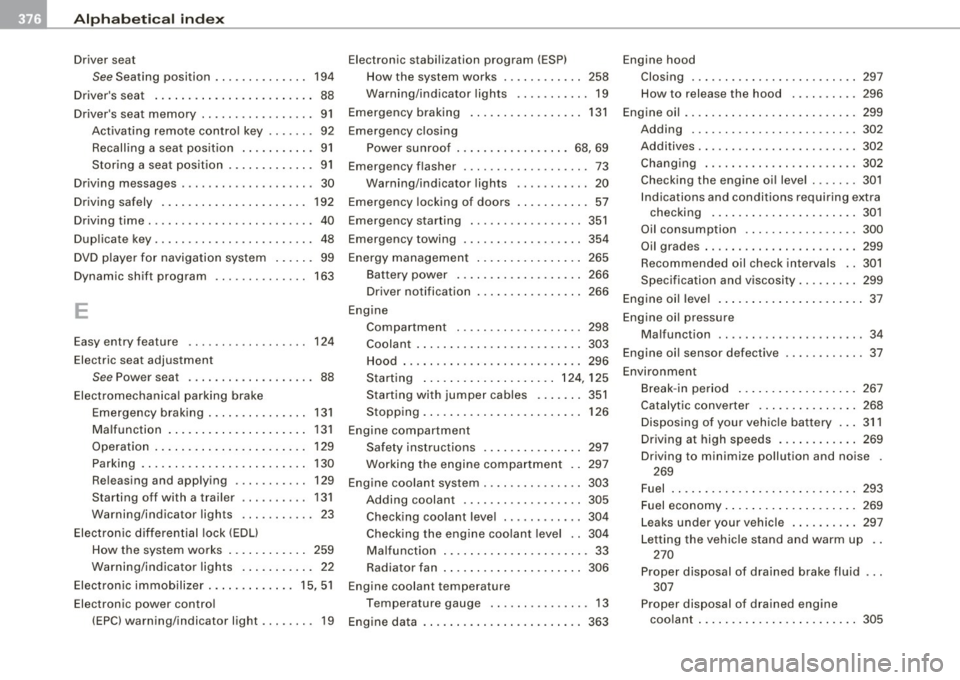
llffl __ A_l.:,. p _h_ a_ b_e _t _ic _ a_l _in _ d_e _x ____________________________________________ _
Driver seat
See Seating position . . . . . . . . . . . . . . 194
Driver's seat . . . . . . . . . . . . . . . . . . . . . . . . 88
Driver's seat memory . . . . . . . . . . . . . . . . . 91
Activating remote control key .. ... .. 92
Recalling a seat posit ion ...... .... . 91
Storing a seat position . ........ .... 91
Driving messages ...... .... .... .... .. 30
Driving safely .... .... .... ...... .... 192
Driving time . ...... .. .... .... .... .... 40
Dup licate key ........... .... ... .... .. 48
DVD player for navigation system . . . . . . 99
Dynamic shift program .............. 163
E
Easy entry feature 124
Electric seat adjustment
S ee Power seat . . . . . . . . . . . . . . . . . . . 88
Electromechanica l parking brake
Emergency braking .. ...... ...... . 131
Malfunction ...... .... .... ....... 131
Operation . . . . . . . . . . . . . . . . . . . . . . . 129
Parking . . . . . . . . . . . . . . . . . . . . . . . . . 130
Rel easing and app lying .... ... .... 129
Starting off with a trailer ... ..... .. 131
Warning /indicator ligh ts ... .... .... 23
Electronic differential lock (EDU
How the system works . . . . . . . . . . . . 259
Warning /indicator lights ....... .... 22
Electronic immobilizer . ... .... .. . .. 15, 51
Electronic power contro l
(EPC) warning/indicator light ...... .. 19 Electronic stabili
zation program (ESP)
How the system works . ...... ..... 258
Wa rning/indicator lights ......... .. 19
Emergency braking . . . . . . . . . . . . . . . . . 131
Emergency closing Power sunroof ......... .... ... . 68, 69
Emergency flasher . . . . . . . . . . . . . . . . . . . 73
Wa rning/indicator lights ..... ...... 20
Emergency locking of doors ....... ... . 57
Emergency starting .. ... .... .... .... 351
Emergency towing ..... .... .... ... .. 354
Energy management ... .. .... .... ... 265
Battery power . . . . . . . . . . . . . . . . . . . 266
Driver notification 266
Engine Compartment . .... .... .... .... .. 298
Coolant ......................... 303
Hood ... .. .... .... .... .... .... .. 296
Starting ...... ........ .... .. 124, 125
Starting with jumper cables .. ..... 351
Stopping ........................ 126
Engine compartment Safety instructions .... ...... ..... 297
Working the engine compartment .. 297
Engine coolant system ........ .... ... 303
Adding coolan t ..... ........ .... . 305
Checking coo lant level .. ....... ... 304
Check ing the engine coolant level .. 304
Malfunction ......... .... .. .. .... . 33
Radiator fan ...... .. .. .... .... ... 306
Engine coolant temper .ature
Temperature gauge ...... ...... ... 13
Engine data .. ... ... .. .... .... ...... 363 Engine hood
Clos ing ... .... ... ... ... .. .... ... 297
How to release the hood . . . . . . . . . . 296
Engine oi l ..... ... .... .... .. .. ..... . 299
Adding ... .... .... .... .... ... ... 302
Additiv es .. ...... ..... .. .. .... ... 302
Changing . ....... .... ... .. ...... 302
Checking the engine oil level . .... .. 301
Indications and conditions requiring extra
checking .. ...... .... .......... 301
Oil consumption ... .... .... .... .. 300
Oil grades . ...... ... ... .... ..... . 299
Recommended oil che ck in tervals .. 301
Specif ication and viscosity .. .. .. ... 299
Engine oil leve l ... .... .... .. .. ..... .. 37
Engine oil pressure Malfunction .. .. .. .... .... .... .... 34
Eng ine oi l sensor defective .... .... .... 37
Environment Break -in period ........ ..... ..... 267
Catalytic converter .... .... ..... .. 268
Disposing of your vehicle battery .. . 311
Driving a t high speeds ............ 269
Driv ing to minimize pollution and noise .
269
Fuel .... .. .... .... .............. 293
Fuel economy ...... .... .. .. .... .. 269
Leaks under your vehicle ....... ... 297
Letting the vehicle stand and warm up ..
270
Proper disposal of drained brake fluid 307
P roper disposal o f drained engine
coo lant ..... .. .. .... .... ....... 305
Page 381 of 390

______________________________________________ A_ l:.!: p :...:h..:. a= b..:e :...: t:..:..i c.::....:.: a..:..l ..:.in :....:..:: d:.:e :.: x-=---"'
Leather . .... ....... ... . .... .. .. .... 286
Cleaning . .... .... ....... ........ 287
Leve l adjustment
See Adaptive Air Suspension . .... .. 182
Lifting jack . .... ........ ... .... .... . 341
Lifting vehicle ...................... 356
Light Exterior lighting in the mirror housing 73
leaving home ...... ..... .... .... .. 73
Light sensor defective ... .... ... .... .. 36
Lighting in the mirror housing ......... 73
Lights ........ .... .... .... ...... .... 70
Coming home ... .... .... .......... 71
Daytime running lights . .... .... .... 71
Emergency flashers . ... .. .... .... .. 73
Exterior lights . .... .... ... .... .... . 71
Front fog lights ...... .... ..... .. ..
72
Headlights .. ... ... .. .... .... .... . 70
High beam .................... 70, 74
High beam warning/indicator light . .. 22
Leaving home .... .... .... .... ..... 71
Rear fog lights ... .... .... .... .... . 72
Side marker lights .. ...... ...... ... 70
Turn signals .... .... .... .... .... .. 74
Xenon headlights ... ..... .. .. .... .. 70
Loading the luggage compartment .... 199
Loading the roof rack .... ....... .... . 102
Lockable backrest .... ....... .... .... . 96
Locking Power locking switch .... .... .... .. 56
Rear lid/trunk lid .................. 58
Remote control key .......... .... .. 54
Using the key .... .... ... ....... ... 55
Controls and equip
ment Safety first
Lower anchorage locator button
..... .. 249
Lower universa l anchorage bars (Canada) ..
249
Lower universal anchorages (Canada) .. 249
Luggage Stowing . .... ....... .... .... .... . 199
Luggage compartment ................ 96
Cargo net .... .... ...... ........ .. 98
DVD player for navigation system ... . 99
Expanding .... .... .... .... .... ... . 96
Fastening eyelets ... .... ....... .... 97
Side Compartment .. ....... .... ... 99
Ski sack . .... ....... .. .. .... .... . 100
See also Loading the luggage
compartment ..... .. ... ... .. .... 199
Lumbar support .... ....... .... .... ... 90
M
Maintenance ... ....... .... .... .... . 366
Malfunction Indicator Lamp (MIU .. .. 20, 29
Master key ... ........... ....... .... . 49
Battery replacemen t .. .... .... .. 49, 50
Check light ..... ........... .... ... 49
Mi leage
Average .. ..... ... .... .... .... ... . 40
Instantaneous ... ...... ... .. .... .. 40
Mirrors Activating the digital compass .... ... 85
Adjusting the anti -glare . .... ..... .. 82
Automatic dimming for the outside mirrors . .... .... .... ........ ... . 84
Automatically dimming inside mirror . 82
Inside day -night m irror .... .... .... . 82 Interior mirror
... .. .... .... ..... .. . 82
Outside mirrors ... .... .... .... .... 83
Recalling position of outside mirrors . 91
Storing position of outside mirrors . .. 91
Monitoring the Advanced Airbag System ..
223
multitronic® ........................ 159
Automatic Shift Lock (ASU ....... .. 162
Driving the multitronic® ... .... .... 160
Dynamic shift program .... .... .... 163
Fail-safe mode .... .... ... .... .... 165
Kick-down ....................... 163
Manual shift program ... .... .... .. 164
Se lector lever ... ... .. .... .... .... 161
Steering wheel with tiptronic® .... . 165
tiptronic .... .... .... .... .... ..... 164
N
Natural leather .... .... ... .. .... .... . 286
New tires and wheels . .... ..... ...... 325
NHTSA Contacting ..... .. ... ... .... .... . 201
Number of seats ...... ... .. .... .... . 202
0
Occupant seating positions .. ... .. .... 194
Octane rating .... .... .... .... ... .... 291
Odometer ... .... .... .... ... .... .... . 15
Oil
See Engine oil ... ...... .. . ... ..... 299
Older children and safety belts .... .... 243
Vehicle operation Vehicle care Do-it-yourself service Technical data