2008 AUDI S6 radiator
[x] Cancel search: radiatorPage 307 of 390

_____________________________________________ C_h_ e_ c_k _in ~ g_ a_n _d_ f_il _li _n ~g __ _
•
When the coolant level is too low , the warning light in the Auto
Check System =>
page 33will blink un til you add coo lant and the
level has been restored to normal. Even though there is an electric
coolant leve l sensor, we still recommend you check the coo lant level
from time to time .
Coola nt lo ss
Coolant loss may indicate a leak in the cooling system . In the event
of coolant loss, the coo ling sys tem should be inspected immedi
ately by your authorized Audi dealer . It is not enough merely to add
coolant.
In a
s ealed system, losses can occur only if the boiling po int of the
coolant is exceeded as a result of overheating.
0 Note
Do not add any type of radiator leak sea lant to your vehicle's engine
coolant . Adding radiator repair fluid may adversely affect the func
tion and performance of your cooling system and could resu lt in
damage not covered by your New Vehic le Limited War ranty .•
Adding coolant
Be very careful when adding engine coolant.
Before you check anything in the engine compartment,
always read and heed all WARNINGS => & in "Working in
the engine compartment" on
page 297 .
- Tu rn off the engine .
- L et the engine coo l dow n.
- Place a t hick rag over the coolant expansion tank
=> page 304, fig . 235 and carefully tw ist t he cap counter
cloc kw ise
=> & .
- Add coolant. - Twist the cap
on agai n
tightly.
Replacement engine coolant must conform to exact specifications
=>
page 303, "Coolant". If in an emergency coolant additive G12 + is
not avai lable, do
not use a different additive . Use p lain water
instead until you can get the correct additive and can restore the
correct ratio . This should be do ne as soon as possible.
If you have lost a considerable amount of coolant, then you should
add cold antifreeze and cold water only when the engine is cold .
Always use
new engine coolant when refilling .
Do not fil l coolant above the "MAX" mark. Excess coolant will be
forced out through the pressure relief va lve in the cap when the
engine becomes ho t.
& WARNING
• The cooling system is under pressure and can get ver y hot.
Redu ce the risk of sc alding from hot coolan t by follow ing the se
s tep s.
- Turn off th e en gine and allo w it to cool down .
- Protect your fa ce , ha nd s and arm s from e sc a pi ng fluid and
s tea m by cov ering the c ap with a large , thick rag.
- Tur n the cap slo wly an d very ca refully in a counter -clockw is e
dire ction whil e applying light , downward pres sure on the top
o f the cap.
- To av oid bei ng burn ed , do n ot spill antifree ze or cool ant on
the e xhau st sy stem or h ot e ngi ne part s. Under cert ain co ndi
tion s, the ethylen e gl ycol in engin e co olant c an c atch fire .
• Antifr eeze is po iso nous. Alwa ys store antifree ze in its or igin al
c ontainer and well out of the reach of c hildren .
• If you dra in t he coola nt, it mu st b e ca ught and sa fel y stor ed in
a prop er container clearly mark ed "poi son ".
~
Vehicle care I t •
Page 308 of 390

•---=C:.:h..:. e=-= c..:.k :..:.in :..:.:= g:.....= a..:.n :.:d::....:. f.:.:il .:.:li ..:.n :..::g~ --------------------------------------------
0 Not e
• Coolant pollutes the environment and cou ld cause an engine
fire. Excess coolant will be forced out through the pressure relief
valve in the cap when the engine becomes hot.
• If, in an emergency, only water can be added, the correct ratio
between water and antifreeze ~
page 303 must be restored as soon
as possible .
ci> For the sake of the environment
Dra ined coolant should not be reused . Always dispose of used
coolant whi le observing all environmental regulations. •
Radiator fan
The radiator fan switches on automatically by itself.
The rad iator fan is driven by the eng ine v ia the V-be lt . The v iscous
clutch regulates the speed of the fan according to the tempera ture
of the coo lant .
An auxiliary electric radiator fan * swi tches on and off depending on
coo lant temperature and other vehicle operating conditions.
After you switch the engine off, the auxiliary fan can continue running for up to 10 minut es -even with th e igni tion o ff. It can even
switch o n again later by itself~ & , if
• the temperature of the engine coo lant rises due to the heat
bui ld -up from the engine in the engine compartment, o r
• the engine compartment heats up because the vehic le is parked
in intense sun light.
& WARNING
• To reduce the ri sk of per sonal injury never tou ch the radiator
f a n.
& W AR N ING (continu ed )
• The auxiliary e le ctri c fan i s temperature controlled and can
s w itch on suddenly even when the engine is not running .
• The auxiliary radiator fan swit ches on automatically when the
engine coolant reache s a ce rtain temperature and will con tinue to
run until the coolant t emperatur e drop s. •
Brake fluid
Checking brake fluid level
Th e brake fluid level c an be checked with a quick glance.
Fig . 23 6 En gin e
co mp art m ent : B ra ke
fl uid re servoir
Befo re yo u c heck anything in th e en gin e compar tme nt,
always read and heed all WARNINGS~ & in "Working in
the eng ine compartment" on
page 297 .
Rea d the brake fl uid level from the bra ke fluid reservoir
~ fig . 236. T he b rake fluid leve l must be betwee n the
" M IN " and "MAX" markings.
The brake fluid reservoir is located at the rear parti tion of the engine
compartment on the left side~
page 298. .,_
Page 369 of 390

_______________________________________________ C _o_ n _ s_u _ m_ e_ r_l_n _f_o _ r_ m_ a_ t _i _o _ n __ PII
workshop personne l in order to assure proper performance, reli
abil ity and sa fe ty of the vehicle a nd i ts many sys te m s.
I mproper maintenance, adjustments and repairs can impair the
operation and reliabil ity of your vehicle and even void your vehicle
war ra nty. T here fore, proof o f serv ic ing in accorda nce with the main
tenance schedule may be a condition for uphold ing a possible
war ra nty claim made withi n th e warranty per iod .
Above all, operat ional safety can be adverse ly affected, creating
unnece ssary risks fo r you and you r passengers .
If in doubt about a ny servici ng, have it do ne by your authorized Aud i
dea ler or any other properly equipped and qua lified workshop. We
str ongly u rge you to give your auth orized Audi dealer the oppo rtu
nity to perform al l scheduled maintenance and necessary repairs.
You r deale r has the facil ities, origi nal par ts and trained special is ts
to keep your vehic le running proper ly.
Performing limited maintenance yourself
T he fo llow ing pages describe a limited numbe r of procedures which
can be perfo rme d on you r vehicle wi th ordi nary too ls, should the
need arise and trained personne l be unavailab le. Before performing
any of these proced ures, always thor oug hly read a ll of th e appli
cable text and carefu lly fo llow the instructions given. Always rigor
ously observe the WARNINGS provided.
Before you check anything in the engine compartment , alway s read
and heed all WARNINGS:::>
& and:::> & in "Wo rking in the engine
compartment" on
page 297.
& WARNING
• Ser ious persona l injury may occur as a result of improperly
performed maintenance , adjustments or repairs.
• Always be e xtremely careful when working on the vehicle .
Always follow commonly accepted safety practices and general
c ommon sense . Never ri sk per sonal injury .
Controls and equip ment Safety first
Vehicle operation
& WARNING (continued )
• Do not attempt any of the maintenance , checks or repairs
described on the following pages if you are not fully familiar with
these or other pro cedures with respect to the vehicle , or are uncer
tain how to proceed.
• Do not do any work without the proper tools and equipment.
Have the necessary work done by your autho rized Audi dealer or
another properly equipped and qualified workshop .
• The engine compartment of any motor vehicle is a potentially
hazardous area . Never reach into the area around or touch the
radiator fan . It i s temperature controlled and can switch on
suddenly - even when the engine is off and the ignition key has
been removed . The radiator fan switche s on automatically when
the coolant reaches a certain tempe rature and will continue to run
until the coolant temperature drops .
• Always remove the ignition key before anyone gets under the
vehicle.
• Always support your vehicle with safety stands if it is neces
sary to work underneath the vehicle. The jack supplied with the
vehicle is not adequate for this purpose and could collapse
causing serious personal injury .
• If you must work underneath the vehicle with the wheels on
the ground, always make sure the vehicle is on level ground , that
the wheels are always securely blocked and that the engine
cannot be started .
• Always make sure the transmission selector lever (automatic
transmission) is in "P " (Park position) and the park br ake is firmly
appl ied .
ffi For the sake of the environment
• Changing the engine settings wi ll adverse ly affect emission
leve ls. T his is detrimenta l to the envi ro nmen t and i ncreas es fu el
consumption.
Vehicle care Do-it-yourself service Tec hn ica l da ta
Page 378 of 390
llffl __ A_l.:,. p _h_ a_ b_e _t _ic _ a_l _in _ d_e _x ____________________________________________ _
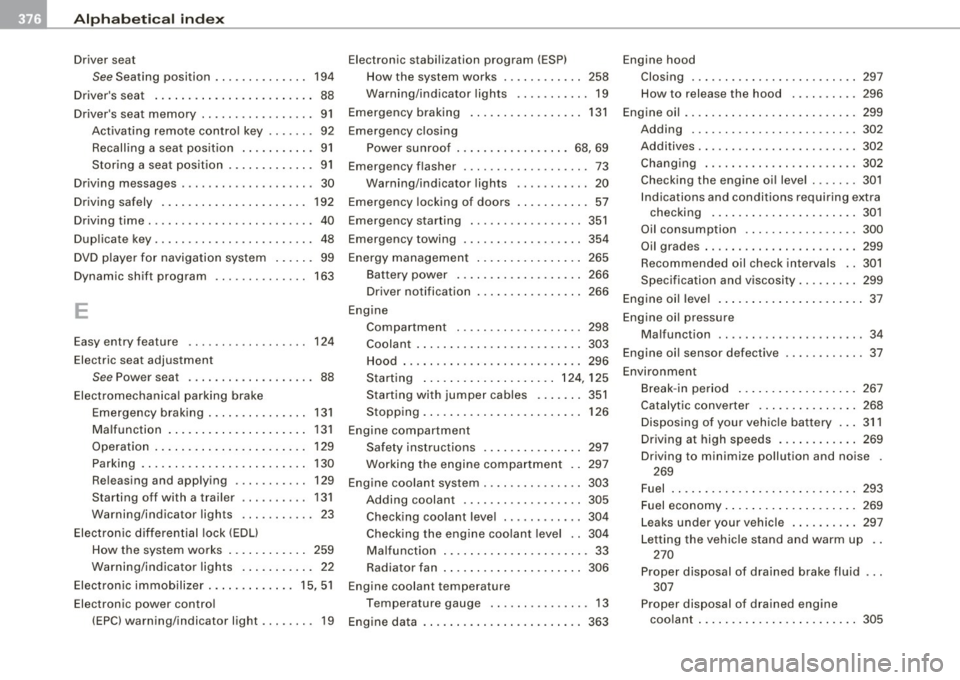
Driver seat
See Seating position . . . . . . . . . . . . . . 194
Driver's seat . . . . . . . . . . . . . . . . . . . . . . . . 88
Driver's seat memory . . . . . . . . . . . . . . . . . 91
Activating remote control key .. ... .. 92
Recalling a seat posit ion ...... .... . 91
Storing a seat position . ........ .... 91
Driving messages ...... .... .... .... .. 30
Driving safely .... .... .... ...... .... 192
Driving time . ...... .. .... .... .... .... 40
Dup licate key ........... .... ... .... .. 48
DVD player for navigation system . . . . . . 99
Dynamic shift program .............. 163
E
Easy entry feature 124
Electric seat adjustment
S ee Power seat . . . . . . . . . . . . . . . . . . . 88
Electromechanica l parking brake
Emergency braking .. ...... ...... . 131
Malfunction ...... .... .... ....... 131
Operation . . . . . . . . . . . . . . . . . . . . . . . 129
Parking . . . . . . . . . . . . . . . . . . . . . . . . . 130
Rel easing and app lying .... ... .... 129
Starting off with a trailer ... ..... .. 131
Warning /indicator ligh ts ... .... .... 23
Electronic differential lock (EDU
How the system works . . . . . . . . . . . . 259
Warning /indicator lights ....... .... 22
Electronic immobilizer . ... .... .. . .. 15, 51
Electronic power contro l
(EPC) warning/indicator light ...... .. 19 Electronic stabili
zation program (ESP)
How the system works . ...... ..... 258
Wa rning/indicator lights ......... .. 19
Emergency braking . . . . . . . . . . . . . . . . . 131
Emergency closing Power sunroof ......... .... ... . 68, 69
Emergency flasher . . . . . . . . . . . . . . . . . . . 73
Wa rning/indicator lights ..... ...... 20
Emergency locking of doors ....... ... . 57
Emergency starting .. ... .... .... .... 351
Emergency towing ..... .... .... ... .. 354
Energy management ... .. .... .... ... 265
Battery power . . . . . . . . . . . . . . . . . . . 266
Driver notification 266
Engine Compartment . .... .... .... .... .. 298
Coolant ......................... 303
Hood ... .. .... .... .... .... .... .. 296
Starting ...... ........ .... .. 124, 125
Starting with jumper cables .. ..... 351
Stopping ........................ 126
Engine compartment Safety instructions .... ...... ..... 297
Working the engine compartment .. 297
Engine coolant system ........ .... ... 303
Adding coolan t ..... ........ .... . 305
Checking coo lant level .. ....... ... 304
Check ing the engine coolant level .. 304
Malfunction ......... .... .. .. .... . 33
Radiator fan ...... .. .. .... .... ... 306
Engine coolant temper .ature
Temperature gauge ...... ...... ... 13
Engine data .. ... ... .. .... .... ...... 363 Engine hood
Clos ing ... .... ... ... ... .. .... ... 297
How to release the hood . . . . . . . . . . 296
Engine oi l ..... ... .... .... .. .. ..... . 299
Adding ... .... .... .... .... ... ... 302
Additiv es .. ...... ..... .. .. .... ... 302
Changing . ....... .... ... .. ...... 302
Checking the engine oil level . .... .. 301
Indications and conditions requiring extra
checking .. ...... .... .......... 301
Oil consumption ... .... .... .... .. 300
Oil grades . ...... ... ... .... ..... . 299
Recommended oil che ck in tervals .. 301
Specif ication and viscosity .. .. .. ... 299
Engine oil leve l ... .... .... .. .. ..... .. 37
Engine oil pressure Malfunction .. .. .. .... .... .... .... 34
Eng ine oi l sensor defective .... .... .... 37
Environment Break -in period ........ ..... ..... 267
Catalytic converter .... .... ..... .. 268
Disposing of your vehicle battery .. . 311
Driving a t high speeds ............ 269
Driv ing to minimize pollution and noise .
269
Fuel .... .. .... .... .............. 293
Fuel economy ...... .... .. .. .... .. 269
Leaks under your vehicle ....... ... 297
Letting the vehicle stand and warm up ..
270
Proper disposal of drained brake fluid 307
P roper disposal o f drained engine
coo lant ..... .. .. .... .... ....... 305
Page 379 of 390

______________________________________________ A_ l_,_ p _h_ a_ b_e _t_i c_ a _ l _in _ d_e _ x __ ftllll
Proper disposal of drained engine oil 302
Recycling used engine oil ..... ..... 302
Un leaded fuel ..... ....... .... ... . 291
What should I do with an old battery?
311
EPC
See Electronic power control . .... ... 19
ESP
See Electronic stabilization program
(ESP) ..... ... .. .... .... ...... ... 19
Event Data Recorder (EDR) ... .... ..... 258
Expansion tank ...... ....... ........ 304
Exterior lighting in the mirror housing ... 73
Eyeglasses compartment ............. 108
F
Fan
Radiator .............. .......... 306
Fastening eyelets ...... .... .......... 97
Flat tire Changing ... ... ... .. .... ...... .. 338
Floor mats . . . . . . . . . . . . . . . . . . . . . . . . . 198
Fog lights .... .... .... ... .. .... .... .. 72
Fo lding master key with remote contro l . 48
Foot pedals ...... .. .... .... ..... ... 198
For the sake of the environment Gasoline fumes and the environment 293
Letting you r engine warm up ...... . 125
Reducing engine noise by early
upshifting .. ...... ..... .... ... .. 13
Refuel ing .... .... ....... .... .... 293
Controls and equip
ment Safety first
Saving
fuel by early upshifting .... .. 13
Usingtherearwindowdefogger .. .. 117
Front airbags
Description ......... .... .... .... . 216
How they work .... ........ ....... 221
Front arm rest adjusting . ...... .... .... ... .... ... 96
Storage compartment ... .... ..... .. 96
Front ashtray .... .... .... ........ ... 104
Front fog lights ..... ........ .... .... . 72
Front seats .. ............ .... ....... . 87
Adjusting ... ....... .... .... .... . 195
Child restraints in the front seat ... . 214
Fronta l collisions and the laws of physics
203
Fuel Additives ... .. ...... .... ..... .... 291
Blended gasoline .... ....... .... .. 291
Consumption ....... .... .... .... .. 40
Fi ller neck ......... .. ... .... .... . 292
Fuel gauge ... .. .... .... ...... .... 15
Gasoline .. .... ... .... .... .... ... 291
Gasoline additives ................ 292
Low fuel level .............. .... 15, 36
Octane rating .................... 291
Recommendation ....... ... ... ... 291
Refuel ling .............. ...... ... 293
Reserve .......................... 15
Tank capacity .... .... ... .... .... . 363
Un locking the fue l f iller flap by hand 295
Fuse arrangement ............. ...... 345 G
Garage door opener (HomeLink®) . .... . 186
Gas discharge lamps . .... ........... . 349
Gauges Engine coolant temperature .. .. .. . .. 13
Fuel gauge ..... .... .. .. . ... ...... 15
Speedometer ... .... ... .. .... ..... 15
Tachometer . .... .... .... .... ...... 14
Trip odometer ... .. .... .... ... .. .. . 15
General illustration Instruments and controls ... .. .... .. 11
Generator Warning/indicator lights ............ 19
G lossary of tire and loading terminology .. .
314
G love compartment ......... .... .... 107
cd changer ... .... .... .... .... ... 107
Valet key function .... .... .... ... .. 51
G love compartment -emergency unlocking
108
Gross Vehicle Weight Rating (GVWR) ... 361
H
Head restraints ... .... ..... ... ... ... 197
Adjusting .. .... .... ... .... .... ... 197
Front seats ... .... .... ... .... ..... 93
Installation and removal ............ 94
Rear seats .... .... .... .... ..... 94, 95
Headlight washer reservoir .. .... .... . 312
Vehicle operation Vehicle care Do-it-yourself service Technical data
Page 382 of 390

___ A_l.:,. p _h_ a_ b_e _t _ic _ a_l _in _ d_e _x ____________________________________________ _
On-Board Diagnostic System (08D)
Data Link Connector (DLC) .. .... ....
29
Electronic speed limiter ... ..... ... . 30
Malfunction Indicator Lamp (MIU .... 29
Open door or rear lid warning . .... .... 27
Opening
Power sunroof ..... .... ........... 66
Operate your vehicle economically and mini- mize pollution ... .... .... .... ...
269
Optional equipment
Marked with an asterisk . . . . . . . . . . . . . 6
Outlets . . . . . . . . . . . . . . . . . . . . . . . . . . . .
106
Outside air pollution
How to prevent from entering the vehicle
117
Outside mirrors . ... .. .... .... ...... ..
83
Outside temperature display ........ .. 26
Owner's manual How the Owner's Manual is organized . 6
p
Paint
Touch-up
282
Paint No. . . . . . . . . . . . . . . . . . . . . . . . . . . 360
Park assist . . . . . . . . . . . . . . . . . . . . . . . . . 167
rear ........ ... .. .... .... ....... 167
Parking . . . . . . . . . . . . . . . . . . . . . . . . . . . .
130
Automatic transmission ... .... .... 153
Caution when parking near a parking bar -
rier or curb .. .... ....... .... ...
130
Low bumper cover, spoilers and
suspens ion
130
multitronic® ........ .... ... .. ... 160
Parking brake
See Electromechanical parking brake 129
Parking on a decline (downhill) . ....... 130
Parking on an incline (uphill) . ...... ... 130
Parts replacement ................ .. 368
PASSENGER AIR BAG OFF light ........ 224
Passenger's seat . . . . . . . . . . . . . . . . . . . . . 88
Passive safety system . . . . . . . . . . . . . . .
192
Pedals . ........ ....... ...... .... .. 198
Perimeter lighting .................... 73
Physical principles of a frontal collision 203
Polishing ......... ... .... .... .... .. 281
Power locking switch ........ ... ... ... 56
Power locking system ..... .... .... ... 52
Convenience close/open feature ..... 65
Locking and unlock ing the vehicle from
inside .... .... ..... .. .... .... ... 56
Opening and closing the windows ... 65 Power sunroof ......... .... ... .... 67
Rear lid/trunk lid ...... .... .... .... 58
Remote control key . . . . . . . . . . . . . . . .
49
Se lective unlock feature .... ...... .. 55
Settings . . . . . . . . . . . . . . . . . . . . . . . . . 55
Un locking and locking vehic le ... .... 54
Power outlets . . . . . . . . . . . . . . . . . . . . . .
106
Power roof . . . . . . . . . . . . . . . . . . . . . . . . . . 66
Power seat Controls ...... ..... ..............
88
Power steering ... .... .... .... ..... . 263
Power sunroof
Emergency closing .. .... .. .... . 68, 69
Emergency c losing (Step 1) ... .. .... 68
Power window switches ...............
63
In the driver's door ......... .... ... 63
In the front passenger's door ....... 64
Reactivating the system .. ....... .. . 65
Pregnant women
Special considerations when wearing a
safety belt . . . . . . . . . . . . . . . . . . . . .
208
Programming the HomeLink® universal re-
mote control ..... ....... ... .... 186
Proper occupant seating positions .... . 194
Proper safety belt position ...........
207
Proper seating position
Fron t passenger ... .... ... .... ... 195
Occupants .... .... .... ... .... ... 194
Rear passengers ................. 196
a
Quartz clock ..... ........ ........ .... 14
quattro®
See All Wheel Drive .. ...... .... ... 264
Question
R
What happens to unbelted occupants? . .
204
Why safety belts? ........... ..... 202
Seat adjustment .......... .... ... . 89 Radiator fan .... .... .... .... .... .... 306
Power side door closer . . . . . . . . . . . . . . . 56 Rain sensor . ... .. .... .... .... ...... . 78