2008 AUDI S5 gearbox
[x] Cancel search: gearboxPage 259 of 294
Downloaded from www.Manualslib.com manuals search engine Self-help257
Controls
Safety
Driving tips
General maintenance
Self-help
Technical data terminal must not touch metal parts of the vehicle: this can cause
short circuiting.
•
Do not bend over the batteries – risk of acid burns.
•
The screw plugs on the battery cells must be screwed in firmly.
•
Keep sparks, flame and lighted cigarettes away from batteries:
the gases given off can cause an explosion.
•
If jump-starting another vehicle, position the jump leads in
such a way that they cannot come into contact with any moving
parts in the engine compartment of the other vehicle.Caution
Please note that the above method of connecting the leads is meant
for jump-starting your vehicle. If jump-starting another vehicle, you
should not connect the negative lead (–) to the negative terminal of
the discharged battery, but directly to the engine block or a solid
metal part bolted to the engine block. If the battery of the other
vehicle does not have a gas vent, there is a risk that a mixture of
oxygen and hydrogen gas can accumulate and cause an
explosion.Tow-starting and towing awayGeneral notes
Points to observe when tow-starting or towing awayIf you use a towrope:
Notes for the driver of the towing vehicle
– The towrope must be taut before driving off.– Engage the clutch very gently when starting to move; on
vehicles with automatic gearbox press the accelerator
slowly.
Notes for the driver of the towed vehicle
– The ignition should be switched on so that the turn
signals, horn, windscreen wipers and washers can be
used. Please ensure that the steering wheel is unlocked
when you switch on the ignition, and that it moves freely.
–Put gear lever in neutral (manual gearbox) or move
selector lever to position N (automatic gearbox).
– The brake servo and power steering only work when the
engine is running. Considerably more effort is required
on the brake pedal and steering wheel when the engine
is switched off.
– Ensure that the towrope remains taut at all times when
towing.
Towrope or towbar
It is easier and safer to tow a vehicle with a towbar. You should only
use a towrope if you do not have a towbar.
A towrope should be slightly elastic to reduce the loading on both
vehicles. It is advisable to use a towrope made of synthetic fibre or
similar material.
Attach the tow-rope or tow-bar only to the towing anchorages
intended for this purpose ⇒page 258 or ⇒page 259.
Driving technique
Towing requires some experience – especially when using a
towrope. Both drivers should be familiar with the technique required
for towing. Inexperienced drivers should not attempt to tow-start or
tow away another vehicle.
WARNING (continued)
document_0900452a81793dcc.book Seite 257 Mittwoch, 21. März 2007 5:42 17
Page 260 of 294
Downloaded from www.Manualslib.com manuals search engine Self-help 258Do not pull too hard with the towing vehicle and take care to avoid
jerking the towrope. When towing on a loose surface there is always
a risk of overloading and damaging the anchorage points.
Caution
If there is no oil in the gearbox or no lubricant in the automatic
transmission the car may only be towed with the driven wheels
lifted clear of the road, or transported on a special car transporter
or trailer.
Note
•
Note the regulations concerning towing.
•
The hazard warning lights of both vehicles must normally be
switched on. However, observe any regulations to the contrary.
•
Make sure that the towrope is not twisted, as otherwise the front
towline anchorage on your vehicle could work itself loose.
Front towline anchorage
The front towline anchorage is only mounted if the vehicle
has to be towed.
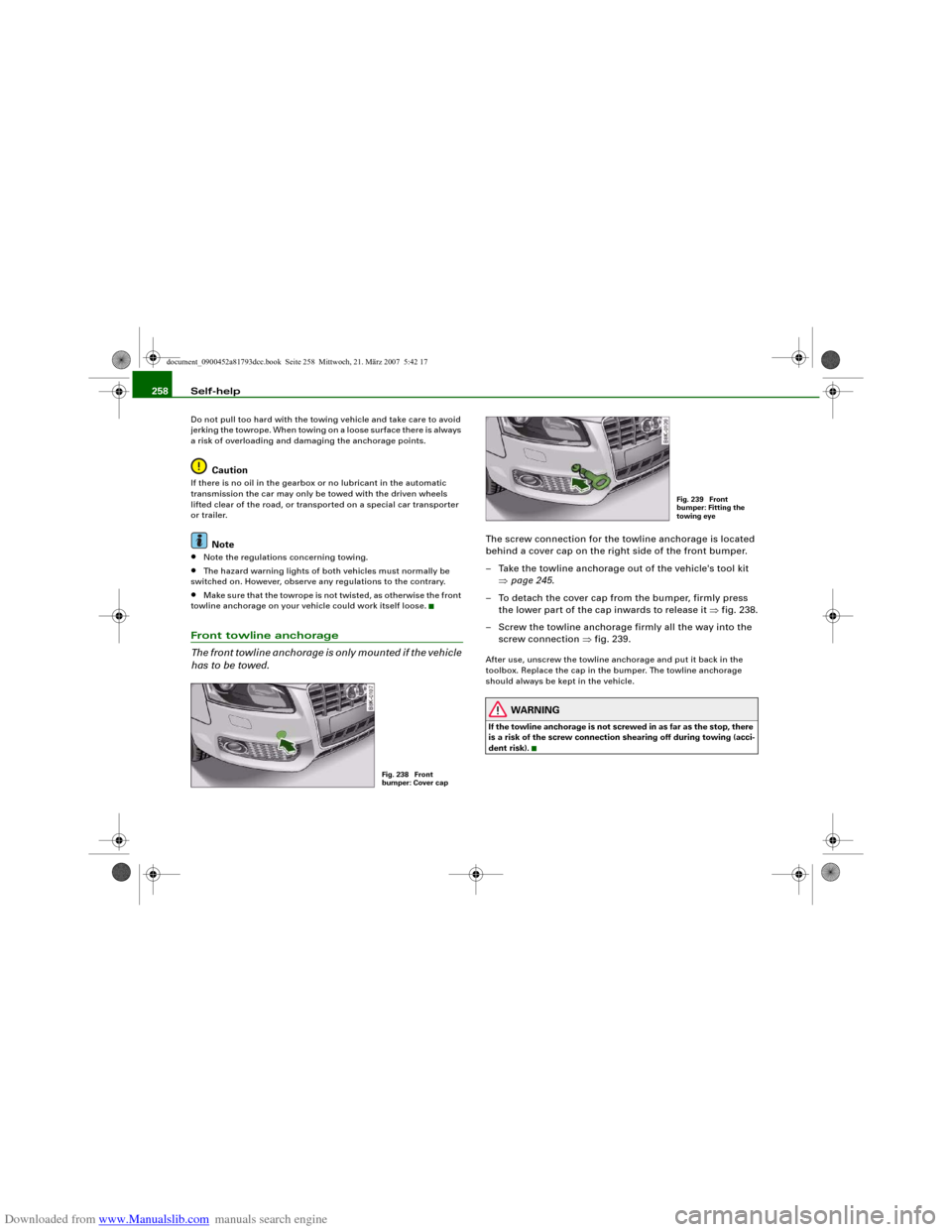
The screw connection for the towline anchorage is located
behind a cover cap on the right side of the front bumper.
– Take the towline anchorage out of the vehicle's tool kit
⇒page 245.
– To detach the cover cap from the bumper, firmly press
the lower part of the cap inwards to release it ⇒fig. 238.
– Screw the towline anchorage firmly all the way into the
screw connection ⇒fig. 239.After use, unscrew the towline anchorage and put it back in the
toolbox. Replace the cap in the bumper. The towline anchorage
should always be kept in the vehicle.
WARNING
If the towline anchorage is not screwed in as far as the stop, there
is a risk of the screw connection shearing off during towing (acci-
dent risk).
Fig. 238 Front
bumper: Cover cap
Fig. 239 Front
bumper: Fitting the
towing eye
document_0900452a81793dcc.book Seite 258 Mittwoch, 21. März 2007 5:42 17
Page 261 of 294
Downloaded from www.Manualslib.com manuals search engine Self-help259
Controls
Safety
Driving tips
General maintenance
Self-help
Technical data
Rear towline anchorage
Vehicles which do not have a factory-fitted towing
bracket* have a towline anchorage on the right side of the
rear bumper.Vehicles with towline anchorage
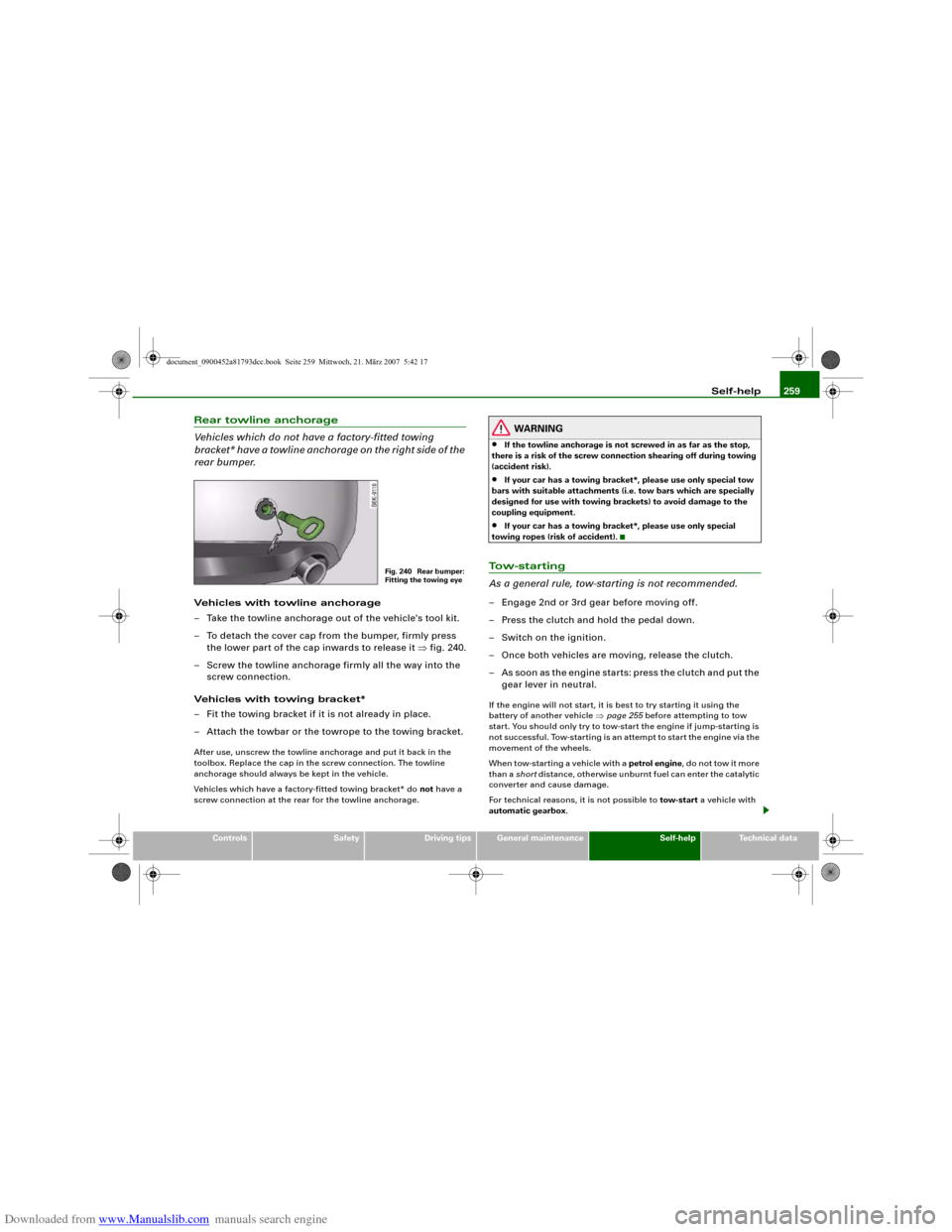
– Take the towline anchorage out of the vehicle's tool kit.
– To detach the cover cap from the bumper, firmly press
the lower part of the cap inwards to release it ⇒fig. 240.
– Screw the towline anchorage firmly all the way into the
screw connection.
Vehicles with towing bracket*
– Fit the towing bracket if it is not already in place.
– Attach the towbar or the towrope to the towing bracket.After use, unscrew the towline anchorage and put it back in the
toolbox. Replace the cap in the screw connection. The towline
anchorage should always be kept in the vehicle.
Vehicles which have a factory-fitted towing bracket* do not have a
screw connection at the rear for the towline anchorage.
WARNING
•
If the towline anchorage is not screwed in as far as the stop,
there is a risk of the screw connection shearing off during towing
(accident risk).
•
If your car has a towing bracket*, please use only special tow
bars with suitable attachments (i.e. tow bars which are specially
designed for use with towing brackets) to avoid damage to the
coupling equipment.
•
If your car has a towing bracket*, please use only special
towing ropes (risk of accident).
To w - s t a r t i n g
As a general rule, tow-starting is not recommended.– Engage 2nd or 3rd gear before moving off.
– Press the clutch and hold the pedal down.
– Switch on the ignition.
– Once both vehicles are moving, release the clutch.
– As soon as the engine starts: press the clutch and put the
gear lever in neutral.If the engine will not start, it is best to try starting it using the
battery of another vehicle ⇒page 255 before attempting to tow
start. You should only try to tow-start the engine if jump-starting is
not successful. Tow-starting is an attempt to start the engine via the
movement of the wheels.
When tow-starting a vehicle with a petrol engine, do not tow it more
than a short distance, otherwise unburnt fuel can enter the catalytic
converter and cause damage.
For technical reasons, it is not possible to tow-start a vehicle with
automatic gearbox.
Fig. 240 Rear bumper:
Fitting the towing eye
document_0900452a81793dcc.book Seite 259 Mittwoch, 21. März 2007 5:42 17
Page 262 of 294
Downloaded from www.Manualslib.com manuals search engine Self-help 260
WARNING
There is a high risk of accidents when tow-starting, as the towed
vehicle can easily be driven into the towing vehicle.
Caution
When tow-starting the vehicle, do not tow it further than 50 metres:
otherwise the catalytic converter could be damaged.Towing a vehicle with manual gearbox and four-wheel drive
Certain restrictions must be observed when towing your
vehicle.Please observe the notes ⇒page 257.
The vehicle can be towed with a towbar or towrope in the normal
way, with all four wheels on the ground. It can also be towed by a
breakdown truck, with the wheels lifted at either the front or rear.
When doing so, please note the following points:•
The vehicle must not be towed faster than 50 km/h.
•
The vehicle must not be towed further than 50 km.Note
If it is not possible to tow the vehicle as described above, or if it has
to be towed further than 50 km, it must be transported on a special
car transporter or trailer.
Towing a vehicle with automatic gearbox and four-wheel drive
Certain restrictions must be observed when towing your
vehicle.Please observe the notes ⇒page 257.
The vehicle can be towed with a towbar or towrope in the normal
way, with all four wheels on the ground. When doing so, please note
the following points:•
Release the parking brake ⇒page 119.
•
Make sure the selector lever is in the N position.
•
The vehicle must not be towed faster than 50 km/h.
•
The vehicle must not be towed further than 50 km. The reason
for this is: when the engine is not running, the gearbox oil pump
does not work and the gearbox is not adequately lubricated for
higher speeds or longer distances.
The vehicle must not be towed with the wheels lifted at either the
front or rear.Note
If it is not possible to tow the vehicle as described above, or if it has
to be towed further than 50 km, it must be transported on a special
car transporter or trailer.
document_0900452a81793dcc.book Seite 260 Mittwoch, 21. März 2007 5:42 17
Page 282 of 294
Downloaded from www.Manualslib.com manuals search engine General notes 280Vehicle data sticker
The vehicle data sticker ⇒page 279, fig. 264 is located near the
battery in the luggage compartment. One section of the vehicle data
sticker is attached to the inside cover of the Service Schedule before
the vehicle is handed over.
The sticker lists the following data:
Vehicle identification number (chassis number)
Vehicle type / engine power / gearbox type
Engine and gearbox code letters
Paint No. / Interior equipment No.
Optional equipment codes
Fuel consumption and emissions
Fuel consumption and emissions
Information on the vehicle's fuel consumption and emissions is
given at the bottom of the vehicle data sticker :
Urban cycle consumption (ltr./100 km)
Extra-urban cycle consumption (ltr./100 km)
Combined cycle consumption (ltr./100 km)
Combined CO
2 emissions (g/km)
The specified values were determined in accordance with the test
procedure prescribed by the currently applicable version of
Directive 80/1268/EEC. The specifications do not refer to an indi-
vidual vehicle. The consumption figures achieved during normal
driving may differ from the test values quoted in accordance with
the above Directive, depending on special equipment fitted, vehicle
loading, personal driving style, road and traffic conditions, environ-
mental factors and the condition of the car.
A1A2A3A4A5A6
A6
AAABACAD
document_0900452a81793dcc.book Seite 280 Mittwoch, 21. März 2007 5:42 17
Page 286 of 294

Downloaded from www.Manualslib.com manuals search engine Index 284AABS
SeeAnti-lock brake system . . . . . . . . . 17
AC mode . . . . . . . . . . . . . . . . . . . . . . . 96, 105
Acceleration figures
SeePerformance, weights and
dimensions . . . . . . . . . . . . . . . . . . . . 281
Accessories . . . . . . . . . . . . . . . . . . . . . . . . 239
Trailer . . . . . . . . . . . . . . . . . . . . . . . . . . 201
Adapter for anti-theft wheel bolts . . . . . 254
adaptive light . . . . . . . . . . . . . . . . . . . . . . . 57
Defective . . . . . . . . . . . . . . . . . . . . . . . . 37
advanced key
Locking and unlocking the vehicle . . . 44
START ENGINE STOP button . . . . . . . 116
Starting the engine . . . . . . . . . . . . . . . 116
Switching on the ignition . . . . . . . . . . 116
Air conditioner . . . . . . . . . . . . . . . . . . . 91, 99
AC mode . . . . . . . . . . . . . . . . . . . . . . . . . 96
See alsoDeluxe automatic air conditioner
91
Air recirculation mode
Deluxe automatic air conditioner . . . . 95
Deluxe automatic air conditioner plus . . .
103
Airbag . . . . . . . . . . . . . . . . . . . . . . . . . . . . 166
Deactivating . . . . . . . . . . . . . . . . . . . . . 173
Front airbags . . . . . . . . . . . . . . . . . . . . 168
Head-protection airbag . . . . . . . . . . . 171
Key-operated switch for front passenger's
airbag . . . . . . . . . . . . . . . . . . . . . . . . 173
Side airbags . . . . . . . . . . . . . . . . . . . . . 170Triggering . . . . . . . . . . . . . . . . . . . . . . 167
Warning lamp . . . . . . . . . . . . . . . . . . . . 16
Alterations to the vehicle . . . . . . . . . . . . . 239
Alternator
Fault . . . . . . . . . . . . . . . . . . . . . . . . . . . . 31
Anti-dazzle interior mirror . . . . . . . . . . . . . 65
Anti-freeze additive . . . . . . . . . . . . . . . . . 224
Anti-knock properties of petrol . . . . . . . . 217
Anti-lock brake system
How the system works . . . . . . . . . . . . 187
Warning lamp . . . . . . . . . . . . . . . . . . . . 17
Anti-theft alarm . . . . . . . . . . . . . . . . . . . . . . 42
Interior monitor . . . . . . . . . . . . . . . . . . . 47
Tow-away protection . . . . . . . . . . . . . . 47
Anti-theft wheel bolts . . . . . . . . . . . . . . . . 254
Armrest (front)
Adjusting . . . . . . . . . . . . . . . . . . . . . . . . 75
Storage compartment . . . . . . . . . . . . . 75
Ashtrays
Front . . . . . . . . . . . . . . . . . . . . . . . . . . . . 84
Rear . . . . . . . . . . . . . . . . . . . . . . . . . . . . . 85
Audi hold assist . . . . . . . . . . . . . . . . . . . . 122
Warning lamp . . . . . . . . . . . . . . . . . . . . 18
Auto Lock . . . . . . . . . . . . . . . . . . . . . . . . . . . 42
Auto-check control . . . . . . . . . . . . . . . . . . . 29
Automatic air conditioner plus
SeeDeluxe automatic air conditioner plus
99
Automatic gearbox
Safety interlock for ignition key . . . . 114
Automatic headlight control . . . . . . . . . . . 54Auxiliary heating
Deluxe automatic air conditioner plus . . .
108
Description . . . . . . . . . . . . . . . . . . . . . . 108
Remote control . . . . . . . . . . . . . . . . . . 111
Running time . . . . . . . . . . . . . . . . . . . . 111
Switching on/off immediately . . . . . . 109
Timer . . . . . . . . . . . . . . . . . . . . . . . . . . . 110
Average fuel consumption . . . . . . . . . . . . . 25
Average speed . . . . . . . . . . . . . . . . . . . . . . . 25
Axle weights
SeePerformance, weights and
dimensions . . . . . . . . . . . . . . . . . . . . 281
BBattery
Charging . . . . . . . . . . . . . . . . . . . . . . . . 230
Low charge . . . . . . . . . . . . . . . . . . . . . . 192
Power level . . . . . . . . . . . . . . . . . . . . . . 192
Power management . . . . . . . . . . . . . . 192
Replacing . . . . . . . . . . . . . . . . . . . . . . . 231
Winter conditions . . . . . . . . . . . . . . . . 228
Battery power . . . . . . . . . . . . . . . . . . . . . . . 36
Bayonet fastener
Bulb . . . . . . . . . . . . . . . . . . . . . . . . . . . . 266
Bulb holder . . . . . . . . . . . . . . . . . . . . . . 266
Belt tensioners . . . . . . . . . . . . . . . . . . . . . 165
Bicycle rack
Trailer . . . . . . . . . . . . . . . . . . . . . . . . . . 201
Bioethanol fuel . . . . . . . . . . . . . . . . . . . . . 217
document_0900452a81793dcc.book Seite 284 Mittwoch, 21. März 2007 5:42 17