2008 AUDI S5 remote start
[x] Cancel search: remote startPage 114 of 294
Downloaded from www.Manualslib.com manuals search engine Heating and cooling 112
Changing the battery
– Push back and remove the battery cover on the remote
control ⇒page 111, fig. 128.
– Change the battery. The diagram in the battery compart-
ment shows how the battery should be fitted. The new
battery must be of the same type as the old battery.
– Re-fit the battery cover.When it is switched on, the auxiliary heating or auxiliary ventilation
starts immediately and remains on for the period set in the menu.
The maximum running time is 60 minutes.
If you want to switch the system on again after the end of the
programmed running time, press the button .
Transmitter indicator lamp
The transmitter indicator lamp will flash accordingly to show
whether the command you sent via the remote control was
successful.
When you switch the system on by pressing the button the
indicator lamp will flash green for about 30 seconds to confirm that
the heating/ ventilation has been switched on. When you switch the
system off by pressing the button the indicator lamp will
flash red to confirm that the heating/ ventilation has been switched
off.
If the remote control is outside the transmitting range the indicator
lamp will flash red slowly. If there is a fault in the system (e.g. fuel
level is down to reserve), the indicator lamp will flash red rapidly. In
both cases the command will not be executed.
When the remote control battery is almost completely flat, the
transmitter indicator lamp will not light up and no commands will
be executed.Transmitting range
The range of the remote control transmitter is about 600 metres.
However, this can be greatly reduced by obstacles (buildings, etc.)
between the remote control transmitter and the vehicle. Hold the
aerial upright when using the remote control.
You should not normally use the remote control at a distance of less
than 3 metres from the vehicle. If you are closer than this, or if you
use the remote control inside the vehicle, this can cause signal over-
load.
For the sake of the environment
Please dispose of old batteries in the proper manner so that they do
not harm the environment.Seat heatingApplies to vehicles: with front seat heatingSeat heating for front seats
The seat cushions and backrests of the front seats can be
heated electrically.– Press the button for the seat heating .
A1
A3
A1
OFF
A2
A4
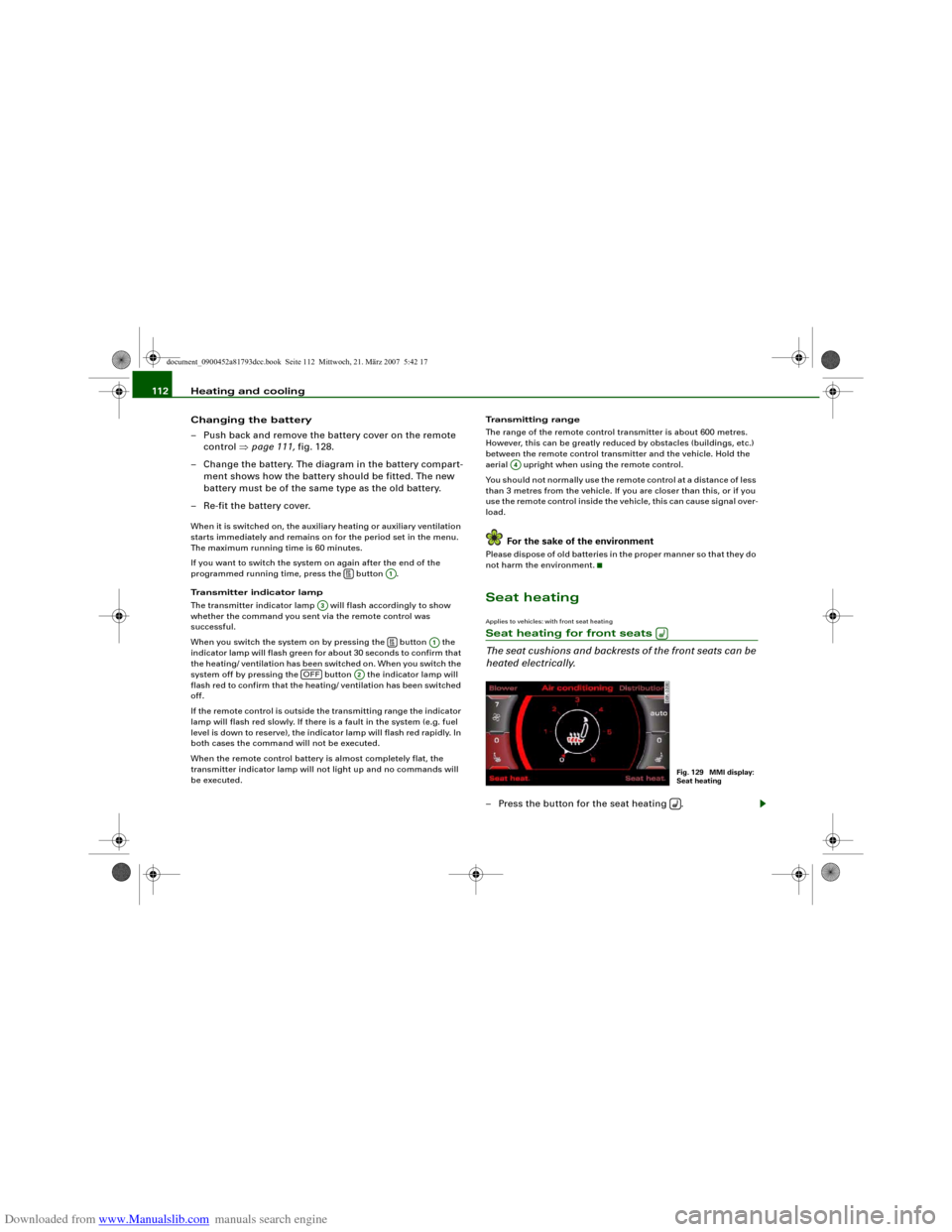
Fig. 129 MMI display:
Seat heating
document_0900452a81793dcc.book Seite 112 Mittwoch, 21. März 2007 5:42 17
Page 117 of 294
Downloaded from www.Manualslib.com manuals search engine Driving115
Controls
Safety
Driving tips
General maintenance
Self-help
Technical data When starting from cold the engine may be a little noisy for the first
few seconds until oil pressure has built up in the hydraulic tappets.
This is quite normal and no cause for concern.
If the engine fails to start straight-away, switch off the starter after
about 10 seconds and try again after about half a minute.
Driver message in the instrument cluster display
Press brake pedal to start engine
This message appears on vehicles with an automatic gearbox if you
try to start the engine without first pressing the brake pedal.
Press clutch pedal to start engine
This message appears on vehicles with a manual gearbox if you try
to start the engine without first pressing the clutch pedal.
Engage N or P to start engine
This message will appear if you try to start the engine when the
selector lever of the automatic gearbox is not in P or N.
Shift to P, otherwise vehicle can roll away. Doors do not lock if lever
is not in P. or Please move selector lever to position P. Vehicle
cannot be locked.
For safety reasons, this message will appear and a warning buzzer
will sound if the selector lever of the automatic gearbox is not in
position P after you switch off the ignition. Put the selector lever in
position P; otherwise the vehicle can roll away. If the lever is not in
position P you will not be able to lock the vehicle using the exterior
locking switch on the door handle or the remote control key.
Steering lock
The steering is locked when the key is not in the ignition. The
steering lock acts as a theft deterrent. .
WARNING
•
Always take the key with you when you leave the vehicle.
Otherwise the engine can be started or power-operated equip-
ment such as the electric windows can be used. This could result
in serious injury.
•
Never leave children or disabled people alone in the car. The
doors could be locked with the remote control key and the occu-
pants could become trapped in the vehicle. The vehicle occupants
could be exposed to extremely high or low temperatures,
depending on the time of year.
•
Never remove the key from the ignition while the vehicle is
moving. The steering lock could engage suddenly, and you would
not be able to steer the car.Caution
•
If a malfunction occurs in the electronic ignition lock, a flashing
symbol and the message Ignition lock defective will appear in the
instrument cluster display.
•
Avoid high engine speeds, full throttle and extreme load condi-
tions until the engine has reached its normal operating tempera-
ture, otherwise this can damage the engine.For the sake of the environment
Do not warm up the engine by running it with the car stationary. You
should drive off immediately whenever possible. This will help avoid
unnecessary exhaust emissions.
Note
If the key should become stuck in the ignition lock, remove the top
part of the key and use it to lock the vehicle.
document_0900452a81793dcc.book Seite 115 Mittwoch, 21. März 2007 5:42 17
Page 119 of 294
Downloaded from www.Manualslib.com manuals search engine Driving117
Controls
Safety
Driving tips
General maintenance
Self-help
Technical data If the engine fails to start straight-away, switch off the starter after
about 10 seconds and try again after about half a minute.
When starting from cold the engine may be a little noisy for the first
few seconds until oil pressure has built up in the hydraulic tappets.
This is quite normal and no cause for concern.
Driving away from a standstill
On some vehicles, the engine revs are automatically increased
slightly as soon as you release the clutch. This helps you drive off
more smoothly.
Driver message in the instrument cluster display
No key identified
This message appears when you press the Start/Stop button if there
is no remote control key inside the vehicle or if the system cannot
detect or identify the key. This can happen, for example, if the radio
signal from the key is obstructed by a metal briefcase or similar.
Electronic equipment, such as mobile phones, can also interfere
with the radio signal from the key.
Press brake pedal to start engine
This message appears on automatic vehicles if you press the
Start/Stop button to start the engine without first pressing the
brake pedal. The engine will only start if you press the brake pedal.
Press clutch pedal to start engine
This message appears on manual vehicles if you press the
Start/Stop button to start the engine without first pressing the
clutch pedal. The engine will only start if you press the clutch pedal.
Engage N or P to start engine
This message will appear if you try to start the engine when the
selector lever of the automatic gearbox is not in P or N. The engine
can only be started if the selector lever is in one of these positions. Key not in vehicle
This message will appear together with the symbol
if the remote
control key is removed from the vehicle while the engine is running.
This is to remind you not to continue driving without the key (for
example if you change drivers).
If the remote control key is not in the vehicle you will not be able to
switch on the ignition or restart the engine after it has been
switched off. Without the key, you will also not be able to lock the
vehicle from the outside.
Shift to P, otherwise vehicle can roll away. Doors do not lock if lever
is not in P. or Please move selector lever to position P. Vehicle
cannot be locked.
For safety reasons, this message will appear and a warning buzzer
will sound if the selector lever of the automatic gearbox is not in
position P when you switch off the ignition with the Start/Stop
button. Put the selector lever in position P; otherwise the vehicle
can roll away. If the lever is not in position P you will not be able to
lock the vehicle using the exterior locking switch on the door handle
or the remote control key.
Advanced key defective! Use ignition lock
This message appears if the vehicle has to be started with the igni-
tion key instead of the Start/Stop button.
Steering lock
The steering is locked if the key is not in the ignition and the driver
door has been opened. The steering lock acts as a theft deterrent.
WARNING
Never run the engine in confined spaces. The exhaust gases are
toxic.•
Never switch off the engine until the vehicle is stationary.
•
The brake servo and the power steering system work only
when the engine is running. You need more strength to steer and
document_0900452a81793dcc.book Seite 117 Mittwoch, 21. März 2007 5:42 17
Page 195 of 294
Downloaded from www.Manualslib.com manuals search engine Intelligent technology193
Controls
Safety
Driving tips
General maintenance
Self-help
Technical data
Points to remember
Starting ability has first priority.Short trips, city traffic and low temperatures all place a heavy load
on the battery. In these conditions a large amount of power is
consumed, but only a small amount is supplied. The situation is also
critical if electrical equipment is in use when the engine is not
running. In this case power is consumed when none is being gener-
ated.
In these situations you will be aware that the power management
system is intervening to control the distribution of electrical power.
When the vehicle is parked for long periods
If you do not drive your vehicle for a period of several days or weeks,
the power management will gradually shut off the on-board
systems one by one, or reduce the amount of current they are using.
This limits the amount of power consumed and helps to ensure reli-
able starting even after a long period.
Please note that certain convenience features, such as the Audi
advanced key*, the remote control key or the electrical seat adjust-
ment may not be available when you unlock the vehicle. These func-
tions will be restored when you switch on the ignition and start the
engine.
With the engine switched off
If you listen to the radio or use the other MMI functions when the
engine is not running, this will discharge the battery.
The MMI display will show this warning message before the battery
power drops to a level where the starting ability is impaired.
Please start engine, otherwise system will switch off
in 3 minutes.
This message warns you that the system you are using will be
switched off automatically after 3 minutes. You should therefore
start the engine if you wish to continue using the system.When the engine is running
Although the alternator generates electrical power, the battery can
still become discharged while the vehicle is being driven. This can
occur when a lot of power is being consumed but only a small
amount supplied, especially if the battery is not fully charged
initially.
To restore the necessary energy balance, the system will then
temporarily shut off the electrical components that are using a lot
of power, or reduce the current they are consuming. Heating
systems in particular use a large amount of electrical power. If you
notice, for instance, that the seat heating* or the rear window
heater is not working, they may have been temporarily switched off
or regulated to a lower heat output. These systems will be available
again as soon as sufficient electrical power is available.
You may also notice that the engine runs at a slightly faster idling
speed. This is quite normal, and no cause for concern. The increased
idling speed allows the alternator to meet the greater power
requirement and charge the battery at the same time.
Driver message in the instrument cluster displayIf battery power drops to a level at which you may encounter prob-
lems when starting the engine, the following message will appear
in the instrument cluster display:
Low battery charge: Battery will be charged while driving
This message reminds you that the starting reliability may be
impaired. The message will disappear as soon as you set off and the
battery is charged.
Message comes on and goes out again
If the message appears in the display after the ignition is switched
on or while driving, and goes out again after a period of time, the
document_0900452a81793dcc.book Seite 193 Mittwoch, 21. März 2007 5:42 17
Page 230 of 294
Downloaded from www.Manualslib.com manuals search engine Checking and topping up fluids 228
For the sake of the environmentIf the fluid has to be drained out of the brake system, use an appro-
priate container to catch the used brake fluid and dispose of it in the
proper manner.BatteryGeneral notes
All work on batteries requires specialist knowledge.The battery is virtually maintenance-free. It is checked as part of the
Inspection Service.
We recommend that you replace a battery once it is older than 5
years.
When an airbag is triggered, the battery will, under certain circum-
stances, be disconnected from the on-board power supply for
safety reasons ⇒ in “General notes on airbag system” on
page 166.
Disconnecting the battery
If the battery is disconnected, some of the vehicle's functions will
become inoperative (e.g. electric windows). These functions will
require resetting after the battery is reconnected. For this reason,
the battery should only be disconnected from the vehicle's electrical
system when absolutely necessary.
If the vehicle is not used for long periods
If you do not drive your vehicle for a period of several days or weeks,
the power management will gradually shut off the on-board
systems one by one, or reduce the amount of current they are using.
This limits the amount of power consumed and helps to ensure reli-
able starting even after a long period ⇒page 192.Please note that certain convenience features, such as the Audi
advanced key*, the remote control key or the electrical seat adjust-
ment may not be available when you unlock the vehicle. These func-
tions will be restored when you switch on the ignition and start the
engine.
Winter conditions
At low temperatures the battery has to work very hard. It also
provides only a fraction of the starting power it has at normal
temperatures.
For this reason, we recommend having the battery checked and
charged if necessary before the start of winter ⇒page 230.
WARNING
•
All work on batteries requires specialist knowledge. For queries
regarding the vehicle battery please contact an Audi dealership or
other qualified workshop (risk of chemical burns / risk of explo-
sion).
•
The battery must not be opened. Do not attempt to make any
changes to the electrolyte level of the battery. Otherwise, there is
a risk that a mixture of oxygen and hydrogen gas can accumulate
and cause an explosion.Note
If the vehicle is to be left standing for a period of several weeks at
extremely low temperatures, the battery should be removed from
the vehicle. This ensures that it cannot “freeze up” and be
damaged.
document_0900452a81793dcc.book Seite 228 Mittwoch, 21. März 2007 5:42 17
Page 286 of 294

Downloaded from www.Manualslib.com manuals search engine Index 284AABS
SeeAnti-lock brake system . . . . . . . . . 17
AC mode . . . . . . . . . . . . . . . . . . . . . . . 96, 105
Acceleration figures
SeePerformance, weights and
dimensions . . . . . . . . . . . . . . . . . . . . 281
Accessories . . . . . . . . . . . . . . . . . . . . . . . . 239
Trailer . . . . . . . . . . . . . . . . . . . . . . . . . . 201
Adapter for anti-theft wheel bolts . . . . . 254
adaptive light . . . . . . . . . . . . . . . . . . . . . . . 57
Defective . . . . . . . . . . . . . . . . . . . . . . . . 37
advanced key
Locking and unlocking the vehicle . . . 44
START ENGINE STOP button . . . . . . . 116
Starting the engine . . . . . . . . . . . . . . . 116
Switching on the ignition . . . . . . . . . . 116
Air conditioner . . . . . . . . . . . . . . . . . . . 91, 99
AC mode . . . . . . . . . . . . . . . . . . . . . . . . . 96
See alsoDeluxe automatic air conditioner
91
Air recirculation mode
Deluxe automatic air conditioner . . . . 95
Deluxe automatic air conditioner plus . . .
103
Airbag . . . . . . . . . . . . . . . . . . . . . . . . . . . . 166
Deactivating . . . . . . . . . . . . . . . . . . . . . 173
Front airbags . . . . . . . . . . . . . . . . . . . . 168
Head-protection airbag . . . . . . . . . . . 171
Key-operated switch for front passenger's
airbag . . . . . . . . . . . . . . . . . . . . . . . . 173
Side airbags . . . . . . . . . . . . . . . . . . . . . 170Triggering . . . . . . . . . . . . . . . . . . . . . . 167
Warning lamp . . . . . . . . . . . . . . . . . . . . 16
Alterations to the vehicle . . . . . . . . . . . . . 239
Alternator
Fault . . . . . . . . . . . . . . . . . . . . . . . . . . . . 31
Anti-dazzle interior mirror . . . . . . . . . . . . . 65
Anti-freeze additive . . . . . . . . . . . . . . . . . 224
Anti-knock properties of petrol . . . . . . . . 217
Anti-lock brake system
How the system works . . . . . . . . . . . . 187
Warning lamp . . . . . . . . . . . . . . . . . . . . 17
Anti-theft alarm . . . . . . . . . . . . . . . . . . . . . . 42
Interior monitor . . . . . . . . . . . . . . . . . . . 47
Tow-away protection . . . . . . . . . . . . . . 47
Anti-theft wheel bolts . . . . . . . . . . . . . . . . 254
Armrest (front)
Adjusting . . . . . . . . . . . . . . . . . . . . . . . . 75
Storage compartment . . . . . . . . . . . . . 75
Ashtrays
Front . . . . . . . . . . . . . . . . . . . . . . . . . . . . 84
Rear . . . . . . . . . . . . . . . . . . . . . . . . . . . . . 85
Audi hold assist . . . . . . . . . . . . . . . . . . . . 122
Warning lamp . . . . . . . . . . . . . . . . . . . . 18
Auto Lock . . . . . . . . . . . . . . . . . . . . . . . . . . . 42
Auto-check control . . . . . . . . . . . . . . . . . . . 29
Automatic air conditioner plus
SeeDeluxe automatic air conditioner plus
99
Automatic gearbox
Safety interlock for ignition key . . . . 114
Automatic headlight control . . . . . . . . . . . 54Auxiliary heating
Deluxe automatic air conditioner plus . . .
108
Description . . . . . . . . . . . . . . . . . . . . . . 108
Remote control . . . . . . . . . . . . . . . . . . 111
Running time . . . . . . . . . . . . . . . . . . . . 111
Switching on/off immediately . . . . . . 109
Timer . . . . . . . . . . . . . . . . . . . . . . . . . . . 110
Average fuel consumption . . . . . . . . . . . . . 25
Average speed . . . . . . . . . . . . . . . . . . . . . . . 25
Axle weights
SeePerformance, weights and
dimensions . . . . . . . . . . . . . . . . . . . . 281
BBattery
Charging . . . . . . . . . . . . . . . . . . . . . . . . 230
Low charge . . . . . . . . . . . . . . . . . . . . . . 192
Power level . . . . . . . . . . . . . . . . . . . . . . 192
Power management . . . . . . . . . . . . . . 192
Replacing . . . . . . . . . . . . . . . . . . . . . . . 231
Winter conditions . . . . . . . . . . . . . . . . 228
Battery power . . . . . . . . . . . . . . . . . . . . . . . 36
Bayonet fastener
Bulb . . . . . . . . . . . . . . . . . . . . . . . . . . . . 266
Bulb holder . . . . . . . . . . . . . . . . . . . . . . 266
Belt tensioners . . . . . . . . . . . . . . . . . . . . . 165
Bicycle rack
Trailer . . . . . . . . . . . . . . . . . . . . . . . . . . 201
Bioethanol fuel . . . . . . . . . . . . . . . . . . . . . 217
document_0900452a81793dcc.book Seite 284 Mittwoch, 21. März 2007 5:42 17