2008 AUDI A4 Tyres
[x] Cancel search: TyresPage 277 of 342
Wheels and tyres275
Controls
Safety
Driving tips
General maintenance
Self-help
Technical data Furthermore, this could cause damage to your vehicle and
possibly also result in an accident.
Note
•
If you cannot continue driving even with run flat tyres please
obtain professional assistance.
•
You should obtain professional assistance if you are in any doubt
regarding the rims and tyres for your vehicle.
Applies to vehicles: with run flat tyresDriving with run flat tyres
Please remember that the vehicle's handling will be
impaired.Driving a vehicle with a deflated tyre, or with insufficient
tyre pressure, is an abnormal situation. However, since the
handling of a vehicle equipped with run flat tyres is only
slightly impaired, it is important to remember that you are
driving with a deflated tyre. If you have to make use of the
run flat system please remember the following points:
– The Electronic Stabilisation Program (ESP) must be
switched on.
–Do not exceed 80km/h ⇒.
– Anticipate the traffic situation well in advance.
– Be careful when accelerating.
– Avoid unnecessary braking and steering manoeuvres.
– Reduce speed in good time before corners and potential
hazards.
Please refer to ⇒page 274, “ When is it no longer possible to
continue driving with the help of the run flat tyres?”
Effects on handling when driving with defective tyres
If one of the front tyres is defective, your vehicle will tend to pull
slightly towards that side and braking performance will be
impaired.
A defective rear tyre will also make the vehicle pull slightly to one
side, and the braking response will again be slightly impaired.
These effects will be most noticeable when driving in a corner.
WARNING
•
When using the run flat system the changes in vehicle handling
will be noticeable when braking, in corners and during fast accel-
eration.
•
The maximum permitted speed of 80 km/h is subject to road
and weather conditions. Always observe the relevant rules and
regulations. Run flat tyres allow you to continue your journey in
the event of a loss of tyre pressure. However, the driver remains
responsible for the safety of the vehicle and for restoring the
correct tyre pressure and having defective parts replaced
⇒page 276. For these reasons you should always adjust your
driving to suit the circumstances.Caution
We recommend that you drive with great care when making use of
the run flat system. Avoid abrupt manoeuvres.
WARNING (continued)
document_0900452a81b1b9de.book Seite 275 Donnerstag, 26. Juli 2007 9:16 09
Page 278 of 342
Wheels and tyres 276Applies to vehicles: with run flat tyresRenewing defective components on run flat tyres
The run flat tyres have been specially developed for your
vehicle and matched to its requirements.Use and combine only the approved run flat tyres and rims. It is not
permissible to combine standard wheels and run flat tyres ⇒.
If you have to drive with low tyre pressure or with a completely
deflated tyre, you should always take the vehicle to an authorised
qualified workshop and have the defective parts inspected and the
condition corrected.
WARNING
•
We recommend that you have the run flat tyre renewed and
also have the rim checked by a qualified workshop to identify any
damage.
•
Using tyres or rims which have not been approved can cause
damage to the vehicle. Vehicle handling can be impaired and
driving safety can no longer be guaranteed. This can also void the
vehicle's certification for use on public roads.Note
Run-flat tyres can be repaired with the TMS ⇒page 285.
document_0900452a81b1b9de.book Seite 276 Donnerstag, 26. Juli 2007 9:16 09
Page 287 of 342
Self-help285
Controls
Safety
Driving tips
General maintenance
Self-help
Technical data How to use the compact temporary spare wheel
Should you ever have a punctured tyre, the compact temporary
spare wheel is only intended for temporary use until you can reach
a workshop. The standard-size road wheel should be refitted as
soon as possible.
Please note the following restrictions when using the compact
temporary spare wheel. The compact temporary spare wheel is
designed specifically for this model. For this reason, do not use a
temporary spare from a different type of vehicle.
Snow chains
For technical reasons, snow chains must not be used on the
compact temporary spare wheel.
If you should have a puncture on one of the front wheels when using
snow chains, fit the compact temporary spare in place of one of the
rear wheels. You can then attach the snow chains to the wheel taken
from the rear and use this wheel to replace the punctured front
wheel.
WARNING
•
The tyre pressures must be checked and corrected as soon as
possible. The tyre pressure of the compact temporary spare wheel
must be 4.2 bar – an incorrectly inflated tyre can cause an acci-
dent.
•
Do not drive faster than 80 km/h - higher speeds can cause an
accident.
•
Avoid heavy acceleration, hard braking and fast cornering – risk
of accident.
•
Never use two or more compact spare tyres at the same time –
risk of accident.
•
No other type of tyre (normal summer or winter tyres) may be
fitted on the compact temporary spare wheel.
Ty r e r e p a i r sGeneral information and safety notes
Repaired tyres are only suitable for temporary use.Your vehicle is equipped with a tyre repair kit: the Tyre Mobility
System (TMS).
In the event of a puncture you will find the TMS, which consists of a
sealing compound and an electric compressor, located under the
floor panel in the luggage compartment.
The TMS will reliably seal tyres damaged by foreign bodies,
provided that the cuts or punctures are no larger than approx. 4 mm
in diameter.
It is not necessary to remove the foreign body from the tyre.
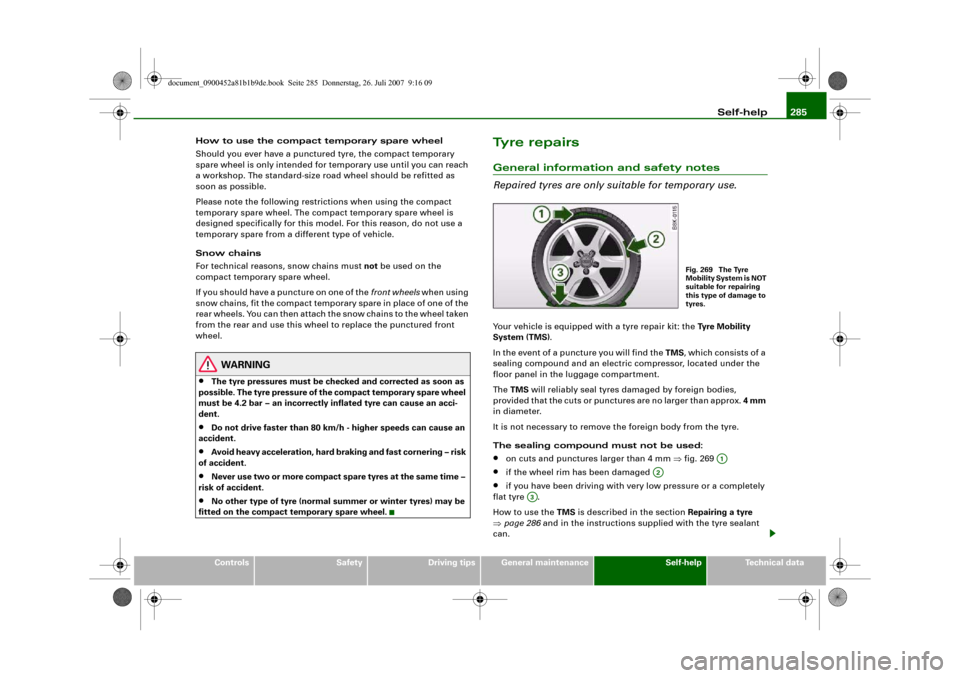
The sealing compound must not be used:•
on cuts and punctures larger than 4 mm ⇒fig. 269
•
if the wheel rim has been damaged
•
if you have been driving with very low pressure or a completely
flat tyre .
How to use the TMS is described in the section Repairing a tyre
⇒page 286 and in the instructions supplied with the tyre sealant
can.
Fig. 269 The Tyre
Mobility System is NOT
suitable for repairing
this type of damage to
tyres.
A1
A2
A3
document_0900452a81b1b9de.book Seite 285 Donnerstag, 26. Juli 2007 9:16 09
Page 288 of 342
Self-help 286The TMS can be used at outside temperatures down to – 20 °C.
WARNING
After repairing a tyre please note the following points:•
Do not drive faster than 80 km/h.
•
Avoid heavy acceleration, hard braking and fast cornering.
•
Vehicle handling could be impaired.
•
Tyres which have been sealed using the TMS are only suitable
for temporary use. Damaged tyres must be renewed.
•
The TMS must NOT be used,
−on cuts and punctures larger than 4 mm
−if the wheel rim has been damaged
−if you have been driving with very low pressure or a
completely flat tyre
•
Seek professional assistance if the repair of a tyre puncture is
not possible with the sealing compound.
•
Do not allow the sealant to come into contact with your eyes,
skin or clothing.
•
If you do come into contact with the sealant immediately rinse
the eyes or skin affected with clean water.
•
Change clothing immediately if it becomes soiled with the tyre
sealant.
•
Make sure you do not breathe in the fumes!
•
If any of the tyre sealant is accidentally ingested, immediately
rinse the mouth thoroughly and drink lots of water.
•
Do not induce vomiting. Immediately contact a doctor!
•
If any allergic reactions should occur get medical help immedi-
ately.
•
Keep the sealant away from children.
For the sake of the environment
Used bottles of sealing compound can be returned to an Audi dealer
for disposal.
Note
•
If sealant should leak out, leave it to dry. When it has dried, you
can pull it off like a piece of foil.
•
Observe the expiry date stated on the sealing compound can.
Have the sealing compound exchanged by a qualified workshop.
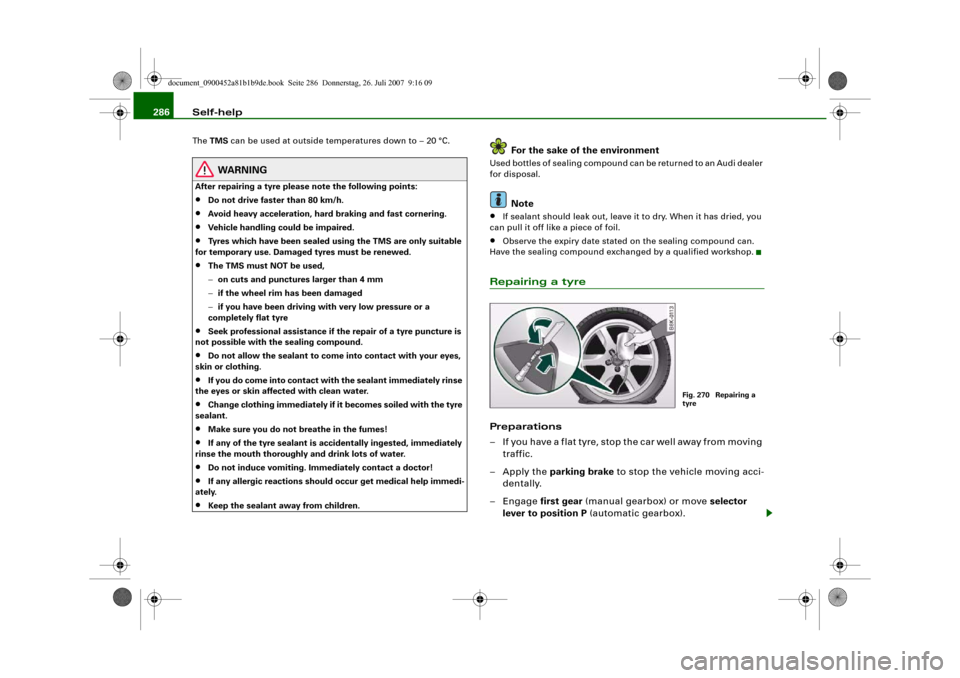
Repairing a tyrePreparations
– If you have a flat tyre, stop the car well away from moving
traffic.
– Apply the parking brake to stop the vehicle moving acci-
dentally.
–Engage first gear (manual gearbox) or move selector
lever to position P (automatic gearbox).
Fig. 270 Repairing a
tyre
document_0900452a81b1b9de.book Seite 286 Donnerstag, 26. Juli 2007 9:16 09
Page 294 of 342
Self-help 292
– Screw in the mounting pin (provided in the vehicle's tool
kit) by hand in place of the wheel bolt ⇒page 291,
fig. 276.
– Then unscrew the other wheel bolts as described above.
– Take off the wheel. The mounting pin stays where it is.
Putting on the spare wheel
– Put on the spare wheel, using the mounting pin to guide
it into place.
– Screw in the wheel bolts and tighten them lightly using
the hexagonal opening in the screwdriver handle.
– Then unscrew the mounting pin and tighten the
remaining wheel bolt lightly.
– Carry out the steps required after you have changed the
wheel ⇒page 289, “After changing a wheel”.The wheel bolts should be clean and turn easily. Before putting on
the spare wheel, inspect the condition of the wheel and hub
mounting surfaces. These surfaces must be clean before mounting
the wheel.
The wheel bolts are easier to remove from the wheel rim if you use
the hexagonal socket in the screwdriver handle. The reversible
screwdriver blade should be removed as a precautionary measure
when the tool is used for this purpose.
Note the direction of rotation when putting on a tyre with direc-
tional tread pattern ⇒page 292.
Note
Do not use the hexagonal socket in the screwdriver handle to loosen
or tighten the wheel bolts.
Tyres with directional tread pattern
Tyres with directional tread pattern must be mounted so
that they rotate in the correct direction.A directional tread pattern is identified by arrows on the sidewall
pointing in the forward running direction. Always note the direction
of rotation indicated when mounting the wheel. This is important so
that these tyres can give maximum grip and avoid excessive noise,
tread wear and aquaplaning.
Drive carefully should you ever have a puncture and have to mount
the spare wheel so it rotates in the wrong direction. This is because
the tyre will not give optimum performance. Bear this in mind
particularly when driving on wet roads.
To benefit from the advantages of tyres with this type of tread
pattern, the defective tyre should be replaced and refitted as soon
as possible so that all tyres again rotate in the correct direction.Applies to vehicles: with anti-theft wheel boltsAnti-theft wheel bolts
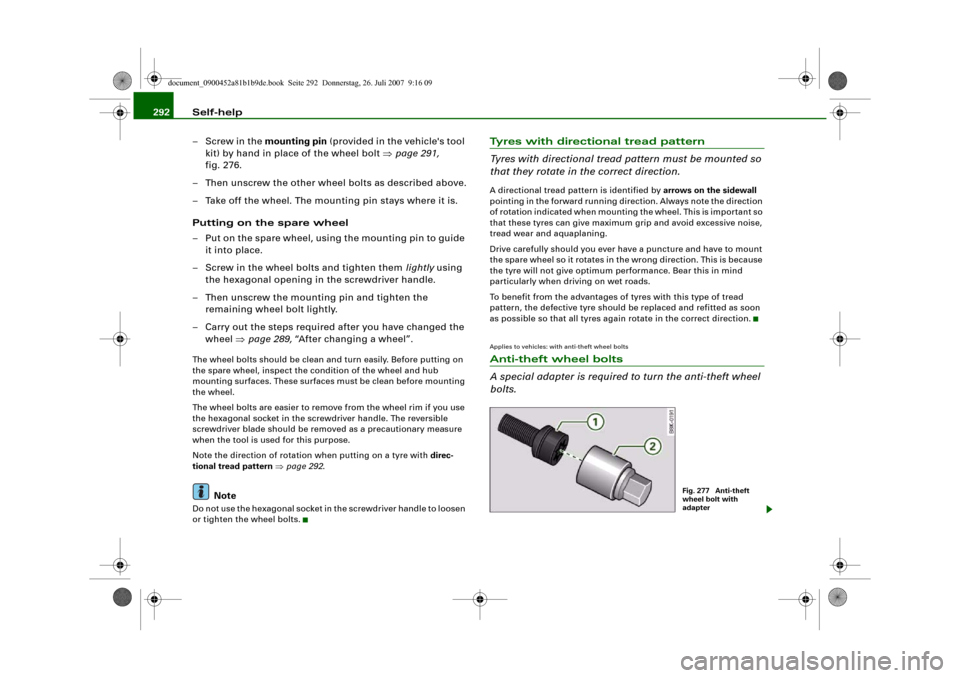
A special adapter is required to turn the anti-theft wheel
bolts.
Fig. 277 Anti-theft
wheel bolt with
adapter
document_0900452a81b1b9de.book Seite 292 Donnerstag, 26. Juli 2007 9:16 09
Page 322 of 342
General notes 320General notesExplanation of technical dataWhere not otherwise indicated or separately listed, all technical
data apply to vehicles with standard equipment for the German
market. Other figures may apply for special versions and export
models.
Please note that the details listed in the vehicle's registration docu-
ments can be taken as correct.
Engine data
The figures for engine power output are determined according to
EU standards.
Performance figures
The performance figures were measured without equipment which
may influence performance, such as mudflaps or extremely wide-
section tyres.
Kerb weight (unladen weight)
These figures (kerb weight according to the currently applicable
version of EU Directive 92/21/EEC) apply to the vehicle with the tank
90% full, with no special equipment. The figures include an addi-
tional 75 kg to allow for the weight of the driver.
When towing a trailer, the gross vehicle weight may be exceeded by
up to 30 kg and the maximum rear axle weight may be exceeded by
up to 80 kg.
Maximum trailer weights
The maximum trailer weights are calculated in accordance with the
currently applicable version of EU Directive 92/21/EEC.
The figures for a trailer with brakes, on gradients up to 8% are appli-
cable only up to a maximum speed of 80 km/h (even though higher
speeds may be permitted when towing a trailer in some countries).The figures for a trailer with brakes on gradients up to 12% and for
the weight of car and trailer on gradients up to 12% are applicable
up to a maximum speed of 100 km/h. This maximum speed must not
be exceeded even in countries where higher speeds are permitted.
Maximum draw bar loading
The vertical load exerted by the trailer drawbar on the ball joint of
the towing bracket must not exceed 80 kg.
In the interest of safety, we recommend applying the maximum
permitted draw bar weight. The stability of the trailer could be
adversely affected if too little weight is applied.
If the maximum permitted drawbar weight cannot be obtained, e.g.
when using small or light trailers, statutory regulations require that
the drawbar weight be at least 4% of the actual trailer weight (for
single-axle trailers or twin-axle trailers with an axle spacing less
than 1.0 m).
Dimensions1) The height of the vehicle depends on the tyres and suspension.
Take care not to damage low-mounted parts of the car (such as the
spoiler or exhaust system) on steep ramps, uneven road surfaces or
roadside kerbs, etc.
This applies especially when the vehicle is fully laden.Length
mm
4703
Width
mm
1826
Width across mirrors
mm
1953
Height, unladen
1)
mm
1417-1437
document_0900452a81b1b9de.book Seite 320 Donnerstag, 26. Juli 2007 9:16 09
Page 335 of 342

Index333
Controls
Safety
Driving tips
General maintenance
Self-help
Technical data Supplementary heater . . . . . . . . . . . . 101
Switching on and off . . . . . . . . . . . . . . . 95
Temperature . . . . . . . . . . . . . . . . . . . . . . 96
Deluxe automatic air conditioner plus . . 101
AC mode . . . . . . . . . . . . . . . . . . . . . . . . 107
Air distribution . . . . . . . . . . . . . . . . . . . 106
Air outlets . . . . . . . . . . . . . . . . . . . . . . . 107
Air outlets for rear passengers . . . . . 108
Air recirculation mode . . . . . . . . . . . . 105
Automatic mode . . . . . . . . . . . . . . . . . 103
Automatic recirculation . . . . . . . . . . . 109
Auxiliary heating . . . . . . . . . . . . . . . . . 110
Auxiliary heating - remote control . . . 113
Auxiliary heating - running time . . . . 112
Basic settings . . . . . . . . . . . . . . . . . . . . 109
Blower . . . . . . . . . . . . . . . . . . . . . . . . . . 104
Controls . . . . . . . . . . . . . . . . . . . . . . . . 102
Defrosting . . . . . . . . . . . . . . . . . . . . . . . 106
Description . . . . . . . . . . . . . . . . . . . . . . 101
Economical operation . . . . . . . . . . . . . 108
Heated rear window . . . . . . . . . . . . . . 106
Supplementary heater . . . . . . . . . . . . 110
Switching on and off . . . . . . . . . . . . . . 103
Synchronisation . . . . . . . . . . . . . . . . . . 109
Temperature . . . . . . . . . . . . . . . . . . . . . 104
Diesel . . . . . . . . . . . . . . . . . . . . . . . . . . . . . 251
Diesel particulate filter . . . . . . . . . . . . 38, 229
Engine oil . . . . . . . . . . . . . . . . . . . . . . . 257
Digital clock . . . . . . . . . . . . . . . . . . . . . . . . . 13
Digital compass . . . . . . . . . . . . . . . . . . . . . . 71
Digital speedometer . . . . . . . . . . . . . . . . . . 23
Dimensions . . . . . . . . . . . . . . . . . . . . . . . . 320Dipped headlights . . . . . . . . . . . . . . . . . . . . 57
Defective . . . . . . . . . . . . . . . . . . . . . . . . . 37
DIS
SeeDriver information system . . . . . . . 21
Distance control system
Seeadaptive cruise control . . . . . . . . 128
Door catches/boot lid warning . . . . . . . . . 24
Doors
Child-proof catches . . . . . . . . . . . . . . . . 53
Manual locking . . . . . . . . . . . . . . . . . . . . 51
Driver
SeeSitting position . . . . . . . . . . . . . . . 188
Driver information system . . . . . . . . . . . . . 21
Auto-check control . . . . . . . . . . . . . . . . 30
Bulb monitor . . . . . . . . . . . . . . . . . . . . . 37
CD and radio display . . . . . . . . . . . . . . . 22
Digital speedometer . . . . . . . . . . . . . . . 23
Door catches/boot lid warning . . . . . . . 24
Driver messages . . . . . . . . . . . . . . . . . . 30
On-board computer . . . . . . . . . . . . . . . . 25
Outside temperature display . . . . . . . . 22
Red symbols . . . . . . . . . . . . . . . . . . . . . . 31
Service interval display . . . . . . . . . . . . . 24
Speed warning . . . . . . . . . . . . . . . . . . . . 28
Yellow symbols . . . . . . . . . . . . . . . . . . . 35
Driver messages . . . . . . . . . . . . . . . . . . . . . 30
Driving
Run flat tyres . . . . . . . . . . . . . . . . . . . . 275
Driving abroad
Headlights . . . . . . . . . . . . . . . . . . . . . . . 59
Unleaded fuel . . . . . . . . . . . . . . . . . . . . 251
Driving away from a standstill . . . . . . . . . 122
Driving away when towing a trailer . . . . 123Driving on left . . . . . . . . . . . . . . . . . . . . . . . 59
Driving on right . . . . . . . . . . . . . . . . . . . . . . 59
Driving safety . . . . . . . . . . . . . . . . . . . . . . . 187
Driving time . . . . . . . . . . . . . . . . . . . . . . . . . 25
Dust filter
Deluxe automatic air conditioner . . . . . 93
Deluxe automatic air conditioner plus . .
101
DVD player . . . . . . . . . . . . . . . . . . . . . . . . . . 80
Dynamic gear control program . . . . . . . . 166
Dynamic steering . . . . . . . . . 16, 36, 159, 222
EEconomical driving . . . . . . . . . . . . . . . . . . 229
EDL
SeeElectronic differential lock . . . . . . . 19
Electric seat adjustment
SeeSeat adjustment . . . . . . . . . . . . . . . 74
Electric windows . . . . . . . . . . . . . . . . . . . . . 53
Central locking system . . . . . . . . . . . . . 54
Convenience open/close function . . . . 54
Malfunctions . . . . . . . . . . . . . . . . . . . . . . 55
Settings . . . . . . . . . . . . . . . . . . . . . . . . . . 55
Electrical accessories
SeeElectrical socket . . . . . . . . . . . . . . . 88
Electrical socket . . . . . . . . . . . . . . . . . . . 87, 88
Electro-mechanical parking brake . . . . . . 124
Auto release function . . . . . . . . . . . . . 122
Driving away from a standstill . . . . . . 122
Driving away when towing a trailer . . 123
Emergency braking function . . . . . . . 123
Malfunction . . . . . . . . . . . . . . . . . . . . . 123
document_0900452a81b1b9de.book Seite 333 Donnerstag, 26. Juli 2007 9:16 09
Page 337 of 342
Index335
Controls
Safety
Driving tips
General maintenance
Self-help
Technical data Hazard warning lights . . . . . . . . . . . . . . . . 61
Indicator lamp . . . . . . . . . . . . . . . . . . . . 18
Head restraints
Front seats . . . . . . . . . . . . . . . . . . . . . . . 77
Rear seats . . . . . . . . . . . . . . . . . . . . . . . . 78
Headlamp converter . . . . . . . . . . . . . . . . . . 59
Headlight flasher . . . . . . . . . . . . . . . . . . . . . 62
Headlight range control . . . . . . . . . . . . . . . 60
Malfunction . . . . . . . . . . . . . . . . . . . . . . 39
Headlights . . . . . . . . . . . . . . . . . . . . . . . . . . 57
adaptive light . . . . . . . . . . . . . . . . . . . . . 61
Changing dip settings . . . . . . . . . . . . . . 59
Driving abroad . . . . . . . . . . . . . . . . . . . . 59
Headlight range control . . . . . . . . . . . . 60
Washer system . . . . . . . . . . . . . . . . . . . . 67
Heated
Exterior mirrors . . . . . . . . . . . . . . . . . . . 70
Front seats (deluxe automatic air
conditioner) . . . . . . . . . . . . . . . . . . . . 114
Rear seats . . . . . . . . . . . . . . . . . . . . . . . 115
Rear window . . . . . . . . . . . . . . . . . 98, 106
Washer jets . . . . . . . . . . . . . . . . . . . . . . . 65
Heated rear window . . . . . . . . . . . . . . 98, 106
Heating
Deluxe automatic air conditioner . . . . 93
Deluxe automatic air conditioner plus . .
101
HomeLink . . . . . . . . . . . . . . . . . . . . . . . . . . 179
Horn . . . . . . . . . . . . . . . . . . . . . . . . . . . . . . . . 9
IIgnition key
Emergency release . . . . . . . . . . . . . . . . 46
Safety interlock . . . . . . . . . . . . . . . . . . 116
Ignition lock . . . . . . . . . . . . . . . . . . . . . . . . 116
Malfunction . . . . . . . . . . . . . . . . . . . 34, 39
Immobiliser . . . . . . . . . . . . . . . . . . . . . . 14, 43
Indicator lamps . . . . . . . . . . . . . . . . . . . . . . 15
adaptive cruise control . . . . . . . . . . . . 134
Cruise control system . . . . . . . . . . . . . . 19
Glow plug system . . . . . . . . . . . . . . . . . 16
Main beam headlights . . . . . . . . . . . . . 18
Overview . . . . . . . . . . . . . . . . . . . . . . . . . 15
Trailer turn signals . . . . . . . . . . . . . . . . 18
Turn signals . . . . . . . . . . . . . . . . . . . . . . 18
Inflation pressures (tyres) . . . . . . . . . 39, 268
Inspection intervals . . . . . . . . . . . . . . . . . . . 24
Instrument cluster . . . . . . . . . . . . . . . . . . . . 11
Instrument lighting . . . . . . . . . . . . . . . . . . . 59
Interior lights
Dimming . . . . . . . . . . . . . . . . . . . . . . . . . 63
Front . . . . . . . . . . . . . . . . . . . . . . . . . . . . 63
Rear . . . . . . . . . . . . . . . . . . . . . . . . . . . . . 63
Interior mirrors
SeeMirrors . . . . . . . . . . . . . . . . . . . . 68, 69
Interior monitor . . . . . . . . . . . . . . . . . . . . . . 50
Intermittent wipe . . . . . . . . . . . . . . . . . . . . . 65
Rain sensor . . . . . . . . . . . . . . . . . . . . . . . 65
ISOFIX . . . . . . . . . . . . . . . . . . . . . . . . . . . . . 218
JJack . . . . . . . . . . . . . . . . . . . . . . . . . . . 283, 290
Jacking points . . . . . . . . . . . . . . . . . . . . . . 290
Jump-starting . . . . . . . . . . . . . . . . . . . . . . 293KKey-operated switch for front passenger's
airbag . . . . . . . . . . . . . . . . . . . . . . . . . 208
Keys . . . . . . . . . . . . . . . . . . . . . . . . . . . . . . . . 43
Emergency key . . . . . . . . . . . . . . . . . . . . 45
Replacement keys . . . . . . . . . . . . . . . . . 43
Replacing the battery . . . . . . . . . . . . . . 45
Kick-down feature . . . . . . . . . . . . . . . . . . . 165Llane assist
Changing settings on the MMI . . . . . . 147
Description . . . . . . . . . . . . . . . . . . . . . . 145
Indicator lamp in instrument cluster . 145
Instrument cluster display . . . . . . . . . 146
Switching on and off . . . . . . . . . . . . . . 145
Leather care
Alcantara . . . . . . . . . . . . . . . . . . . . . . . . 250
Natural leather . . . . . . . . . . . . . . . . . . . 249
leaving home . . . . . . . . . . . . . . . . . . . . . . . . 59
Light sensor . . . . . . . . . . . . . . . . . . . . . . . . . 57
Light sensor defective . . . . . . . . . . . . . . . . . 37
Lights . . . . . . . . . . . . . . . . . . . . . . . . . . . . . . 57
coming home . . . . . . . . . . . . . . . . . . . . . 59
Daytime running lights . . . . . . . . . . . . . 59
document_0900452a81b1b9de.book Seite 335 Donnerstag, 26. Juli 2007 9:16 09