2008 AUDI A4 main
[x] Cancel search: mainPage 215 of 342
Child safety213
Controls
Safety
Driving tips
General maintenance
Self-help
Technical data
Child safety seatsChild seat categories
Only use child restraint systems that are officially
approved and suitable for the child.Child restraint systems are covered by the European standard
ECE R 44 (issued by the Economic Commission of Europe).
The child seats are divided into 5 categories:
Children who are taller than 1.5 metres can use the existing seat
belts without a booster cushion.
Child restraints that have been tested and approved under the ECE
R 44 standard bear the ECE-R 44 test mark on the seat (the letter E
in a circle with the test number below it).
Child safety seat: category 0 / 0+
A suitable child safety seat and a correctly worn seat belt
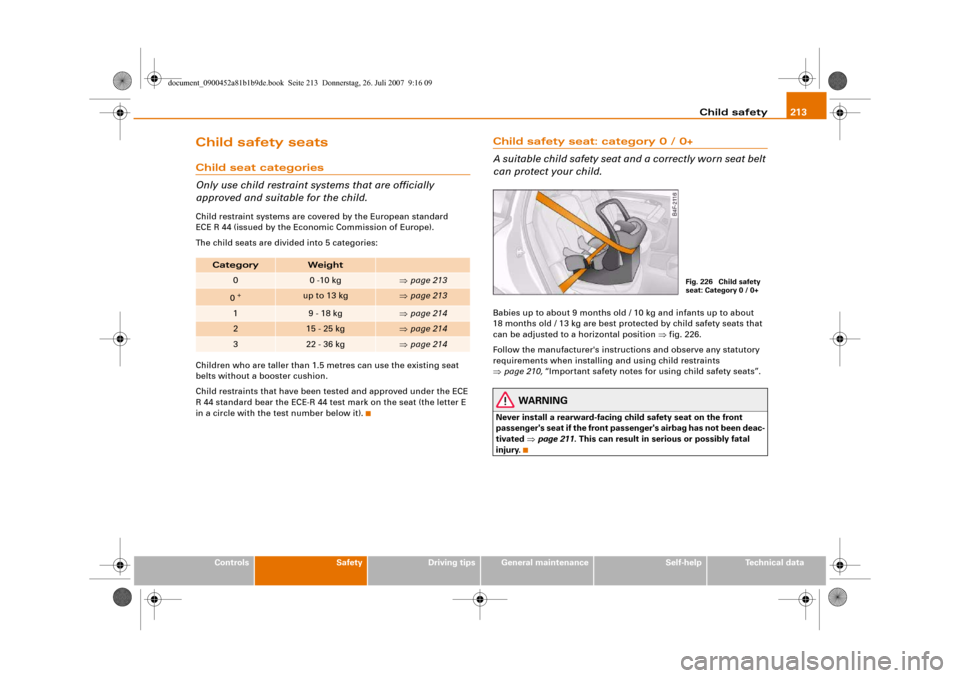
can protect your child.Babies up to about 9 months old / 10 kg and infants up to about
18 months old / 13 kg are best protected by child safety seats that
can be adjusted to a horizontal position ⇒fig. 226.
Follow the manufacturer's instructions and observe any statutory
requirements when installing and using child restraints
⇒page 210, “Important safety notes for using child safety seats”.
WARNING
Never install a rearward-facing child safety seat on the front
passenger's seat if the front passenger's airbag has not been deac-
tivated ⇒page 211. This can result in serious or possibly fatal
injury.
Category
Weight
0
0 -10 kg
⇒page 213
0 +
up to 13 kg
⇒page 213
1
9 - 18 kg
⇒page 214
2
15 - 25 kg
⇒page 214
3
22 - 36 kg
⇒page 214
Fig. 226 Child safety
seat: Category 0 / 0+
document_0900452a81b1b9de.book Seite 213 Donnerstag, 26. Juli 2007 9:16 09
Page 217 of 342
Child safety215
Controls
Safety
Driving tips
General maintenance
Self-help
Technical data
WARNING
The diagonal part of the belt should be positioned roughly over the
centre of the shoulder and fit closely against the upper part of the
body. It must never be allowed to run across the neck. The lap part
of the belt should fit closely over the hips. It must not be posi-
tioned over the stomach. Pull the belt tight if necessary to take up
any slack.
Note
We recommend that you fit child safety seats with backrests.
document_0900452a81b1b9de.book Seite 215 Donnerstag, 26. Juli 2007 9:16 09
Page 219 of 342
Child safety217
Controls
Safety
Driving tips
General maintenance
Self-help
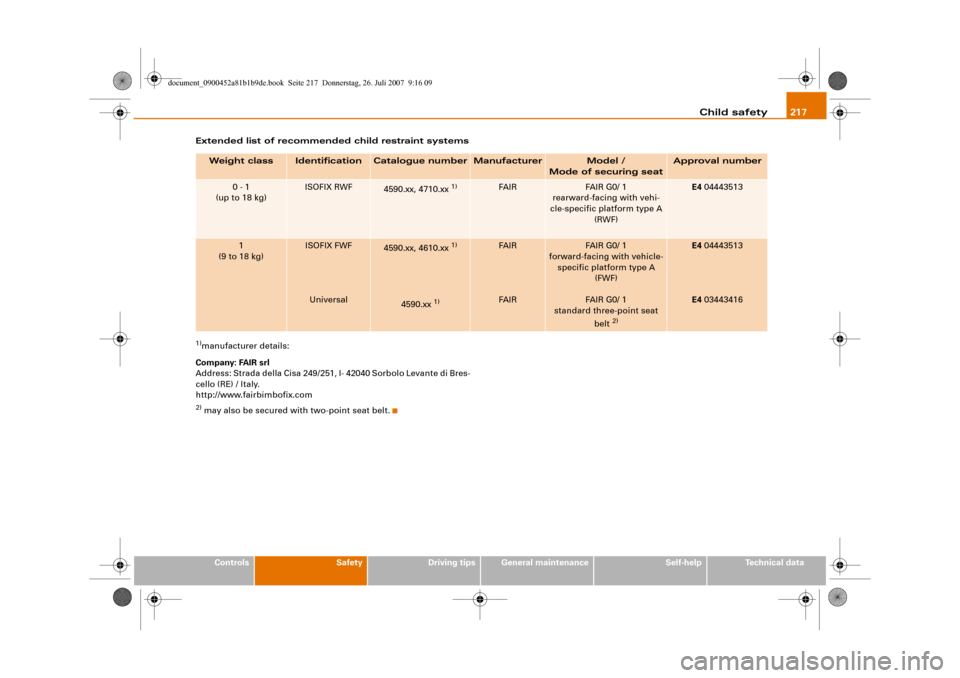
Technical data Extended list of recommended child restraint systems
1)manufacturer details:
Company: FAIR srl
Address: Strada della Cisa 249/251, I- 42040 Sorbolo Levante di Bres-
cello (RE) / Italy.
http://www.fairbimbofix.com2) may also be secured with two-point seat belt.Weight class
Identification
Catalogue number
Manufacturer
Model /
Mode of securing seat
Approval number
0 - 1
(up to 18 kg)
ISOFIX RWF
4590.xx, 4710.xx
1)
FAIR
FAIR G0/ 1
rearward-facing with vehi-
cle-specific platform type A
(RWF)
E4 04443513
1
(9 to 18 kg)
ISOFIX FWF
Universal
4590.xx, 4610.xx
1)
4590.xx
1)
FAIR
FAIR
FAIR G0/ 1
forward-facing with vehicle-
specific platform type A
(FWF)
FAIR G0/ 1
standard three-point seat
belt
2)
E4 04443513
E4 03443416
document_0900452a81b1b9de.book Seite 217 Donnerstag, 26. Juli 2007 9:16 09
Page 221 of 342
Child safety219
Controls
Safety
Driving tips
General maintenance
Self-help
Technical data
– Fit the protective sleeves onto the retainers
between the backrest and the seat cushion ⇒page 218,
fig. 231.
– Push the mountings on the child safety seat into the
protective sleeves until they engage audibly (2x)
⇒page 218, fig. 231.
– Pull on the child safety seat to check whether both
catches have engaged properly.Child safety seats with the “ISOFIX” system can be secured quickly
and safely on the rear seat* or on the front passenger's seat*.
Detailed fitting instructions are supplied with the child safety seat.
Child seats with “ISOFIX” mountings are available from Audi dealers
and specialist retailers.
If required, the “ISOFIX” mounting system can be retrofitted.
WARNING
The retainers used here are specially designed for child safety
seats with “ISOFIX” mountings. Do not attempt to secure other
types of child safety seat, seat belts or other objects with these
retainers – this could result in serious or possibly fatal injury.
AA
AB
document_0900452a81b1b9de.book Seite 219 Donnerstag, 26. Juli 2007 9:16 09
Page 225 of 342
Intelligent technology223
Controls
Safety
Driving tips
General maintenance
Self-help
Technical data
Note
•
To ensure that the ASR works properly, all four wheels must be
fitted with identical tyres. Any differences in the rolling radius of the
tyres can cause the system to reduce engine power when this is not
desired.
•
Should a malfunction occur in the ABS or EDL, both the ABS
warning lamp
and the ESP warning lamp
⇒page 19 will light
up.
•
In the event of a malfunction in the ESP system, the warning
lamp ⇒page 17 will light up.
•
If a malfunction should occur in the ABS, the ESP, EDL and ASR
will also be out of action.
•
The systems can make noises when they intervene.
Switching on and off
The ESP is switched on automatically when the engine is
started.
Switching off the traction control system (ASR)
In particular circumstances, it may be advisable to switch off the
traction control system (ASR) to allow a certain amount of wheel
slip. For example:•
Rocking the car backwards and forwards to free it
•
Driving in deep snow or on loose surfaces
•
Driving with snow chains
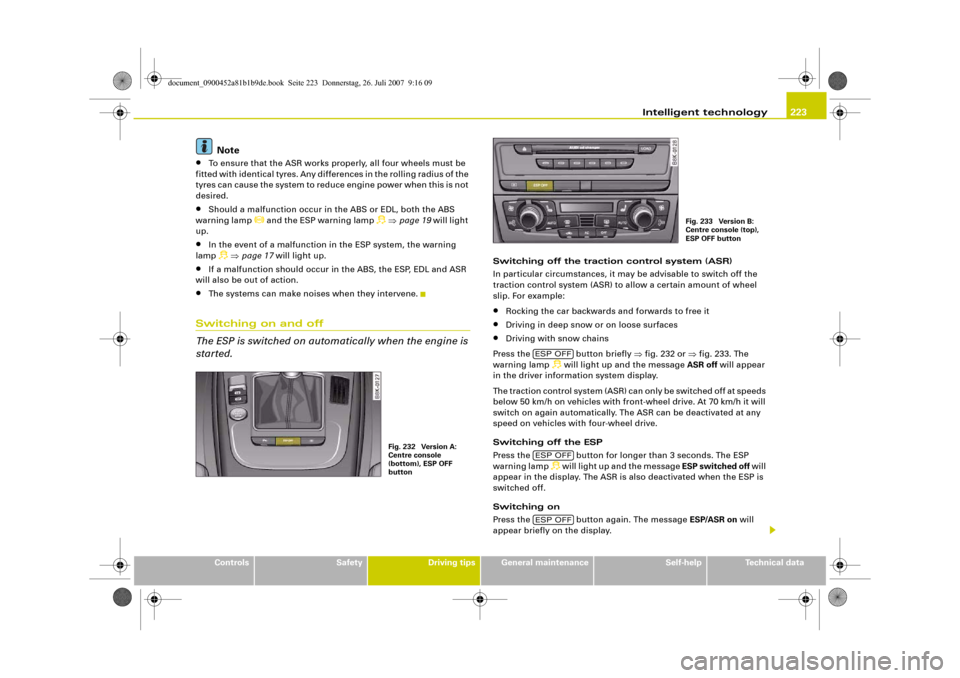
Press the button briefly ⇒fig. 232 or ⇒fig. 233. The
warning lamp
will light up and the message ASR off will appear
in the driver information system display.
The traction control system (ASR) can only be switched off at speeds
below 50 km/h on vehicles with front-wheel drive. At 70 km/h it will
switch on again automatically. The ASR can be deactivated at any
speed on vehicles with four-wheel drive.
Switching off the ESP
Press the button for longer than 3 seconds. The ESP
warning lamp will light up and the message ESP switched off will
appear in the display. The ASR is also deactivated when the ESP is
switched off.
Switching on
Press the button again. The message ESP/ASR on will
appear briefly on the display.
Fig. 232 Version A:
Centre console
(bottom), ESP OFF
button
Fig. 233 Version B:
Centre console (top),
ESP OFF button
ESP OFFESP OFFESP OFF
document_0900452a81b1b9de.book Seite 223 Donnerstag, 26. Juli 2007 9:16 09
Page 227 of 342
Intelligent technology225
Controls
Safety
Driving tips
General maintenance
Self-help
Technical data
WARNING
•
When applying the brakes to clean off deposits on the pads and
discs, select a clear, dry road. Be sure not to inconvenience or
endanger other road users; do not risk an accident.
•
Never let the car coast with the engine switched off (this can
cause accidents).Caution
•
Never let the brakes “drag” by leaving your foot on the pedal
when you do not really intend to brake. This overheats the brakes,
resulting in longer stopping distances and greater wear.
•
Before driving down a long, steep gradient, it is advisable to
reduce speed and move the selector lever to a lower gear. In this
way you will make use of the engine braking effect and relieve the
load on the brakes. If you still have to use the brakes, it is better to
brake firmly at intervals than to apply the brakes continuously.Note
•
If the brake servo is out of action due to a malfunction, or if the
car has to be towed, you will have to press the brake pedal consid-
erably harder to make up for the lack of servo assistance.
•
If you wish to equip the car with accessories such as a front
spoiler or wheel covers, it is important that the flow of air to the
front wheels is not obstructed, otherwise the brakes can overheat.
Power steering (servotronic)The power steering assists the driver when turning the
steering wheel (with the engine running).The power steering assists the driver by reducing the force needed
to turn the steering wheel. The degree of power assistance is
adapted electronically, depending on the speed.If a fault should occur in the servotronic system the power steering
will still operate. The degree of power assistance will, however, no
longer adapt to different speeds. If the electronic regulating system
is not working properly, this is most noticeable when turning the
steering wheel at low speeds (for instance when parking) – more
effort will be required than usual. The fault should be corrected by
a qualified workshop as soon as possible.
The power steering does not function when the engine is switched
off. In this case the steering wheel is very hard to turn.
If the steering is held at its turning limit when the car is stationary,
this will place an excessive load on the power steering system. In
this case, the power steering system will make noises. It will also
reduce the idling speed of the engine.
Caution
Do not keep the steering in the full-lock position for longer than
15 seconds when the engine is running – this could cause damage
to the power steering system.
Note
•
If the power steering should fail at any time or the engine is
switched off (for instance when being towed), the car can still be
steered. However, more effort will be required to turn the steering
wheel.
•
If the system is leaking or malfunctioning, please take the car to
a qualified workshop as soon as possible.
•
The power steering requires a special hydraulic fluid. The fluid
reservoir is located at the front of the engine compartment on the
left ⇒page 256. The correct fluid level in the reservoir is important
for the power steering to function properly. The hydraulic fluid level
is checked at the Inspection Service.
document_0900452a81b1b9de.book Seite 225 Donnerstag, 26. Juli 2007 9:16 09
Page 228 of 342
Intelligent technology 226Applies to vehicles: with four-wheel driveFour-wheel drive (quattro
®)
On quattro models the engine power is distributed to all
four wheelsGeneral notes
On four-wheel drive vehicles, the engine power is distributed to all
four wheels. The distribution of power is controlled automatically
according to your driving style and the road conditions. Also refer
to ⇒page 222, “Description”.
The four-wheel drive is specially designed to complement the supe-
rior engine power of your Audi. This combination gives the car
exceptional handling and performance capabilities – both on
normal roads and in more difficult conditions, such as snow and ice.
Even so (or perhaps especially for this reason), it is important to
observe certain safety points ⇒.
Winter tyres
Thanks to its four-wheel drive, your car will have plenty of traction
in winter conditions, even with the standard tyres. Nevertheless, we
still recommend that winter tyres or all-season tyres should be fitted
on all four wheels when winter road conditions are expected, mainly
because this will give a better braking response.
Snow chains
On roads where snow chains are mandatory, this also applies to cars
with four-wheel drive ⇒page 273, “Snow chains”.
Replacing tyres
On vehicles with four-wheel drive, all four tyres must have the same
rolling circumference. Also avoid using tyres with varying tread
depths ⇒page 270, “Replacing wheels and tyres”.Off-roader?
Your Audi does not have enough ground clearance to be used as an
off-road vehicle. It is therefore best to avoid rough tracks and
uneven terrain as much as possible.
WARNING
•
Even with four-wheel drive, you should always adjust your
speed to suit the conditions. Do not let the extra safety provided
tempt you into taking any risks when driving – this can cause acci-
dents.
•
The braking ability of your car is limited by the grip of the tyres.
In this respect, your car is no different from a car without four-
wheel drive. So do not be tempted to drive too fast on icy or slip-
pery roads just because the car still has good acceleration in these
conditions (accident risk).
•
On wet roads bear in mind that the front wheels may start to
“aquaplane” and lose contact with the road if the car is driven too
fast. If this should happen, there will be no sudden increase in
engine speed to warn the driver, as with a front-wheel drive car. So
do not drive too fast in the wet: adjust your speed to suit the
conditions (accident risk).
Power managementThis system helps to ensure reliable starting
The power management controls the distribution of elec-
trical energy and thus helps to ensure that there is always
enough power available to start the engine.If a vehicle with a conventional electrical system is left parked for a
long time, the battery will gradually lose its charge because certain
electrical equipment (such as the immobiliser) continues to draw
document_0900452a81b1b9de.book Seite 226 Donnerstag, 26. Juli 2007 9:16 09
Page 229 of 342
Intelligent technology227
Controls
Safety
Driving tips
General maintenance
Self-help
Technical data current even when the ignition is off. In some cases there may not
be enough power available to start the engine.
Your vehicle is equipped with an intelligent power management
system to control the distribution of electrical energy. This signifi-
cantly improves reliability when starting the engine, and also
prolongs the life of the battery.
The main functions incorporated in the power management system
are battery diagnosis, residual current management and dynamic
power management.
Battery diagnosis
The battery diagnosis function constantly registers the condition of
the battery. Sensors detect the battery voltage, battery current and
battery temperature. This enables the system to calculate the
current power level and charge condition of the battery.
Residual current management
The residual current management reduces power consumption
while the vehicle is parked. It controls the supply of power to the
various electrical components while the ignition is switched off. The
system takes the battery diagnosis data into consideration.
Depending on the power level of the battery, the individual electrical
components are switched off one after the other to prevent the
battery from losing too much charge and to ensure that the engine
can be started reliably.
Dynamic power management
While the vehicle is moving, this function distributes the available
power to the various electrical components and systems according
to their requirements. The power management ensures that on-
board systems do not consume more electrical power than the
alternator can supply, and thus maintains the maximum possible
battery power level.
Note
•
The power management system is not able to overcome the
given physical limits. Please remember that the power and life of
the battery are limited.
•
A warning message will appear ⇒page 228, “Driver message in
the instrument cluster display” if the battery power has dropped to
a level where reliable starting is impaired.
Points to remember
Starting ability has first priority.Short trips, city traffic and low temperatures all place a heavy load
on the battery. In these conditions a large amount of power is
consumed, but only a small amount is supplied. The situation is also
critical if electrical equipment is in use when the engine is not
running. In this case power is consumed when none is being gener-
ated.
In these situations you will be aware that the power management
system is intervening to control the distribution of electrical power.
When the vehicle is parked for long periods
If you do not drive your vehicle for a period of several days or weeks,
the power management will gradually shut off the on-board
systems one by one, or reduce the amount of current they are using.
This limits the amount of power consumed and helps to ensure reli-
able starting even after a long period.
Please note that certain convenience features, such as the Audi
advanced key*, the remote control key or the electrical seat adjust-
ment may not be available when you unlock the vehicle. These func-
tions will be restored when you switch on the ignition and start the
engine.
document_0900452a81b1b9de.book Seite 227 Donnerstag, 26. Juli 2007 9:16 09