2008 AUDI A4 AVANT tow
[x] Cancel search: towPage 110 of 368

___ S_ e
_ a_t_s _ a_n_ d
__ s _t _o _r_a ...::g==---- e ________________________________________________ _
Fastening eyes
The luggage compartment is equipped with four tie-down
eyelets to secure luggage and other items.
Fig. 109 Luggage
compartment:
fastening eyes
Use the fastening eyes to secure your cargo properly
~ fig. 109 -arrows-.
Adhere to all safety
instructions ~ page 173, "Stowing
luggage".
In a collision, the laws of physics mean that even smaller items that
are loose in the vehicle will become heavy missiles that can cause
serious injury. Items in the vehicle possess energy which vary with
vehicle and the weight of the item . The vehicle speed is the most
significant factor.
For example, in a frontal collision at a speed of 30 mph (48 km/hl,
the forces acting on a 10 lbs (4,5 kg) object are about 20 times the
normal weight of the item. This means that the weight of the item
would suddenly be about 200 lbs (90 kgl. You can imagine the inju
ries that a 200 lbs (90 kg) item flying freely through the passenger
compartment could cause in a collision like this.
& WARNING
Weak, damaged or improper straps used to secure items to
fastening eyes can fail during hard braking or in a collision and cause serious personal injury .
• Always use suitable mounting straps and properly secure
items to the fastening eyes in the luggage compartment to help
prevent items from shifting or flying forward.
• When the rear seat backrest is folded down, always use suit
able mounting straps and properly secure items to the fastening
eyes in the luggage compartment to help prevent items from flying
forward into the passenger compartment.
• Never attach a child safety seat tether strap to a fastening
eye. •
Applies to vehicles : w ith cargo net
Elastic cargo net
The cargo net prevents light objects from sliding around
in the luggage compartment.
Fig . 110 Luggage
compartment: cargo
net .,_
Page 112 of 368

___ S_ e
_ a_t_s _ a_n_ d
__ s _t _o _r_a ...::g==---- e ________________________________________________ _
& WARNING
Fo r st rength -related r easons, th e partition net can o nly be us ed to
s ecure object s weigh ing 10 lb (5 kg ) or le ss. Heavier objects will
not be adequ atel y sec ured -risk of i njury ! •
Retractable luggage compartment cover
The luggage comp artment cover keeps luggage or other
objects out of view.
Pulling out
Fi g. 113 Lugga ge
co mp art m ent:
co mp artm ent c over
c lo se d
- Use t he hand le @ ~ fig. 11 3 to pull the rolled- up cover
toward the rear of t he veh icle in a steady mot ion.
- Secure the en ds of the crossbar in the o penings in the
s ide tr im panels on the right and left
sides ~ fig. 113
-arrows-.
Rolling up th e cov er
- Pull the crossbar out of the ope nings in the side trim
panels.
- Allow the cover to roll up
slowly.
Removing /insta lling luggage compartment cover/partition net
~ page 111.
& WARNING
Whenev er dri vin g, ne ver pl ace any h ard or heavy ob ject s on th e
luggage comp art m ent or allow p ets to sit on the luggage compart
m ent c over. They could become a hazar d to vehic le occupant s in
the e vent of sudden bra king or in an a ccident.
0 Note
Make sure that the heating/ antenna wires in th e rear lid do no t get
damaged by objects scraping against them.
[ i ] Tips
• You can use the luggage compartment cover to store light
weight clothing or ar ticles bu t do not leave any heavy or sharp
objects in the pockets of the clothing .
• Remember that placing c lothing or articl es on the luggage
compartment cover can block the driver 's vis ion in the rear view
mirror. This also applies especially when you have to transport larg e
objects .
• So that sta le air can escap e from the vehicle b e sure not to cov er
the venti lation slot between the rear lid and the luggage compart
men t cov er ins talled. •
Page 114 of 368

-
Seats and storag e
----=---------------
Removing luggage compartment
cover /partition net
- Ope n the right rea r door.
- Fo ld the se at backs down
~ page 104 .
Fig . 116 Inst alling
luggage comp art m ent
c o ver /p arti tion n et
- Pull the partition net in the direction ind icated by the
arrow~ page 111, fig. 115 and lift it out of the retaining
rails .
Installing luggag e comp artment cover /part ition
n et
- Open the right rea r door .
- F old th e seat backs down
~ page 104 .
- Position the pa rtition net @ on the seat back s o that the
brackets @ are located in fron t of the retai ning ra ils ©
~fig .116.
- Slide the luggage compa rtme nt cove r/partit io n net
toward the left side of the vehicle until it cannot travel
any furt her. •
Applies to vehi cles: w ith attach men t hoo ks
Attachment hooks
You can use the attachment hooks to secure relatively
li g ht items.
Fig. 117 Lugg ag e
c omp artment cove r:
atta chm ent hook s
Secure the cargo net* in the outer attachment hooks~ page 108.
If you are not using the hooks to secure the cover net, you can use
a ll three of them to secure re latively l ight luggage items (purses,
bags,
etc.l.
Addi tiona l hooks for securing relat ively ligh t luggage items may be
located in on the side trim pane ls below the mounting holes for the
luggage compar tment cover .
& WARNING
For str ength -r e lated rea son s, the atta chment hooks must not be
s ubje cted to lo ads greater th an 10 lb . (5 kg l. Hea vier obje cts will
not be adequately sec ured -risk of injury! •
Page 115 of 368

Seats and storage -______________ __,:_____.
Applies to vehi cles: with protect ive li ner
Protective liner
The protective liner should be used for carrying dirty or
wet objects.
Fig . 118 Cargo floor:
folded upright
Fig . 119 Removing the
cargo floor
The space for stowing the protective liner can be enlarged
by folding the entire cargo floor all the way forward or
removing the entire cargo floor.
Controls and equip
ment
Putting the cargo floor in the upright position
-Open the rear lid.
-Holding the handle@~ fig. 118, tip the cargo floor
cover @ up, and align the outer edges in the recesses
®·
-Place the objects to be transported in the protective liner.
Folding the cargo floor forward
-Open the rear lid.
-Grasp the handle@~ fig. 118 and fold the cargo floor
forward all the way to the seat back .
-Secure the attachment eye located in the middle of the
cargo floor in the center hook provided for the compart
ment cover/ partition net.
Removing the cargo floor
-Open the rear lid.
-Grasp the handle @~ fig. 118 and fold the cargo floor
forward all the way to the seat back.
-Pull the entire cargo floor rearward out of the brackets @
~ fig. 119.
You can also store small objects below the cargo floor cover @
=> fig. 118.
& WARNING
When the cargo floor is folded upright, the items being trans
ported must not exceed the maximum cargo height, 2/3 of the
cargo floor space with the floor folded forward, or a weight of
about 15 lb.
(7 . 5 kg).
irechnical data
Page 117 of 368

Seats and storage -______________ __,:_____.
Fig. 123 Ski sack:
securing
Load the ski sack from the luggage compartment.
Loading
- Open the rear lid and clear a space in the center.
- Press the button (arrow)
~ page 114, fig. 122 on the
hatch cover to release the cover from the seatback back
panel.
- Inside the passenger compartment, fold the armrest out
of the rear seatback.
- Reach into the recess, release and open the inner hatch
cover .
- Pull out and unfold the ski sack.
- Load skis or similar objects through the luggage
compartment into the interior of the
vehicle~ &.
Securing
-Insert the ski sack strap @~ fig. 123 in the center buckle
®·
Controls and equip
ment
- Pull the lose belt end until the belt sits tight@.
Stowing
- In the luggage compartment, close the ski sack hatch
cover.
- Inside the passenger compartment, fold the ski sack up
neat and tight.
- Close and engage the inner hatch cover.
You can now fold the armrest back into the rear seatback.
& WARNING
• The ski sack is intended only for the transportation of skis and
other light objects. To reduce the risk of serious personal injury
never transport heavy or pointed objects in the ski sack.
• When braking rapidly or during an accident the load could be
displaced and cause injury to occupants.
• Sharp edges on the load must be covered for protection.
Always fasten the belt tightly around the sack and its contents
~ fig. 123.
[ i] Tips
Never stow the ski sack away if it's wet or damp (for example, snow
melting from skis). Let it dry completely before you stow it away. •
irechnical data
Page 136 of 368

___ O_ n_ t
_ h_ e_ ro_ a_d __________________________________________________ _
On the road
Steering
Adjusting the steering wheel column
The height and reach of the steering wheel can be
adjusted.
Fig . 142 Lever under
the steering column
First, adjust the driver's seat correctly.
- Push the
lever => fig. 142 -Arrow- =>& .
Move the steering wheel to the desired position.
- Push the lever against the steering column unt il it locks.
There must be at least 10 inches (25 cm) between your breastbone
and the center of the steering wheel. If you cannot sit more than 10
inches (25 cm) from the steering wheel,
we recommend that you
investigate whether adaptive equipment is available to help you
reach the pedals and increase your seating distance from the
steering wheel. For detailed information on how to adjust the driver's seat, see
=> page 97, "Power seat adjustment"
.
& WARNING
Improper use of steering wheel adjustment and improper seating
position can cause serious personal injury .
• Adjust the steering wheel column only when the vehicle is not
moving to prevent loss of vehicle control.
• Always make sure that the adjustment lever is securely pushed
up so that the position of the steering wheel cannot be changed
unintentionally when the vehicle is moving.
• Adjust the driver's seat or steering wheel so that there is a
minimum of 10 inches (25 cm) between your breastbone and the
steering
wheel ~ page 168, fig. 162. If you cannot maintain this
minimum distance the airbag system cannot protect you properly.
• If physical limitations prevent you from sitting 10 inches (25
cm) or more from the steering wheel, check with your authorized
Audi dealer to see if adaptive equipment is available.
• Pointing the steering wheel toward your face decreases the
ability of the supplemental driver's airbag to protect you in an
accident. Always make sure that the steering wheel is pointed
towards your chest .
• Always hold the steering wheel on the outside of the steering
wheel rim with your hands at the 9 o'clock and 3 o'clock positions
to help reduce the risk of personal injury if the driver's airbag inflates.
• Never hold the steering wheel at the 12 o'clock position or with
your hands at other positions inside the steering wheel rim or on
the steering wheel hub. Holding the steering wheel the wrong way
can cause serious injuries to the hands, arms and head if the
driver's airbag inflates.
•
Page 138 of 368

___ o_ n_ t_h _e _ r_o _a_ d __________________________________________________ _
temporarily interrupted to conserve battery power. After the engine
has started, release the key and it will return to position
0-
Before the starter can be operated again the key must be turned
back to position
G) . The non-repeat lock prevents you from
damaging the starter when the engine is running.
_& WARNING
• Never remove the key from the ignition lock while the vehicle is
moving. The steering wheel will lock causing loss of control.
• If you have to leave your vehicle-even for just a minute- always
remove the ignition key and take it with you. This is especially
important if you are going to leave children behind in the vehicle.
The children could start the engine or use other vehicle controls.
Unsupervised use of vehicle controls (for example, power
windows) can cause serious personal injuries.
[ i] Tips
If the vehicle battery has been disconnected and then reconnected,
then you must leave the key in position
0 for about 5 seconds
before you can start the engine. •
Ignition key safety lock
The ignition key can only be removed when the selector
lever is in the
"P" (Park) position.
After switching off the ignition, the ignition key can only be
removed from the ignition lock when the selector lever is in the
"P"
(Park) position. After you have removed the key, the selector lever is
locked and cannot be moved. •
Starting and stopping the engine
Starting the engine
The engine can only be started with your original Audi
key.
-Set the parking brake.
-Move the selector lever to the neutral position (automatic
transmission: selector lever in P or N)
=> & .
-On vehicles with manual transmission, fully depress the
clutch pedal.
-Turn the ignition key to position 0 => page 135, fig. 143
- do not depress the gas pedal when starting the engine!
-Let go of the key as soon as the engine starts.
A cold engine may at first be loud after it has been started. This is
due to the hydraulic valves building up the oil pressure . This is
normal and no need for concern.
If the engine does not start immediately, stop trying after 10
seconds and then try to restart the engine about 30 seconds later.
What to do if the engine does not start
• ~ page 330
• ~ page 332, "Emergency towing with commercial tow truck"
_& WARNING
Never start or let the engine run in a confined or enclosed area.
Exhaust fumes from the engine contain carbon monoxide, a color
less and odorless gas. Carbon monoxide can be fatal if inhaled.
• Never leave the engine idling unattended. An unattended
vehicle with a running engine poses a danger of personal injury or
theft.
~
Page 139 of 368
_________________________________________________ O_ n_ t_h _e _ ro_ a_d _ __._
0 Note
• Avo id high eng ine speeds, fast acceleration or heavy e ngine
loads while the engine is still cold . This could damage the engine!
• The engine cannot be started by pushing or towing the vehic le.
ffi For the sake of the environment
To avoid unnecessary e ngine wear and to reduce exhaust emis
sions, do not let your vehic le stand and warm up. Be ready to drive
o ff immediate ly aft er starting your vehicle. Mai ntain mode rate
speed until the engine is completely warm. R emember, the engine
per forms bes t at opera ting temperature .•
Stopping the engine
- Tur n t he ignitio n ke y t o posit io n G) => page 135 , fig. 14 3.
& WARNING
• Nev er turn off the engine until the vehicle has come to a
complete stop.
• The brake boo ster and servotronic only work when the engine
is running . With the ignition turned off , you have to app ly more
force when steering or braking . Since you cannot steer and stop
normally, th is can lead to accidents and seriou s injurie s.
• The radiator fan can continue to run for up to 10 minutes even
afte r you have turned off the engine and removed the ignition key .
The radiator fan can also turn on again if the engine coolant heats
up because of intense sunlight or heat build-up in the engine
c ompartment.
Controls and equip
ment
0 Note
Do not stop the e ng ine immed iately after hard or extended drivin g.
Keep the engine running for appro ximate ly two minutes to prevent
e xcessive heat build -up. •
Parking brake
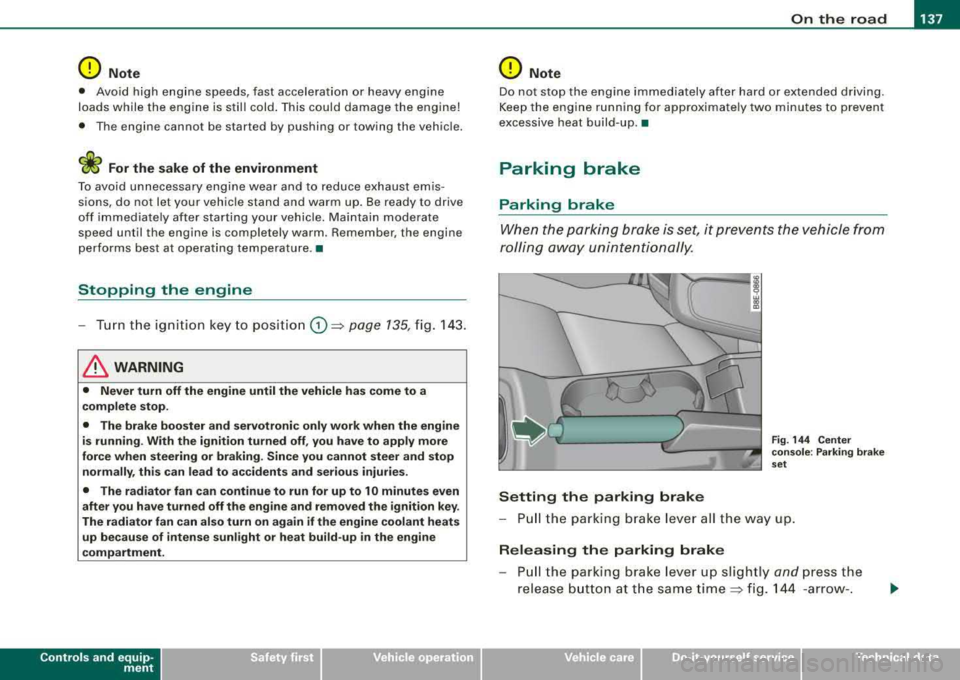
Parking brake
When the parkin g brake is set , it prevents the vehicle from
rolling aw ay unin tentionally.
Setting the parking brake
Fig . 144 Cent er
co nso le : P ark ing bra ke
set
- Pull the p arking brak e lever all the way up.
Releasing the parking brake
Pull t he pa rkin g brake lever up sligh tly and press the
release butto n at th e s ame tim e::::> fig . 144 -ar row- .
irechnical data