Page 5 of 163
8
Familiarisation
INTERIOR
Instruments and controls
1. Fuse box.
2. Programmable heating.
3. Cruise control switch.
4. MODE, configuration and
personalisation/lighting rheostat/
headlamp beam height adjustment.
5. Lights and direction indicators control.
6. Instrument panel with display.
7. Wipers/wash-wipe/trip computer
controls.
8. Ignition switch.
9. Driver's air bag/horn.
Page 12 of 163
4221
FAMILIARISATION
15
Familiarisation
MONITOR
Instrument panel Warning lights
A. Speedometer.
B. Instrument panel display.
C. Rev counter.
With the ignition on, the orange and red
warning lights come on.
With the engine running, these warning
lights should switch off.
If warning lights remain on, refer to the
chapter concerned.
26 27
Reversing camera
The camera comes on when you engage
reverse gear and remains active up to
approximately 9 mph (15 km/h). It is
deactivated above 11 mph (18 km/h).
Screen
Press the button and place the screen in the
required position.
Buttons
Brightness adjustment.
Back-lighting adjustment.
ON/OFF provides views of the rear
without engaging reverse gear.
76
Page 13 of 163
542
16
Familiarisation
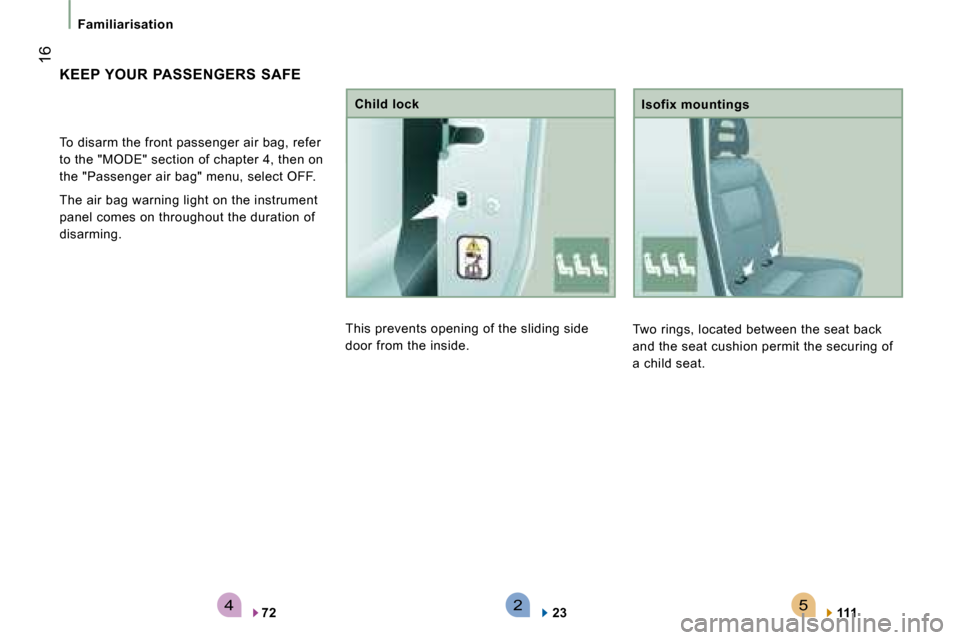
Child lock
This prevents opening of the sliding side
door from the inside. Two rings, located between the seat back
and the seat cushion permit the securing of
a child seat.
Isofix mountings
23 111
KEEP YOUR PASSENGERS SAFE
72
To disarm the front passenger air bag, refer
to the "MODE" section of chapter 4, then on
the "Passenger air bag" menu, select OFF.
The air bag warning light on the instrument
panel comes on throughout the duration of
disarming.
Page 14 of 163
4321
FAMILIARISATION
17
Familiarisation
Cruise control
The cruise control is displayed on the
instrument panel by a warning light located
in the rev counter.
43
Hill start assistance
This function, linked with the ESP, makes
hill starts easier and is activated in the
following conditions:
- the vehicle must be stationary, with the
engine running,
- the gradient of the road must be higher
than 5 %.
38
Pneumatic suspension
This equipment allows you to alter the
height of the rear sill to make loading or
unloading easier.
Press the control, release to stop the
movement. Each press increases by one
level: +1 to +3.
Press the control, release to stop the
movement. Each press decreases by one
level: -1 to -3.
Driving with the sill too high or too low may
damage the components under the body.
78
Function deactivated.
Function selected.
DRIVE SAFELY
Page 23 of 163
26
Instruments and controls
INSTRUMENT PANEL
1. Distance recorder in kilometres/miles.
2. Display.
3. Dials and gauges.
4. Rev counter.
INSTRUMENTS AND CONTROLS
Instrument panel display 1
- Time,
- Kilometres/Miles travelled,
- Range,
- Consumption,
- Average speed,
- Headlamp beam height,
- Programmable overspeed warning via MODE,
- Service indicator. Instrument panel display 2
- Time,
- Date,
- Exterior temperature,
- Kilometres/Miles travelled,
- Range,
- Consumption,
- Average speed,
- Headlamp beam height,
- Programmable overspeed warning via
MODE,
- Service indicator,
- Warning messages displayed in the top section,
- Radio (frequency of the current station).
Page 30 of 163
33
2
READY TO SET OFF
Instruments and controls
Display displays indicates Solution - action
Temperature/Ice
the ice warning,
the temperature
flashing
accompanied by
a message on
the display. weather conditions which could
result in ice on the road.
Be particularly vigilant and do not brake sharply.
Refer to the "Driving Safety" section of chapter 5" .
Date 11:00:00 a setting: of
the Date. of the
Time. a configuration via the MODE
menu.
Refer to the "Mode" section of chapter 4.
Headlamp beam
height a headlamp
height setting. A position from 0 to 3 depending
on the load carried Adjust using the control on the fascia panel. Refe
r to
the "Steering wheel controls" section of chapter 3.
Service spanner a service
spanner which
remains lit. that a service will soon be due.
Refer to the list of checks in the servicing boo
klet. Have
the service carried out by a CITROËN dealer.
Page 31 of 163

34
Instruments and controls
FUEL GAUGE
The fuel level is tested each time the key is
turned to the "running" position.
The gauge is positioned on:
- F (Full): the fuel tank is full,
approximately 90 litres.
- E (Empty): the reserve is now being
used, the warning light comes on
continuously.
The reserve when the warning first comes
on is approximately 11 litres.
Fuel tanks of different capacities (60 and
125 litres) are available as an option. COOLANT TEMPERATURE
The needle is positioned between C
(Cold) and H (Hot): normal operation.
In arduous conditions of use or hot climatic
conditions, the needle may move close to
the red graduations. - wait for the engine to cool down in
order to check the level and top it up if
necessary. Follow this advice:
the cooling system is pressurised. In order to
avoid any risk of scalding, unscrew the cap
by two turns to allow the pressure to drop.
When the pressure has dropped, check the
level and remove the cap to top up.
If the needle remains in the red zone,
contact a CITROËN dealer.
Refer to the "Levels" section of
chapter 7.
Refer to the "Fuel" section of chapter 7.
What you should do if the needle enters the
red zone, or if the warning light comes on:
- stop immediately, switch off the ignition. The fan may continue to operate for
a certain time up to approximately
10 minutes. EMISSION CONTROL
EOBD (European On Board Diagnosis) is
a diagnostics system which complies with,
among others, the standards concerning
authorised emissions of:
- CO (carbon monoxide),
- HC (unburnt hydrocarbons),
- NOx (nitrogen oxides) or particles,
detected by oxygen sensors placed
upstream and downstream of the
catalytic converters.
Therefore, the driver is warned of
any malfunction of this emission
control system by the lighting of
this specifi c warning light on the
instrument panel.
There is a risk of damage to the catalytic
converter. Have it checked by a CITROËN
dealer.
Page 32 of 163

35
2
READY TO SET OFF
Instruments and controls
SERVICE INDICATOR
For a few seconds after the ignition is
switched on, the spanner symbolising the
service indicator comes on: the display
informs you when the next service is due,
in accordance with the "Manufacturer ’s"
servicing schedule indicated in the servicing
booklet. This information is determined in
relation to the distance travelled since the
previous service.
LIGHTING RHEOSTAT
The rheostat is active when the lights are on.
Refer to the list of checks in the
servicing booklet which was given to
you on delivery of the vehicle.
After a few seconds, the display returns to
its usual functions. Use these controls to adjust the
brightness of the instrument
panel.
There are 8 setting levels.
Deterioration of the engine oil (100 and 120 bhp engines)
"Oil Life" or "Suit in Oil" function: your
vehicle’s service interval is 24,000 miles
(40,000 km), in normal use.
However, the engine control unit tests the
degree of wear of the engine oil.
If your vehicle is used in arduous conditions
and consequently suffers engine oil wear.
And if your vehicle is fitted with
this equipment, you are warned
by flashing of the engine oil
pressure warning light and the
displaying of a message on the instrument
panel each time the vehicle is started.
In this case, your vehicle must be
serviced as soon as possible.