Page 620 of 650

7 - 10
TUN
Examples of carburetor setting depending on symptom
This should be taken simply for an example. It is necessary to set the carburetor while checking
the operating conditions of the engine.
Symptom Setting Checking
At full throttle
Hard breathing
Shearing noise
Whitish spark plug
Lean mixtureIncrease main jet calibration no.
(Gradually)
Discoloration of spark plug
→
If tan color, it is in good condition.
If cannot be corrected:
Clogged float valve seat
Clogged fuel hose
Clogged fuel cock
Check that the accelerator pump
operates smoothly.
At full throttle
Speed pick-up stops
Slow speed pick-up
Slow response
Sooty spark plug
Rich mixtureDecrease main jet calibration no.
(Gradually)
Discoloration of spark plug
→
If tan color, it is in good condition.
If cannot be corrected:
Clogged air cleaner
Fuel overflow from carburetor
Lean mixture Lower jet needle clip position.
(1 groove down)
The clip position is the jet needle
groove on which the clip is installed.
The positions are numbered from the
top.
Check that the accelerator pump oper-
ates smoothly (except for rich mixture
symptom). Rich mixture Raise jet needle clip position.
(1 groove up)
1/4 ~ 3/4 throttle
Hard breathing
Lack of speedLower jet needle clip position.
(1 groove down)
1/4 ~ 1/2 throttle
Slow speed pick-up
Poor accelerationRaise jet needle clip position.
(1 groove up)
Closed to 1/4 throttle
Hard breathing
Speed downUse jet needle with a smaller diame-
ter.Slow-speed-circuit passage
Clogged
→ Clean.
Overflow from carburetor
Closed to 1/4 throttle
Poor accelerationUse jet needle with a larger diameter.
Raise jet needle clip position. (1
groove up)
Poor response in the low to
intermediate speedsRaise jet needle clip position.
If this has no effect, lower the jet nee-
dle clip position.
Poor response when throt-
tle is opened quicklyCheck overall settings.
Use main jet with a lower calibration
no.
Raise jet needle clip position.
(1 groove up)
If these have no effect, use a main jet
with a higher calibration no. and lower
the jet needle clip position.Check air cleaner for fouling.
Check that the accelerator pump
operates smoothly.
Jet needleClip
Groove 7 Groove 6
Groove 5
Groove 4
Groove 3
Groove 2
Groove 1
Leaner
↑
(Standard)
↓
Richer
*
SETTING
Page 624 of 650

7 - 11
TUN
EC720000
CHASSIS
EC71P002
Selection of the secondary reduction ratio
(Sprocket)
reduction ratio>
•It is generally said that the secondary gear
ratio should be reduced for a longer straight
portion of a speed course and should be
increased for a course with many corners.
Actually, however, as the speed depends on
the ground condition of the day of the race,
be sure to run through the circuit to set the
machine suitable for the entire course.
•In actuality, it is very difficult to achieve set-
tings suitable for the entire course and some
settings may be sacrificed. Thus, the settings
should be matched to the portion of the
course that has the greatest effect on the
race result. In such a case, run through the
entire course while making notes of lap times
to find the best balance; then, determine the
secondary reduction ratio.
•If a course has a long straight portion where
a machine can run at maximum speed, the
machine is generally set such that it can
develop its maximum revolutions toward the
end of the straight line, with care taken to
avoid the engine over-revving.
NOTE:
Riding technique varies from rider to rider and
the performance of a machine also vary from
machine to machine. Therefore, do not imitate
other rider’s settings from the beginning but
choose your own setting according to the level
of your riding technique. Secondary
reduction
ratio=Number of driven sprocket teeth
Number of drive sprocket teeth
Standard secondary
reduction ratio49/13 (3.769)
SETTING
Page 628 of 650
7 - 13
TUNSETTING
EC722011
Front fork setting
The front fork setting should be made depend-
ing on the rider’s feeling of an actual run and
the circuit conditions.
The front fork setting includes the following
three factors:
1. Setting of air spring characteristics
•Change the fork oil amount.
2. Setting of spring preload
•Change the spring.
3. Setting of damping force
•Change the compression damping.
•Change the rebound damping.
The spring acts on the load and the
damping force acts on the cushion travel
speed.
EC723001
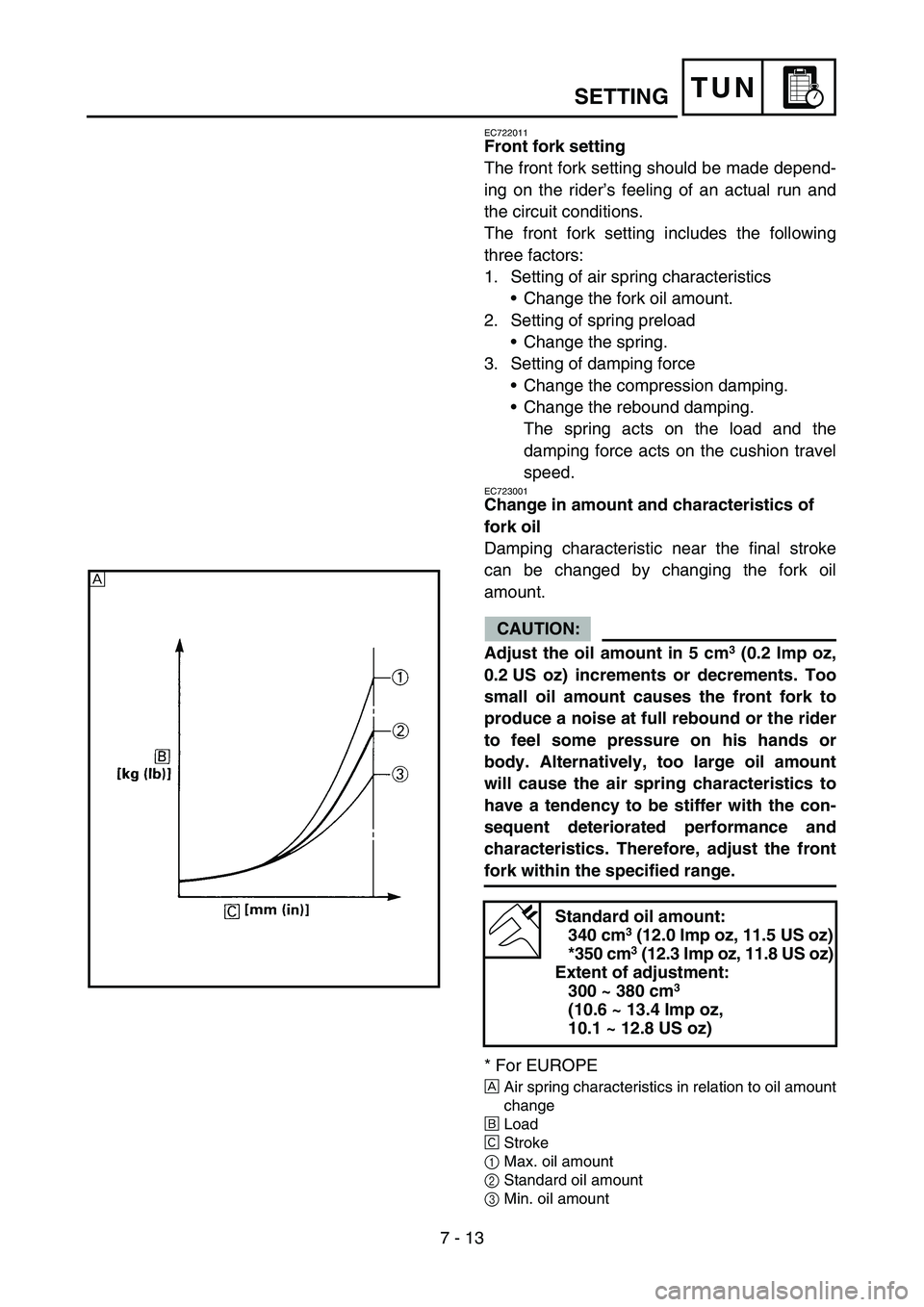
Change in amount and characteristics of
fork oil
Damping characteristic near the final stroke
can be changed by changing the fork oil
amount.
CAUTION:
Adjust the oil amount in 5 cm
3 (0.2 Imp oz,
0.2 US oz) increments or decrements. Too
small oil amount causes the front fork to
produce a noise at full rebound or the rider
to feel some pressure on his hands or
body. Alternatively, too large oil amount
will cause the air spring characteristics to
have a tendency to be stiffer with the con-
sequent deteriorated performance and
characteristics. Therefore, adjust the front
fork within the specified range.
* For EUROPE
ÈAir spring characteristics in relation to oil amount
change
ÉLoad
ÊStroke
1Max. oil amount
2Standard oil amount
3Min. oil amount
Standard oil amount:
340 cm3 (12.0 Imp oz, 11.5 US oz)
*350 cm3 (12.3 Imp oz, 11.8 US oz)
Extent of adjustment:
300 ~ 380 cm
3
(10.6 ~ 13.4 Imp oz,
10.1 ~ 12.8 US oz)
È
Page:
< prev 1-8 9-16 17-24