Page 180 of 650

3 - 18
INSP
ADJIDLE SPEED ADJUSTMENT/
VALVE CLEARANCE ADJUSTMENT
EC35M021
IDLE SPEED ADJUSTMENT
1. Start the engine and thoroughly warm it up.
2. Adjust:
Idle speed
VALVE CLEARANCE ADJUSTMENT
NOTE:
The valve clearance should be adjusted
when the engine is cool to the touch.
The piston must be at Top Dead Center
(T.D.C.) on compression stroke to check or
adjust the valve clearance.
1. Remove:
Seat
Fuel tank
Refer to “SEAT, FUEL TANK AND SIDE
COVERS” section in the CHAPTER 4.
2. Remove:
Spark plug
Engine upper bracket
Hot starter plunger
Refer to “CARBURETOR” section in the
CHAPTER 4.
Cylinder head cover
Refer to “CAMSHAFTS” section in the
CHAPTER 4. Adjustment steps:
Adjust the pilot screw.
Refer to “PILOT SCREW ADJUSTMENT”
section.
Turn the throttle stop screw 1 until the
specified engine idling speed.
NOTE:
Using a digital engine tachometer for idle
speed adjustment, detect the engine idling
speed by bringing the sensing element c of
the engine tachometer close to the ignition
coil 2.
To increase idle speed
→
Turn the throttle stop screw
1 in
a.
To decrease idle speed
→
Turn the throttle stop screw
1 out
b.
Engine idling speed:
1,900 ~ 2,100 r/min
c2
Page 238 of 650
3 - 46
INSP
ADJ
ELECTRICAL/SPARK PLUG INSPECTION
EC370000
ELECTRICAL
EC371001
SPARK PLUG INSPECTION
1. Remove:
Spark plug
2. Inspect:
Electrode 1
Wear/damage → Replace.
Insulator color 2
Normal condition is a medium to light tan
color.
Distinctly different color → Check the
engine condition.
NOTE:
When the engine runs for many hours at low
speeds, the spark plug insulator will become
sooty, even if the engine and carburetor are in
good operating condition.
3. Measure:
Plug gap a
Use a wire gauge or thickness gauge.
Out of specification → Regap.
Spark plug gap:
0.7 ~ 0.8 mm (0.028 ~ 0.031 in)
4. Clean the plug with a spark plug cleaner if
necessary.
5. Tighten:
Spark plug
NOTE:
Before installing a spark plug, clean the gas-
ket surface and plug surface.
Finger-tighten a the spark plug before torqu-
ing to specification b.
T R..13 Nm (1.3 m · kg, 9.4 ft · lb)
Page 240 of 650
3 - 47
INSP
ADJ
IGNITION TIMING CHECK
IGNITION TIMING CHECK
1. Remove:
Timing plug 1
2. Attach:
Timing light
Inductive tachometer
To the ignition coil lead
(orange lead 1).
Timing light:
YM-33277-A/90890-03141
3. Adjust:
Engine idling speed
Refer to “IDLE SPEED ADJUSTMENT”.
4. Check:
Ignition timing
Visually check the stationary pointer a is
within the firing range b on the rotor.
Incorrect firing range → Check rotor and
pickup assembly.
5. Install:
Timing plug
Page 578 of 650

–+ELEC
6 - 2
MAP-CONTROLLED CDI UNIT
MAP-CONTROLLED CDI UNIT
A map-controlled, CDI ignition system is used in the YZ450F.
The microcomputer in the CDI unit detects the engine speed and throttle position, thus determining
the optimum ignition timing through the entire operating range. In this way, quick throttle response
can be achieved according to various riding conditions.
Throttle position sensorCDI unitIgnition coil
Pickup coilCDI magneto rotor
�Function of Component
Component Function
TPS
(throttle position sensor)Detects throttle valve opening and inputs it into the computer in the
CDI unit as a throttle opening signal.
Pickup coil Detects signal rotor revolutions and inputs them into the computer in
the CDI unit as engine revolution signals.
CDI unit The signals of the TPS and pickup coil sensor are analyzed by the
computer in the CDI unit, which then adjusts ignition timing for the
operation requirements.
�Principal of 3-Dimensional Control
Conventionally, ignition timing was controlled only
by engine revolutions (2-dimensional control).
However, ignition timing needs advancement also
by engine load. Thus, accurate ignition timing can
be determined by adding throttle opening to deter-
mine ignition timing (3-dimensional control).
3-D Image Map of Ignition Timing
(different from actual characteristics)
Ignition timing
Thr
ot
tl
e
ope
ni
ngR
evo
l
ut
io
ns
Page 598 of 650
6 - 10
–+ELECTPS (THROTTLE POSITION SENSOR) SYSTEM
6. Adjust:
•Idle speed
Refer to “IDLE SPEED ADJUSTMENT”
section in the CHAPTER 3.
7. Insert the thin electric conductors 2 (lead)
into the TPS coupler 1, as shown, and
connect the tester to them.
CAUTION:
Do not insert the electric conductors
more than required because it may
reduce the waterproof function of the
coupler.
Make sure that a short-circuit does not
develop between the terminals because it
may cause damage to electrical compo-
nents.
8. Start the engine.
9. Adjust:
•TPS output voltage Tester (+) lead
→ Yellow lead
3
Tester (–) lead
→ Black lead
4
Adjustment steps:
Adjust the installation angle of the TPS 1 to
obtain the specified output voltage.
NOTE:
Measure the output voltage accurately with
a digital electronic voltmeter that gives an
easy reading of a small voltage.
TPS output
voltageTester selector
position
0.58 ~ 0.78 V DCV
Page 610 of 650
7 - 5
TUNSETTING
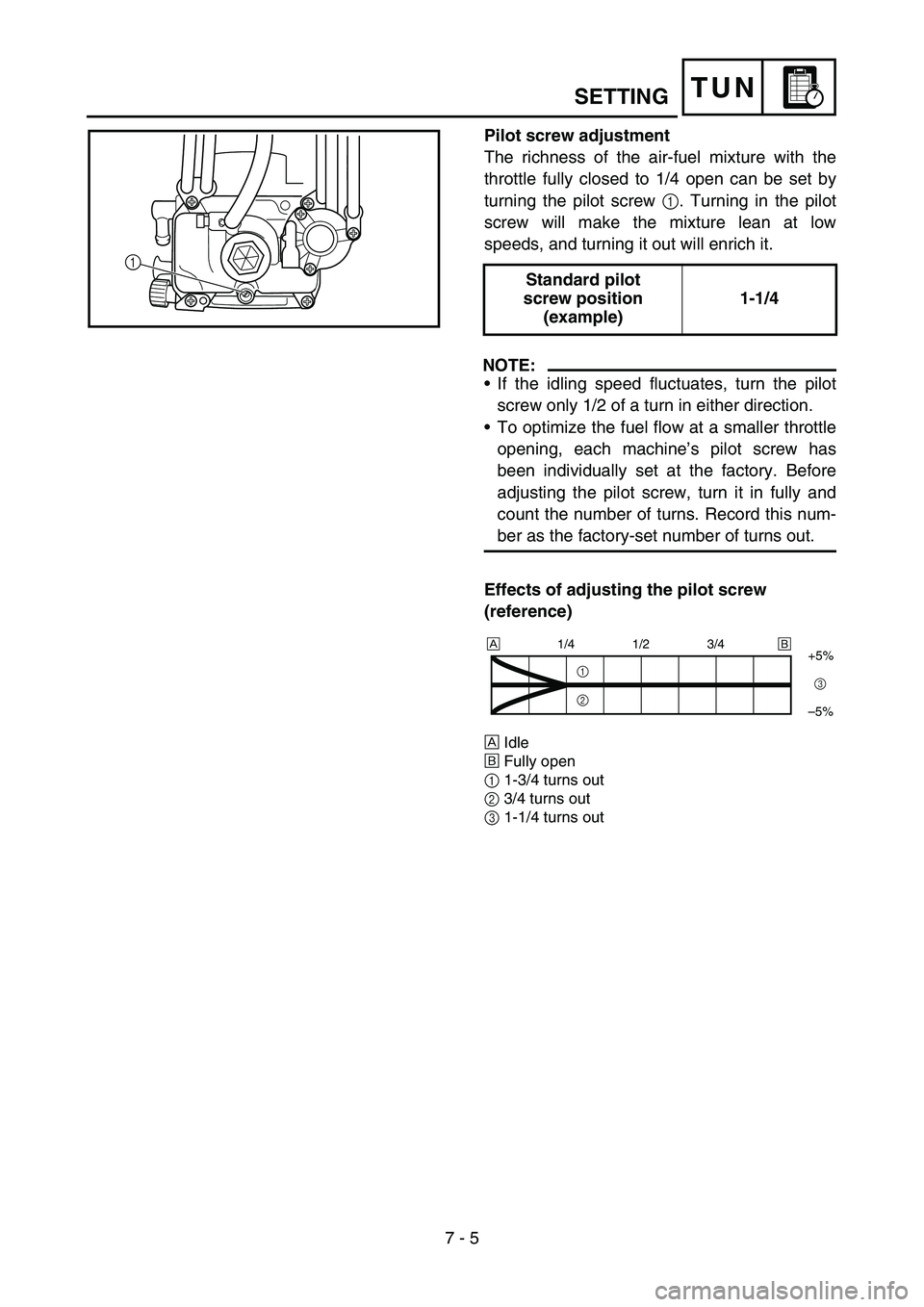
Pilot screw adjustment
The richness of the air-fuel mixture with the
throttle fully closed to 1/4 open can be set by
turning the pilot screw 1. Turning in the pilot
screw will make the mixture lean at low
speeds, and turning it out will enrich it.
NOTE:
•If the idling speed fluctuates, turn the pilot
screw only 1/2 of a turn in either direction.
•To optimize the fuel flow at a smaller throttle
opening, each machine’s pilot screw has
been individually set at the factory. Before
adjusting the pilot screw, turn it in fully and
count the number of turns. Record this num-
ber as the factory-set number of turns out.
Effects of adjusting the pilot screw
(reference)
ÈIdle
ÉFully open
11-3/4 turns out
23/4 turns out
31-1/4 turns out
Standard pilot
screw position
(example)1-1/4
1
1/4 1/2 3/4
+5%
–5%
1
23
ÈÉ
Page 612 of 650

7 - 6
TUNSETTING
Pilot jet adjustment
The richness of the air-fuel mixture with the
throttle open 1/4 or less can be set by adjust-
ing the pilot jet 1.
Effects of adjusting the pilot jet (reference)
ÈIdle
ÉFully open
Jet needle groove position adjustment
Adjusting the jet needle 1 position affects the
acceleration when the throttle is 1/8 to 3/4
open.
1. Too rich at intermediate speeds
Rough engine operation is felt and the
engine will not pick up speed smoothly. In
this case, step up the jet needle clip by one
groove and move down the needle to lean
out the mixture.
2. Too lean at intermediate speeds
The engine breathes hard and will not pick
up speed quickly.
Step down the jet needle clip by one
groove and move up the needle to enrich
the mixture.
Effects of changing the jet needle groove
position (reference)
ÈIdle
ÉFully open
1No.5 groove
2No.3 groove
3No.4 groove
Standard pilot jet #45
Standard clip position No.4 groove
1/4 1/2 3/4
+5%
–5%
#48
#42#45
È
É
1/4 1/2 3/4
+10%
–10%
1
23
ÈÉ
Page 616 of 650

7 - 8
TUN
Relationship with throttle opening
The flow of the fuel through the carburetor
main system is controlled by the main jet and
then, it is further regulated by the area
between the main nozzle and the jet needle.
The fuel flow relates to the diameter of the
straight portion of the jet needle with the throt-
tle 1/8 to 1/4 open and relates to the clip posi-
tion with the throttle 1/8 to 3/4 open.
Therefore, the fuel flow is balanced at each
stage of throttle opening by the combination of
the jet needle straight portion diameter, and
clip position.
Leak jet adjustment (accelerator pump
adjustment)
The leak jet 1 is a setting part that adjusts the
flow of fuel discharged by the accelerator
pump. Since the accelerator pump operates
only when throttle is open, the leak jet is used
to adjust a fuel mixture ratio for quick throttle
opening and is therefore different from other
setting parts that adjust a fuel mixture for each
throttle opening (each engine speed).
1. The engine breathes hard in quick throttle
opening.
Select a leak jet having lower calibrating
No. than standard to enrich the mixture.
#55 → #50
2. Rough engine operation is felt in quick
throttle opening.
Select a leak jet having higher calibrating
No. than standard to lean out the mixture.
#55 → #60
Standard leak jet #55
1
SETTING