Page 95 of 148

8-13
1
2
3
4
5
6
78
9
10
11
2. Clean the surface of the spark plug gasket
and its mating surface, and then wipe off any
grime from the spark plug threads.
3. Install the spark plug with the spark plug
wrench, and then tighten it to the specified
torque.
NOTE:
If a torque wrench is not available when installing
a spark plug, a good estimate of the correct torque
is 1/4–1/2 turn past finger tight. However, the spark
plug should be tightened to the specified torque as
soon as possible.
4. Install the spark plug cap.
5. Place the fuel tank in the original position, and
then install the bolt.
6. Remove the fuel tank cap by turning it coun-
terclockwise.
7. Place the panel in the original position.8. Install the fuel tank cap by turning it clockwise.
9. Install the bolts and the quick fastener screws.
10. Install the seat.
EBU23303
Engine oil and oil filter element
The engine oil level should be checked before
each ride. In addition, the oil must be changed and
the oil filter element replaced at the intervals spec-
ified in the periodic maintenance and lubrication
chart. Tightening torque:
Spark plug:
12.5 Nm (1.25 m·kgf, 9.0 ft·lbf)
1. Projection
2. Slot
21
Page 110 of 148

8-28
1
2
3
4
5
6
78
9
10
11
7. Start the engine and rev it up approximately
twenty times while momentarily creating ex-
haust system back pressure by blocking the
end of the muffler with a shop towel.
8. Stop the engine and allow the exhaust pipe to
cool.
9. Install the purging bolt and tighten it.
WARNING
EWB02380
Never run the engine in an enclosed area when
purging the spark arrester, otherwise it could
cause injury to the eyes, burns, carbon monox-ide poisoning, possibly leading to death, and
start a fire.
�
Always let the exhaust system cool prior to
touching exhaust components.
�
Always wear eye protection, and make sure
no one is behind the ATV.
�
Make sure there are no combustible materi-
als in the area.
EBU23940
Adjusting the carburetor
The carburetor should be checked and, if neces-
sary, adjusted at the intervals specified in the peri-
odic maintenance and lubrication chart. The
carburetor is an important part of the engine and
requires very sophisticated adjustment. Therefore,
most carburetor adjustments should be left to a
Yamaha dealer, who has the necessary profes-
sional knowledge and experience. The adjustment
described in the following section, however, may
be performed by the owner as part of routine main-
tenance.
CAUTION:
ECB00480
The carburetor has been set and extensively
tested at the Yamaha factory. Changing these
1. Purging bolt
2. Gasket
1 2
Page 111 of 148
8-29
1
2
3
4
5
6
78
9
10
11
settings without sufficient technical knowl-
edge may result in poor performance of or
damage to the engine.
EBU24030
Checking the engine idling speed
A special tester is needed to check the engine
idling speed on this model.
Therefore, take the ATV to a Yamaha dealer to
have the engine idling speed checked and adjust-
ed.
EBU24043
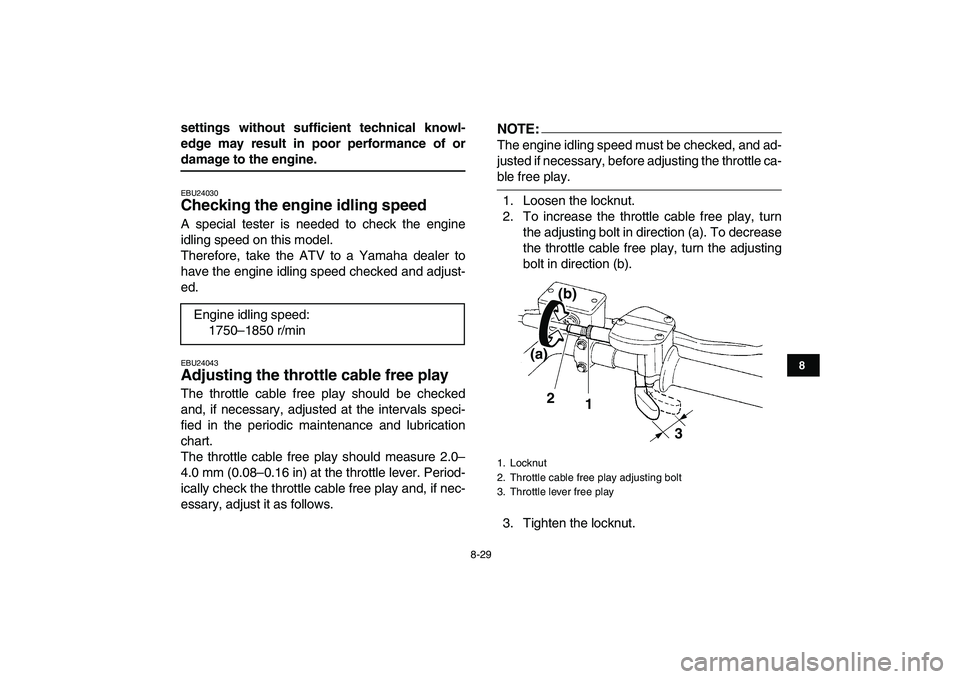
Adjusting the throttle cable free play
The throttle cable free play should be checked
and, if necessary, adjusted at the intervals speci-
fied in the periodic maintenance and lubrication
chart.
The throttle cable free play should measure 2.0–
4.0 mm (0.08–0.16 in) at the throttle lever. Period-
ically check the throttle cable free play and, if nec-
essary, adjust it as follows.
NOTE:
The engine idling speed must be checked, and ad-
justed if necessary, before adjusting the throttle ca-
ble free play.
1. Loosen the locknut.
2. To increase the throttle cable free play, turn
the adjusting bolt in direction (a). To decrease
the throttle cable free play, turn the adjusting
bolt in direction (b).
3. Tighten the locknut. Engine idling speed:
1750–1850 r/min
1. Locknut
2. Throttle cable free play adjusting bolt
3. Throttle lever free play
3 2
1
(a)(b)
Page 116 of 148

8-34
1
2
3
4
5
6
78
9
10
11
�
Refill with the same type of brake fluid. Mixing
fluids may result in a harmful chemical reaction
and lead to poor braking performance.
�
Be careful that water does not enter the brake
fluid reservoir when refilling. Water will signifi-
cantly lower the boiling point of the fluid and may
result in vapor lock.
�
Brake fluid may deteriorate painted surfaces or
plastic parts. Always clean up spilled fluid imme-
diately.
�
As the brake pads wear, it is normal for the brake
fluid level to gradually go down. However, if the
brake fluid level goes down suddenly, have a
Yamaha dealer check the cause.
EBU24290
Changing the brake fluid
Have a Yamaha dealer change the brake fluid at
the intervals specified in the NOTE after the peri-
odic maintenance and lubrication chart. In addi-
tion, have the oil seals of the master cylinders and
calipers as well as the brake hoses replaced at the
intervals listed below or whenever they are dam-
aged or leaking.
�
Oil seals: Replace every two years.
�
Brake hoses: Replace every four years.
EBU24390
Checking the front brake lever free play
The brake lever free play must be checked at the
intervals specified in the periodic maintenance and
lubrication chart. The brake lever should have a
free play of zero mm (zero in) as shown. If the free
play is incorrect, have a Yamaha dealer check the
brake system.
WARNING
EWB02070
Operating with improperly serviced or adjust-
ed brakes could cause loss of braking ability,
which could lead to an accident.
1. Brake lever free play
1
Page 118 of 148
8-36
1
2
3
4
5
6
78
9
10
11
should be performed by a Yamaha dealer.
EBU24710
Adjusting the parking brake free play
The parking brake free play must be checked and,
if necessary, adjusted at the intervals specified in
the periodic maintenance and lubrication chart.
Cable length “A” should measure 47–51 mm (1.9–
2.0 in). Adjust the parking brake free play as fol-
lows.
1. Release the parking brake by moving theparking brake lever to the right.
2. Fully loosen the locknut and the adjusting bolt
at the rear brake caliper.
3. Loosen the locknut on the brake cable.
4. Turn the adjusting nut on the brake cable in di-
rection (a) to increase the cable length, and in
direction (b) to decrease it.
NOTE:
If the cable length cannot be adjusted to specifica-
tion, consult a Yamaha dealer.
5. Tighten the locknut on the brake cable.
1. Adjusting bolt
2. Cable length “A”
3. Locknut
2
3
1
1. Locknut
2. Adjusting nut
(a)
(b)
12
Page 119 of 148

8-37
1
2
3
4
5
6
78
9
10
11
6. Turn in the adjusting bolt at the rear brake cal-
iper until it feels tight, then turn it out 1/8 turn
and tighten its locknut to the specified torque.
CAUTION:
ECB00520
When tightening the locknut, hold the adjust-
ing bolt with a wrench so that it does not turn
together with the locknut.
WARNING
EWB02090
Operating with improperly serviced or adjust-
ed brakes could cause the brakes to malfunc-
tion, resulting in reduced braking
performance. This could increase the chance
of a collision or accident. After adjusting the
parking brake free play, block the rear of the
ATV off the ground and spin the rear wheels.
Check to make sure there is no brake drag. If
brake drag is noticed, perform the adjustment
again.
EBU24740
Brake light switches
The operation of the brake light switches must be
checked and, if necessary, adjusted at the inter-
vals specified in the periodic maintenance and lu-
brication chart.
The brake light switch for the brake pedal can be
adjusted as follows, but the other brake light
switches should be adjusted by a Yamaha dealer.
NOTE:
The brake light switch is properly adjusted when
the brake light comes on just before braking takes
effect.
Turn the adjusting nut while holding the brake light
switch in place. To make the brake light come on
earlier, turn the adjusting nut in direction (a). To
make the brake light come on later, turn the adjust-
ing nut in direction (b). Tightening torque:
Locknut (rear brake caliper):
16 Nm (1.6 m·kgf, 12 ft·lbf)
Page 120 of 148

8-38
1
2
3
4
5
6
78
9
10
11
EBU24820
Adjusting the clutch lever free play
The clutch lever free play must be checked and, if
necessary, adjusted at the intervals specified in
the periodic maintenance and lubrication chart.
The clutch lever free play should measure 8.0–
13.0 mm (0.31–0.51 in) as shown. If the free play
is incorrect, adjust it as follows.1. Loosen the locknut at the clutch lever.
2. To increase the clutch lever free play, turn the
adjusting bolt at the clutch lever in direction
(a), and to decrease it, turn the bolt in direction
(b).
3. Tighten the locknut at the clutch lever.
If the specified free play cannot be obtained,
proceed with the following steps.
4. Loosen the locknut at the clutch lever.
5. Fully turn the adjusting bolt at the clutch lever
in direction (a) to loosen the clutch cable.
6. Loosen the locknut at the crankcase.
1. Brake light switch
2. Brake light switch adjusting nut
(a)
(b)1
2
1. Clutch lever free play
2. Clutch lever free play adjusting bolt
1
(a)
(b)
2
Page 121 of 148

8-39
1
2
3
4
5
6
78
9
10
11
7. To increase the clutch lever free play, turn the
adjusting nut at the crankcase in direction (a),
and to decrease it, turn the nut in direction (b).
8. Tighten the locknut at the crankcase and the
clutch lever.
NOTE:
If the specified free play cannot be obtained as de-
scribed above or if the clutch does not operate cor-
rectly, have a Yamaha dealer check the internal
clutch mechanism.
EBU26860
Drive chain slack
The drive chain slack should be checked before
each ride and adjusted if necessary.
To check the drive chain slack
1. Place the ATV on a level surface.
NOTE:
When checking and adjusting the drive chain
slack, there should be no weight on the ATV and
all tires must be touching the ground.
2. Move the ATV back and forth to locate the
tightest portion of the drive chain, and then
measure the drive chain slack as shown.
1. Locknut
2. Clutch lever free play adjusting nut (crankcase)
(a)
(b)
2
1
Drive chain slack:
25.0–35.0 mm (0.98–1.38 in)
