Page 47 of 79

Drive chain lubricationThe chain consists of many parts
which work with each other. If the
chain is not maintained properly, it
will wear out quickly. Therefore, the
chain must be serviced regularly.
This service is especially necessary
when riding in dusty areas.
1. The drive chain should be
lubricated every 5,000 km.
2. To clean the chain thoroughly,
remove it from the Motorcycle,
dip it in solvent, and clean out as
much dirt as possible. Then, take
the chain out of the solvent to dry
it, and then dip the chain in oil of
20W40. Remove the chain and
hang it on a peg for a while till the
excess oil drips down completely.
Then using a clean cloth wipe the
chain.
Cable inspection and
lubricationDamage to the outer housing of
cables may lead to internal rusting
and interfere with the cable
movement. Replace damaged
cables as soon as possible to
prevent unsafe conditions.
Lubricate the cables with anti-
corrosive oil and cable ends. If a
cable does not operate smoothly,
ask a YAMAHA dealer to replace it.
Recommended lubricant:
20W40 Type SG
Throttle cable and grip
lubricationThe throttle twist grip assembly
should be greased at the time that
the cable is lubricated, since the
grip must be removed to get at the
end of the throttle cable. After
removing the screws, hold the end
of the cable up in the air and put in
several drops of lubricant. With the
throttle grip disassembled, coat the
metal surface of the grip assembly
with a suitable all purpose grease.
PERIODIC MAINTENANCE AND MINOR REPAIR
6-21
WARNING
Page 54 of 79
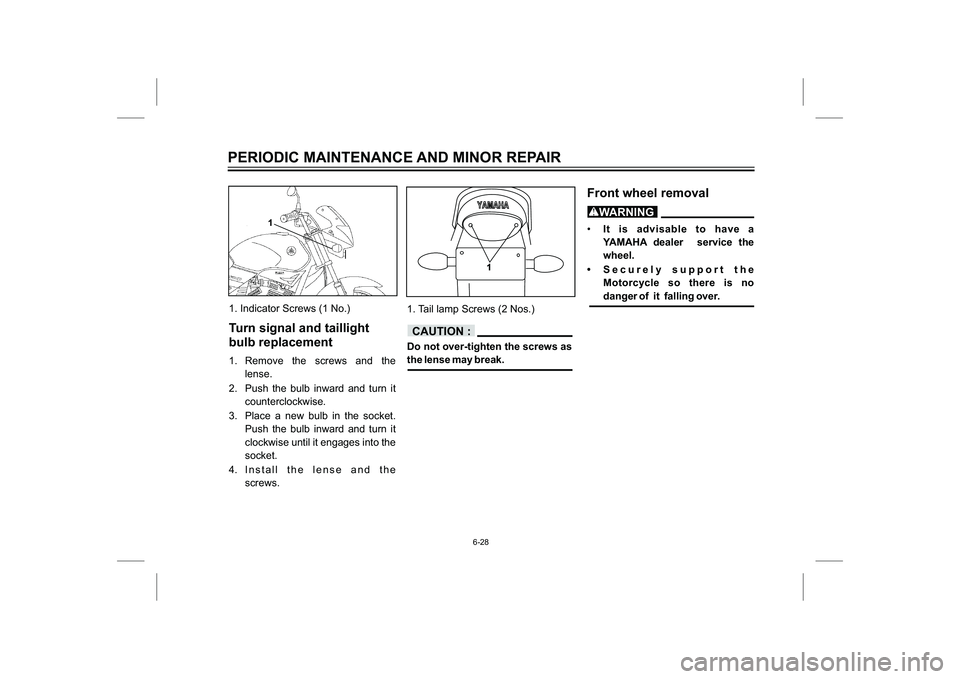
1. Indicator Screws (1 No.)Turn signal and taillight
bulb replacement1. Remove the screws and the
lense.
2. Push the bulb inward and turn it
counterclockwise.
3. Place a new bulb in the socket.
Push the bulb inward and turn it
clockwise until it engages into the
socket.
4. Install the lense and the
screws.1. Tail lamp Screws (2 Nos.)
Do not over-tighten the screws as
the lense may break.
Front wheel removalIt is advisable to have a
YAMAHA dealer service the
wheel.
Securely support the
Motorcycle so there is no
danger of it falling over.
PERIODIC MAINTENANCE AND MINOR REPAIR
6-28
WARNING
CAUTION :
Page 56 of 79
1. StopperFront wheel installationWhen installing the front wheel,
reverse the removal procedure.
Pay attention to the following points:
1. Make sure the slot in the brake
shoe plate fits over the stopper on
the front fork outer tube.
2. Make sure the axle nut is properly
torqued and a new cotter pin is
installed.Always use a new cotter pin.
Axle nut torque:
33 ft-lb (4.55 m-kg)
3. Adjust the free play in the brake
lever.PERIODIC MAINTENANCE AND MINOR REPAIR
6-30
WARNING
Rear wheel removalIt is advisable to service the
wheel by a YAMAHA dealer.
Securely support the
Motorcycle so there is no
danger of it falling over.
WARNING
Page 58 of 79

Rear wheel installation1. Install the rear wheel and the
axle.
2. Install the axle nut.
3. Insert the brake rod into the
brake cam lever and install the
brake free play adjusting nut.
4. Install the tension bar onto the
brake shoe plate and tighten the
tension bar nut to the specified
tightening torque.
5. Take the Motorcycle off the
centerstand.
6. Tighten the axle nut to the
specified tightening torque.
Then install a new cotter pin.
Specified torque:
Tension bar nut:
14 ft-lb (1.9 m kg)
Axle nut:
65 ft-lb (9.05 m kg)Always use a new cotter pin.
Check the operation of the brake
light after adjusting the rear brake. 7. Adjust the rear brake pedal free
play. (See page 6-17.)
TroubleshootingAlthough YAMAHA Motorcycles
receive a rigid inspection before
shipment from the factory, trouble
may occur during operation. Any
problem in the fuel, compression, or
ignition systems can cause poor
starting and loss of power. The
troubleshooting chart describes a
quick, easy procedure for making
checks. If your Motorcycle requires
any repair, bring it to a YAMAHA
dealer. The skilled technicians at a
YAMAHA dealership have the tools,
experience, and know-how to
properly service your Motorcycle.
Use only genuine YAMAHA parts
on your Motorcycle. Imitation
parts may look like YAMAHA
parts, but they are often inferior.
Consequently, they have a shorter
service life and can lead to
expensive repair bills.
PERIODIC MAINTENANCE AND MINOR REPAIR
6-32
WARNINGWARNING
Page 66 of 79
10-1
1. Check for any missing item(s), scratches in painted/plated part(s), saddle or other external
visual damages and take corrective action.
Check each of the following items individually and mention the corrective action (as per the
recommended specifications) in the boxes provided.2. Check for missing part(s), if any.A. FRAME
a. Brakes
Front : Free Play at Lever End (10 ~ 15 mm)
Rear :Free Play at Rear Brake (20 ~ 30 mm)
b. Clutch :Free Play at Lever End (10 ~ 15 mm)c. Throttle :Free Play at Throttle Grip (3 ~7 mm)d. Steering :Check for Free Movemente. Suspension
Front Fork : Check for any sticky movement
Rear Shock Abs : For Free Stroking & Setting on both
(To be filled in by the Dealer on receipt of the Motorcycle from YMIS)
Odo-Meter
ReadingDate of
Inspection
Frame
No.Engine
No.Date of
SaleFound OK
Set RightReplaced
Cleaned
Lubricated
RCL
S
PRE-DELIVERY INSPECTION REPORT
No.
service2.pmd11/3/2006, 8:50 PM 1
Page 67 of 79
PRE-DELIVERY INSPECTION REPORT
f. Wheels
Tyre :Tyre pressure Solo Double
(PSI)
Front 25 25
Rear 33 36
R i m : Runout - Radial - 1.5 mm (Max)
- Lateral - 1.5 mm (Max)
Spokes : No loosenes
g. Locks Operation : • Ignition
• Steering• Fuel Tank Cap• Side Cover (L.H.)
h. FastenersSpecified Torque
(Ft-Lb)
1. Front Wheel Axle Nuts 25-40
2. Front Fork (Crown Handle & Inner Tube)13-202. Front Fork under Bracket Stem Nut18-223. Handle Bar Mounting Bolts 13-204. Rear Shock Absorber Mounting Bolts22-355. Rear Swing Arm Pivot Shaft Nut32-526. Rear Wheel Axle/Sprocket. Shaft Nuts60-70
B. ENGINE
a. Engine Oil : • Oil Level (For checking - Refer Pg. 6-9)
• Check for any Leakages
10-2
service2.pmd11/3/2006, 8:50 PM 2
Page 68 of 79
b. Spark Plug :Recommended No. P-RA7HC(Champion)
Gap 0.8 ±0.1 mm
c. Valve Clearance :(Cold condition)
(If required) Inlet0.08 ~ 0.12 mm
Exhaust0.10 ~ 0.14 mm
(After matching of the mark on sprocket cam chain with mark on Cylinder
Head Casting and ensuring the Piston at TDC of compression stroke.)
d. Kick Operation: For free Movement
e. Carburetor : • Idle RPM
In warmed up condition
(1300~1500 RPM)
• Check for Overflow
f. Drive Chain : • Alignment
• Slackness(20 ~ 30 mm)
g. FastenersSpecified Torque
(Ft-Lb)
1. Cylinder Head Bolts14-17
2. Engine Mounting
a) Engine Mounting Front and Stay Front25-29
b) Stay Engine Front and Frame25-29c) Engine Mounting Rear and Frame25-29d) Engine Mounting Upper &
Stay Engine Upper25-29e) Stay Engine Upper and Frame25-29f) Engine Mounting Front Lower and Frame25-29
3. Front and Rear Silencer Mounting Nut9-124. Crown Handle Centre Bolt8-14
PRE-DELIVERY INSPECTION REPORT
10-3
service2.pmd11/3/2006, 8:50 PM 3
Page 69 of 79
PRE-DELIVERY INSPECTION REPORT10-4
C. ELECTRICAL
a. Ignition Switch Operation
b. Left Hand Switch Operation & Pass Beam
• Horn
• Indicator• Head Light
c. All Bulbs - Functioningd. Battery
• Electrolyte Level
• Specific Gravity• Routing of Breather Pipe• Fuse• Routing of Positive Wire (Red) Below Breather Pipe
D. ROAD TEST
a. Starting
b. Gear Shifting Operationc. Clutch Operationd. Application of Brakes (Front and Rear)e. Speedo/ Odo Meter Operationf. Fuel gauge OperationEXPLAINED BYSIGNATURE: _____________ NAME:
CUSTOMER’S SIGN
MAIN SELLING DLR’S STAMP, SIGNATURE
service2.pmd11/3/2006, 8:50 PM 4