Page 43 of 124
6-3
6
NOTE:The engine is warm when it responds normally tothe throttle with the starter (choke) turned off.EBU20291Starting a warm engine Follow the same procedure as for starting a cold
engine, with the exception that the starter (choke)
is not required when the engine is warm. Instead,
start the engine with the throttle slightly open.EBU20380Operating the drive select lever and
driving in reverse CAUTION:ECB00170Before shifting, stop the ATV, otherwise thetransmission may be damaged.
Shifting: Forward
1. Bring the ATV to a complete stop.
2. Shift from neutral to forward and vice versa by
moving the drive select lever along the shift
guide.
NOTE:Make sure that the drive select lever is completelyshifted into position.
3. Open the throttle lever gradually.
Shifting: Reverse
1. Bring the ATV to a complete stop.
2. Apply the brake pedal.1. Drive select lever
2. F (Forward)
3. N (Neutral)
4. R (Reverse)
U3D561E0.book Page 3 Thursday, June 29, 2006 11:03 AM
Page 44 of 124

6-4
63. Shift from neutral to reverse and vice versa by
moving the drive select lever along the shift
guide.
NOTE:When in reverse, the reverse indicator light should
come on. If the indicator light does not come on,have a Yamaha dealer check the electrical circuit.
4. Check behind for people or obstacles, and
then release the brake pedal.5. Open the throttle lever gradually and continue
to watch to the rear while backing.
WARNING
EWB00720Improper operation in reverse could make you
hit an obstacle or even a person behind you,
resulting in serious injury. When you shift into
reverse, make sure there are no people or ob-
stacles behind you. When it is safe to proceed,go slowly.EBU20682Engine break-in NOTE:�For ATVs equipped with an odometer or an hour
meter, follow the figures given in km (mi) or the
figures given in hours.�For ATVs not equipped with an odometer orhour meter, follow the figures given in hours.
There is never a more important period in the life of
your engine than the first 320 km (200 mi) or 20
hours of riding. For this reason, you should read
the following material carefully.
Since the engine is brand new, do not put an ex-
cessive load on it for the first 320 km (200 mi) or 20
hours. The various parts in the engine wear and
1. Drive select lever
2. F (Forward)
3. N (Neutral)
4. R (Reverse)U3D561E0.book Page 4 Thursday, June 29, 2006 11:03 AM
Page 77 of 124

8-6
8
EBU23070NOTE:�The air filter needs more frequent service if you are riding in unusually wet or dusty areas.�Hydraulic brake service
Regularly check and, if necessary, correct the brake fluid level.
Every two years replace the internal components of the brake master cylinders and calipers, and
change the brake fluid.Replace the brake hoses every four years and if cracked or damaged.27*Throttle lever hous-
ing and cableCheck operation and correct if necessary.
Check throttle cable free play and adjust if neces-
sary.
Lubricate throttle lever housing and cable.√√√√√
28*Exhaust systemCheck for leakage and replace gasket(s) if neces-
sary.
Check for looseness and tighten all screw clamps
and joints if necessary.√√√
29 Spark arresterClean.√√√
30*Front and rear brake
switchesCheck operation and correct if necessary.√√√√√
31*Lights and switchesCheck operation and correct if necessary.
Adjust headlight beams.√√√√√ NO. ITEMCHECK OR MAINTENANCE
JOBINITIAL EVERY
Whichev-
er comes
firstmonth136612
km
(mi)320
(200)1200
(750)2400
(1500)2400
(1500)4800
(3000)
hours 20 75 150 150 300U3D561E0.book Page 6 Thursday, June 29, 2006 11:03 AM
Page 100 of 124
8-29
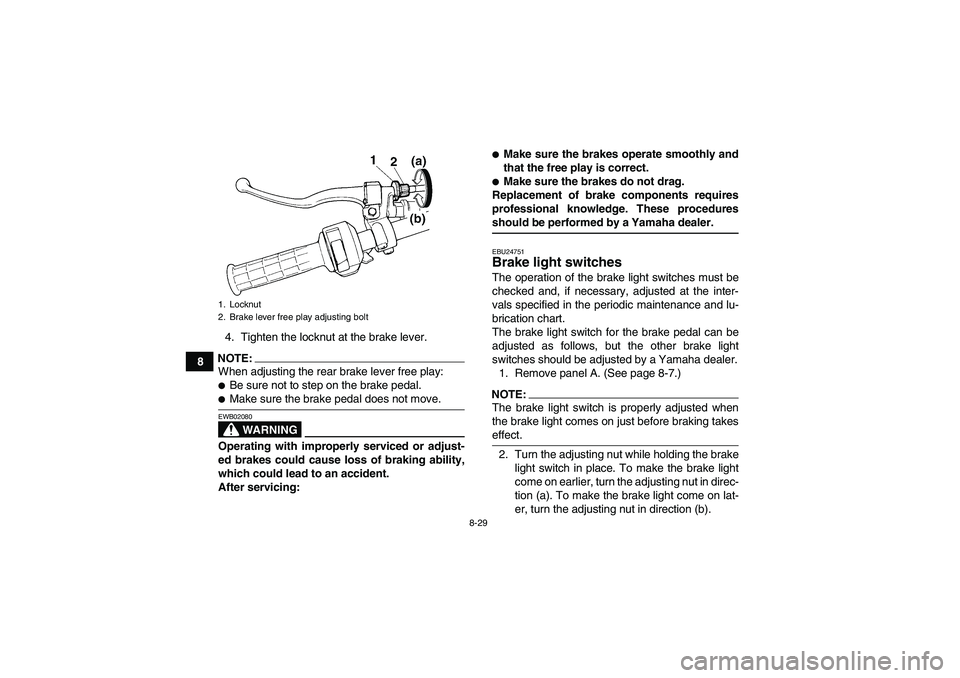
84. Tighten the locknut at the brake lever.
NOTE:When adjusting the rear brake lever free play:�Be sure not to step on the brake pedal.�Make sure the brake pedal does not move.
WARNING
EWB02080Operating with improperly serviced or adjust-
ed brakes could cause loss of braking ability,
which could lead to an accident.
After servicing:
�Make sure the brakes operate smoothly and
that the free play is correct.�Make sure the brakes do not drag.
Replacement of brake components requires
professional knowledge. These proceduresshould be performed by a Yamaha dealer.EBU24751Brake light switches The operation of the brake light switches must be
checked and, if necessary, adjusted at the inter-
vals specified in the periodic maintenance and lu-
brication chart.
The brake light switch for the brake pedal can be
adjusted as follows, but the other brake light
switches should be adjusted by a Yamaha dealer.
1. Remove panel A. (See page 8-7.)NOTE:The brake light switch is properly adjusted when
the brake light comes on just before braking takeseffect.
2. Turn the adjusting nut while holding the brake
light switch in place. To make the brake light
come on earlier, turn the adjusting nut in direc-
tion (a). To make the brake light come on lat-
er, turn the adjusting nut in direction (b).
1. Locknut
2. Brake lever free play adjusting boltU3D561E0.book Page 29 Thursday, June 29, 2006 11:03 AM
Page 101 of 124

8-30
8 3. Install the panel.
EBU24900Checking and lubricating the cables The operation and the condition of all control ca-
bles should be checked before each ride, and the
cables and cable ends should be lubricated if nec-
essary. If a cable is damaged or does not move
smoothly, have a Yamaha dealer check or replace
it.
WARNING
EWB02130Inspect cables frequently and replace if dam-
aged. Corrosion can result when the cable
sheaths become damaged, and cables can
also become frayed or kinked, which could re-
strict the operation of controls and lead to anaccident or injury.EBU24911Checking and lubricating the front and
rear brake levers The operation of the front and rear brake levers
should be checked before each ride, and the lever
pivots should be lubricated if necessary.
1. Brake light switch
2. Brake light switch adjusting nutRecommended lubricant:
Engine oil
Recommended lubricant:
Lithium-soap-based grease (all-purpose
grease)
U3D561E0.book Page 30 Thursday, June 29, 2006 11:03 AM
Page 108 of 124
8-37
86. Install the headlight bulb holder cover at the
rear of the headlight.
CAUTION:ECB00670Make sure the headlight bulb holder cover is
securely fitted over the bulb holder and seatedproperly.
7. Adjust the headlight beam if necessary.EBU25560Adjusting a headlight beam CAUTION:ECB00690It is advisable to have a Yamaha dealer makethis adjustment.To raise a headlight beam, turn the adjusting bolt
in direction (a).
To lower a headlight beam, turn the adjusting bolt
in direction (b).
EBU25600Replacing the tail/brake light bulb If the tail/brake light bulb burns out, replace it as
follows.
1. Remove the lens by removing the screws.1. Headlight beam adjusting bolt
U3D561E0.book Page 37 Thursday, June 29, 2006 11:03 AM
Page 109 of 124
8-38
8 2. Remove the defective bulb by pushing it in
and turning it counterclockwise.3. Insert a new bulb into the socket, push it in,
and then turn it clockwise until it stops.
4. Install the lens by installing the screws.
CAUTION:ECB00700Do not overtighten the screws, otherwise thelens may break.EBU25650Removing a wheel 1. Loosen the wheel nuts.
2. Elevate the ATV and place a suitable stand
under the frame.
3. Remove the nuts from the wheel.
1. Screw
1. Tail/brake light bulb
1. Nut
U3D561E0.book Page 38 Thursday, June 29, 2006 11:03 AM
Page 119 of 124
10-4
10
Rear suspension:Type:
Swingarm (monocross)
Spring/shock absorber type:
Coil spring/oil damper
Wheel travel:
180 mm (7.1 in)Electrical system:Ignition system:
DC. CDI
Charging system:
AC magnetoBattery:Model:
YTX14AH
Voltage, capacity:
12 V, 12.0 AhHeadlight:Bulb type:
Krypton bulbBulb voltage, wattage x quantity:Headlight:
12 V, 30.0/30.0 W × 2
Tail/brake light:
12 V, 5.0/21.0 W × 1
Neutral indicator light:
12 V, 1.7 W × 1
Reverse indicator light:
12 V, 1.7 W × 1
Oil temperature warning light:
12 V, 1.7 W × 1
Fuses:Main fuse:
20.0 A
Headlight fuse:
15.0 A
Signaling system fuse:
10.0 A
Ignition fuse:
15.0 A
U3D561E0.book Page 4 Thursday, June 29, 2006 11:03 AM


