Page 53 of 94

PERIODIC MAINTENANCE AND MINOR REPAIR
6-10
2
3
4
5
67
8
9 To check the spark plugs
1. Check that the porcelain insulator
around the center electrode on
each spark plug is a medi-
um-to-light tan (the ideal color
when the vehicle is ridden normal-
ly).
2. Check that all spark plugs installed
in the engine have the same color.
NOTE:
If any spark plug shows a distinctly dif-
ferent color, the engine could be oper-
ating improperly. Do not attempt to
diagnose such problems yourself. In-
stead, have a Yamaha dealer check
the vehicle.
3. Check each spark plug for elec-
trode erosion and excessive car-
bon or other deposits, and replace
it if necessary.
To install a spark plug
1. Measure the spark plug gap with a
wire thickness gauge and, if nec-essary, adjust the gap to specifica-
tion.
2. Clean the surface of the spark plug
gasket and its mating surface, and
then wipe off any grime from the
spark plug threads.
3. Install the spark plug with the
spark plug wrench, and then tight-
en it to the specified torque.
NOTE:
If a torque wrench is not available when
installing a spark plug, a good estimate
of the correct torque is 1/4–1/2 turn
past finger tight. However, the spark
plug should be tightened to the speci-
fied torque as soon as possible.
4. Install the spark plug cap.
5. Place the spark plug cover in the
original position as shown, and
then install the cowling.
Specified spark plug:
NGK/CR7E
1. Spark plug gap
Spark plug gap:
0.7–0.8 mm (0.028–0.031 in)
1
Tightening torque:
Spark plug:
12.5 Nm (1.25 m·kgf, 9 ft·lbf)
1. Spark plug cover
1
Page 54 of 94

PERIODIC MAINTENANCE AND MINOR REPAIR
6-11
1
2
3
4
5
6
7
8
9
EAU19854
Engine oil and oil filter
cartridge
The engine oil level should be checked
before each ride. In addition, the oil
must be changed and the oil filter car-
tridge replaced at the intervals speci-
fied in the periodic maintenance and
lubrication chart.
To check the engine oil level
1. Place the vehicle on the center-
stand.
CAUTION:
ECA11290
The engine must be cold before pro-
ceeding with the oil level check, oth-
erwise the check will result in a false
reading.
NOTE:
Make sure that the vehicle is positioned
straight up when checking the oil level.
A slight tilt to the side can result in a
false reading.
2. Start the engine, warm it up for two
minutes, and then turn it off.
3. Wait two minutes until the oil set-tles, and then check the oil level
through the check window located
at the bottom-left side of the crank-
case.
NOTE:
The engine oil should be between the
minimum and maximum level marks.
4. If the engine oil is below the mini-
mum level mark, add sufficient oil
of the recommended type to raise
it to the correct level.
To change the engine oil (with or
without oil filter cartridge replace-
ment)
1. Start the engine, warm it up for
several minutes, and then turn it
off.
2. Place an oil pan under the engine
to collect the used oil.
3. Remove the engine oil filler cap
and drain bolt to drain the oil from
the crankcase.
1. Engine oil level check window
2. Maximum level mark
3. Minimum level mark
1
32
1. Engine oil filler cap
1
Page 58 of 94

PERIODIC MAINTENANCE AND MINOR REPAIR
6-15
1
2
3
4
5
6
7
8
9
10. Install the panel.
EAU20070
Coolant
The coolant level should be checked
before each ride. In addition, the cool-
ant must be changed at the intervals
specified in the periodic maintenance
and lubrication chart.
EAU42831
To check the coolant level
1. Place the vehicle on a level sur-
face and hold it in an upright posi-
tion.
NOTE:
�
The coolant level must be checked
on a cold engine since the level
varies with engine temperature.
�
Make sure that the vehicle is posi-
tioned straight up when checking
the coolant level. A slight tilt to the
side can result in a false reading.
2. Check the coolant level through
the check window.
NOTE:
The coolant should be between the
minimum and maximum level marks.3. If the coolant is at or below the
minimum level mark, lift up the
right floorboard mat as shown.
4. Remove the coolant reservoir cov-
1. Maximum level mark
2. Minimum level mark
3. Coolant level check window
1. Right floorboard mat
3
1
2
1
Page 60 of 94
PERIODIC MAINTENANCE AND MINOR REPAIR
6-17
1
2
3
4
5
6
7
8
9
EAU21121
Cleaning the air filter element
The air filter element should be cleaned
at the intervals specified in the periodic
maintenance and lubrication chart.
Clean the air filter element more fre-
quently if you are riding in unusually
wet or dusty areas.
1. Remove cowling A. (See
page 6-6.)
2. Remove the windshield by remov-
ing the screws.
3. Remove the panel shown by re-
moving the screws.4. Remove the air filter case cover by
removing the screws, and then pull
the air filter element out.5. Lightly tap the air filter element to
remove most of the dust and dirt,
and then blow the remaining dirt
out with compressed air as shown.
If the air filter element is damaged,
replace it.
6. Insert the air filter element into the
1. Screw
1
1
1. Screw
2. Panel
1. Air filter case cover
2. Screw
11 2
1
2
2
1. Air filter element
1
Page 73 of 94
PERIODIC MAINTENANCE AND MINOR REPAIR
6-30
2
3
4
5
67
8
9
necessary.
3. Fully charge the battery before in-
stallation.
4. After installation, make sure that
the battery leads are properly con-
nected to the battery terminals.
CAUTION:
ECA10630
�
Always keep the battery
charged. Storing a discharged
battery can cause permanent
battery damage.
�
To charge a sealed-type (MF)
battery, a special (constant-volt-
age) battery charger is required.
Using a conventional battery
charger will damage the battery.
If you do not have access to a
sealed-type (MF) battery charg-
er, have a Yamaha dealer
charge your battery.
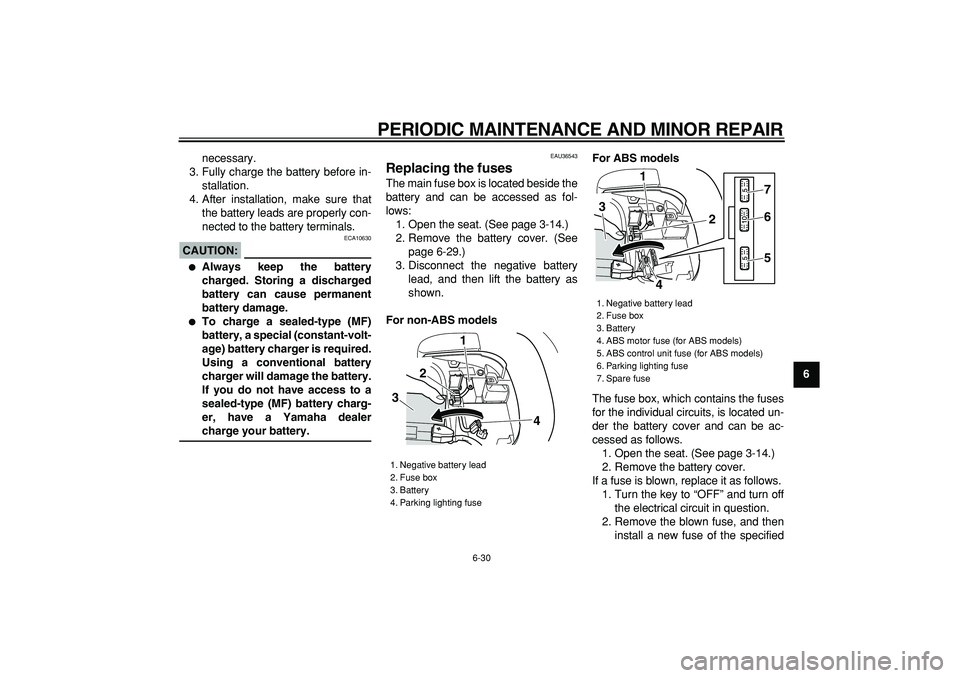
EAU36543
Replacing the fuses
The main fuse box is located beside the
battery and can be accessed as fol-
lows:
1. Open the seat. (See page 3-14.)
2. Remove the battery cover. (See
page 6-29.)
3. Disconnect the negative battery
lead, and then lift the battery as
shown.
For non-ABS modelsFor ABS models
The fuse box, which contains the fuses
for the individual circuits, is located un-
der the battery cover and can be ac-
cessed as follows.
1. Open the seat. (See page 3-14.)
2. Remove the battery cover.
If a fuse is blown, replace it as follows.
1. Turn the key to “OFF” and turn off
the electrical circuit in question.
2. Remove the blown fuse, and then
install a new fuse of the specified
1. Negative battery lead
2. Fuse box
3. Battery
4. Parking lighting fuse1
2
4 3
1. Negative battery lead
2. Fuse box
3. Battery
4. ABS motor fuse (for ABS models)
5. ABS control unit fuse (for ABS models)
6. Parking lighting fuse
7. Spare fuse
1
3
2
4
765
Page 74 of 94
PERIODIC MAINTENANCE AND MINOR REPAIR
6-31
1
2
3
4
5
6
7
8
9
amperage.
NOTE:
To access the main fuse, remove the
main fuse box cover as shown.
For non-ABS models For ABS models
1. Main fuse
2. Spare main fuse
3. Main fuse box cover
21
3
1. Signaling system fuse
2. Headlight fuse
3. Ignition fuse
4. Radiator fan fuse
5. Fuel injection system fuse
6. Backup fuse (for odometer and clock)
7. Spare fuse
7
123456
1. Signaling system fuse
2. Headlight fuse
3. Ignition fuse
4. Radiator fan fuse
5. Fuel injection system fuse
6. Backup fuse (for odometer and clock)
7. Spare fuse
7
123456
Page 75 of 94

PERIODIC MAINTENANCE AND MINOR REPAIR
6-32
2
3
4
5
67
8
9
CAUTION:
ECA10640
Do not use a fuse of a higher amper-
age rating than recommended to
avoid causing extensive damage to
the electrical system and possibly a
fire.
3. Turn the key to “ON” and turn onthe electrical circuit in question to
check if the device operates.
4. If the fuse immediately blows
again, have a Yamaha dealer
check the electrical system.
EAU23760
Replacing the headlight bulb
This model is equipped with a quartz
bulb headlight. If the headlight bulb
burns out, replace it as follows.
1. Disconnect the headlight coupler,
and then remove the bulb cover.
2. Unhook the headlight bulb holder,
and then remove the defective
bulb.
Specified fuses:
Main fuse:
30.0 A
Headlight fuse:
15.0 A
Signaling system fuse:
XP500 20.0 A
XP500A 15.0 A
Ignition fuse:
10.0 A
Parking lighting fuse:
10.0 A
Radiator fan fuse:
15.0 A
Fuel injection system fuse:
10.0 A
ABS control unit fuse:
XP500A 5.0 A
ABS motor fuse:
XP500A 30.0 A
Backup fuse:
10.0 A
1. Headlight coupler
2. Headlight bulb cover
1
2
Page 76 of 94

PERIODIC MAINTENANCE AND MINOR REPAIR
6-33
1
2
3
4
5
6
7
8
9
WARNING
EWA10790
Headlight bulbs get very hot. There-
fore, keep flammable products away
from a lit headlight bulb, and do not
touch the bulb until it has cooled
down.
3. Place a new headlight bulb into po-
sition, and then secure it with the
bulb holder.
CAUTION:
ECA10660
Do not touch the glass part of the
headlight bulb to keep it free from
oil, otherwise the transparency of
the glass, the luminosity of the bulb,and the bulb life will be adversely af-
fected. Thoroughly clean off any dirt
and fingerprints on the headlight
bulb using a cloth moistened with al-
cohol or thinner.
4. Install the headlight bulb cover,
and then connect the coupler.
5. Have a Yamaha dealer adjust the
headlight beam if necessary.
EAU43040
Tail/brake light
If the tail/brake light does not come on,
have a Yamaha dealer check its electri-
cal circuit or replace the bulb.
1. Headlight bulb holder
2. Unhook.
1
2
1. Do not touch the glass part of the bulb.
1

