2007 YAMAHA GIGGLE50 light
[x] Cancel search: lightPage 6 of 72

1
2
3
4
5
6
7
8
9
EAU10210
TABLE OF CONTENTSSAFETY INFORMATION ................... 1-1
Fur ther safe-riding points ............... 1-4
DESCRIPTION ................................... 2-1
Left view ......................................... 2-1
Right view ....................................... 2-2
Controls and instruments ............... 2-3
INSTRUMENT AND CONTROL FUNC-
TIONS ................................................ 3-1
Main switch/steering lock ............... 3-1
Keyhole cover ................................. 3-2
Indicator and warning lights ........... 3-2
Speedometer unit ........................... 3-4
Fuel gauge ...................................... 3-4
Handlebar switches ........................ 3-5
Front brake lever ............................. 3-6
Rear brake lever ............................. 3-6
Fuel tank cap .................................. 3-6
Fuel .................................................3-7
Catalytic converter .......................... 3-8
Kickstarter....................................... 3-8
Seat ................................................3-9
Luggage hook ................................. 3-9
Helmet holder ................................. 3-9
Storage compartment ................... 3-10
PRE-OPERATION CHECKS ............. 4-1
Pre-operation check list .................. 4-2OPERATION AND IMPORTANT RIDING
POINTS .............................................. 5-1
Star ting the engine ......................... 5-1
Star ting off ...................................... 5-2
Acceleration and deceleration ........ 5-2
Braking........................................... 5-2
Engine break-in .............................. 5-3
Parking........................................... 5-3
PERIODIC MAINTENANCE AND MINOR
REPAIR .............................................. 6-1
Periodic maintenance and lubrication
chart............................................ 6-2
Removing and installing panels ..... 6-5
Checking the spark plug ................. 6-6
Engine oil and oil strainer ............... 6-7
Final transmission oil ...................... 6-9
Coolant......................................... 6-10
Replacing the air filter element ..... 6-12
Checking the throttle cable free
play............................................ 6-12
Valve clearance ............................ 6-12
Tires.............................................. 6-13
Cast wheels .................................. 6-15
Adjusting the brake lever free
play............................................ 6-15
Adjusting the rear brake lever free
play............................................ 6-16
Checking the front and rear brake
shoes......................................... 6-16Checking and lubricating the throttle
grip and cable ............................ 6-17
Lubricating the front and rear brake
levers......................................... 6-17
Checking and lubricating the
centerstand............................... 6-18
Checking the front fork ................. 6-18
Checking the steering ................... 6-19
Checking the wheel bearings ....... 6-19
Battery.......................................... 6-20
Replacing the fuse ........................ 6-21
Replacing the headlight bulb ........ 6-22
Replacing the tail/brake light bulb 6-23
Replacing a turn signal light bulb . 6-24
Troubleshooting............................ 6-24
Troubleshooting charts ................. 6-25
SCOOTER CARE AND STORAGE ... 7-1
Care ................................................ 7-1
Storage ........................................... 7-3
SPECIFICATIONS ............................. 8-1
CONSUMER INFORMATION ............ 9-1
Identification numbers .................... 9-1
15P-F8199-E0_ch0.pmd2007/06/13, 11:15 5
Page 10 of 72

1-3
1
2
3
4
5
6
7
8
9
EAU10220
Q QQ Q
Q
SAFETY INFORMATION
When loading within this weight limit,
keep the following in mind:
8Cargo and accessory weight should
be kept as low and close to the
scooter as possible. Make sure to
distribute the weight as evenly as
possible on both sides of the
scooter to minimize imbalance or
instability.
8Shifting weights can create a sud-
den imbalance. Make sure that ac-
cessories and cargo are securely
attached to the scooter before riding.
Check accessory mounts and
cargo restraints frequently.
8Never attach any large or heavy
items to the handlebar, front fork,
or front fender. Such items can cre-
ate unstable handling or a slow
steering response.Accessories
Genuine Yamaha accessories have
been specifically designed for use on
this scooter. Since Yamaha cannot test
all other accessories that may be avail-
able, you must personally be responsible
for the proper selection, installation and
use of non-Yamaha accessories. Useextreme caution when selecting and in-
stalling any accessories.
Keep the following guidelines in mind,
as well as those provided under “Load-
ing” when mounting accessories.
8Never install accessories or carry
cargo that would impair the perfor-
mance of your scooter. Carefully
inspect the accessory before us-
ing it to make sure that it does not
in any way reduce ground clear-
ance or cornering clearance, limit
suspension travel, steering travel
or control operation, or obscure
lights or reflectors.
9Accessories fitted to the
handlebar or the front fork area
can create instability due to
improper weight distribution or
aerodynamic changes. If
accessories are added to the
handlebar or front fork area,
they must be as lightweight as
possible and should be kept to
a minimum.
9Bulky or large accessories may
seriously affect the stability of
the scooter due to aerodynamic
effects. Wind may attempt tolift the scooter, or the scooter
may become unstable in cross
winds. These accessories may
also cause instability when
passing or being passed by
large vehicles.
9Certain accessories can
displace the operator from his
or her normal riding position.
This improper position limits
the freedom of movement of
the operator and may limit
control ability, therefore, such
accessories are not recom-
mended.
8Use caution when adding electrical
accessories. If electrical accesso-
ries exceed the capacity of the
scooter’s electrical system an elec-
tric failure could result, which could
cause a dangerous loss of lights or
engine power.
Gasoline and exhaust gas
8GASOLINE IS HIGHLY FLAM-
MABLE:
9Always turn the engine off
when refueling.
15P-F8199-E0_ch1.pmd2007/06/20, 14:20 3
Page 14 of 72
2-1
1
2
3
4
5
6
7
8
9
DESCRIPTION
EAU10400
DESCRIPTIONPart locations
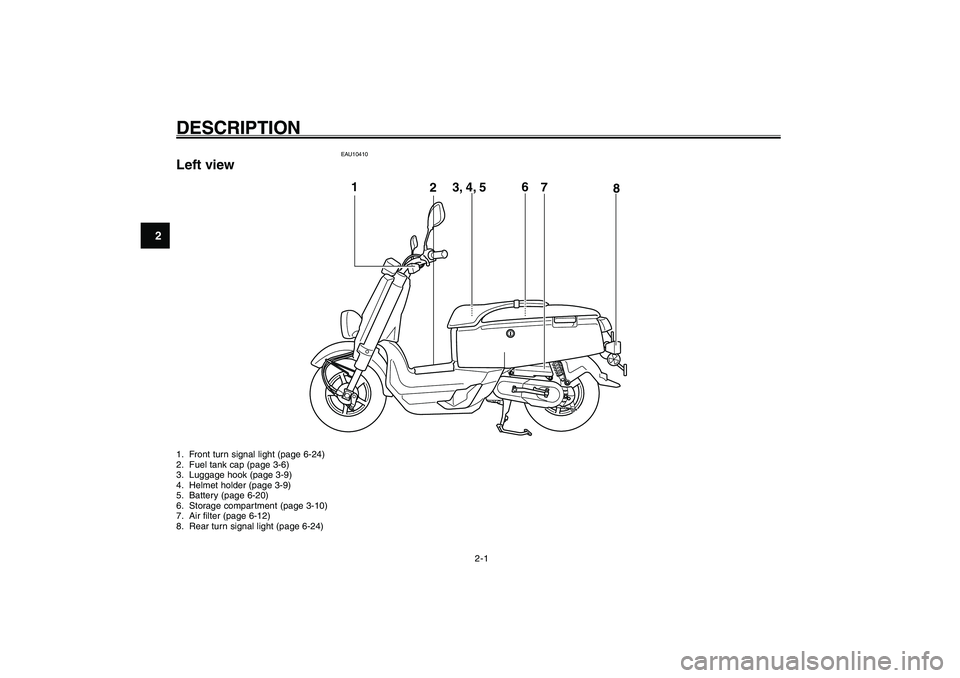
EAU10410
Left view1. Front turn signal light (page 6-24)
2. Fuel tank cap (page 3-6)
3. Luggage hook (page 3-9)
4. Helmet holder (page 3-9)
5. Battery (page 6-20)
6. Storage compartment (page 3-10)
7. Air filter (page 6-12)
8. Rear turn signal light (page 6-24)
1
23, 4, 56
8
7
15P-F8199-E0_ch2.pmd2007/06/13, 11:16 1
Page 15 of 72
2-2
1
2
3
4
5
6
7
8
9
DESCRIPTION
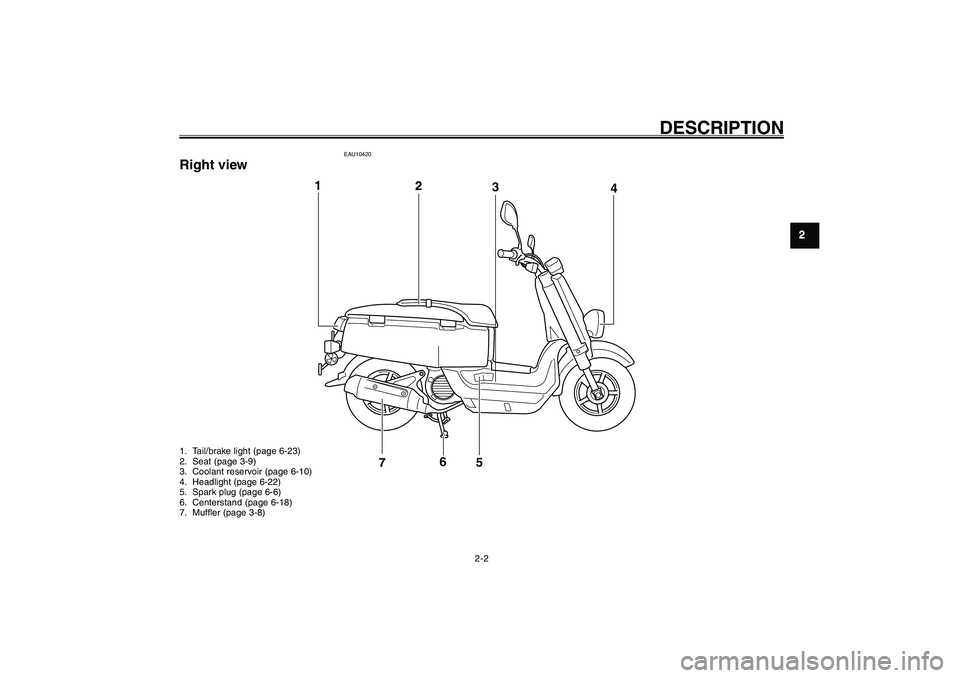
EAU10420
Right view1. Tail/brake light (page 6-23)
2. Seat (page 3-9)
3. Coolant reservoir (page 6-10)
4. Headlight (page 6-22)
5. Spark plug (page 6-6)
6. Centerstand (page 6-18)
7. Muffler (page 3-8)
2
3 1
4
5
6
7
15P-F8199-E0_ch2.pmd2007/06/13, 11:16 2
Page 17 of 72

3-1
1
2
3
4
5
6
7
8
9
INSTRUMENT AND CONTROL FUNCTIONS
EAU1044D
INSTRUMENT AND CONTROL FUNCTIONS
EAU10460
Main switch/steering lockZAUM00**The main switch/steering lock controls
the ignition and lighting systems, and is
used to lock the steering. The various
positions are described below. Main switch/steering lock
EAU10660
OFF
All electrical systems are off. The key
can be removed.
EAU10680
LOCK
The steering is locked, and all electri-
cal systems are off. The key can be re-
moved.To loc
k the steer
ing
ZAUM00**
1
1. Push.1. Turn the handlebars all the way to
the left.
2. Push the key in from the “OFF” po-
sition, and then turn it to “LOCK”
while still pushing it.
3. Remove the key. (15P1/15P2)
EAUT2270
ON
All electrical circuits are supplied with
power, and the meter lighting and tail-
light come on, and the engine can be
started. The key cannot be removed.NOTE:
The headlight comes on automatically
when the engine is started and stays
on until the key is turned to “OFF”.
(15P3/15P4)
EAUT2060
ON
All electrical circuits are supplied with
power, and the meter lighting, taillight,
and license plate light come on, and the
engine can be started. The key cannot
be removed.NOTE:
The headlight comes on automatically
when the engine is started and stays
on until the key is turned to “OFF”, even
if the engine stalls.
15P-F8199-E0_ch3.pmd2007/06/20, 14:21 1
Page 18 of 72

3-2
1
2
3
4
5
6
7
8
9
INSTRUMENT AND CONTROL FUNCTIONS
EAUT2120
Keyhole coverZAUM00**To open the keyhole cover
Insert the key bow into the keyhole
cover receptacle as shown, and then
turn the key to “OPEN” to open the
cover.
To close the keyhole cover
Insert the key bow into the keyhole
cover receptacle as shown, and then
turn the key to “SHUT” to close the
cover. Keyhole cover
Indicator and warning lights
EAU11003
Indicator and warning lights(15P1/15P2/15P4)ZAUM00**
3
24
1
(15P3)ZAUM00**
0102030
40
50
60
3
24
1
1. Turn signal indicator light "5"
2. High beam indicator light "&"
3. Engine trouble warning light "
"
4. Coolant temperature warning light "
"
To unloc
k the steer
ing
12
ZAUM00**1. Turn.
2. Release.Push the key in, and then turn it to “OFF”
while still pushing it.
EWA10060
wNever turn the key to “OFF” or
“LOCK” while the vehicle is moving,
otherwise the electrical systems will
be switched off, which may result in
loss of control or an accident. Make
sure that the vehicle is stopped be-
fore turning the key to “OFF” or
“LOCK”.
15P-F8199-E0_ch3.pmd2007/06/20, 14:21 2
Page 19 of 72

3-3
1
2
3
4
5
6
7
8
9
INSTRUMENT AND CONTROL FUNCTIONS
EAU11020
Turn signal indicator light “
5 55 5
5”
This indicator light flashes when the turn
signal switch is pushed to the left or
right.
EAU11080
High beam indicator light “
& && &
&”
This indicator light comes on when the
high beam of the headlight is switched
on. Turn signal indicator light
High beam indicator light
Coolant temperature warning light
Engine trouble warning light
EAUT1930
Engine trouble warning light “
”
This warning light flashes when an elec-
trical circuit monitoring the engine is
defective. When this occurs, have a
Yamaha dealer check the self-diagno-
sis system.
The electrical circuit of the warning light
can be checked by turning the key to
“ON”. If the warning light does not come
on for a few seconds, then go off, have
a Yamaha dealer check the electrical
circuit.
EAU11440
Coolant temperature warning light
“
”
This warning light comes on when the
engine overheats. When this occurs,
stop the engine immediately and allow
the engine to cool.
The electrical circuit of the warning light
can be checked by turning the key to
“ON”.
If the warning light does not come on
for a few seconds, then go off, have a
Yamaha dealer check the electrical cir-
cuit.
ECA10020
cCDo not operate the engine if it is over-
heated.
15P-F8199-E0_ch3.pmd2007/06/20, 14:21 3
Page 21 of 72
3-5
1
2
3
4
5
6
7
8
9
INSTRUMENT AND CONTROL FUNCTIONS
The fuel gauge indicates the amount of
fuel in the fuel tank. The needle moves
towards “E” (Empty) as the fuel level
decreases. When the needle reaches
the red line, refuel as soon as possible.NOTE:
Do not allow the fuel tank to empty it-
self completely.
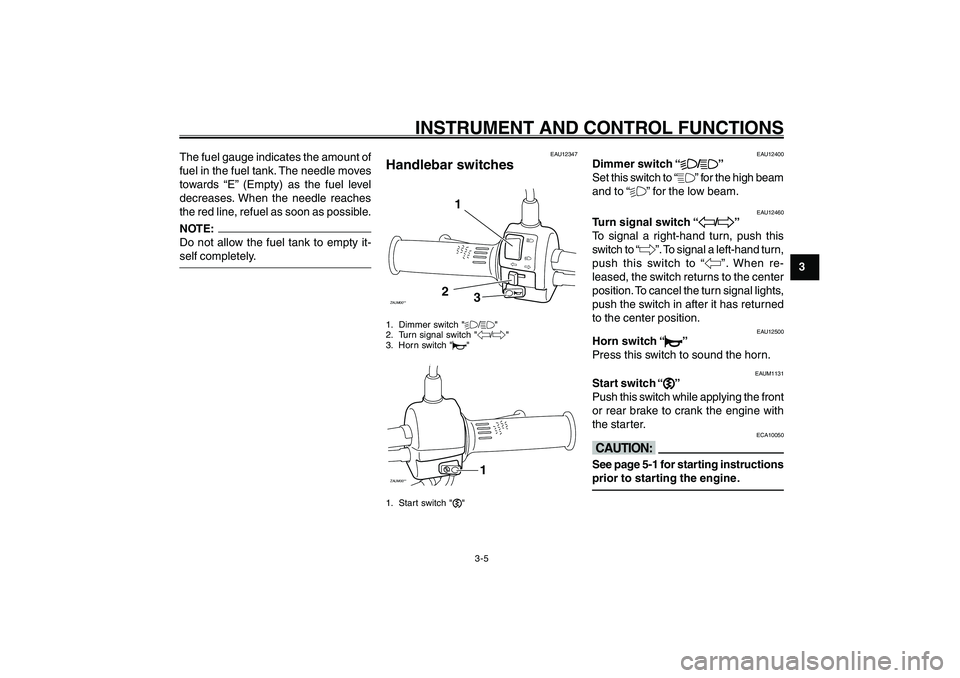
EAU12347
Handlebar switchesZAUM00**
1
2
3
1. Dimmer switch "%/&"
2. Turn signal switch "4/6"
3. Horn switch "*"ZAUM00**
1
1. Start switch ","
Handlebar switches
Dimmer switch
Turn signal switch
Horn switch
Start switch
EAU12400
Dimmer switch “
% %% %
%/
& && &
&”
Set this switch to “&” for the high beam
and to “%” for the low beam.
EAU12460
Turn signal switch “
4 44 4
4/
6 66 6
6”
To signal a right-hand turn, push this
switch to “6”. To signal a left-hand turn,
push this switch to “4”. When re-
leased, the switch returns to the center
position. To cancel the turn signal lights,
push the switch in after it has returned
to the center position.
EAU12500
Horn switch “
* ** *
*”
Press this switch to sound the horn.
EAUM1131
Start switch “
, ,, ,
,”
Push this switch while applying the front
or rear brake to crank the engine with
the starter.
ECA10050
cCSee page 5-1 for starting instructions
prior to starting the engine.
15P-F8199-E0_ch3.pmd2007/06/20, 14:21 5