2007 VOLVO XC90 interior
[x] Cancel search: interiorPage 6 of 268

2007 Volvo XC90
driving safely. Distraction can lead to a serious accident.In addition t\
o this general warning, we offer the
following guidance regarding specific newer features that may be found i\
n your vehicle:
l Never use a hand-held cellular telephone while driving. Some jurisdictio\
ns prohibit cellular telephone
use by a driver while the vehicle is moving.
l If your vehicle is equipped with a navigation system, set and make chang\
es to your travel itinerary only
with the vehicle parked.
l Never program your audio system while the vehicle is moving. Program rad\
io presets with the vehicle
parked, and use your programmed presets to make radio use quicker and si\
mpler.
l Never use portable computers or personal digital assistants while the ve\
hicle is moving.
A driver has a responsibility to do everything possible to ensure his or\
her own safety and the safety of
passengers in the vehicle and others sharing the roadway. Avoiding distr\
actions is part of that
responsibility.
pg. 6 Introduction
This page left intentionally blank.
pg. 7 Introduction
Contents
Safety
Instruments and controls
Climate control
Interior
Locks and alarm
Starting and driving
Wheels and tires
Vehicle care
Maintenance
Specifications
file:///K|/ownersdocs/2007/2007_XC90/07xc90_00.htm (6 of 7)12/30/2006 \
5:53:31 PM
Page 29 of 268

2007 Volvo XC90
for your child restraint can result in your child striking the vehicle's\
interior in a sudden stop.
Holding a child in your arms is NOT a suitable substitute for a child re\
straint system. In an accident, a
child held in a person's arms can be crushed between the vehicle's inter\
ior and an unrestrained person.
The child could also be injured by striking the interior, or by being ej\
ected from the vehicle during a
sudden maneuver or impact. The same can also happen if the infant or chi\
ld rides unrestrained on the
seat. Other occupants should also be properly restrained to help reduce \
the chance of injuring or
increasing the injury of a child.
All states and provinces have legislation governing how and where childr\
en should be carried in a
vehicle. Find out the regulations existing in your state or province. Re\
cent accident statistics have shown
that children are safer in rear seating positions than front seating pos\
itions when properly restrained. A
child restraint system can help protect a child in a vehicle. Here's wha\
t to look for when selecting a child
restraint system:
l It should have a label certifying that it meets applicable Federal Motor\
Vehicle Safety Standards
(FMVSS 213) - or in Canada, CMVSS 213.
l Make sure the child restraint system is approved for the child's height,\
weight and development - the
label required by the standard or regulation, or instructions for infant\
restraints, typically provide this
information.
l In using any child restraint system, we urge you to carefully look over \
the instructions that are
provided with the restraint. Be sure you understand them and can use the\
device properly and safely in
this vehicle. A misused child restraint system
pg. 29 Safety
Child safety
can result in increased injuries for both the infant or child and other \
occupants in the vehicle.
When a child has outgrown the child safety seat, you should use the rear\
seat with the standard seat belt
fastened. The best way to help protect the child here is to place the ch\
ild on a cushion so that the seat
belt is properly located on the hips (see the illustration on
page 40). Legislation in your state or province
may mandate the use of a child seat or cushion in combination with the s\
eat belt, depending on the
child's age and/or size. Please check local regulations.
A specially designed and tested booster cushion (not available in Canad\
a) can be obtained from your
Volvo retailer for children weighing 33 - 80 lb. (15 - 36 kg) and 38-5\
4 inches (97 - 137 cm) in height.
file:///K|/ownersdocs/2007/2007_XC90/07xc90_01.htm (22 of 39)12/30/200\
6 5:53:33 PM
Page 30 of 268
 in")
2007 Volvo XC90
WARNING!
l Do not use child safety seats or child booster cushions/backrests in the\
front passenger's seat. We
also recommend that children under 4 feet 7 inches (140 cm) in height \
who have outgrown these
devices sit in the rear seat with the seat belt fastened.
l On hot days, the temperature in the vehicle interior can rise very quick\
ly. Exposure to these high
temperatures for even a short period of time can cause heat-related inju\
ry or death. Small children are
particularly at risk.
pg. 30 Safety
Child safety
Automatic Locking Retractor/ Emergency Locking Retractor
To make child seat installation easier, each seat belt (except for the \
driver's belt) is equipped with a
locking mechanism to help keep the seat belt taut.
When attaching the seat belt to a child seat:
- Attach the seat belt to the child seat according to the child seat man\
ufacturer's instructions.
- Pull the seat belt out as far as possible.
- Insert the seat belt latch plate into the buckle (lock) in the usual\
way.
- Release the seat belt and pull it taut around the child seat.
A sound from the seat belt retractor will be audible at this time and is\
normal.
The belt will now be locked in place.
This function is automatically disabled when the seat belt is unlocked an\
d the belt is fully
retracted.
WARNING!
Do not use child safety seats or child booster cushions/backrests in the\
front passenger's seat. We also
recommend that children who have outgrown these devices sit in the rear \
seat with the seat belt
properly fastened.
Volvo's recommendations
Why does Volvo believe that no child should sit in the front seat of a v\
ehicle? It's quite simple really. A
front airbag is a very powerful device designed, by law, to help protect\
an adult.
Because of the size of the airbag and its speed of inflation, a child sh\
ould never be placed in the front
file:///K|/ownersdocs/2007/2007_XC90/07xc90_01.htm (23 of 39)12/30/200\
6 5:53:33 PM
Page 93 of 268

- Press the switch once for maximum seat he")
2007 Volvo XC90
to manually adjust air flow. An LED in the switch will light up if an ai\
r flow control has been pressed.
Heated front seats (option)
- Press the switch once for maximum seat heating. Both LEDs in the switc\
h will be lit.
- Press the switch a second time for comfort heating. One LED in the swi\
tch will be lit.
- Press the switch a third time to turn the heating off completely. The \
LED will go off.
The seat heating for the passenger seat should be switched off when the \
seat is not occupied.
A/C - ON/OFF
Press the switch to turn the air conditioning on or off. The "ON" or "OF\
F" LED will light up to indicate if the
system is switched on or off. Other functions will still be regulated au\
tomatically (if the AUTO switch is on).
l The air conditioning functions only at temperatures above 32 °F (0 °\
C).
l While the Defroster function is selected, the air conditioning is tempor\
arily activated to dehumidify the air,
even if you have manually switched the air conditioning off. This will o\
nly function if the blower is not switched
off.
Recirculation
Press this switch to engage the recirculation function (air in the pass\
enger compartment recirculates - no fresh air
enters the compartment). The LED in the switch will light up to indicat\
e that the function is engaged.
l Use this function if the outside air is contaminated with exhaust gases,\
smoke, etc or to heat/cool the vehicle
quickly.
l Recirculation should not be used for more than 15 minutes. If your windo\
ws begin to fog or mist, make sure
that the recirculation function is switched off.
l Selecting Defroster automatically switches recirculation off.
l Timer mode activation: (Vehicles equipped with the Interior Air Quality\
system have no timer mode) Press and
hold the recirculation button for at least 3 seconds to activate a recir\
culation timer mode. The amber LED in the
recirculation button will flash 5 times to show that the timer mode is b\
eing activated. In timer mode, each time
the recirculation button is pressed, the climate control system will rec\
irculate the air in the passenger
compartment for 5-12 minutes, depending on the outside air temperature, \
and then revert back to fresh air.
l Timer mode deactivation: Press and hold the recirculation button for 3 s\
econds. The amber LED in the
recirculation button will illuminate steadily for 5 seconds to show a re\
turn to "normal" mode.
l In normal mode, when the recirculation button is pressed, the climate co\
ntrol
file:///K|/ownersdocs/2007/2007_XC90/07xc90_03.htm (7 of 8)12/30/2006 \
5:53:38 PM
Page 94 of 268

system will recirculate the air in the passenger compartment until the r\
ecirculation button is pressed again.
l Timer")
2007 Volvo XC90
pg. 82 Climate control
Electronic climate control (ECC)
system will recirculate the air in the passenger compartment until the r\
ecirculation button is pressed again.
l Timer mode memory: If the vehicle is turned off while timer mode is acti\
ve, timer mode will still be active
when the vehicle is restarted.
Interior air quality sensor (option)
Some vehicles are equipped with a multi-filter and air quality sensor. T\
he filter separates gases and particles,
thereby reducing the amounts of odors and contaminants entering the vehi\
cle. The air quality sensor detects
increased levels of contaminants in the outside air. When the air qualit\
y sensor detects contaminated outside air,
the air intake closes and the air inside the passenger compartment is re\
circulated, i.e. no outside air enters the
vehicle. The filter also cleans recirculated passenger compartment air. \
When the ECC system is in the AUTO mode, the green LED will be on
.
Operation
Press
to operate the air quality sensor (normal setting).
or:
Select one of the following three functions by pressing
1, 2 or 3 times.
1. The AUT LED lights. The air quality sensor is now activated.
2. No LED lights. Recirculation is not activated unless needed to cool t\
he passenger compartment in a warm
climate.
3. The MAN LED lights. Recirculation is now activated.
Keep in mind the following:
l Make it a rule to have the air quality sensor activated at all times.
l Recirculation is limited in cold climates to avoid fogging.
l If window fogging occurs, you should deactivate the air quality sensor. \
l If fogging occurs, use the defroster functions for the windshield, side \
windows and rear window. See page 80.
l The filter should be changed at the intervals recommended in the service\
schedule. However, if the vehicle is
used in a severely contaminated environment, it may be necessary to chan\
ge the filter more frequently.
Contents | Top of Page
file:///K|/ownersdocs/2007/2007_XC90/07xc90_03.htm (8 of 8)12/30/2006 \
5:53:38 PM
Page 95 of 268
2007 Volvo XC90
2 0 0 7
VOLVO XC90
Interior
pg. 83 Interior
Front seats
84
Rear seats
88
Interior lighting
91
Storage
compartments
93
Securing cargo
97
pg. 84 Interior
Front seats
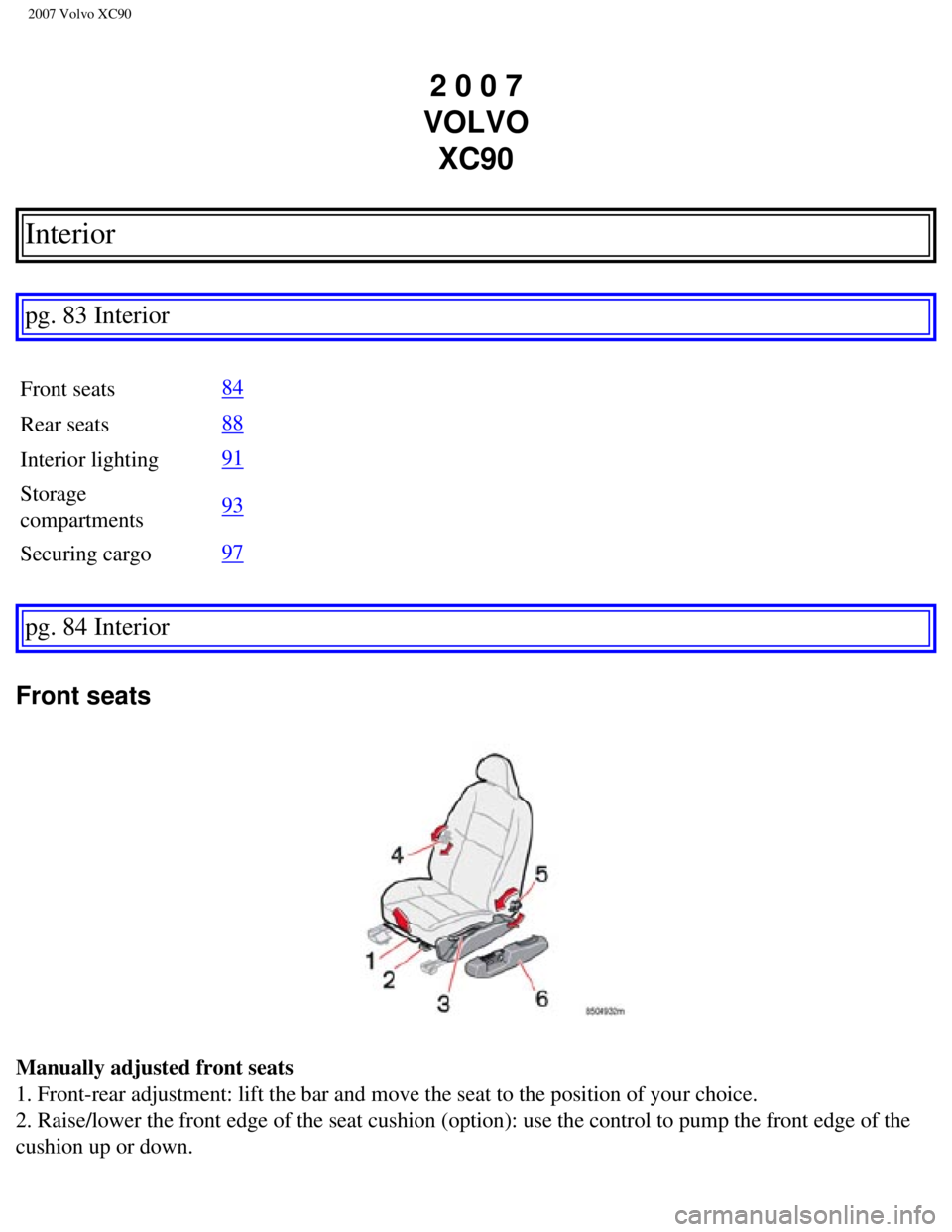
Manually adjusted front seats
1. Front-rear adjustment: lift the bar and move the seat to the position\
of your choice.
2. Raise/lower the front edge of the seat cushion (option): use the co\
ntrol to pump the front edge of the
cushion up or down.
file:///K|/ownersdocs/2007/2007_XC90/07xc90_04.htm (1 of 23)12/30/2006\
5:53:40 PM
Page 96 of 268

2007 Volvo XC90
3. Raise/lower seat height: pump the seat up or down.
4. Lumbar support: turn the control for firmer or softer lumbar support.\
5. Backrest tilt: turn the control to adjust the angle of the backrest. \
6. Control panel for optional power seat (see
page 86 for more information).
WARNING!
l Do not adjust the seat while driving. The seat should be adjusted so tha\
t the brake pedal can be
depressed fully. In addition, position the seat as far rearward as comfo\
rt and control allow.
l Check that the seat is securely locked into position after adjusting.
pg. 85 Interior
Front seats
Folding the backrests in the front seat
The front passenger seat backrest can be folded to a horizontal position\
to make room for a long load.
Fold the backrest as follows:
- Move the seat as far back as possible.
- Adjust the backrest to the upright position.
- Lift the catches on the rear of the backrest.
- Without releasing the catches, push the backrest forward.
- Move the seat as far forward as possible so that the head restraint sl\
ides under the glove compartment.
file:///K|/ownersdocs/2007/2007_XC90/07xc90_04.htm (2 of 23)12/30/2006\
5:53:40 PM
Page 97 of 268

2007 Volvo XC90
WARNING!
Cover sharp edges on the load to help prevent injury to occupants. Secur\
e the load to help prevent
shifting during sudden stops.
pg. 86 Interior
Front seats
Power seat - (option on certain models)
Operation
Driver's seat: The seat can be adjusted if the ignition key is in position I, II or if\
the engine is running.
It can also be adjusted as follows with the ignition off:
l Within several minutes after the driver's door has been unlocked from th\
e outside, has been opened,
and remains open.
l Within a short period if the driver's door has just been closed.
l Within a short period if the driver's door has not been opened after the\
ignition has been switched off.
Passenger seat: The seat can only be adjusted if the ignition key is in position I, II o\
r if the engine is
running.
Power seat adjustment controls
Seat adjustment
Adjust the power seat(s) with the two controls at the side of the seat\
as follows:
1. Front edge of seat (raise/lower)
2. Forward - rearward
3. Rear edge of seat (raise/lower)
4. Backrest tilt
NOTE: The power seats have an overload protector that activates if a seat is \
blocked by any object. If
file:///K|/ownersdocs/2007/2007_XC90/07xc90_04.htm (3 of 23)12/30/2006\
5:53:40 PM