Page 224 of 313

2162007 YARIS HATCHBACK from Feb. ’07Prod. (OM52754U)
BRAKE AND SAFETY CHAINS
�Toyota recommends trailers with
brakes that conform to any applica-
ble federal and state/provincial regu-
lations.
�A safety chain must always be used
between the towing vehicle and the
trailer. Leave sufficient slack in the
chain for turns. The chain should
cross under the trailer tongue to
prevent the tongue from dropping to
the ground in case it becomes dam-
aged or separated. For correct safety
chain procedures, follow the hitch or
trailer manufacturer ’s recommenda-
tion.
CAUTION
�Never tap into your vehicle’s hy-
draulic system as it would lower its
braking effectiveness.
�Never tow a trailer without using a
safety chain securely attached to
both the trailer and the vehicle. If
damage occurs to the coupling unit
or hitch ball, there is danger of the
trailer wandering over into another
lane.
TIRES
�Ensure that your vehicle’s tires are
properly inflated. See page 274 in Sec-
tion 7−2 and page 299 in Section 8 for
instructions.
�The trailer tires should be inflated to
the pressure recommended by the trail-
er manufacturer in respect to the total
trailer weight.
TRAILER LIGHTS
�Trailer lights must comply with federal,
state/provincial and local regulations.
See your local recreational vehicle
dealer or rental agency for the correct
type of wiring and relays for your trail-
er. Check for correct operation of the
turn signals and stop lights each time
you hitch up. Direct splicing may dam-
age your vehicle’s electrical system
and cause a malfunction of your lights.
BREAKIN SCHEDULE
�Toyota recommends that you do not
tow a trailer with a new vehicle or a
vehicle with any new power train com-
ponent (engine, transmission, differen-
tial, wheel bearing, etc.) for the first
800 km (500 miles) of driving. MAINTENANCE
�If you tow a trailer, your vehicle will
require more frequent maintenance due
to the additional load. For this
information, please refer to the
scheduled maintenance information in
the “Scheduled Maintenance Guide” or
“Owner ’s Manual Supplement”.
�Retighten all fixing bolts of the towing
ball and bracket after approximately
1000 km (600 miles) of trailer driving.
PRETOWING SAFETY CHECK
�Check that your vehicle remains level
when a loaded or unloaded trailer is
hitched. Do not drive if the vehicle has
an abnormal nose −up or nose −down
condition, and check for improper
tongue load, overload, worn suspension
or other possible causes.
�Make sure the trailer cargo is securely
loaded so that it can not shift.
�Check that your rear view mirrors con-
form to any applicable federal, state/
provincial or local regulations. If not,
install the rear view mirrors required
for towing purpose.
Page 241 of 313
2332007 YARIS HATCHBACK from Feb. ’07Prod. (OM52754U)
3. Remove the wheel ornament.
Pry off the wheel ornament, using the
beveled end of the wheel nut wrench
as shown.
CAUTION
Do not try to pull off the orna-
ment by hand. Take due care in
handling the ornament to avoid
unexpected personal injury.
—Loosening wheel nuts
PS41508
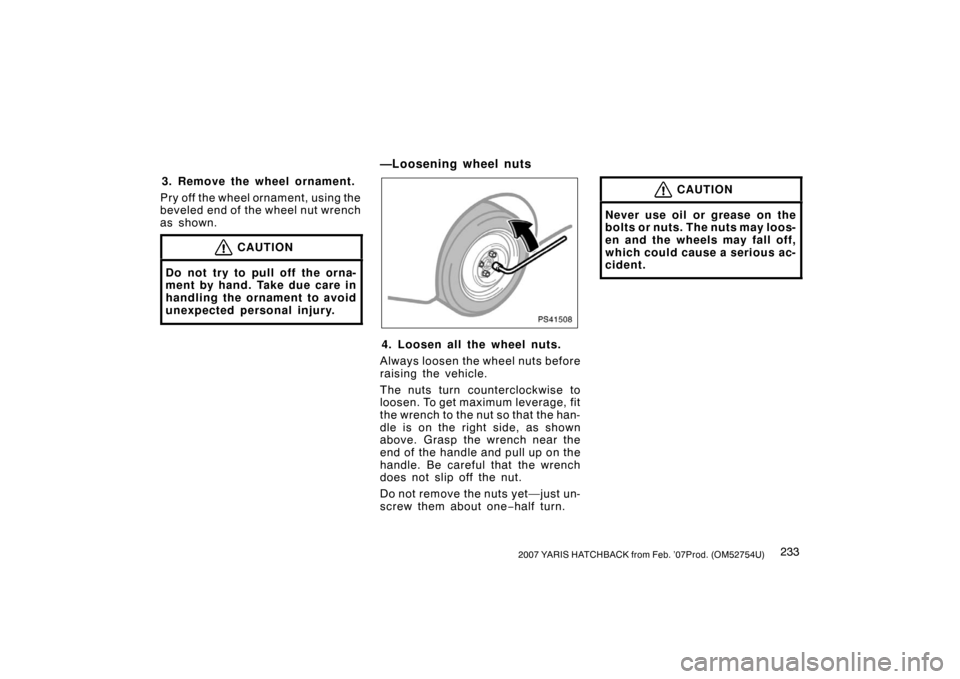
4. Loosen all the wheel nuts.
Always loosen the wheel nuts before
raising the vehicle.
The nuts turn counterclockwise to
loosen. To get maximum leverage, fit
the wrench to the nut so that the han-
dle is on the right side, as shown
above. Grasp the wrench near the
end of the handle and pull up on the
handle. Be careful that the wrench
does not slip off the nut.
Do not remove the nuts yet—just un-
screw them about one −half turn.
CAUTION
Never use oil or grease on the
bolts or nuts. The nuts may loos-
en and the wheels may fall off,
which could cause a serious ac-
cident.
Page 243 of 313
2352007 YARIS HATCHBACK from Feb. ’07Prod. (OM52754U)
—Changing wheels
NS41511
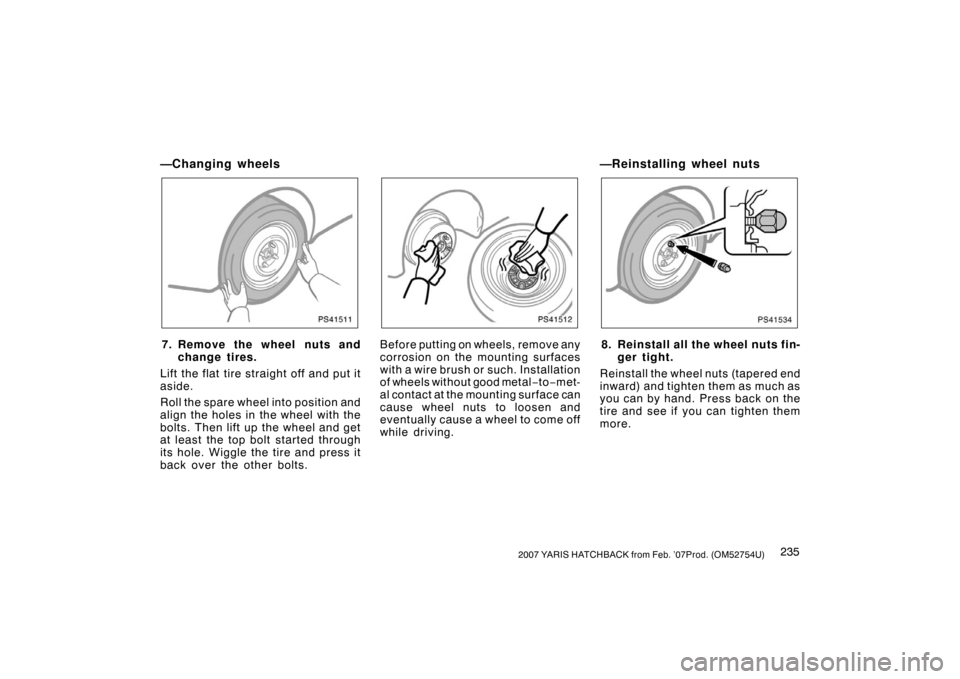
7. Remove the wheel nuts andchange tires.
Lift the flat tire straight off and put it
aside.
Roll the spare wheel into position and
align the holes in the wheel with the
bolts. Then lift up the wheel and get
at least the top bolt started through
its hole. Wiggle the tire and press it
back over the other bolts.
NS41512
Before putting on wheels, remove any
corrosion on the mounting surfaces
with a wire brush or such. Installation
of wheels without good metal− to−met-
al contact at the mounting surface can
cause wheel nuts to loosen and
eventually cause a wheel to come off
while driving.
—Reinstalling wheel nuts
PS41534
8. Reinstall all the wheel nuts fin- ger tight.
Reinstall the wheel nuts (tapered end
inward) and tighten them as much as
you can by hand. Press back on the
tire and see if you can tighten them
more.
Page 244 of 313
2362007 YARIS HATCHBACK from Feb. ’07Prod. (OM52754U)
CAUTION
Never use oil or grease on the
bolts or nuts. Doing so may lead
to overtightening the nuts and
damaging the bolts. The nuts
may loosen and the wheels may
fall off, which could cause a seri-
ous accident. If there is oil or
grease on any bolt or nut, clean
it.
—Lowering your vehicle
PS41514
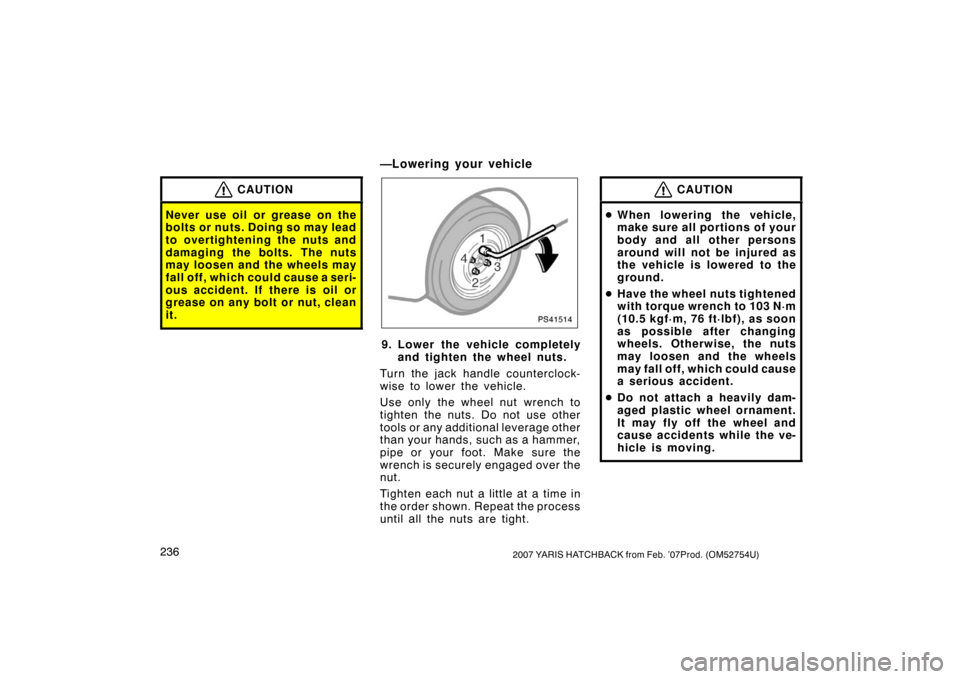
9. Lower the vehicle completelyand tighten the wheel nuts.
Turn the jack handle counterclock-
wise to lower the vehicle.
Use only the wheel nut wrench to
tighten the nuts. Do not use other
tools or any additional leverage other
than your hands, such as a hammer,
pipe or your foot. Make sure the
wrench is securely engaged over the
nut.
Tighten each nut a little at a time in
the order shown. Repeat the process
until all the nuts are tight.
CAUTION
� When lowering the vehicle,
make sure all portions of your
body and all other persons
around will not be injured as
the vehicle is lowered to the
ground.
� Have the wheel nuts tightened
with torque wrench to 103 N·m
(10.5 kgf·m, 76 ft·lbf), as soon
as possible after changing
wheels. Otherwise, the nuts
may loosen and the wheels
may fall off, which could cause
a serious accident.
� Do not attach a heavily dam-
aged plastic wheel ornament.
It may fly off the wheel and
cause accidents while the ve-
hicle is moving.