Page 556 of 611
5472007 TUNDRA from Jul. ’07 Prod. (OM34463U)
If either of the above parts are extremely
dirty or you are not sure of their condi-
tion, take your vehicle to a Toyota dealer.
CAUTION
To prevent burning yourself, be care-
ful not to touch the radiator or con-
denser when the engine is hot.
NOTICE
To prevent damage to the radiator
and condenser, do not perform the
work by yourself.
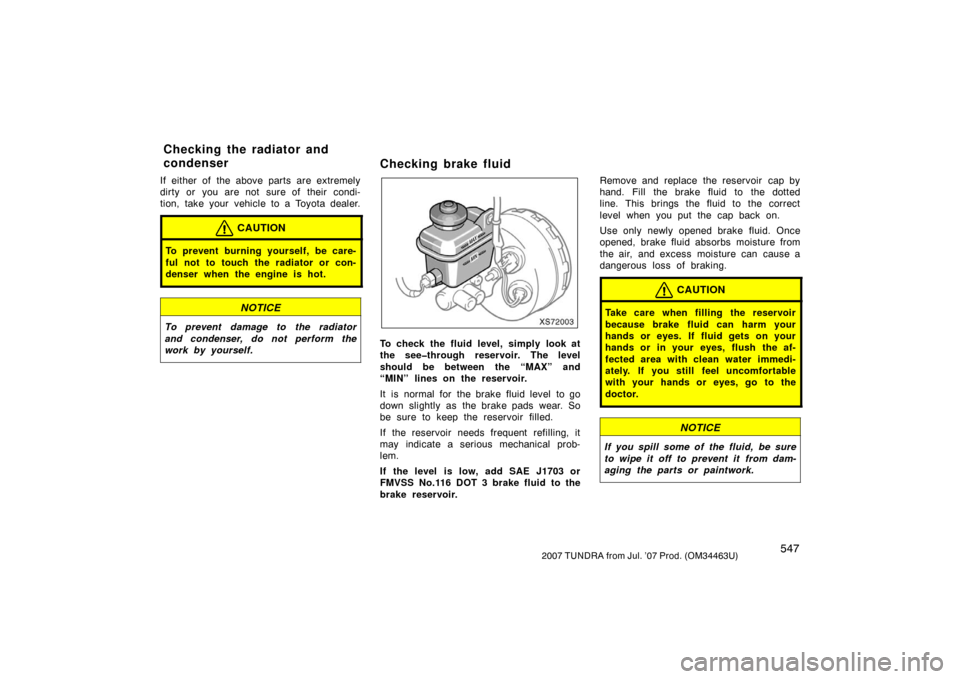
Checking brake fluid
XS72003
To check the fluid level, simply look at
the seethrough reservoir. The level
should be between the “MAX” and
“MIN” lines on the reservoir.
It is normal for the brake fluid level to go
down slightly as the brake pads wear. So
be sure to keep the reservoir filled.
If the reservoir needs frequent refilling, it
may indicate a serious mechanical prob-
lem.
If the level is low, add SAE J1703 or
FMVSS No.116 DOT 3 brake fluid to the
brake reservoir. Remove and replace the reservoir cap by
hand. Fill the brake fluid to the dotted
line. This brings the fluid to the correct
level when you put the cap back on.
Use only newly opened brake fluid. Once
opened, brake fluid absorbs moisture from
the air, and excess moisture can cause a
dangerous loss of braking.
CAUTION
Take care when filling the r
eservoir
because brake fluid can harm your
hands or eyes. If fluid gets on your
hands or in your eyes, flush the af-
fected area with clean water immedi-
ately. If you still feel uncomfortable
with your hands or eyes, go to the
doctor.
NOTICE
If you spill some of the fluid, be sure
to wipe it off to prevent it from dam-
aging the parts or paintwork.
Checking the radiator and
condenser
Page 557 of 611
5482007 TUNDRA from Jul. ’07 Prod. (OM34463U)
XS72005
If hot
O.K.OpenIf cold
O.K.
If hot
add If cold
add
Close
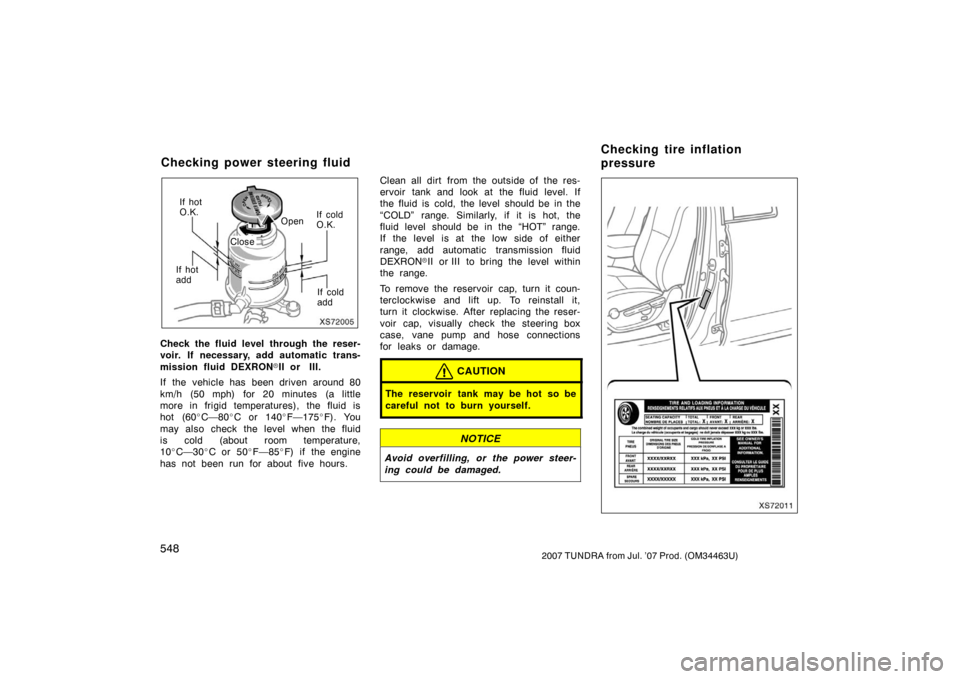
Check the fluid level through the reser-
voir. If necessary, add automatic trans-
mission fluid DEXRON�II or III.
If the vehicle has been driven around 80
km/h (50 mph) for 20 minutes (a little
more in frigid temperatures), the fluid is
hot (60 �C—80 �C or 140 �F—175 �F). You
may also check the level when the fluid
is cold (about room temperature,
10 �C—30 �C or 50 �F—85 �F) if the engine
has not been run for about five hours. Clean all dirt from the outside of the res-
ervoir tank and look at the fluid level. If
the fluid is cold, the level should be in the
“COLD” range. Similarly, if it is hot, the
fluid level should be in the “HOT” range.
If the level is at the low side of either
range, add automatic transmission fluid
DEXRON
�II or III to bring the level within
the range.
To remove the reservoir cap, turn it coun-
terclockwise and lift up. To reinstall it,
turn it clockwise. After replacing the reser-
voir cap, visually check the steering box
case, vane pump and hose connections
for leaks or damage.
CAUTION
The reservoir tank may be hot so be
careful not to burn yourself.
NOTICE
Avoid overfilling, or the power steer-
ing could be damaged.
XS72011
Checking power steering fluid Checking tire inflation
pressure
Page 569 of 611

5612007 TUNDRA from Jul. ’07 Prod. (OM34463U)
NOTICE
�Be sure the engine and all accesso-
ries are off before performing main-
tenance.
� When checking the battery, remove
the ground cable from the negative
terminal (“” mark) first and rein-
stall it last.
� Be careful not to cause a short cir-
cuit with tools.
� Take care no solution gets into the
battery when washing it.
If the battery is disconnected or run
down, the moon roof may not operate
automatically and the jam protection func-
tion will not function correctly after you
reconnect, replace or recharge the battery.
In any of these cases, you should normal-
ize the moon roof. To normalize the moon
roof, see “Electric moon roof” on page 43
in Section 1 −2.
Ty p e A
Green Dark Clear or
light yellow
Ty p e B Blue White Red
CHECKING BY INDICATOR
Check the battery condition by the indi-
cator color.
Indicator color
ConditionTy p e ATy p e B
GreenBlueGood
DarkWhite
Charging necessary.
Have battery checked
by your Toyota
dealer.
Clear orlight
yellow
Red
Have battery checked
by your Toyota
dealer.
During recharging, the battery is pro-
ducing hydrogen gas.
Therefore, before recharging:
1. If recharging with the battery installed on the vehicle, be sure to disconnect
the ground cable.
2. Be sure the power switch on the re- charger is off when connecting the
charger cables to the battery and when
disconnecting them.
CAUTION
�Always charge the battery in an un-
confined area. Do not charge the
battery in a garage or closed room
where there is not sufficient ventila-
tion.
�Only do a slow charge (5 A or
less). Charging at a quicker rate is
dangerous. The battery may ex-
plode, causing personal injuries.
NOTICE
Never recharge the battery while the
engine is running. Also, be sure all
accessories are turned off.
—Checking battery fluid Battery recharging precautions
Page 571 of 611
5632007 TUNDRA from Jul. ’07 Prod. (OM34463U)
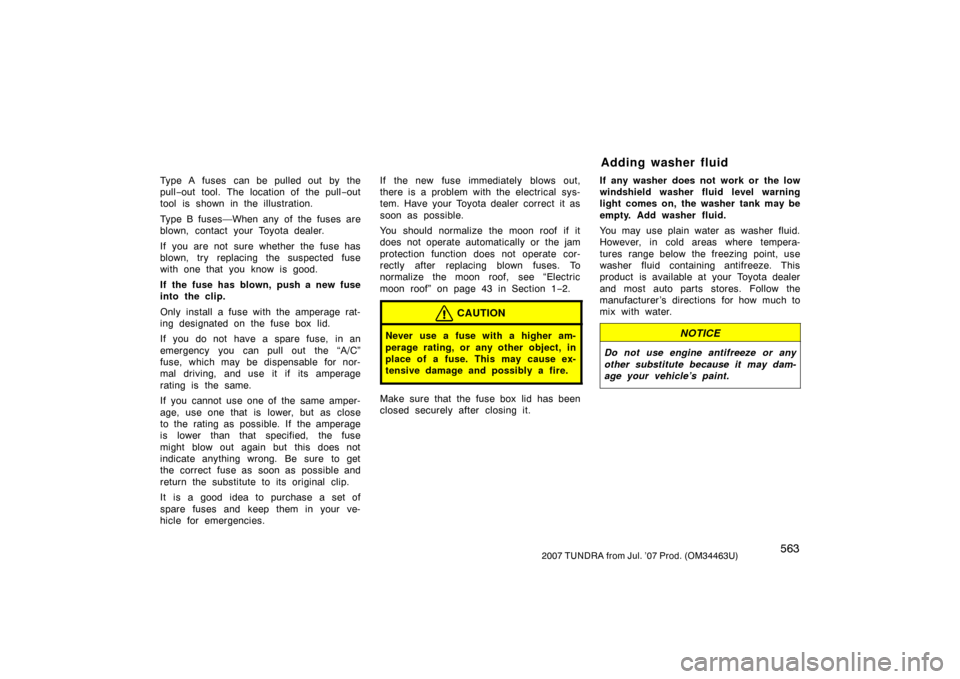
Type A fuses can be pulled out by the
pull−out tool. The location of the pull −out
tool is shown in the illustration.
Type B fuses—When any of the fuses are
blown, contact your Toyota dealer.
If you are not sure whether the fuse has
blown, try replacing the suspected fuse
with one that you know is good.
If the fuse has blown, push a new fuse
into the clip.
Only install a fuse with the amperage rat-
ing designated on the fuse box lid.
If you do not have a spare fuse, in an
emergency you can pull out the “A/C”
fuse, which may be dispensable for nor-
mal driving, and use it if its amperage
rating is the same.
If you cannot use one of the same amper-
age, use one that is lower, but as close
to the rating as possible. If the amperage
is lower than that specified, the fuse
might blow out again but this does not
indicate anything wrong. Be sure to get
the correct fuse as soon as possible and
return the substitute to its original clip.
It is a good idea to purchase a set of
spare fuses and keep them in your ve-
hicle for emergencies. If the new fuse immediately blows out,
there is a problem with the electrical sys-
tem. Have your Toyota dealer correct it as
soon as possible.
You should normalize the moon roof if it
does not operate automatically or the jam
protection function does not operate cor-
rectly after replacing blown fuses. To
normalize the moon roof, see “Electric
moon roof” on page 43 in Section 1
−2.
CAUTION
Never use a fuse with a higher am-
perage rating, or any other object, in
place of a fuse. This may cause ex-
tensive damage and possibly a fire.
Make sure that the fuse box lid has been
closed securely after closing it. If any washer does not work or the low
windshield washer fluid level warning
light comes on, the washer tank may be
empty. Add washer fluid.
You may use plain water as washer fluid.
However, in cold areas where tempera-
tures range below the freezing point, use
washer fluid containing antifreeze. This
product is available at your Toyota dealer
and most auto parts stores. Follow the
manufacturer ’s directions for how much to
mix with water.
NOTICE
Do not use engine antifreeze or any
other substitute because it may dam-
age your vehicle’s paint.
Adding washer fluid
Page 581 of 611

SPECIFICATIONS
Specifications
Dimensions574
. . . . . . . . . . . . . . . . . . . . . . . . . . . . . . . . . . . . \
. . . . . . . . . . . .
Vehicle c")
5732007 TUNDRA from Jul. ’07 Prod. (OM34463U)
SPECIFICATIONS
Specifications
Dimensions574
. . . . . . . . . . . . . . . . . . . . . . . . . . . . . . . . . . . . \
. . . . . . . . . . . .
Vehicle capacity weight 576
. . . . . . . . . . . . . . . . . . . . . . . . . . . . . . . . . . . . \
.
Towing capacity 579
. . . . . . . . . . . . . . . . . . . . . . . . . . . . . . . . . . . . \
. . . . . . . .
Engine 582
. . . . . . . . . . . . . . . . . . . . . . . . . . . . . . . . . . . . \
. . . . . . . . . . . . . . . .
Fuel 582
. . . . . . . . . . . . . . . . . . . . . . . . . . . . . . . . . . . . \
. . . . . . . . . . . . . . . . . . .
Service specifications 582
. . . . . . . . . . . . . . . . . . . . . . . . . . . . . . . . . . . . \
. . .
Tires 586
. . . . . . . . . . . . . . . . . . . . . . . . . . . . . . . . . . . . \
. . . . . . . . . . . . . . . . . .
Fuses 587
. . . . . . . . . . . . . . . . . . . . . . . . . . . . . . . . . . . . \
. . . . . . . . . . . . . . . . .
SECTION 8
Page 584 of 611
5762007 TUNDRA from Jul. ’07 Prod. (OM34463U)
Vehicle capacity weight
kg (lb.)
Cab type
EngineDriving systemBed typeVehicle capacity weight
Regular
4.0 L V6 (1GR −FE)Tw o −wheel drive modelsStandard675 (1495)
Long710 (1575)
4.7 L V8 (2UZ −FE)
Tw o −wheel drive models
Standard780 (1730)
750 (1655)∗
1
Long830 (1830)
795 (1755)∗1
Four −wheel drive models
Standard755 (1670)
720 (1595)∗
1
Long800 (1765)
765 (1690)∗1
5.7 L V8 (3UR −FE)
Tw o −wheel drive models
Standard750 (1660)
715 (1585)∗
1
Long
895 (1975)
860 (1900)∗1
925 (2045)∗ 2
Four −wheel drive models
Standard725 (1605)
690 (1530)∗
1
Long865 (1910)
830 (1835)∗1
∗1: With towing package∗ 2: Without option
Page 585 of 611
5772007 TUNDRA from Jul. ’07 Prod. (OM34463U)
kg (lb.)
Cab type
EngineDriving systemBed typeGradeVehicle capacity weight
Double
4.0 L V6 (1GR −FE)Tw o −wheel drive modelsStandardSR5585 (1300)
4.7 L V8 (2UZ −FE)
Tw o −wheel drive modelsStandard
SR5640 (1415)
605 (1340)∗1
Limited655 (1450)
620 (1375)∗1
LongSR5590 (1305)∗1
Four −wheel drive modelsStandard
SR5600 (1330)
565 (1255)∗1
Limited615 (1360)
580 (1285)∗1
LongSR5550 (1220)∗1
5.7 L V8 (3UR −FE)
Tw o −wheel drive modelsStandard
SR5700 (1550)
665 (1475)∗1
Limited720 (1590)
685 (1515)∗1
LongSR5655 (1455)∗1
Four −wheel drive modelsStandard
SR5665 (1470)
630 (1395)∗1
Limited680 (1505)
645 (1430)∗1
LongSR5615 (1365)∗1
∗
1: With towing package
Page 586 of 611
5782007 TUNDRA from Jul. ’07 Prod. (OM34463U)
kg (lb.)
Cab type
EngineDriving systemBed typeGradeVehicle capacity weight
Crew Max
4.7 L V8 (2UZ −FE)
Tw o −wheel drive models
Short
SR5
605 (1335)
570 (1260)∗1
555 (1225)∗2
Limited
615 (1360)
580 (1285)∗1
565 (1250)∗2
Four −wheel drive models
SR5
570 (1260)
535 (1185)∗1
520 (1150)∗2
Limited
580 (1280)
545 (1205)∗1
530 (1170)∗2
5.7 L V8 (3UR −FE)
Tw o −wheel drive models
SR5
665 (1470)
630 (1395)∗1
615 (1360)∗2
Limited
690 (1530)
655 (1455)∗1
640 (1420)∗2
Four −wheel drive models
SR5
635 (1400)
600 (1325)∗1
585 (1290)∗2
Limited
640 (1420)
610 (1345)∗1
590 (1310)∗2
∗
1: With towing package or electric moon roof∗ 2: With towing package and electric moon roof