331
The electric power steering system, us-
ing an electric motor, assists the turn-
ing of the steering wheel.
In the following cases, you may feel the
steering becomes heavy. However, the
electric power steering system warning
light does not come on. (Because it is
not a malfunction.)
�When maneuvering the steering fre-
quently or keeping the steering wheel
turned fully while the vehicle is stopped
or moving very slowlyThe power steering effect will be re-
duced to prevent the system from over-
heating. Avoid turning the steering
wheel, or stop the vehicle. When you
leave the vehicle in the “IG −ON” mode
for a while, the system will become
cool.
NOTICE
If you repeat the operation which will
turn on the overheating prevention
function, the electric power steering
system may be damaged.
�When the 12 volt battery is discharged
Check the 12 volt battery’s condition.
If necessary, recharge or replace the
battery. For details, see “Checking 12
volt battery condition” on page 418.
�When the steering wheel is operated
with the hybrid system not to be turned
on (with the “READY” light off)
The 12 volt battery capacity is de-
creased temporarily. The system re-
turns to normal some time after the
hybrid system is turned on.
If there is a problem somewhere in the
electric power steering system, the warn-
ing light comes on in the multi −information
display. For details, see “Multi −information
display” on page 133.
When you move the steering wheel, an
electrical motor noise may be heard. This
is power steering motor noise, and is not
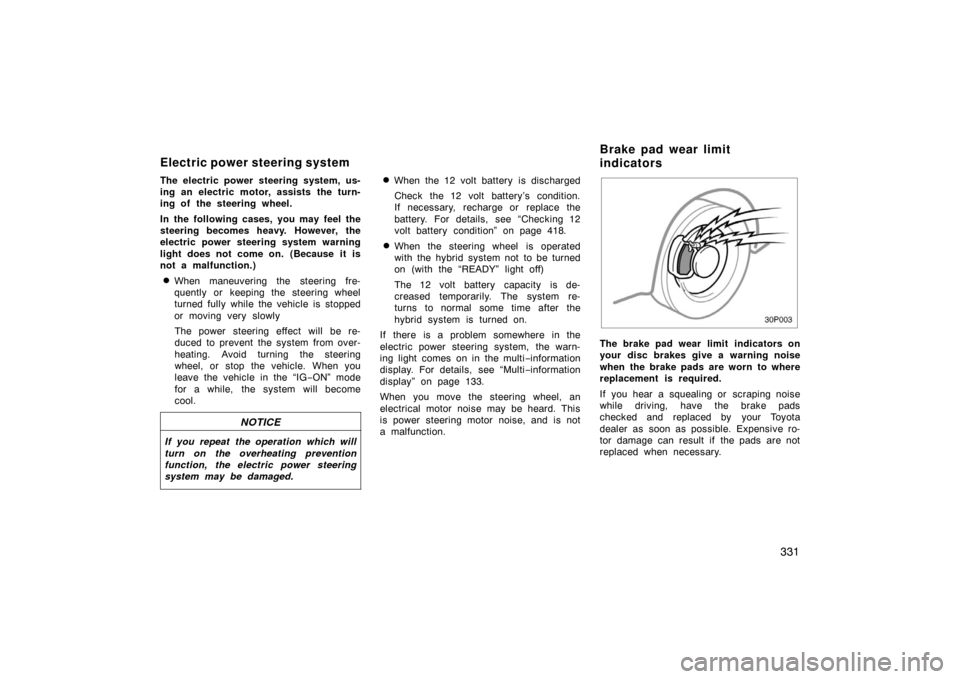
a malfunction.30p003
The brake pad wear limit indicators on
your disc brakes give a warning noise
when the brake pads are worn to where
replacement is required.
If you hear a squealing or scraping noise
while driving, have the brake pads
checked and replaced by your Toyota
dealer as soon as possible. Expensive ro-
tor damage can result if the pads are not
replaced when necessary.
Electric power steering system Brake pad wear limit
indicators
394
Some states have vehicle emission in-
spection programs which include OBD
(On−Board Diagnostics) che cks.
The OBD system monitors the operation
of the emission control system. When the
OBD system determines that a problem
exists somewhere in the emission control
system, the malfunction indicator lamp
comes on. In this case, your vehicle may
not pass the I/M test and need to be
repaired. Contact your Toyota dealer to
service the vehicle.
Even if the malfunction indicator lamp
does not come on, your vehicle may not
pass the I/M test as readiness codes
have not been set in the OBD system.
Readiness codes are automatically set
during ordinary driving. However, when the
battery is disconnected or run down, the
codes are erased. Also, depending on
your driving habits, the codes may not be
completely set.
Also, if the malfunction indicator lamp had
come on recently due to temporary mal-
function such as a loose fuel tank cap,
your vehicle may not pass the I/M test. The malfunction indicator lamp will go off
after taking several driving trips, but the
error code in the OBD system will not be
cleared unless about 40 trips or more are
taken.
If your vehicle does not pass the I/M test
and the malfunction indicator lamp does
not come on, contact your Toyota dealer
to prepare the vehicle for re
−testing.
Emissions inspection and
maintenance (I/M) programs