409
If the level is low, take your vehicle to
a Toyota dealer as soon as possible. Do
not drive if the red brake system warn-
ing light is on. Call a Toyota dealer for
assistance.
If the fluid level goes down soon after
your vehicle is serviced, it may indicate
a serious mechanical problem.
CAUTION
Brake fluid can harm your hands or
eyes. If fluid gets on your hands or
in your eyes, flush the affected area
with clean water immediately. If you
still feel uncomfortable with your
hands or eyes, go to the doctor.
NOTICE
If you spill some of the fluid, be sure
to wipe it off to prevent it from dam-
aging the parts or paintwork.
82p105b
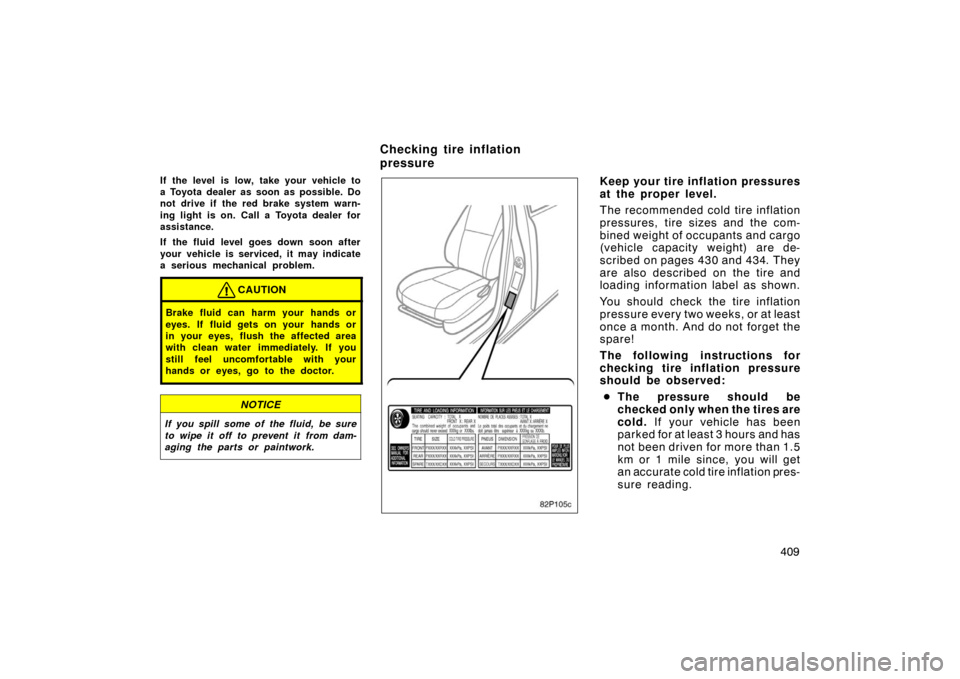
Keep your tire inflation pressures
at the proper level.
The recommended cold tire inflation
pressures, tire sizes and the com-
bined weight of occupants and cargo
(vehicle capacity weight) are de-
scribed on pages 430 and 434. They
are also described on the tire and
loading information label as shown.
You should check the tire inflation
pressure every two weeks, or at least
once a month. And do not forget the
spare!
The following instructions for
checking tire inflation pressure
should be observed:
� The pressure s hould be
checked only when the tires are
cold. If your vehicle has been
parked for at least 3 hours and has
not been driven for more than 1.5
km or 1 mile since, you will get
an accurate cold tire inflation pres-
sure reading.
Checking tire inflation
pressure
414 When rotating tires, check for uneven
wear and damage. Abnormal wear is
usually caused by incorrect tire infla-
tion pressure, improper wheel align-
ment, out−of −balance wheels, or se-
vere braking.
CAUTION
Do not include a compact spare
tire when rotating the tires. It is
designed for temporary use only.
WHEN TO USE SNOW TIRES OR
CHAINS
Snow tires or chains are recommended
when driving on snow or ice.
On wet or dry roads, conventional tires
provide better traction than snow tires.
SNOW TIRE SELECTION
If you need snow tires, select tires of
the same size, construction and load
capacity as the originally installed tires.
Do not use tires other than those men-
tioned above. Do not install studded tires
without first checking local regulations for
possible restrictions.
CAUTION
Do not use snow tires other than the
manufacturer ’s recommended size, as
this may cause dangerous handling
characteristics resulting in loss of
control. Otherwise, an accident may
occur resulting in death or serious
injuries.
SNOW TIRE INSTALLATION
Snow tires should be installed on all
wheels.
Installing snow tires on the front wheels
only can lead to an excessive difference
in road grip capability between the front
and rear tires which could cause loss of
vehicle control.
When storing removed tires, you should
store them in a cool dry place.
Mark the direction of rotation and be sure
to install them in the same direction when
replacing.
CAUTION
�Do not drive with the snow tires
incorrectly inflated.
�Never drive over 120 km/h (75 mph)
with any type of snow tires.
Installing snow tires and
chains