Page 133 of 374

11 9
When the headlight switch is on with all
the doors locked, pushing the “LOCK” but-
ton on the wireless remote control key
turns off the headlights.
NOTE: *The time before turning off the
lights can be changed. Ask your Toyota
dealer for details.
NOTICE
To prevent the battery from being dis-
charged, do not leave the lights on
for a long period when the engine is
not running.
Daytime running light system
The headlights turn on at reduced intensi-
ty when the parking brake is released with
the engine started, even with the light
switch in the “OFF” position. They will not
go off until the ignition switch is turned
off.
To turn on the other exterior lights and
instrument panel lights, twist the knob to
the position 1.
Twist the knob to the position 2 to turn
the headlights to full intensity for driving
at night.HighLow beams—For high beams, turn
the headlights on and push the lever away
from you (position 1). Pull the lever to-
ward you (position 2) for low beams.
The headlight high beam indicator light
(blue light) on the instrument panel will
tell you that the high beams are on.
Flashing the high beam headlights
(position 3)—Pull the lever all the way
back. The high beam headlights turn off
when you release the lever.
You can flash the high beam headlights
with the knob turned to “OFF”.TURN SIGNALS
To signal a turn, push the headlight/
turn signal lever up or down to position
1.
The key must be in the “ON” position.
The lever automatically returns after you
make a turn, but you may have to return
it by hand after you change lanes.
To signal a lane change, move the lever
up or down to the pressure point (position
2) and hold it.
If the turn signal indicator lights (green
lights) on the instrument panel flash faster
than normal, a front or rear turn signal
bulb is burned out. See “Replacing light
bulbs” on page 343.
Page 139 of 374
125
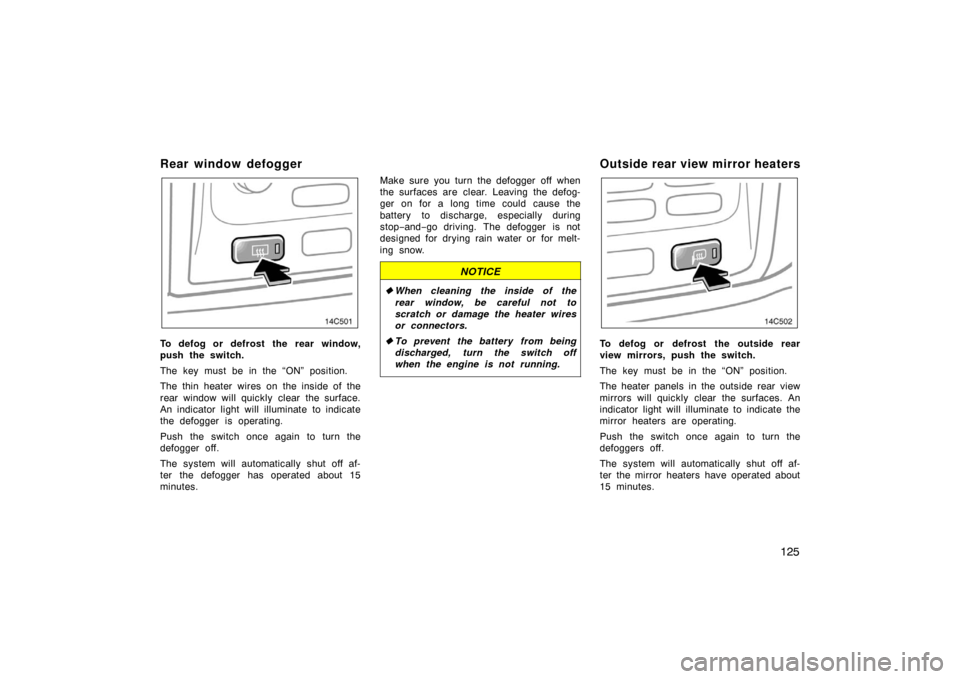
Rear window defogger
To defog or defrost the rear window,
push the switch.
The key must be in the “ON” position.
The thin heater wires on the inside of the
rear window will quickly clear the surface.
An indicator light will illuminate to indicate
the defogger is operating.
Push the switch once again to turn the
defogger off.
The system will automatically shut off af-
ter the defogger has operated about 15
minutes.Make sure you turn the defogger off when
the surfaces are clear. Leaving the defog-
ger on for a long time could cause the
battery to discharge, especially during
stop
−and− go driving. The defogger is not
designed for drying rain water or for melt-
ing snow.
NOTICE
� When cleaning the inside of the
rear window, be careful not to
scratch or damage the heater wires
or connectors.
� To prevent the battery from being
discharged, turn the switch off
when the engine is not running.
Outside rear view mirror heaters
To defog or defrost the outside rear
view mirrors, push the switch.
The key must be in the “ON” position.
The heater panels in the outside rear view
mirrors will quickly clear the surfaces. An
indicator light will illuminate to indicate the
mirror heaters are operating.
Push the switch once again to turn the
defoggers off.
The system will automatically shut off af-
ter the mirror heaters have operated about
15 minutes.
Page 140 of 374
126
CAUTION
Since the mirror surfaces can get hot,
do not touch them when the mirror
heater switch is on.
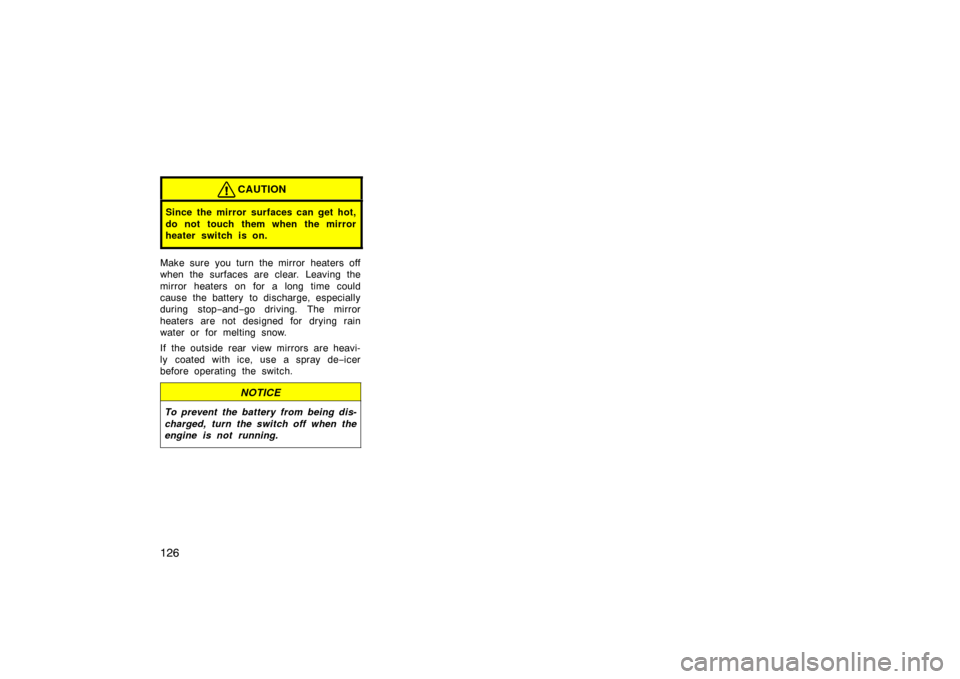
Make sure you turn the mirror heaters off
when the surfaces are clear. Leaving the
mirror heaters on for a long time could
cause the battery to discharge, especially
during stop−and−go driving. The mirror
heaters are not designed for drying rain
water or for melting snow.
If the outside rear view mirrors are heavi-
ly coated with ice, use a spray de −icer
before operating the switch.
NOTICE
To prevent the battery from being dis-
charged, turn the switch off when the
engine is not running.
Page 141 of 374
127
OPERATION OF INSTRUMENTS AND
CONTROLS
Gauges, Meters and Service reminder indicators
Fuel gauge128
. . . . . . . . . . . . . . . . . . . . . . . . . . . . . . . . . . . . .\
. . . . . . . . . . .
Engine coolant temperature gauge 128
. . . . . . . . . . . . . . . . . . . . . . . . . . .
Engine oil pressure gauge 129
. . . . . . . . . . . . . . . . . . . . . . . . . . . . . . . . . . .
Vo ltme te r 130
. . . . . . . . . . . . . . . . . . . . . . . . . . . . . . . . . . . . \
. . . . . . . . . . . . . .
Tachometer 130
. . . . . . . . . . . . . . . . . . . . . . . . . . . . . . . . . . . . \
. . . . . . . . . . . .
Odometer and two trip meters 131
. . . . . . . . . . . . . . . . . . . . . . . . . . . . . . . .
Service reminder indicators and warning buzzers 132
. . . . . . . . . . . . . .
Trip information display 140
. . . . . . . . . . . . . . . . . . . . . . . . . . . . . . . . . . . . \
. .
SECTION 1 6
Page 142 of 374
128
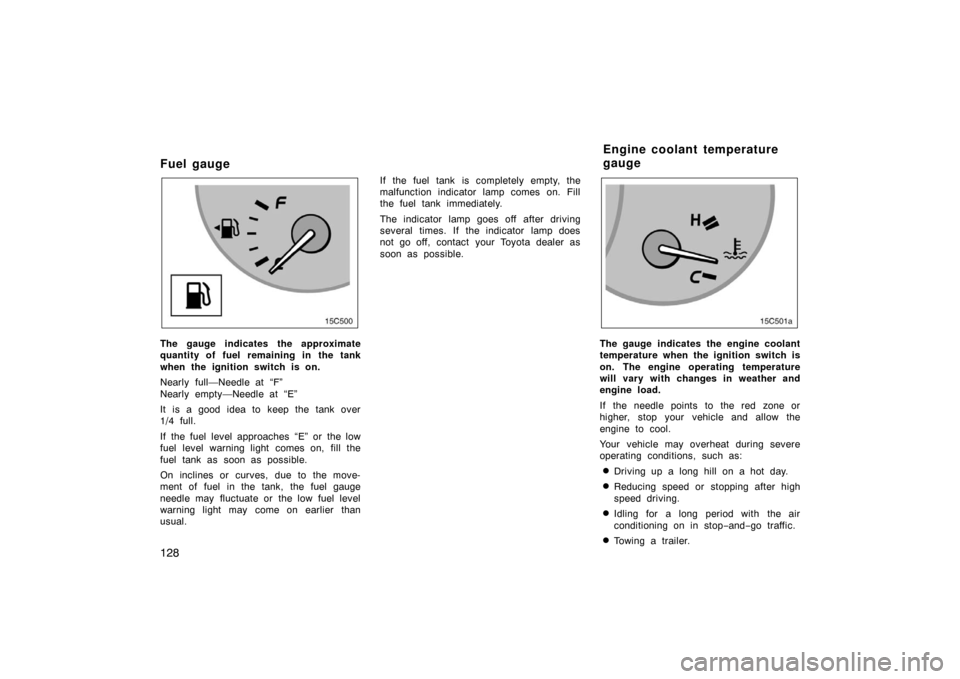
Fuel gauge
15C004
The gauge indicates the approximate
quantity of fuel remaining in the tank
when the ignition switch is on.
Nearly full—Needle at “F”
Nearly empty—Needle at “E”
It is a good idea to keep the tank over
1/4 full.
If the fuel level approaches “E” or the low
fuel level warning light comes on, fill the
fuel tank as soon as possible.
On inclines or curves, due to the move-
ment of fuel in the tank, the fuel gauge
needle may fluctuate or the low fuel level
warning light may come on earlier than
usual.If the fuel tank is completely empty, the
malfunction indicator lamp comes on. Fill
the fuel tank immediately.
The indicator lamp goes off after driving
several times. If the indicator lamp does
not go off, contact your Toyota dealer as
soon as possible.The gauge indicates the engine coolant
temperature when the ignition switch is
on. The engine operating temperature
will vary with changes in weather and
engine load.
If the needle points to the red zone or
higher, stop your vehicle and allow the
engine to cool.
Your vehicle may overheat during severe
operating conditions, such as:
�Driving up a long hill on a hot day.
�Reducing speed or stopping after high
speed driving.
�Idling for a long period with the air
conditioning on in stop
−and− go traffic.
�Towing a trailer.
Engine coolant temperature
gauge
Page 143 of 374
129
NOTICE
�Do not remove the thermostat in
the engine cooling system as this
may cause the engine to overheat.
The thermostat is designed to con-
trol the flow of coolant to keep the
temperature of the engine within
the specified operating range.
� Do not continue driving with an
overheated engine. See “If your ve-
hicle overheats” on page 284.
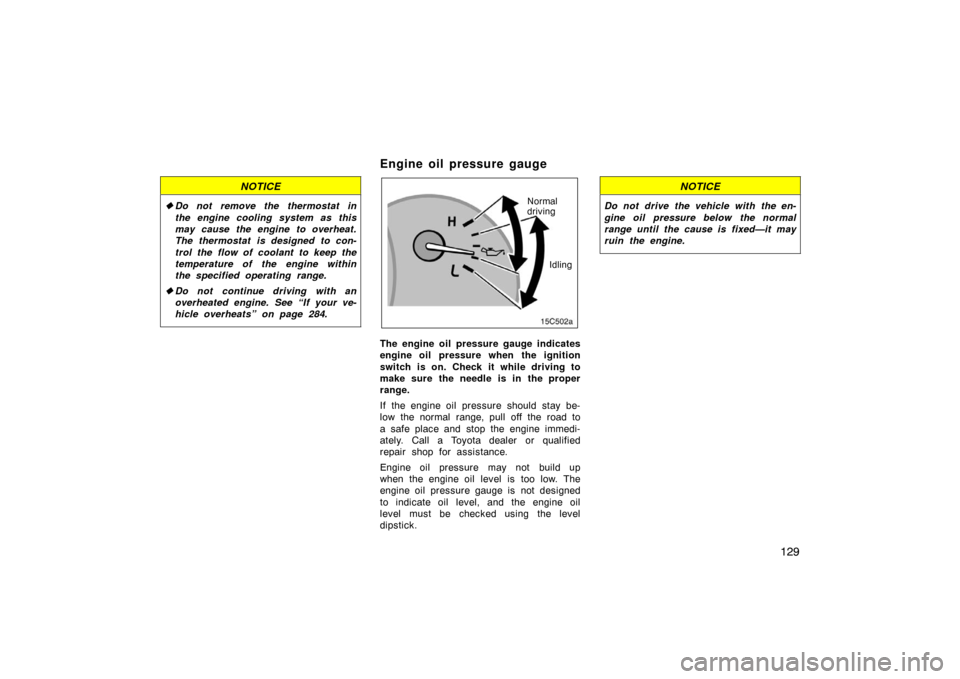
Engine oil pressure gauge
Idling
Normal
driving
The engine oil pressure gauge indicates
engine oil pressure when the ignition
switch is on. Check it while driving to
make sure the needle is in the proper
range.
If the engine oil pressure should stay be-
low the normal range, pull off the road to
a safe place and stop the engine immedi-
ately. Call a Toyota dealer or qualified
repair shop for assistance.
Engine oil pressure may not build up
when the engine oil level is too low. The
engine oil pressure gauge is not designed
to indicate oil level, and the engine oil
level must be checked using the level
dipstick.
NOTICE
Do not drive the vehicle with the en-
gine oil pressure below the normal
range until the cause is fixed—it may
ruin the engine.
Page 144 of 374
130
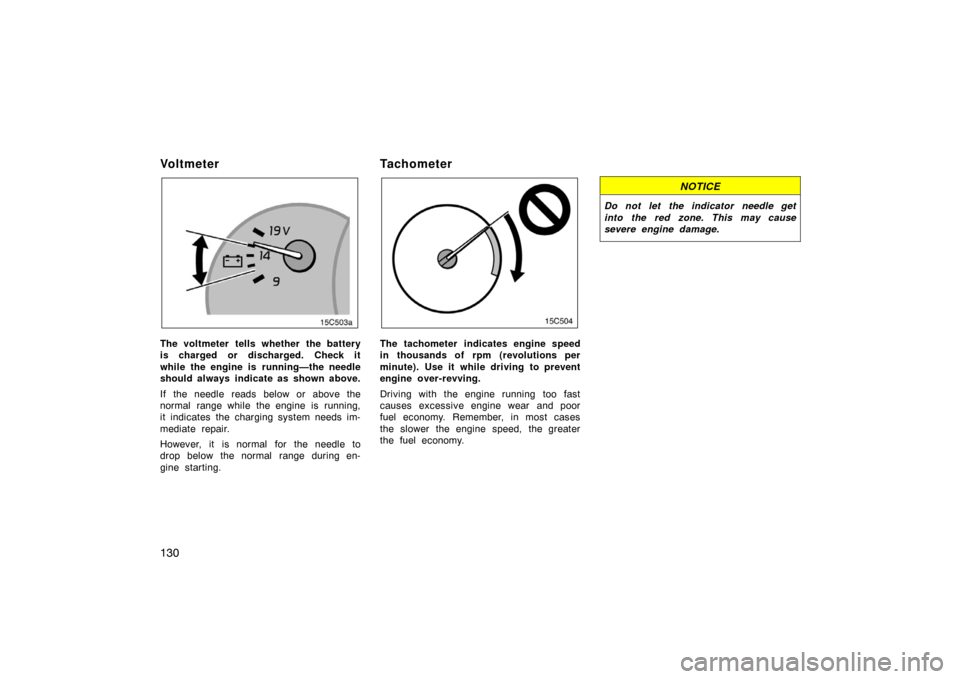
Vo l t m e t e r
The voltmeter tells whether the battery
is charged or discharged. Check it
while the engine is running—the needle
should always indicate as shown above.
If the needle reads below or above the
normal range while the engine is running,
it indicates the charging system needs im-
mediate repair.
However, it is normal for the needle to
drop below the normal range during en-
gine starting.
Tachometer
The tachometer indicates engine speed
in thousands of rpm (revolutions per
minute). Use it while driving to prevent
engine over-revving.
Driving with the engine running too fast
causes excessive engine wear and poor
fuel economy. Remember, in most cases
the slower the engine speed, the greater
the fuel economy.
NOTICE
Do not let the indicator needle get
into the red zone. This may cause
severe engine damage.
Page 146 of 374
132
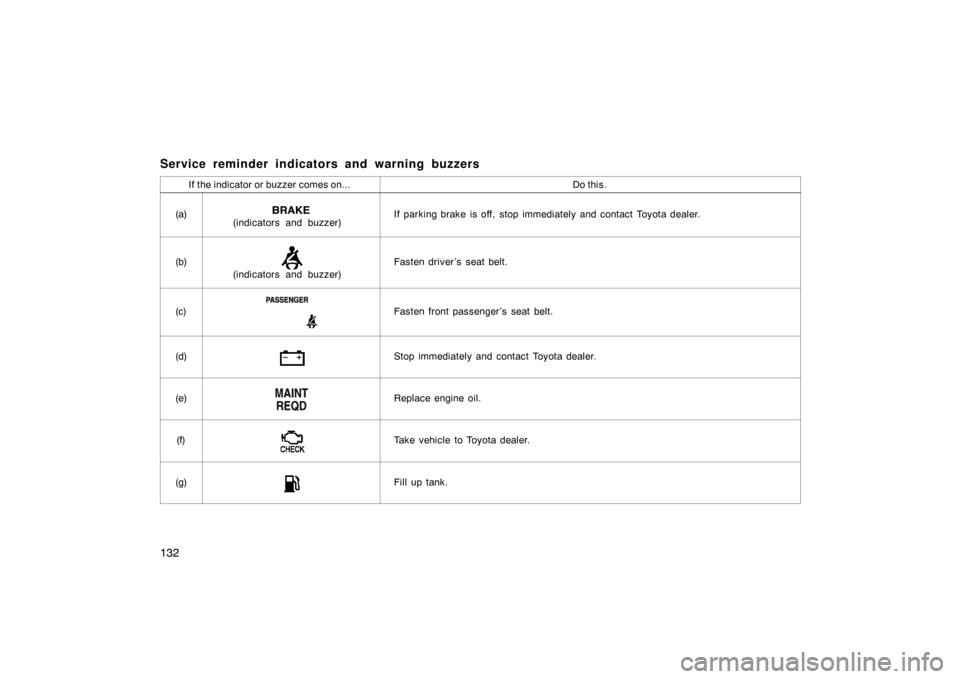
Service reminder indicators and warning buzzers
If the indicator or buzzer comes on...Do this.
(a)(indicators and buzzer)If parking brake is off, stop immediately and contact Toyota dealer.
(b)
(indicators and buzzer)
Fasten driver ’s seat belt.
(c)Fasten front passenger ’s seat belt.
(d)Stop immediately and contact Toyota dealer.
(e)Replace engine oil.
(f)Take vehicle to Toyota dealer.
(g)Fill up tank.