Page 8 of 404

viii
Smart key system
Users of any electrical medical devices such as implanted
pacemakers should consult the manufacturer of the device
for information about its operation under the influence of ra-
dio waves. Radio waves could have unexpected effects on
the operation of such medical devices. For details, see
“Keys” on page 14 and “Smart key system” on page 27 in
Section 1−2.
Tires and loading on yourTo y o t a
Underinflated or overinflated tire pressure and ex-
cess load may result in the deterioration of steering
ability and braking ability, leading to an accident.
Check the tire inflation pressure periodically and be
sure to stay with the load limits given in this Owner’s
Manual. For details about tire inflation pressure and
load limits, see pages 289 and 361.
Scrapping of your Toyota
The SRS airbag and seat belt pretensioner devices in your
Toyota contain explosive chemicals. If the vehicle is scrapped
with the airbags and pretensioners left as they are, this may
cause an accident such as fire. Be sure to have the systems
of the SRS airbag and seat belt pretensioner removed and
disposed of by the qualified service shop or by your Toyota
dealer before you dispose of your vehicle.
Leak detection pump
This pump performs fuel evaporation leakage check. This
check is done approximately five hours after the engine is
turned off. So you may hear sound coming from underneath
the luggage compartment for several minutes. It does not
indicate a malfunction.
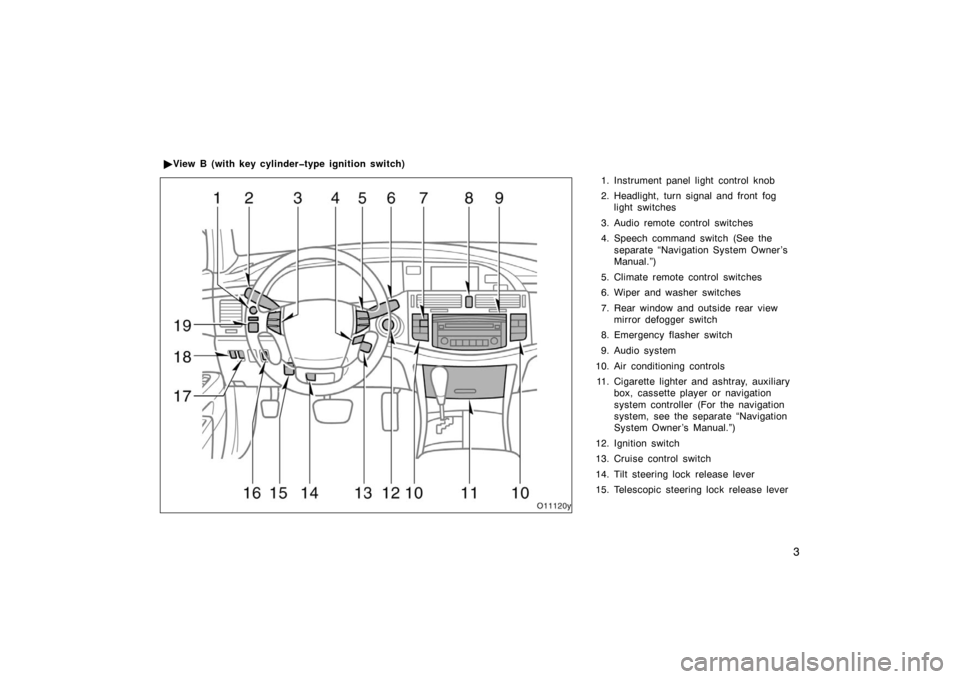
Page 11 of 404
3
1. Instrument panel light control knob
2. Headlight, turn signal and front foglight switches
3. Audio remote control switches
4. Speech command switch (See the separate “Navigation System Owner ’s
Manual.”)
5. Climate remote control switches
6. Wiper and washer switches
7. Rear window and outside rear view mirror defogger switch
8. Emergency flasher switch
9. Audio system
10. Air conditioning controls 11. Cigarette lighter and ashtray, auxiliary box, cassette player or navigation
system controller (For the navigation
system, see the separate “Navigation
System Owner ’s Manual.”)
12. Ignition switch
13. Cruise control switch
14. Tilt steering lock release lever
15. Telescopic steering lock release lever
�
View B (with key cylindertype ignition switch)
Page 13 of 404
5
1. Instrument panel light control knob
2. Headlight, turn signal and front foglight switches
3. Audio remote control switches
4. Speech command switch (See the separate “Navigation System Owner ’s
Manual.”)
5. Climate remote control switches
6. Wiper and washer switches
7. Rear window and outside rear view mirror defogger switch
8. Emergency flasher switch
9. Audio system
10. Air conditioning controls 11. Cigarette lighter and ashtray, auxiliary box, cassette player or navigation
system controller (For the navigation
system, see the separate “Navigation
System Owner ’s Manual.”)
12. Ignition switch (engine switch)
13. Cruise control switch
14. Distance switch
15. Tilt steering lock release lever
�
View B (with smart key system)
Page 17 of 404
9
Brake system warning light∗1
Driver ’s seat belt reminder light∗1
Charging system warning light∗1
Malfunction indicator lamp∗1
Low engine oil pressure warning light∗1
or
Anti −lock brake system warning light∗
1or
Open door warning light∗1
SRS warning light∗1
Low windshield washer fluid level warning
light∗1
Vehicle stability control system and traction
control system warning light∗1
or
Automatic headlight leveling system warning
light∗1
Engine oil replacement reminder light∗1
Engine immobilizer/theft deterrent system
indicator light
Smart key system warning light∗1
Low tire pressure warning light∗1
Indicator symbols on the instrument panel
Page 19 of 404

11
OPERATION OF INSTRUMENTS AND
CONTROLS
Keys and Doors
Keys12
. . . . . . . . . . . . . . . . . . . . . . . . . . . . . . . . . . . . .\
. . . . . . . . . . . . . . . . . .
Engine immobilizer system 16
. . . . . . . . . . . . . . . . . . . . . . . . . . . . . . . . . . .
Wireless remote control 18
. . . . . . . . . . . . . . . . . . . . . . . . . . . . . . . . . . . . \
. .
Smart key system 27
. . . . . . . . . . . . . . . . . . . . . . . . . . . . . . . . . . . . \
. . . . . . . .
Side doors 34
. . . . . . . . . . . . . . . . . . . . . . . . . . . . . . . . . . . . \
. . . . . . . . . . . . . .
Power windows 41
. . . . . . . . . . . . . . . . . . . . . . . . . . . . . . . . . . . . \
. . . . . . . . . .
Trunk lid 44
. . . . . . . . . . . . . . . . . . . . . . . . . . . . . . . . . . . . \
. . . . . . . . . . . . . . . .
Hood 48
. . . . . . . . . . . . . . . . . . . . . . . . . . . . . . . . . . . . \
. . . . . . . . . . . . . . . . . . .
Theft deterrent system 49
. . . . . . . . . . . . . . . . . . . . . . . . . . . . . . . . . . . . \
. . .
Fuel tank cap 51
. . . . . . . . . . . . . . . . . . . . . . . . . . . . . . . . . . . . \
. . . . . . . . . . .
Electric moon roof 52
. . . . . . . . . . . . . . . . . . . . . . . . . . . . . . . . . . . . \
. . . . . . .
SECTION 1 2
Page 20 of 404

12
Your vehicle is supplied with two kinds
of keys.1. Master keys (black)—These keys work in every lock. Your Toyota dealer will
need one of them to make a new key
with a built −in transponder chip.
2. Sub key (gray)—This key will not work in the locks of the glove box and the
door located behind the rear seat arm-
rest. A transponder chip for engine immobilizer
system has been placed in the head of
the master and sub keys. These chips are
needed to enable the system to function
correctly, so be careful not to lose these
keys. If you make your own duplicate key,
you will not be able to cancel the system
or start the engine.
To protect items locked in the trunk or
glove box when using valet parking, leave
the sub key with the attendant.NOTICE
When using a key containing a trans-
ponder chip, observe the following
precautions:
�
When starting the engine, do not
use the key with a key ring resting
on the key grip and do not press
the key ring against the key grip.
Otherwise the engine may not start,
or may stop soon after it starts.
Keys (with key cylindertype
ignition switch)
Page 21 of 404
13
�When starting the engine, do not
use the key with other transponder
keys around (including keys of oth-
er vehicles) and do not press other
key plates against the key grip.
Otherwise the engine may not start,
or may stop soon after it starts. If
this happens, remove the key once
and then insert it again after remov-
ing other transponder keys (includ-
ing keys of other vehicles) from the
ring or while gripping or covering
them with your hand to start the
engine.�Do not bend the key grip.
�Do not cover the key grip with any
material that cuts off electromagnet-
ic waves.
� Do not knock the key hard against
other objects.
� Do not leave the key exposed to
high temperatures for a long period,
such as on the dashboard and hood
under direct sunlight.
� Do not put the key in water or
wash it in an ultrasonic washer.
� Do not use the key with electromag-
netic materials.
Page 22 of 404

14
KEY NUMBER PLATE
Your key number is shown on the plate.
Keep the plate in a safe place such as
your wallet, not in the vehicle.
If you should lose your keys or if you
need additional keys, duplicates can be
made by a Toyota dealer using the key
number.
We recommend writing down the key num-
ber and storing it in a safe place.The key consists of an electronic key
and a mechanical key. The mechanical
key is for emergency use. If the elec-
tronic key does not operate, you can
open the driver ’s door using the me-
chanical key.1. Electronic keys—These keys can lock or unlock all the doors and can open
the trunk by using the wireless remote
control function or entry function of the
smart key system.
2. Mechanical keys—These keys can lock or unlock the driver’s door, the glove
box and the door located behind the
rear seat armrest. Spare keys should not be left in the
cabin. In the event that a spare key is
left in the cabin, the smart key system
will remain actuated even after the
doors have been locked. Under these
circumstances, the trunk can be opened
even after the driver has exited and
locked the vehicle, increasing the dan-
ger of theft. (Refer to “OPENING
TRUNK WITH SMART KEY SYSTEM” on
page 45 in this Section.)
To protect items locked in the trunk or the
glove box when using valet parking, lock
the trunk opener switch and leave the
electronic key with the attendant. Keep the
mechanical key with you. For details about
locking the trunk opener switch, see
“—Luggage security system” on page 46
in this Section.
A transponder chip for engine immobilizer
system has been placed in the electronic
keys. These chips are needed to enable
the system to function correctly, so be
careful not to lose these keys.
Keys (with smart key system)