Page 413 of 470

4032007 4Runner from Aug. ’06 Prod. (OM35866U)
�The interior of your vehicle is apt
to heat up on hot summer days, so
avoid placing on the upholstery
items made of vinyl or plastic or
containing wax as these tend to
stick to leather when warm .
� Improper cleaning of the leather up-
holstery could result in discolor-
ation or staining.
If you have any questions about the
cleaning of your Toyota, your local
Toyota dealer will be pleased to answer
them. On some models, the outside rear view
mirrors have been coated to produce a
“rain clearing” effect. This coating
causes the raindrops to spread, clear-
ing the driver’s rear view when it rains.
It is sufficient to wash the mirrors with
water for day to day care.
The rain clearing effect is reduced in
drizzle and light rain.
In the following cases, the rain clearing
effect will be reduced temporarily, but will
gradually recover.
�After wiping dirt off the mirrors
�When the mirrors fog up
�After waxing your vehicle in an auto-
matic car wash
�After your vehicle has been parked for
a long period in underground parking
lots, etc. where there is no direct sun-
light.
If you would like to restore the rain clear-
ing effect to its normal level immediately
in the above cases, wash the mirrors with
neutral detergent, then rinse thoroughly.
NOTICE
To maintain the rain clearing ability,
and prevent the mirrors from being
scratched, observe the following pre-
cautions.
� Do not use any glass cleaners that
contain compounds.
� If ice should jam the mirror, do not
scrape the mirror. Use a spray de
icer to free the mirror.
� Wash off any wax stuck to the mir-
rors with neutral detergent and
rinse thoroughly as any wax on the
surface of the mirrors can cause
the rain clearing effect to be lost.
� Do not use any water repellents as
they can destroy the rain clearing
effect. If any repellent gets stuck on
the surface of the mirrors, wash it
off with neutral detergent, then
rinse thoroughly.
Rain clearing mirrors
Page 439 of 470
4292007 4Runner from Aug. ’06 Prod. (OM35866U)
For details about the side wall of the
tire and the Certification Label, see
pages 339 and 342.
CAUTION
Observe the following instruc-
tions. Otherwise, an accident
may occur resulting in death or
serious injuries.
�Do not mix radial, bias belted,
or biasply tires on your ve-
hicle, as this may cause dan-
gerous handling characteris-
tics resulting in loss of control.
� Do not use tires other than the
manufacturer’s recommended
size, as this may cause danger-
ous handling characteristics
resulting in loss of control.
�Fourwheel drive models:
Do not use tires of different
brands, sizes, construction or
tread patterns, as this may
cause dangerous handling
characteristics resulting in
loss of control.
Toyota recommends all four tires,
or at least both of the front or rear
tires be replaced at a time as a set.
See “If you have a flat tire” on page
379 for tire change procedure.
When a tire is replaced, the wheel
should always be balanced.
An unbalanced wheel may affect ve-
hicle handling and tire life. Wheels
can get out of balance with regular
use and should therefore be balanced
occasionally.
When replacing a tubeless tire, the
air valve should also be repl aced
w i t h a new on e.
CY72009
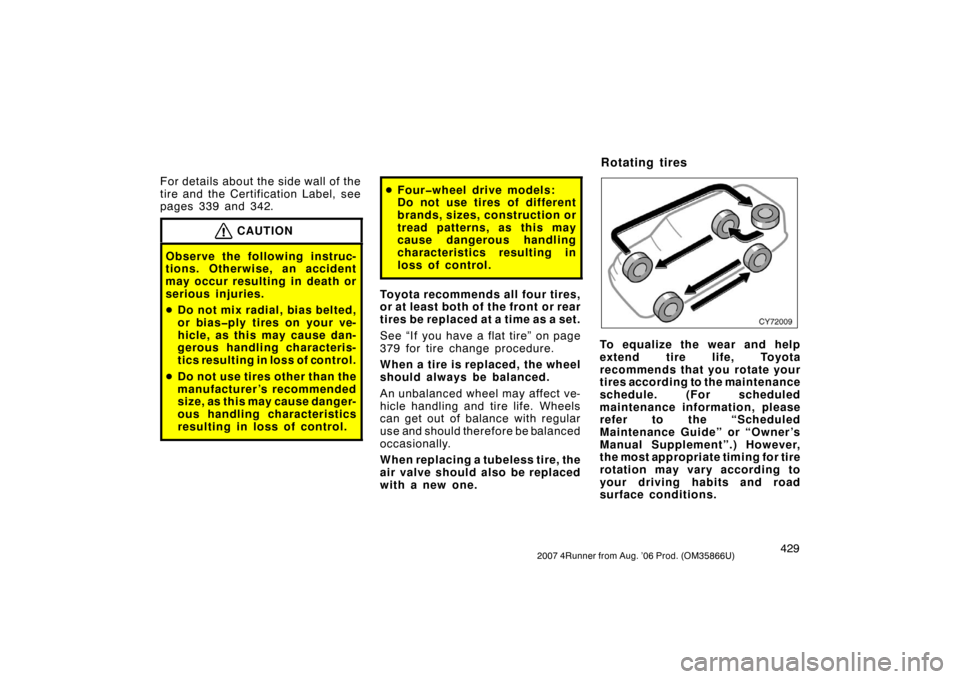
To equalize the wear and help
extend tire life, Toyota
recommends that you rotate your
tires according to the maintenance
schedule. (For scheduled
maintenance information, please
refer to the “Scheduled
Maintenance Guide” or “Owner’s
Manual Supplement”.) How ever,
the most appropriate timing for tire
rotation may vary according to
your driving habits and road
surface conditions.
Rotating tires
Page 440 of 470

4302007 4Runner from Aug. ’06 Prod. (OM35866U)
See “If you have a flat tire” on page
379 in Section 4 for tire change proce-
dure.
When rotating tires, check for uneven
wear and damage. Abnormal wear is
usually caused by incorrect tire pres-
sure, improper wheel alignment, out−
of −balance wheels, or severe braking.WHEN TO USE SNOW TIRES OR
CHAINS
Snow tires or chains are recommended
when driving on snow or ice.
On wet or dry roads, conventional tires
provide better traction than snow tires.
SNOW TIRE SELECTION
If you need snow tires, select tires of
the same size, construction and load
capacity as the originally installed tires.
Also, on fourwheel drive models, all
the tires must be the same brand and
have the same tread patterns.
Do not use tires other than those men-
tioned above. Do not install studded tires
without first checking local regulations for
possible restrictions.
CAUTION
Observe the following instructions.
Otherwise, an accident may occur re-
sulting in death or serious injuries.
�Do not use snow tires other than
the manufacturer ’s recommended si-
ze, as this may cause dangerous
handling characteristics resulting in
loss of control.
�Fourwheel drive models:
Do not use snow tires of different
brands, sizes, construction or tread
patterns, as this may cause danger-
ous handling characteristics result-
ing in loss of control.
SNOW TIRE INSTALLATION
Snow tires should be installed on all
wheels.
Installing snow tires on the front wheels
only can lead to an excessive difference
in road grip capability between the front
and rear tires which could cause loss of
vehicle control.
When storing removed tires, you should
store them in a cool dry place.
Mark the direction of rotation and be sure
to install them in the same direction when
replacing.
CAUTION
�Do not drive with the snow tires
incorrectly inflated.
�Never drive over 120 km/h (75 mph)
with any type of snow tires.
Installing snow tires and
chains
Page 442 of 470
4322007 4Runner from Aug. ’06 Prod. (OM35866U)
Replacement with used wheels is not rec-
ommended as they may have been sub-
jected to rough treatment or high mileage
and could fail without warning. Also, bent
wheels which have been straightened may
have structural damage and therefore
should not be used. Never use an inner
tube in a leaking wheel which is designed
for a tubeless tire.
CAUTION
Observe the following instructions.
Otherwise, an accident may occur re-
sulting in death or serious injuries.
�Do not use wheels other than the
manufacturer ’s recommended size,
as this may cause dangerous han-
dling characteristics resulting in
loss of control.
�Fourwheel drive models:
Do not use wheels of different
brands, sizes and types, as this
may cause dangerous handling
characteristics resulting in loss of
control.
�When installing aluminum wheels,
check that the wheel nuts are tight
after driving your vehicle the first 1600
km (1000 miles).
�If you have rotated, repaired or
changed your tires, check that the
wheel nuts are still tight after driving
1600 km (1000 miles).
�When using tire chains, be careful not
to damage the aluminum wheels.
�Use only Toyota wheel nuts and
wrench designed for your aluminum
wheels.
�When balancing your wheels, use only
Toyota balance weights or equivalent
and a plastic or rubber hammer.
�As with any wheel, periodically check
your aluminum wheels for damage. If
damaged, replace immediately.
Aluminum wheel precautions
Page 459 of 470

4492007 4Runner from Aug. ’06 Prod. (OM35866U)
AUTOMATIC TRANSMISSION
Fluid capacity (drain and refill),
L (qt., Imp. qt.):Up to 3.0 (3.2, 2.6)
Fluid type: Toyota Genuine ATF WS
Change automatic transmission fluid only
as necessary.
Generally, it is necessary to change
automatic transmission fluid only if your
vehicle is driven under one of the Special
Operating Conditions listed in your
“Scheduled Maintenance Guide” or
“Owner ’s Manual Supplement”. When
changing the automatic transmission fluid,
use only “Toyota Genuine ATF WS” (ATF
JWS3324 or NWS9638) to aid in assuring
optimum transmission performance.
Notice: Using automatic transmission
fluid other than “Toyota Genuine ATF
WS” may cause deterioration in shift
quality, locking up of your transmission
accompanied by vibration, and ultimate-
ly damage the automatic transmission
of your vehicle.
Please contact your Toyota dealer for fur-
ther details. TRANSFER
Oil capacity, L (qt., Imp. qt.):
1.4 (1.5, 1.2)
Oil type: Hypoid gear oil API GL −5
Recommended oil viscosity: SAE 75W −90
DIFFERENTIAL (4.0 L V6 [1GRFE] en-
gine)
Oil capacity, L (qt., Imp. qt.): Tw o −wheel drive models
3.05 (3.2, 2.7)
Four −wheel drive models
Front 1.5 (1.6, 1.3)
Rear 3.05 (3.2, 2.7)
Oil type: Hypoid gear oil API GL −5
Recommended oil viscosity: Front
SAE 75W −90
Rear Above −18 �C (0 �F)
SAE 90
Below −18 �C (0 �F)
SAE 80W or 80W −90 DIFFERENTIAL (4.7 L V8 [2UZFE] en-
gine)
Oil capacity, L (qt., Imp. qt.):
Tw o −wheel drive models
3.05 (3.2, 2.7)
Four −wheel drive models
Front 1.4 (1.5, 1.2)
Rear 3.05 (3.2, 2.7)
Oil type: Hypoid gear oil API GL −5
Recommended oil viscosity: Above −18 �C (0 �F)
SAE 90
Below −18 �C (
0 �F)
SAE 80W or 80W −90
CHASSIS LUBRICATION
Propeller shafts: SpidersLithium base chassis grease, NLGI
No.2
Slide yokes Molybdenum −disulfide lithium base
chassis grease, NLGI No.2 or lithium
base multipurpose grease, NLGI No.2