2007 SUZUKI XL7 remove seats
[x] Cancel search: remove seatsPage 45 of 274

1-33 SEATS AND RESTRAINT SYSTEMS
78J00-03E
the belt, and feed the shoulder belt
back into the retractor. If you are using
a forward-facing child restraint, you
may find it helpful to use your knee to
push down on the child restraint as you
tighten the belt. You should not be able
to pull more of the belt from the retrac-
tor once the lock has been set.
7) Push and pull the child restraint in dif-
ferent directions to be sure it is secure.
8) If the airbag is off, the off indicator on
the instrument panel will be lit and stay
lit when the key is turned to RUN or
START.
If a child restraint has been installed and
the on indicator is lit, turn the vehicle off.
Remove the child restraint from the vehicle
and reinstall the child restraint.
If, after reinstalling the child restraint and
restarting the vehicle, the on indicator is
still lit, check to make sure that the vehi-
cle’s seatback is not pressing the child
restraint into the seat cushion. If this hap-
pens, slightly recline the vehicle’s seatback
and adjust the seat cushion if possible.
Also make sure the child restraint is not
trapped under the vehicle head restraint. If
this happens, adjust the head restraint.
If the on indicator is still lit, secure the child
in the child restraint in a rear seat position
in the vehicle if one is available and check
with your dealer.To remove the child restraint, if the top
tether is attached to the top tether anchor,
disconnect it. Unbuckle the vehicle’s safety
belt and let it go back all the way. The
safety belt will move freely again and be
ready to work for an adult or larger child
passenger.
Airbag SystemYour vehicle has a frontal airbag for the
driver and a frontal airbag for the right front
passenger. Your vehicle also has roof-
mounted rollover airbags designed for
either side impact or rollover deployment.
Roof-mounted rollover airbags are avail-
able for the driver and the passenger
seated directly behind the driver and for
the right front passenger and the passen-
ger seated directly behind that passenger.
For roof-mounted rollover airbags, the
word AIRBAG will appear along the head-
liner or trim.
Also, if your vehicle has a third row pas-
senger seat, your vehicle will have third
row roof-mounted rollover airbags.
Airbags are designed to supplement the
protection provided by safety belts. Even
though today’s airbags are also designed
to help reduce the risk of injury from the
force of an inflating bag, all airbags must
inflate very quickly to do their job.
Here are the most important things to
know about the airbag system:
Page 52 of 274

1-40 SEATS AND RESTRAINT SYSTEMS
78J00-03E
If your vehicle does not have a rear seat
that will accommodate a rear-facing child
restraint, never put a child in a rear-facing
child restraint in the right front passenger
seat unless the passenger airbag status
indicator shows off and the airbag is off.
Here is why:The passenger sensing system is
designed to turn off the right front passen-
ger’s frontal airbag if:
The right front passenger seat is unoc-
cupied.
The system determines that an infant is
present in a rear-facing infant seat.
The system determines that a small child
is present in a forward-facing child
restraint.
The system determines that a small child
is present in a booster seat.
A right front passenger takes his/her
weight off of the seat for a period of time.
The right front passenger seat is occu-
pied by a smaller person, such as a child
who has outgrown child restraints.
Or, if there is a critical problem with the
airbag system or the passenger sensing
system.
When the right front passenger’s frontal
airbag has been turned off by the passen-
ger sensing system, the off indicator will
light and stay lit to remind you that the air-
bag is off.
If a child restraint has been installed and
the on indicator is lit, turn the vehicle off.
Remove the child restraint from the vehicle
and reinstall the child restraint following the
child restraint manufacturer’s directions
and refer to “Securing a Child Restraint in
the Right Front Seat Position” in this sec-
tion.
WARNING
A child in a rear-facing child restraint
can be seriously injured or killed if
the right front passenger’s airbag
inflates. This is because the back of
the rear-facing child restraint would
be very close to the inflating airbag.
Even though the passenger sensing
system is designed to turn off the
passenger’s frontal airbag if the sys-
tem detects a rear-facing child
restraint, no system is fail-safe, and
no one can guarantee that an airbag
will not deploy under some unusual
circumstance, even though it is
turned off. We recommend that rear-
facing child restraints be secured in
the rear seat, even if the airbag is off.
If you need to secure a forward-fac-
ing child restraint in the right front
seat, always move the front passen-
ger seat as far back as it will go. It is
better to secure the child restraint in
a rear seat.
WARNING
A child in a rear-facing child restraint
can be seriously injured or killed if
the right front passenger’s airbag
inflates. This is because the back of
the rear-facing child restraint would
be very close to the inflating airbag.
Be sure the airbag is off before using
a rear-facing child restraint in the
right front seat position.
Even though the passenger sensing
system is designed to turn off the
passenger’s frontal airbag if the sys-
tem detects a rear-facing child
restraint, no system is fail-safe, and
no one can guarantee that an airbag
will not deploy under some unusual
circumstance, even though it is
turned off. We recommend that rear-
facing child restraints be trans-
ported in vehicles with a rear seat
that will accommodate a rear-facing
child restraint, whenever possible.
If you need to secure a forward-fac-
ing child restraint in the right front
seat, always move the front passen-
ger seat as far back as it will go. It is
better to secure the child restraint in
a rear seat.
Page 53 of 274

1-41 SEATS AND RESTRAINT SYSTEMS
78J00-03E
If, after reinstalling the child restraint and
restarting the vehicle, the on indicator is
still lit, check to make sure that the vehi-
cle’s seatback is not pressing the child
restraint into the seat cushion. If this hap-
pens, slightly recline the vehicle’s seatback
and adjust the seat cushion if possible.
Also make sure the child restraint is not
trapped under the vehicle head restraint. If
this happens, adjust the head restraint.
If the on indicator is still lit, secure the child
in the child restraint in a rear seat position
in the vehicle if one is available and check
with your dealer.
The passenger sensing system is
designed to enable (may inflate) the right
front passenger’s frontal airbag anytime
the system senses that a person of adult
size is sitting properly in the right front pas-
senger’s seat. When the passenger sens-
ing system has allowed the airbag to be
enabled, the on indicator will light and stay
lit to remind you that the airbag is active.
For some children who have outgrown
child restraints and for very small adults,
the passenger sensing system may or may
not turn off the right front passenger’s fron-
tal airbag, depending upon the person’s
seating posture and body build. Everyone
in your vehicle who has outgrown child
restraints should wear a safety belt prop-
erly – whether or not there is an airbag for
that person.If a person of adult-size is sitting in the
right front passenger’s seat, but the off
indicator is lit, it could be because that per-
son is not sitting properly in the seat. If this
happens, turn the vehicle off and ask the
person to place the seatback in the fully
upright position, then sit upright in the seat,
centered on the seat cushion, with the per-
son’s legs comfortably extended. Restart
the vehicle and have the person remain in
this position for about two minutes. This
will allow the system to detect that person
and then enable the passenger’s airbag.
849515
A thick layer of additional material, such as
a blanket, or aftermarket equipment such
as seat covers, seat heaters, and seat
massagers, can affect how well the pas-
senger sensing system operates. Remove
any additional material from the seat cush-
ion before reinstalling or securing the child
restraint and before a small occupant,
including a small adult, sits in the passen-
ger position. You may want to consider not
using seat covers or other aftermarket
equipment. Refer to “Adding Equipment to
Your Airbag-Equipped Vehicle” in this sec-
tion for more information about modifica-
tions that can affect how the system
operates.
WARNING
If the airbag readiness light in the
instrument panel cluster ever comes
on and stays on, it means that some-
thing may be wrong with the airbag
system. If this ever happens, have
the vehicle serviced promptly,
because an adult-size person sitting
in the right front passenger’s seat
may not have the protection of the
frontal airbag. Refer to “Airbag
Readiness Light” in “Warning Lights,
Gages, and Indicators” in the “Instru-
ment Panel” section for more on this,
including important safety informa-
tion.
Page 94 of 274

3-12 INSTRUMENT PANEL
78J00-03E
The modes can also be selected by press-
ing the following buttons:
AUX (Auxiliary):
This button is on a vehicle that has the
Rear Climate Control System. Press it to
turn on the rear heating and air condition-
ing. Refer to “Rear Air Conditioning and
Heating System” in this section for more
information.
(Outside Air):
Press this button to turn on the outside air
mode. While this mode is on, outside air
circulates throughout the vehicle. An indi-
cator light in the button comes on when
this button is pressed. The outside air
mode can be used with all modes, but it
cannot be used with the recirculation
mode.
(Recirculation):
Press this button to recirculate cabin air
through the vehicle. It can be used to pre-
vent outside air and odors from entering
the vehicle or to help heat or cool the air
inside the vehicle more quickly. An indica-
tor light above the symbol comes on in this
mode. Operation in this mode during peri-
ods of high humidity and cool outside tem-
peratures can result in increased window
fogging. If window fogging is experienced,
select the defrost mode.
The recirculation mode cannot be used
with outside air, floor, defog, or defrost
modes.If your vehicle has a Rear Climate Control
System, use this button to switch between
outside air and recirculation.
(Air Conditioning):
Press this button to turn the air condition-
ing system on or off. When this button is
pressed, an indicator light on the button
comes on to let you know the air condition-
ing is activated.
On hot days, open the windows to let hot
inside air escape, then close them. This
helps to reduce the time it takes for the
vehicle to cool down. It also helps the sys-
tem to operate more efficiently.
The air conditioning system removes mois-
ture from the air, so you might notice a
small amount of water dripping underneath
the vehicle while idling or after turning off
the engine. This is normal.
(Heated Seats):
If your vehicle has heated seats, refer to
“Heated Seats” in the “Seats and Restraint
Systems” section for more information.
Defogging and Defrosting
Fog or frost on the inside of windows is a
result of high humidity (moisture) condens-
ing on the cool window glass. This can be
minimized if the climate control system is
used properly. To avoid fogging windows
on rainy and humid days at temperatures
above freezing, run the air conditioning
compressor. It is best to avoid the use of
the recirculation mode, except when maxi-mum A/C performance is needed or for
short times to avoid exterior odors.
Use the floor/defog mode to clear the win-
dows of fog or moisture and warm the pas-
sengers. Use the defrost mode to remove
fog or frost from the windshield more
quickly.
When either of these modes or the floor
mode is selected, the system runs the air
conditioning compressor and cancels recir-
culation mode to dry the air; however, the
recirculation light stays on. For best
results, clear all snow and ice from the
windshield before defrosting.
Turn the right knob to select the defog or
defrost mode.
(Floor/Defog):
This mode directs about half of the air to
the floor outlets and the remaining air to
the windshield and the side window out-
lets.
(Defrost):
This mode directs most of the air to the
windshield and the side window outlets.
Rear Window Defogger
The rear window defogger uses a warming
grid to remove fog from the rear window.
The rear window defogger only works
when the ignition is in RUN.
Page 96 of 274

3-14 INSTRUMENT PANEL
78J00-03E
Mode Knob
The right knob on the control panel lets
you to choose the direction of air delivery.
(Vent):
This setting directs the air through the
headliner outlets.
(Bi-Level):
This setting directs the air through the floor
outlets, as well as the headliner outlets.
The rear system floor outlets are located
near third row seats. The flow can be
divided between vent and floor outlets
depending upon where the knob is placed
between the settings.
(Floor):
This setting directs most of the air through
the floor outlets. The rear system floor out-
lets are located near third row seats.
Passenger Compartment Air FilterOutside air is routed through a passenger
compartment air filter before entering the
vehicle. This filter removes certain parti-
cles from the air, including pollen and dust
particles. Reductions in airflow, which may
occur more quickly in dusty areas, indicate
that the filter needs to be replaced early.
The filter should be replaced as part of
routine scheduled maintenance. Refer to
“Scheduled Maintenance” in “Mainte-
nance Schedule” in the “Maintenance
Schedule” section for when to replace the
filter.
To change the passenger compartment air
filter, use the following steps:
1580378
1) Remove the push pins from the rear of
the passenger’s side air inlet panel. It is
located in the rear of the engine com-partment on the passenger side of the
vehicle.
2) Open the hood.
3) Remove the push pins from the top and
forward edge of the passenger’s side
air inlet panel.
4) Remove the air inlet panel.
5) Remove the filter from the filter housing
by pressing the release tab at the
inboard edge of the filter housing.
1394346
6) Remove the filter from the vehicle.
7) Install a new passenger compartment
air filter. For the type of filter to use refer
to “Normal Maintenance Replacement
Parts” in “Maintenance Schedule” in the
“Maintenance Schedule” section.
8) Reverse Steps 1 through 5.
Page 230 of 274
5-46 SERVICE AND APPEARANCE CARE
78J00-03E
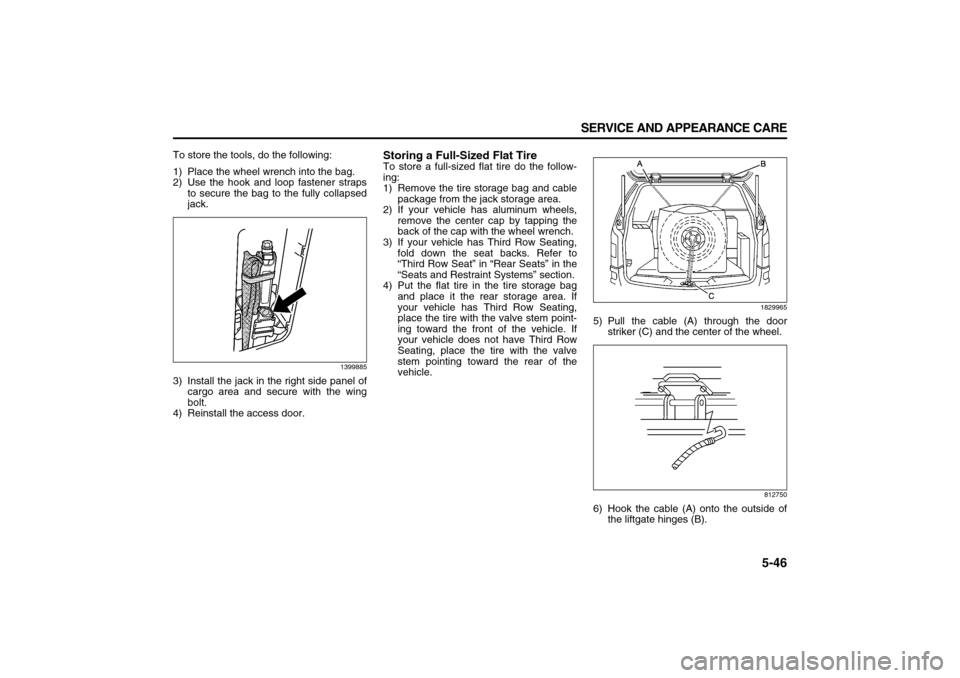
To store the tools, do the following:
1) Place the wheel wrench into the bag.
2) Use the hook and loop fastener straps
to secure the bag to the fully collapsed
jack.
1399885
3) Install the jack in the right side panel of
cargo area and secure with the wing
bolt.
4) Reinstall the access door.
Storing a Full-Sized Flat TireTo store a full-sized flat tire do the follow-
ing:
1) Remove the tire storage bag and cable
package from the jack storage area.
2) If your vehicle has aluminum wheels,
remove the center cap by tapping the
back of the cap with the wheel wrench.
3) If your vehicle has Third Row Seating,
fold down the seat backs. Refer to
“Third Row Seat” in “Rear Seats” in the
“Seats and Restraint Systems” section.
4) Put the flat tire in the tire storage bag
and place it the rear storage area. If
your vehicle has Third Row Seating,
place the tire with the valve stem point-
ing toward the front of the vehicle. If
your vehicle does not have Third Row
Seating, place the tire with the valve
stem pointing toward the rear of the
vehicle.
1829965
5) Pull the cable (A) through the door
striker (C) and the center of the wheel.
812750
6) Hook the cable (A) onto the outside of
the liftgate hinges (B).
Page 237 of 274

5-53 SERVICE AND APPEARANCE CARE
78J00-03E
Service Parts Identification LabelThis label is on the inside of the glove box.
It is very helpful if you ever need to order
parts. The label has the following informa-
tion:
Vehicle Identification Number (VIN)
Model designation
Paint information
Production options and special equip-
ment
Do not remove this label from the vehicle.
Electrical SystemAdd-On Electrical EquipmentAdd-on equipment can drain your vehicle’s
battery, even if your vehicle is not operat-
ing.
Your vehicle has an airbag system. Before
attempting to add anything electrical to
your vehicle, refer to “Servicing Your Air-
bag-Equipped Vehicle” in “Airbag System”
in the “Seats and Restraint Systems” sec-
tion.Windshield Wiper FusesThe windshield wiper motor is protected by
a circuit breaker and a fuse. If the motor
overheats due to heavy snow or ice, the
wiper will stop until the motor cools. If the
overload is caused by some electrical
problem, have it fixed.
Power Windows and Other Power
OptionsCircuit breakers in the fuse panel protect
the power seats. When the current load is
too heavy, the circuit breaker opens and
closes, protecting the circuit until the prob-
lem is fixed.Fuses and Circuit BreakersThe wiring circuits in your vehicle are pro-
tected from short circuits by fuses and cir-
cuit breakers. This greatly reduces the
chance of circuit overload and fire caused
by electrical problems.
Your vehicle has an underhood fuse block
and an instrument panel fuse block.
To identify and check fuses, circuit break-
ers, and relays, refer to the Fuse Usage
Chart on the inside surface of the fuse
panel door.
CAUTION
Do not add anything electrical to your
vehicle unless you check with your
dealer first. Some electrical equip-
ment can damage your vehicle and
the damage would not be covered by
your warranty. Some add-on electri-
cal equipment can keep other compo-
nents from working as they should.
Page 238 of 274

5-54 SERVICE AND APPEARANCE CARE
78J00-03E
Instrument Panel Fuse Block
The instrument panel fuse block is located
on the passenger’s side of the center con-
sole, to the left of the glove box near the
floor.
1708445
Remove the console cover to access the
fuse block.
1808062
Fuses Usage
1 Sunroof
2 Rear Seat Entertainment
3 Rear Wiper
4 Liftgate
5 Airbags
6 Heated Seats
7 Driver’s Side Turn Signal
8 Door Locks
9Automatic Occupant
Sensing Module
10 Power Mirrors
Fuses Usage
11Passenger’s Side Turn
Signal
12 Amplifier
13Steering Wheel Illumina-
tion
SPARE Spare
SPARE Spare
SPARE Spare
SPARE Spare
SPARE Spare
14 Infotainment
15Climate Control System,
Remote Function Actuator
16 Canister Vent
17 Radio
18 Cluster
19 Ignition Switch
20 Body Control Module
21 Not Used
22Center High-Mounted
Stoplamp, Dimmer
23 Interior Lights