2007 SUZUKI FORENZA cooling
[x] Cancel search: coolingPage 159 of 225
5-15 SERVICE AND APPEARANCE CARE
85Z03-03E
If the warning continues and you have not
stopped, pull over, stop, and park your
vehicle right away.
If there’s still no sign of steam, you can idle
the engine for three minutes while you’re
parked. If you still have the warning, turn
off the engine and get everyone out of the
vehicle until it cools down.
You may decide not to lift the hood, but to
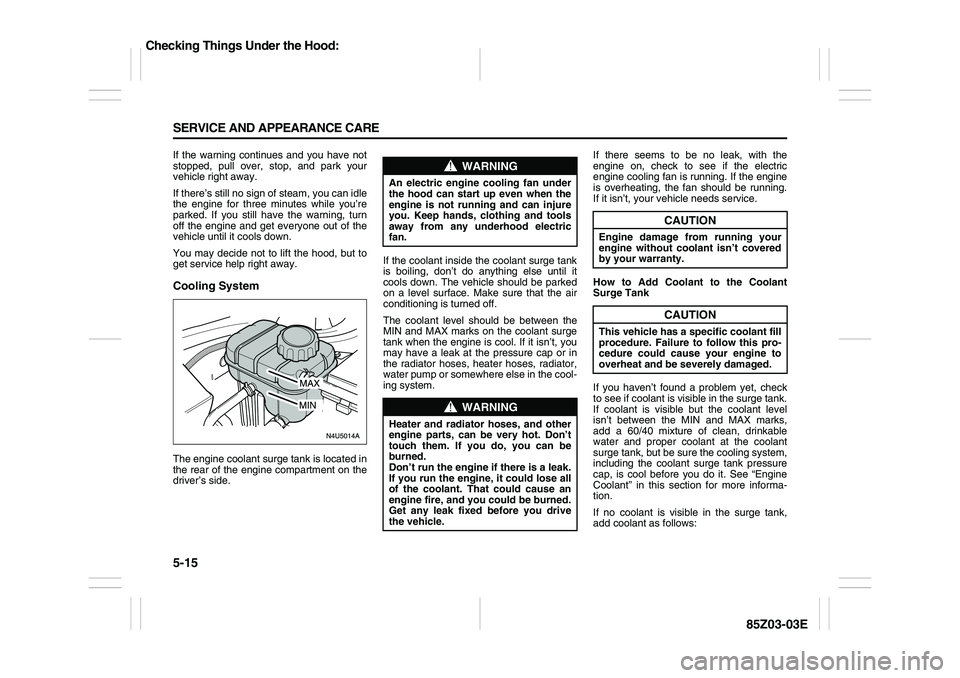
get service help right away.Cooling SystemThe engine coolant surge tank is located in
the rear of the engine compartment on the
driver’s side.If the coolant inside the coolant surge tank
is boiling, don’t do anything else until it
cools down. The vehicle should be parked
on a level surface. Make sure that the air
conditioning is turned off.
The coolant level should be between the
MIN and MAX marks on the coolant surge
tank when the engine is cool. If it isn’t, you
may have a leak at the pressure cap or in
the radiator hoses, heater hoses, radiator,
water pump or somewhere else in the cool-
ing system.If there seems to be no leak, with the
engine on, check to see if the electric
engine cooling fan is running. If the engine
is overheating, the fan should be running.
If it isn’t, your vehicle needs service.
How to Add Coolant to the Coolant
Surge Tank
If you haven’t found a problem yet, check
to see if coolant is visible in the surge tank.
If coolant is visible but the coolant level
isn’t between the MIN and MAX marks,
add a 60/40 mixture of clean, drinkable
water and proper coolant at the coolant
surge tank, but be sure the cooling system,
including the coolant surge tank pressure
cap, is cool before you do it. See “Engine
Coolant” in this section for more informa-
tion.
If no coolant is visible in the surge tank,
add coolant as follows:
WARNING
An electric engine cooling fan under
the hood can start up even when the
engine is not running and can injure
you. Keep hands, clothing and tools
away from any underhood electric
fan.
WARNING
Heater and radiator hoses, and other
engine parts, can be very hot. Don’t
touch them. If you do, you can be
burned.
Don’t run the engine if there is a leak.
If you run the engine, it could lose all
of the coolant. That could cause an
engine fire, and you could be burned.
Get any leak fixed before you drive
the vehicle.
CAUTION
Engine damage from running your
engine without coolant isn’t covered
by your warranty.
CAUTION
This vehicle has a specific coolant fill
procedure. Failure to follow this pro-
cedure could cause your engine to
overheat and be severely damaged.
Checking Things Under the Hood:
Page 160 of 225
5-16 SERVICE AND APPEARANCE CARE
85Z03-03E
1) Park the vehicle on a level surface. You
can remove the coolant surge tank
pressure cap when the cooling system,
including the coolant surge tank pres-
sure cap and upper radiator hose, is no
longer hot. Turn the pressure cap
slowly counterclockwise (left) about two
or two and one-half turns. If you hear a
hiss, wait for that to stop. This will allow
any pressure still left to be vented out
the discharge hose.
WARNING
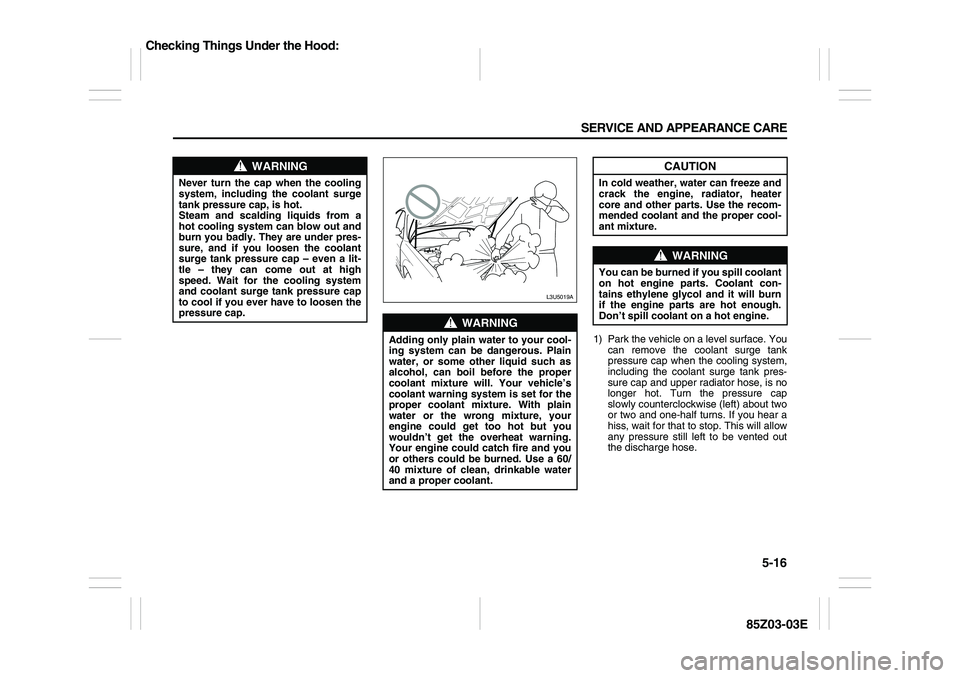
Never turn the cap when the cooling
system, including the coolant surge
tank pressure cap, is hot.
Steam and scalding liquids from a
hot cooling system can blow out and
burn you badly. They are under pres-
sure, and if you loosen the coolant
surge tank pressure cap – even a lit-
tle – they can come out at high
speed. Wait for the cooling system
and coolant surge tank pressure cap
to cool if you ever have to loosen the
pressure cap.
WARNING
Adding only plain water to your cool-
ing system can be dangerous. Plain
water, or some other liquid such as
alcohol, can boil before the proper
coolant mixture will. Your vehicle’s
coolant warning system is set for the
proper coolant mixture. With plain
water or the wrong mixture, your
engine could get too hot but you
wouldn’t get the overheat warning.
Your engine could catch fire and you
or others could be burned. Use a 60/
40 mixture of clean, drinkable water
and a proper coolant.
L3U5019A
CAUTION
In cold weather, water can freeze and
crack the engine, radiator, heater
core and other parts. Use the recom-
mended coolant and the proper cool-
ant mixture.
WARNING
You can be burned if you spill coolant
on hot engine parts. Coolant con-
tains ethylene glycol and it will burn
if the engine parts are hot enough.
Don’t spill coolant on a hot engine.
Checking Things Under the Hood:
Page 161 of 225

5-17 SERVICE AND APPEARANCE CARE
85Z03-03E
2) Then keep turning the pressure cap
slowly, and remove it.
3) Fill the coolant surge tank with the
proper mixture to the MAX mark on the
coolant surge tank. Wait about five min-
utes, then check to see if the level is
below the MAX mark. If the level is
below the MAX mark, add additional
coolant to bring the level up to the MAX
mark. Repeat this procedure until the
level remains constant at the MAX mark
for at least five minutes.
4) With the coolant surge tank pressure
cap off, start the engine and let it run
until you can feel the upper radiator
hose getting hot. Watch out for the
engine cooling fan.
By this time, the coolant level inside the
coolant surge tank may be lower. If thelevel is lower than the MAX mark, add
more of the proper mixture to the cool-
ant surge tank until the level reaches
the MAX mark.
5) Then replace the pressure cap. Be sure
the pressure cap is hand-tight and fully
seated. See your SUZUKI dealer, if
necessary.
Power Steering FluidThe power steering fluid reservoir is
located toward the front of the engine com-
partment on the driver’s side of the vehicle.
See “Engine Compartment Overview” in
this section for more information on loca-
tion.
When to Check Power Steering Fluid
It is not necessary to regularly check
power steering fluid unless you suspect
there is a leak in the system or you hear an
unusual noise. A fluid loss in this system
could indicate a problem. Have the system
inspected and repaired.How to Check Power Steering Fluid
Turn the key off and then check the fluid
level. The level should be between the MIN
and MAX marks on the reservoir. If the
level is below the MIN mark, add power
steering fluid.
What to Use
To determine what kind of fluid to use, see
“Recommended Fluids and Lubricants” in
section 6. Always use the proper fluid. Fail-
ure to use the proper fluid can cause leaks
and can damage hoses and seals.
Checking Things Under the Hood:
Page 183 of 225
5-39 SERVICE AND APPEARANCE CARE
85Z03-03E
See “Changing a Flat Tire” in this section
for more information.
Used Replacement Wheels
Tire Chains
If a Tire Goes FlatIt’s a unusual for a tire to “blowout” while
you’re driving, especially if you maintain
your tire properly. If air goes out of a tire,
it’s much more likely to leak out slowly. But
if you should ever have a “blowout”, here
are a few tips about what to expect and
what to do:
If a front tire fails, the flat tire will create a
drag that pulls the vehicle toward that side.
Take your foot off the accelerator pedal
and grip the steering wheel firmly. Steer to
maintain lane position, and then gently
brake to a stop well out of the traffic lane.A rear blowout, particularly on a curve,
acts much like a skid and may require the
same correction you’d use in a skid. In any
rear blowout, remove your foot from the
accelerator pedal. Get the vehicle under
control by steering the way you want the
vehicle to go. It may be very bumpy and
noisy, but you can still steer. Gently brake
to a stop, well off the road if possible.
If a tire goes flat, the next part shows how
to use your jacking equipment to change a
flat tire safely.
Changing a Flat TireIf a tire goes flat, avoid further tire and
wheel damage by driving slowly to a level
place. Turn on your hazard warning flash-
ers.
CAUTION
The wrong wheel can also cause
problems with bearing life, brake
cooling, speedometer or odometer
calibration, headlamp aim, bumper
height, vehicle ground clearance and
tire or tire chain clearance to the
body and chassis.
WARNING
Putting a used wheel on your vehicle
is dangerous. You can’t know how it’s
been used or how far it’s been driven.
It could fail suddenly and cause a
crash. If you have to replace a wheel,
use a new SUZUKI original equip-
ment wheel.
CAUTION
Use tire chains only where legal and
only when you must. Use only SAE
class “S” type chains that are the
proper size for your tires. Install them
on the front tires and tighten them as
tightly as possible with the ends
securely fastened. Drive slowly and
follow the chain manufacturer’s
instructions. If you can hear the
chains contacting your vehicle, stop
and retighten them. If the contact
continues, slow down until it stops.
Driving too fast or spinning the
wheels with chains on will damage
your vehicle.
WARNING
Lifting a vehicle and getting under it
to do maintenance or repairs is dan-
gerous without the appropriate safety
equipment and training. The jack pro-
vided with your vehicle is designed
only for changing a flat tire. If it is
used for anything else, you or others
could be badly injured or killed if the
vehicle slips off the jack. Use the jack
provided with your vehicle only for
changing a flat tire.
Tires:
Page 197 of 225

5-53 SERVICE AND APPEARANCE CARE
85Z03-03E
Fuses Usages
HEAD LAMPS Head Lamp
ECMEngine Control
Module
I/P FUSEInstrument Panel
Fuse
FUEL PUMP Fuel Pump
A/C Air Conditioning
HORN Horn
HI BEAMHead Lamp
High-Beam
DRIVER’S PWR
WNDWDriver’s Power
Window
STOP LAMPS Stop Lamps
DR/LCK Door Lock
MIR HTD Heated Mirror
FRT FOG Front Fog
ILLUM LTLicense Plate Lamp,
Parking Lamp Left
INJ Injector
Fuses Usages
ENG SNSREVAP Canister Purge
Solenoid, HO2S,
Cooling Fan Relay,
CMP Sensor
LOW BEAM LTHead Lamp
Low-Beam Left
ILLUM RTIllumination
Circuit, Parking Lamp
Right
LOW BEAM RTHead Lamp
Low-Beam Right
SPARE Spare
SPARE Spare
SPARE Spare
BATT PWR Battery Power
ABSAntilock Brake
System
HVAC BLWR HVAC Blower
IGN 2 Ignition 2
IGN 1 Ignition 1
FUSE PLR Fuse Puller
COOL FAN LOW Cooling Fan Low
Fuses Usages
DEFOG Defog
COOL FAN HI Cooling Fan High
PWR WNDW Power Window
Relays Usages
COOL FAN LOW Cooling Fan Low
FRT FOG Front Fog
ILLUM Illumination Relay
A/C CMPRSRAir Conditioning
Compressor
HORN Horn
DEFOG Defog
FUEL PUMP Fuel Pump
MAIN Main Relay
COOL FAN HI Cooling Fan High
PWR WNDW Power Window
HEAD LAMPS Headlamp Relay
Capacities and Specifications:
Page 202 of 225

6-2 MAINTENANCE SCHEDULE
85Z03-03E
MaintenanceScheduled Maintenance ServicesMaintenance services and record retention are the owner’s responsibility. You should retain evidence that proper maintenance has been
performed on your vehicle in accordance with the scheduled maintenance services chart.Maintenance Recommended under Normal Driving ConditionsEngine Control SystemMaintenance
IntervalKilometers (miles) or time in months, whichever comes first
Months 6 1218243036424854606672788490
Maintenance
Itemx 1,000 miles 7.5 15 22.5 30 37.5 45 52.5 60 67.5 75 82.5 90 97.5 105 112.5
x 1,000 km 12 24 36 48 60 72 84 96 108 120 132 144 156 168 180
Drive Belt (Alternator, Power steering
Pump & A/C Compressor)IIIIIIIIIIIIIII
Engine Oil & Oil Filter RRRRRRRRRRRRRRR
Cooling System Hose & Connections I I I I I I I
Engine Coolant Silicate based I I I R I I I R I I I R I I I
Dex-cool Inspect every 7,500 miles (12,000 km) or 6 months, and
replace every 150,000 miles (240,000 km) or 60 months.
Fuel Filter (integrated in Fuel Pump) I* I* R*
Fuel Line & Connections I* I* I* I* I* I* I*
Air Cleaner Element I* I* I* R* I* I* I* R* I* I* I* R* I* I* I*
Spark Plugs I* R* I* R* I* R* I*
Spark Plug Wires Replace every 60,000 miles (96,000 km)
EVAP Canister and Vapor Lines I* I* I*
EVAP Canister Vent Valve Filter I* R* I*
PCV System I* I* I* I* I*
Timing Belt I R I
Page 203 of 225
6-3 MAINTENANCE SCHEDULE
85Z03-03E
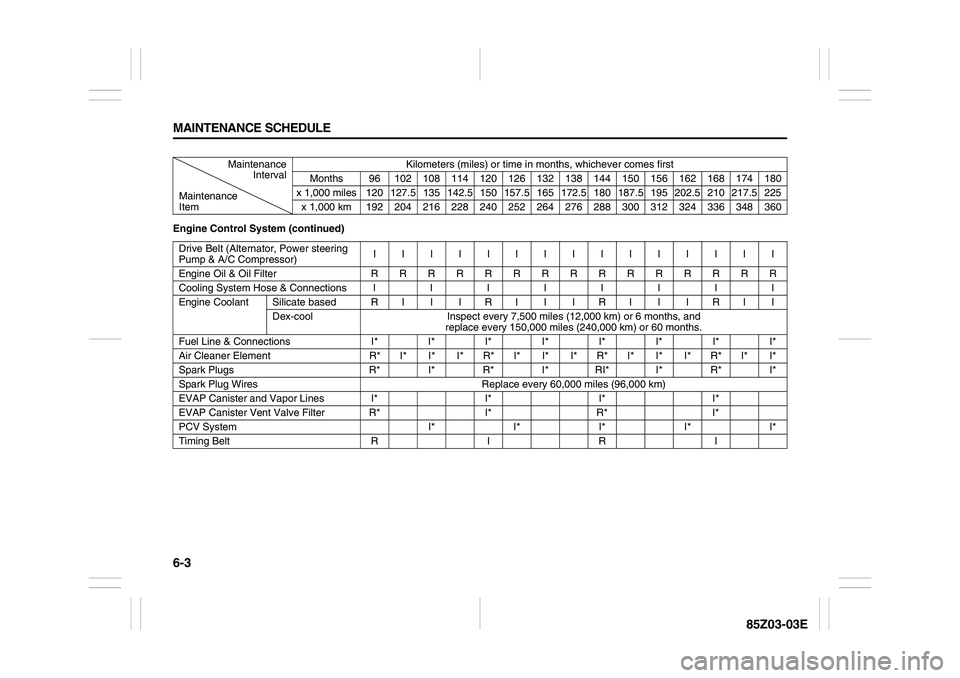
Engine Control System (continued)Maintenance
IntervalKilometers (miles) or time in months, whichever comes first
Months 96 102 108 114 120 126 132 138 144 150 156 162 168 174 180
Maintenance
Itemx 1,000 miles 120 127.5 135 142.5 150 157.5 165 172.5 180 187.5 195 202.5 210 217.5 225
x 1,000 km 192 204 216 228 240 252 264 276 288 300 312 324 336 348 360
Drive Belt (Alternator, Power steering
Pump & A/C Compressor)IIIIIIIIIIIIIII
Engine Oil & Oil Filter RRRRRRRRRRRRRRR
Cooling System Hose & Connections I I I I I I I I
Engine Coolant Silicate based R I I I R I I I R I I I R I I
Dex-cool Inspect every 7,500 miles (12,000 km) or 6 months, and
replace every 150,000 miles (240,000 km) or 60 months.
Fuel Line & Connections I* I* I* I* I* I* I* I*
Air Cleaner Element R* I* I* I* R* I* I* I* R* I* I* I* R* I* I*
Spark Plugs R* I* R* I* RI* I* R* I*
Spark Plug Wires Replace every 60,000 miles (96,000 km)
EVAP Canister and Vapor Lines I* I* I* I*
EVAP Canister Vent Valve Filter R* I* R* I*
PCV System I* I* I* I* I*
Timing Belt RIRI
Page 206 of 225

6-6 MAINTENANCE SCHEDULE
85Z03-03E
Maintenance Recommended under Severe Driving ConditionsFollow this schedule if your car is mainly operated under one or more of the following conditions:
Engine Control System Repeated short-distance driving less than 5 miles (8 km).
Extensive idling and/or slow-speed driving in stop-and-go traffic.
Driving on dusty roads.
Driving on hilly or mountainous terrain. Driving in heavy city traffic where the outside temperatures reg-
ularly reach 90°F (32°C) or higher.
Driving as a taxi, police or delivery vehicle.
Frequent driving when outside temperature remains below
freezing.
Maintenance
IntervalKilometers (miles) or time in months, whichever comes first
Months 3 6 9 121518212427303336394245
Maintenance
Itemx 1,000 miles 3.75 7.5 11.25 15 18.75 22.526.25 30 33.75 37.5 41.25 45 48.75 52.5 56.25
x 1,000 km 6 1218243036424854606672788490Drive Belt (Alternator, Power steering
Pump & A/C Compressor)IIIIIII
Engine Oil & Oil Filter RRRRRRRRRRRRRRR
Cooling System Hose & Connections I I I
Engine Coolant Silicate based I I I R I I I
Dex-cool Inspect every 7,500 miles (12,000 km) or 6 months, and
replace every 150,000 miles (240,000 km) or 60 months.
Fuel Filter (integrated in Fuel Pump) I*
Fuel Line & Connections I* I* I*
Air Cleaner Element I* I* I* I* I* I* I* R* I* I* I* I* I* I* I*
Spark Plugs I* R* I*
Spark Plug Wires Replace every 60,000 miles (96,000 km)
EVAP Canister and Vapor Lines I*
EVAP Canister Vent Valve Filter I*
PCV System I* I*
Timing BeltI