Page 117 of 232

Downloaded from www.Manualslib.com manuals search engine 5-2 OTHER CONTROLS AND EQUIPMENT
54G27-03E
Clutch Pedal (1)(For manual transaxle)
The clutch pedal is used to disengage the
drive to the wheels when starting the
engine, stopping or shifting the gearshift
lever. Depressing the pedal disengages
the clutch.Brake Pedal (2)Your SUZUKI vehicle is equipped with front
disc brakes and rear drum brakes.
Depressing the brake pedal applies both
sets of brakes.
You may hear occasional brake squeal
when you apply the brakes. This is a nor-
mal condition caused by environmental
factors such as cold, wet, snow, etc.
Accelerator Pedal (3)This pedal controls the speed of the
engine. Depressing the accelerator pedal
increases power output and speed.
Gearshift LeverManual transaxle
60B095
4-speed automatic transaxle
54G465
CAUTION
Do not drive with your foot resting on
the clutch pedal. It could result in
excessive clutch wear or clutch dam-
age.
WARNING
If brake squeal is excessive and
occurs each time the brakes are
applied, you should have the brakes
checked by your SUZUKI dealer.
WARNING
Do not “ride” the brakes by applying
them continuously or resting your
foot on the pedal. This will result in
overheating of the brakes which
could cause unpredictable braking
action, longer stopping distances or
permanent brake damage.
EXAMPLEEXAMPLE
Pedals: 6
Gearshift Lever: 10
Page 118 of 232
Downloaded from www.Manualslib.com manuals search engine 5-3 OTHER CONTROLS AND EQUIPMENT
54G27-03E
Your vehicle is equipped with either a man-
ual transaxle or automatic transaxle. The
gearshift lever for each transaxle type is
shown in the illustrations. For details on
how to use the transaxle, refer to the
“Using the Transaxle” in “OPERATING
YOUR VEHICLE” section.
Fuel Filler Cap
54G581
The fuel filler cap is located on the left rear
side of the vehicle. The fuel filler door can
simply be opened by hand.
60G069
To remove the fuel filler cap:
1) Open the fuel filler door.
2) Remove the cap by turning it counter-
clockwise.
To reinstall the fuel filler cap:
1) Turn the cap clockwise until you hear
several clicks.
2) Close the fuel filler door.
EXAMPLE
WARNING
Remove the fuel filler cap slowly. The
fuel may be under pressure and may
spray out, causing injury.Open Close
Gearshift Lever: 10
Fuel Filler Cap: 5
Page 119 of 232

Downloaded from www.Manualslib.com manuals search engine 5-4 OTHER CONTROLS AND EQUIPMENT
54G27-03E
Folding Rear SeatsTo fold the rear seatback(s) forward:
54G372
1) Unlatch the detachable connector
before folding the rear right seatback.
To unlatch, insert the ignition key into
the slot of the connector and allow the
belt to retract.
54G373
2) Once the belt has completely retracted,
secure the latch plate as shown in the
illustration.
WARNING
Gasoline is extremely flammable. Do
not smoke when refueling, and make
sure there are no open flames or
sparks in the area.
WARNING
If you need to replace the fuel cap,
use a genuine SUZUKI cap or its
equivalent. Use of an improper cap
can result in a malfunction of the fuel
system or emission control system. It
may also result in fuel leakage in the
event of an accident.
CAUTION
When you fold a rear right seatback,
be sure to unlatch the detachable
connector. This helps prevent dam-
age to the belt webbing.
Fuel Filler Cap: 5
Folding Rear Seats: 3
Page 120 of 232
Downloaded from www.Manualslib.com manuals search engine 5-5 OTHER CONTROLS AND EQUIPMENT
54G27-03E
54G374
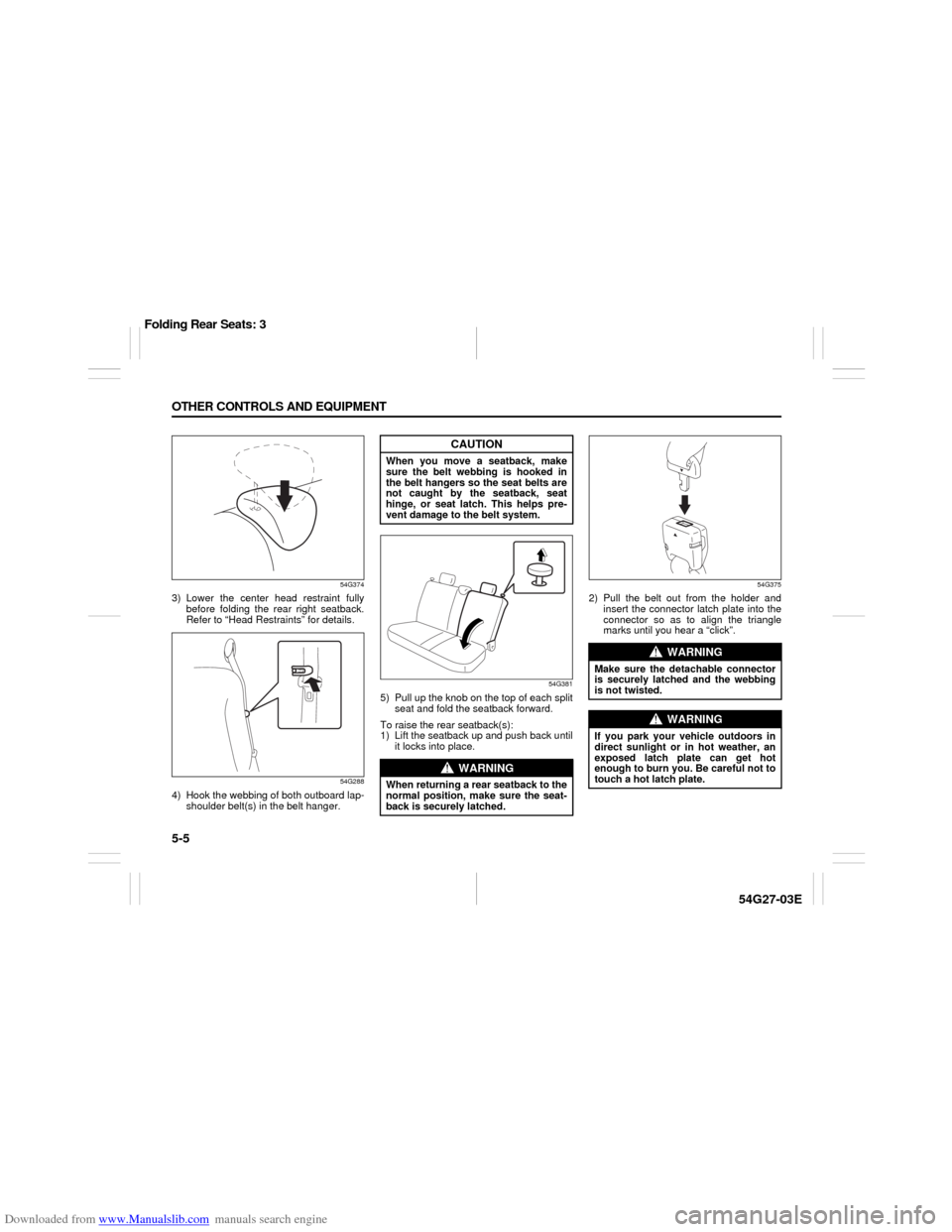
3) Lower the center head restraint fully
before folding the rear right seatback.
Refer to “Head Restraints” for details.
54G288
4) Hook the webbing of both outboard lap-
shoulder belt(s) in the belt hanger.
54G381
5) Pull up the knob on the top of each split
seat and fold the seatback forward.
To raise the rear seatback(s):
1) Lift the seatback up and push back until
it locks into place.
54G375
2) Pull the belt out from the holder and
insert the connector latch plate into the
connector so as to align the triangle
marks until you hear a “click”.
CAUTION
When you move a seatback, make
sure the belt webbing is hooked in
the belt hangers so the seat belts are
not caught by the seatback, seat
hinge, or seat latch. This helps pre-
vent damage to the belt system.
WARNING
When returning a rear seatback to the
normal position, make sure the seat-
back is securely latched.
WARNING
Make sure the detachable connector
is securely latched and the webbing
is not twisted.
WARNING
If you park your vehicle outdoors in
direct sunlight or in hot weather, an
exposed latch plate can get hot
enough to burn you. Be careful not to
touch a hot latch plate.
Folding Rear Seats: 3
Page 124 of 232
Downloaded from www.Manualslib.com manuals search engine 5-9 OTHER CONTROLS AND EQUIPMENT
54G27-03E
54G497
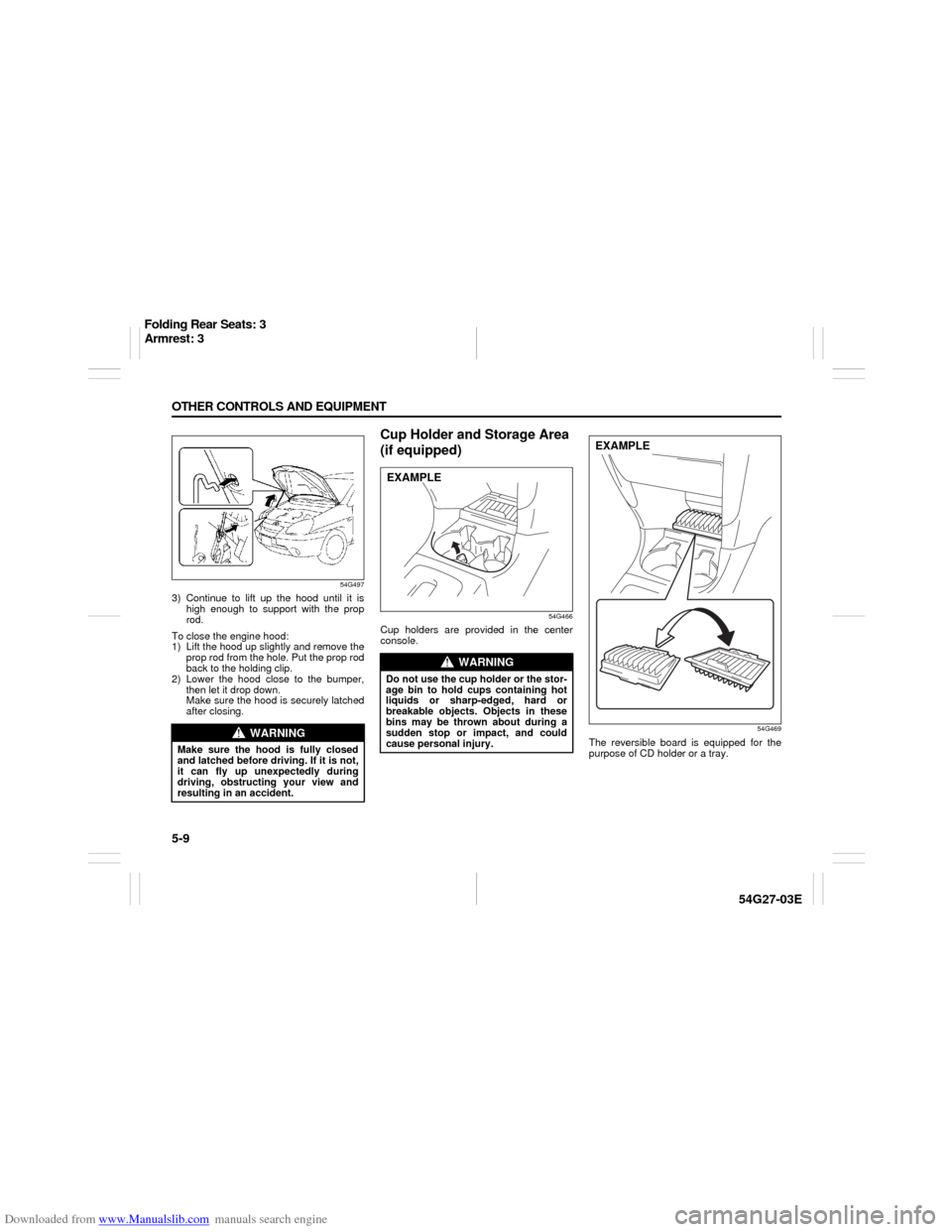
3) Continue to lift up the hood until it is
high enough to support with the prop
rod.
To close the engine hood:
1) Lift the hood up slightly and remove the
prop rod from the hole. Put the prop rod
back to the holding clip.
2) Lower the hood close to the bumper,
then let it drop down.
Make sure the hood is securely latched
after closing.
Cup Holder and Storage Area
(if equipped)
54G466
Cup holders are provided in the center
console.
54G469
The reversible board is equipped for the
purpose of CD holder or a tray.
WARNING
Make sure the hood is fully closed
and latched before driving. If it is not,
it can fly up unexpectedly during
driving, obstructing your view and
resulting in an accident.
WARNING
Do not use the cup holder or the stor-
age bin to hold cups containing hot
liquids or sharp-edged, hard or
breakable objects. Objects in these
bins may be thrown about during a
sudden stop or impact, and could
cause personal injury.EXAMPLE
EXAMPLE
Folding Rear Seats: 3
Armrest: 3
Page 126 of 232
Downloaded from www.Manualslib.com manuals search engine 5-11 OTHER CONTROLS AND EQUIPMENT
54G27-03E
Frame HooksFront (type A)
54G468
Front (type B)
54G532
Rear (type A)
54G646
Rear (type B)
54G534
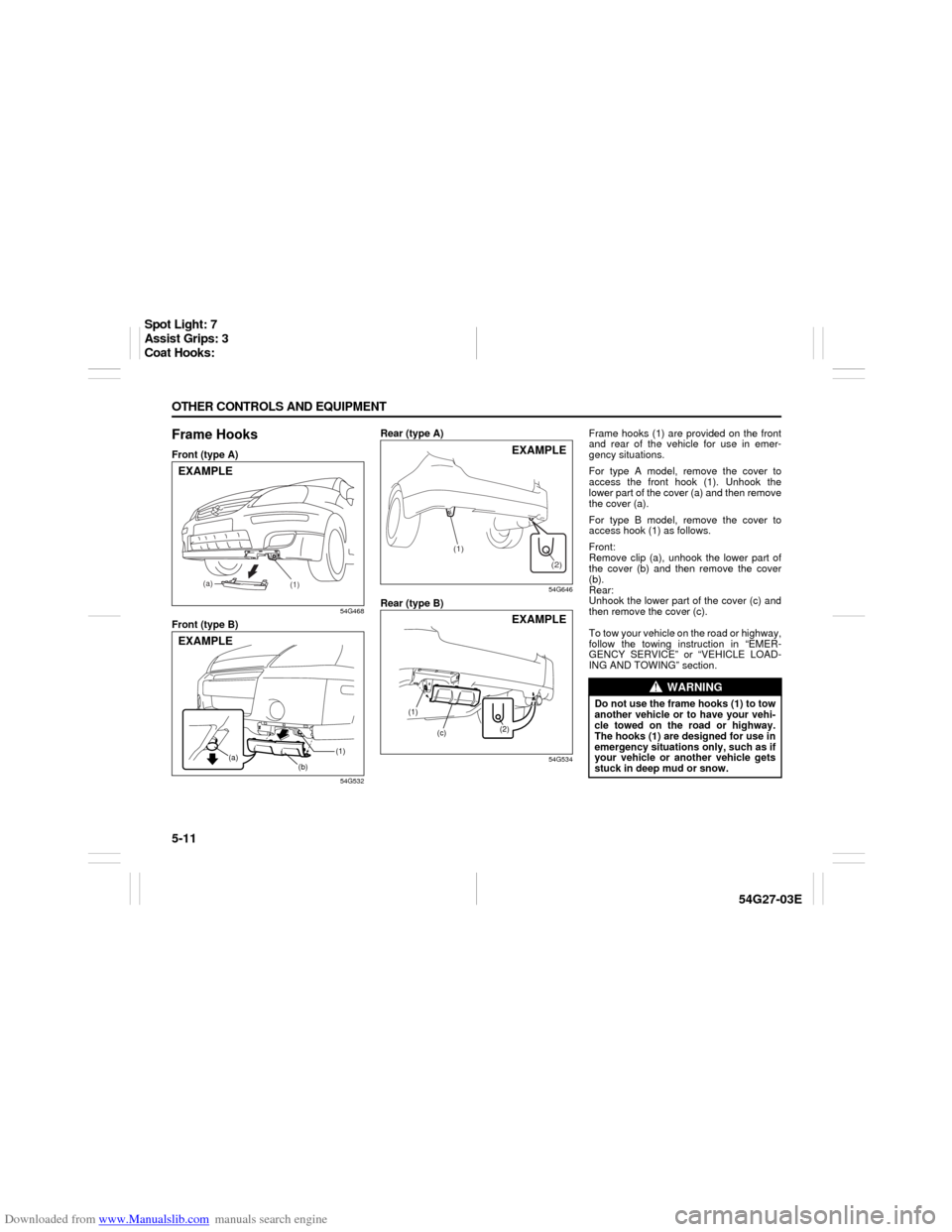
Frame hooks (1) are provided on the front
and rear of the vehicle for use in emer-
gency situations.
For type A model, remove the cover to
access the front hook (1). Unhook the
lower part of the cover (a) and then remove
the cover (a).
For type B model, remove the cover to
access hook (1) as follows.
Front:
Remove clip (a), unhook the lower part of
the cover (b) and then remove the cover
(b).
Rear:
Unhook the lower part of the cover (c) and
then remove the cover (c).
To tow your vehicle on the road or highway,
follow the towing instruction in “EMER-
GENCY SERVICE” or “VEHICLE LOAD-
ING AND TOWING” section.
(1)
(a)
EXAMPLE
(1)
(a)
(b)
EXAMPLE
(2)
(1)
EXAMPLE
(2) (1)
(c)
EXAMPLE
WARNING
Do not use the frame hooks (1) to tow
another vehicle or to have your vehi-
cle towed on the road or highway.
The hooks (1) are designed for use in
emergency situations only, such as if
your vehicle or another vehicle gets
stuck in deep mud or snow.
Spot Light: 7
Assist Grips: 3
Coat Hooks:
Page 128 of 232
Downloaded from www.Manualslib.com manuals search engine 5-13 OTHER CONTROLS AND EQUIPMENT
54G27-03E
Front Seat Back Pocket
(if equipped)
60B119
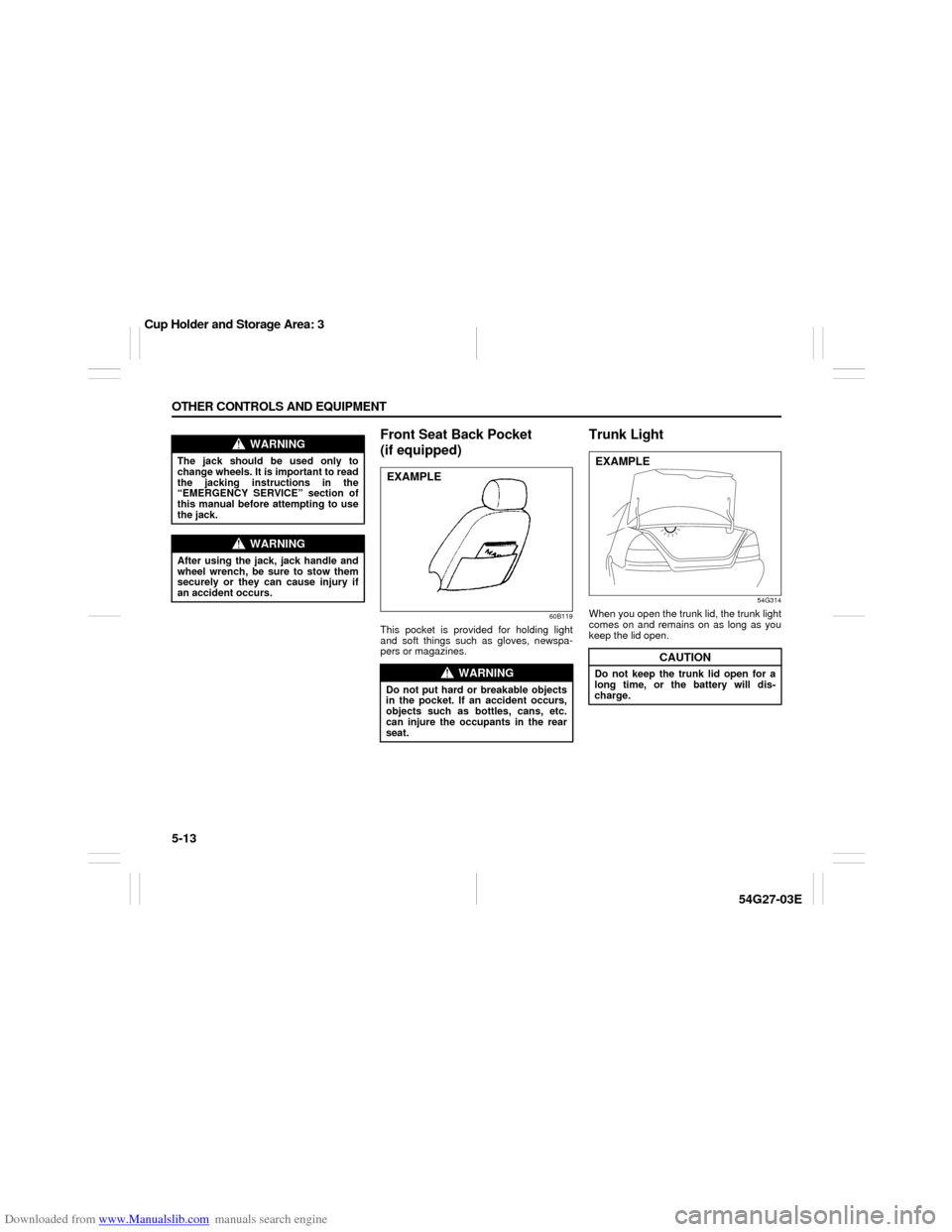
This pocket is provided for holding light
and soft things such as gloves, newspa-
pers or magazines.
Trunk Light
54G314
When you open the trunk lid, the trunk light
comes on and remains on as long as you
keep the lid open.
WARNING
The jack should be used only to
change wheels. It is important to read
the jacking instructions in the
“EMERGENCY SERVICE” section of
this manual before attempting to use
the jack.
WARNING
After using the jack, jack handle and
wheel wrench, be sure to stow them
securely or they can cause injury if
an accident occurs.
WARNING
Do not put hard or breakable objects
in the pocket. If an accident occurs,
objects such as bottles, cans, etc.
can injure the occupants in the rear
seat.EXAMPLE
CAUTION
Do not keep the trunk lid open for a
long time, or the battery will dis-
charge.EXAMPLE
Cup Holder and Storage Area: 3
Page 129 of 232
Downloaded from www.Manualslib.com manuals search engine OPERATING YOUR VEHICLE
6
54G27-03E
60G408
OPERATING YOUR VEHICLEExhaust Gas Warning ......................................................... 6-1
Daily Inspection Checklist .................................................. 6-1
Starting the Engine ............................................................. 6-2
Engine Block Heater (if equipped) ..................................... 6-3
Using the Transaxle ............................................................ 6-4
Braking ................................................................................. 6-7
Break-In ................................................................................ 6-9
Catalytic Converter ............................................................. 6-9
Improving Fuel Economy ................................................... 6-10

