2007 SUZUKI AERIO steering wheel
[x] Cancel search: steering wheelPage 163 of 232

Downloaded from www.Manualslib.com manuals search engine 9-10 INSPECTION AND MAINTENANCE
54G27-03E
R: Replace or change
I : Inspect and correct, replace or lubricate if necessary
NOTE:
This table shows the service schedule up to 125000 km (75000 miles).
Beyond 125000 km (75000 miles), perform the same services at the same intervals shown in the chart.Interval: This interval should be judged by odometer
reading or months, whichever comes first.miles (x 1000) 42 45 48 51 54 57 60 63 66 69 72 75
km (x 1000) 70 75 80 85 90 95 100 105 110 115 120 125
months 42 45 48 51 54 57 60 63 66 69 72 75CHASSIS AND BODY
1. Clutch (for manual transaxle)
Fluid level check
–
I
–
–
–
–
I
–
–
–
–
I
*2. Brake discs and pads (front) – – I – – – I – – – I –
Brake drums and shoes
(rear)
–
–
I
–
–
–
I
–
–
–
I
–
*3. Brake hoses and pipes – – I – – – I – – – I –
4.Brake fluid level check, *replacement
–
I
–
–
–
–
R
–
–
–
–
I
5. Brake pedal stroke check, *adjustment – I–––– I –––– I
6.Parking brake lever and *cableLever movement check, *adjustment – I –––– I –––– I7.Tires (including tire rotation)
I
–
I
–
I
–
I
–
I
–
I
–
8.Wheel discs I–I–I–I–I–I–
*9.
Wheel bearings
–
–
I
–
–
–
I
–
–
–
I
–
*10. Suspension system I – I – I – I – I – I –
*11.
Propeller shafts (AWD)/Drive axle boots
I
–
I
–
I
–
I
–
I
–
I
–
*12. Manual transaxle oil
Level check, *replacement
–
R
–
–
–
–
R
–
–
–
–
R
13.Automatic transaxle (A/T) Fluid level – I –––– I –––– I
*Fluid change
Replace every 80000 km (48000 miles)-----4-speed A/T
*Fluid hose – I ––––––––––
*14.
Transfer oil (AWD)
–
R
–
–
–
–
R
–
–
–
–
R
*15.Rear differential oil (AWD) –R––––R––––R
16.
Steering systemSteering wheel movement, *linkage I – I – I – I – I – I –
17.
Power steering (if equipped)
I
–
I
–
I
–
I
–
I
–
I
–
18. All latches, hinges and locks I – I – I – I – I – I –
Engine Oil and Filter: 1, 2
Gear Oil: 6, 10
Page 173 of 232

Downloaded from www.Manualslib.com manuals search engine 9-20 INSPECTION AND MAINTENANCE
54G27-03E
Check that there is washer fluid in the tank
by looking at the washer fluid level gauge
which is attached to the cap of the washer
fluid tank. If the fluid level is near “0” mark,
refill it.
Use a good quality windshield washer
fluid, diluted with water as necessary.
Air Cleaner
54G421
(1) Mass air flow sensor
If the air cleaner is clogged with dust, there
will be greater intake resistance, resulting
in decreased power output and increased
fuel consumption.
To remove the air cleaner element:
1) Loosen the clamp of the hose and
detach the hose from the cover.
2) Remove the connector of the Mass air
flow sensor.
3) Unclamp the side clamps.
4) With the right end of the cleaner cover
lifted, move the cover to the left to
remove it.
5) Remove the element from the air
cleaner. If it appears to be dirty, replace
it with a new one.
WARNING
Do not use “anti-freeze” solution in
the windshield washer reservoir. This
can severely impair visibility when
sprayed on the windshield, and also
damage your vehicle’s paint.
CAUTION
Damage may result if the washer
motor is operated with no fluid in the
washer tank.
(1)
CAUTION
The air cleaner element should be
replaced every 50000 km (30000
miles). More frequent replacement is
necessary when you drive under
dusty conditions.
Brakes: 6
Steering Wheel: 6
Page 177 of 232

Downloaded from www.Manualslib.com manuals search engine 9-24 INSPECTION AND MAINTENANCE
54G27-03E
Parking Brake Lever
60A226
Check the parking brake for proper adjust-
ment by counting the number of clicks
made by the ratchet teeth as you slowly
pull up on the parking brake lever to the
point of full engagement. The parking
brake lever should stop between the speci-
fied ratchet teeth and the rear wheels
should be securely locked. If the parking
brake is not properly adjusted or the
brakes drag after the lever has been fully
released, have the parking brake
inspected and/or adjusted by your SUZUKI
dealer.
Steering Wheel
65D187
Check the play of the steering wheel by
gently turning it from left to right and mea-
suring the distance that it moves before
you feel slight resistance. The play should
be between the specified values. Check
that the steering wheel turns easily and
smoothly without rattling by turning it all
the way to the right and to the left while
driving very slowly in an open area. If the
amount of free play is outside the specifi-
cation or you find anything else to be
wrong, an inspection must be performed
by your SUZUKI dealer.
Power Steering (if equipped)
54G225
(1) UPPER
(2) LOWER
Check the steering box case, vane pump
and hose connections for leaks or dam-
age.Power Steering FluidCheck the fluid level by looking at the res-
ervoir in the engine compartment when the
fluid is cold (about room temperature).
Check that the fluid level is between the
“UPPER” and “LOWER” lines. If the fluid
level is near the “LOWER” line, fill it up to
the “UPPER” line with an automatic tran-
saxle fluid equivalent to ATF DEXRON
®-II
(Esso JWS 2326) or DEXRON
®-III. Do not
overfill. Ratchet tooth specification “b”
6th – 8th
200 N (44 lbs, 20 kg)
“b”
Steering wheel play “c”
0 – 30 mm (0.0 – 1.2 in.)
“c”
EXAMPLE
Tires: 6
Page 179 of 232

Downloaded from www.Manualslib.com manuals search engine 9-26 INSPECTION AND MAINTENANCE
54G27-03E
of cord and number of plies in the
sidewall and under the tread.
I. Load Index and Speed Rating
The two- or three-digit number is the
tire’s load index, the maximum load a
tire can carry at the speed indicated
by its speed symbol at the maximum
inflation pressure. The higher the
number is, the greater the load carry-
ing capacity. The letter symbol
denotes the speed at which a tire is
designed to be driven for extended
periods of time. (Ratings are listed
below.)
*The letters ZR may be used on tires with a
maximum speed capability over 149 mph
and will always be used on tires with a
maximum speed capability over 186 mph.J. M+S Marking
This marking indicates the tire has
some mud and snow capabilities and
is designed for all-season use.
Tire SizeThe following illustration shows an exam-
ple of a typical passenger car tire size.
67D028
A. Tire Type
This letter code indicates the primary
intended use of the tire. The letter “P”
identifies a tire primarily intended for
use on a passenger vehicle.
B. Tire Width
This three-digit number indicates the
tire section width in millimeters from
sidewall to sidewall.
C. Aspect Ratio
This two-digit number represents the
tire section height divided by the tire
section width.D. Construction Code
This letter code is used to indicate the
type of ply construction in the tire. The
letter “R” means radial ply tire con-
struction, the letter “D” means diago-
nal or bias ply construction, and the
letter “B” means belted-bias ply con-
struction.
E. Rim Diameter
This two-digit number is the wheel or
rim diameter in inches.
Tire Inflation PressureTire inflation pressure should be checked
when the tire is cold. “Cold tire inflation
pressure” is the pressure in a tire that has
been driven less than 1 mile (1.6 km) or
has been standing for three hours or more. Letter Rating Speed Rating
Q 99 mph
R106 mph
S112 mph
T118 mph
U124 mph
H130 mph
V149 mph
W 168 mph*
Y 186 mph*
A
B
C
D
E
WARNING
Your SUZUKI is equipped with tires
which are all the same type and size.
This is important to ensure proper
steering and handling of the vehicle.
Never mix tires of different size or
type on the four wheels of your vehi-
cle. Mixing tires could cause you to
lose control while driving which may
lead to an accident. The size and type
of tires used should be only those
approved by SUZUKI Motor Corpora-
tion as standard or optional equip-
ment for your vehicle.
Tires: 6
Page 181 of 232

Downloaded from www.Manualslib.com manuals search engine 9-28 INSPECTION AND MAINTENANCE
54G27-03E
sary. Remember to check the spare
tire, too. Refer to the “Measuring Air
Pressure” section.
54G136
(1) Tread wear indicator
(2) Indicator location mark
2) Check that the depth of the tread
groove is more than 1.6 mm (0.06 in.).
To help you check this, the tires have
molded-in tread wear indicators in the
grooves. When the indicators appear
on the tread surface, the remaining
depth of the tread is 1.6 mm (0.06 in.)
or less and the tire should be replaced.
3) Check for abnormal wear, cracks and
damage. Any tires with cracks or other
damage should be replaced. If any tires
show abnormal wear, have them
inspected by your SUZUKI dealer.4) Check for loose wheel nuts.
5) Check that there are no nails, stones or
other objects sticking into the tires.
WARNING
Hitting curbs and running over rocks
can damage tires and affect wheel
alignment. Be sure to have tires and
wheel alignment checked periodi-
cally by your SUZUKI dealer.
WARNING
Your SUZUKI is equipped with tires
which are all the same type and size.
This is important to ensure proper
steering and handling of the vehicle.
Never mix tires of different size or
type on the four wheels of your vehi-
cle. The size and type of tires used
should be only those approved by
SUZUKI Motor Corporation as stan-
dard or optional equipment for your
vehicle.
CAUTION
For All-wheel drive (AWD) models,
replacing a tire with one of a different
size, or using different brands among
the four tires can result in damage to
the drive train.
WARNING
Replacing the wheels and tires
equipped on your vehicle with certain
combinations of aftermarket wheels
and tires can significantly change the
steering and handling characteristics
of your vehicle. Oversized tires may
also rub against the fender over
bumps, causing vehicle damage or
tire failure. Therefore, use only those
wheel and tire combinations
approved by SUZUKI Motor Corpora-
tion as standard or optional equip-
ment for your vehicle. For
information regarding the specified
tires, refer to the Tire Information
Label located on the driver’s side
door pillar or the “SPECIFICATIONS”
section.
CAUTION
Replacing the original tires with tires
of a different size may result in false
speedometer or odometer readings.
Check with your SUZUKI dealer
before purchasing replacement tires
that differ in size from the original
tires.
Tires: 6
Page 202 of 232
Downloaded from www.Manualslib.com manuals search engine 10-5 EMERGENCY SERVICE
54G27-03E
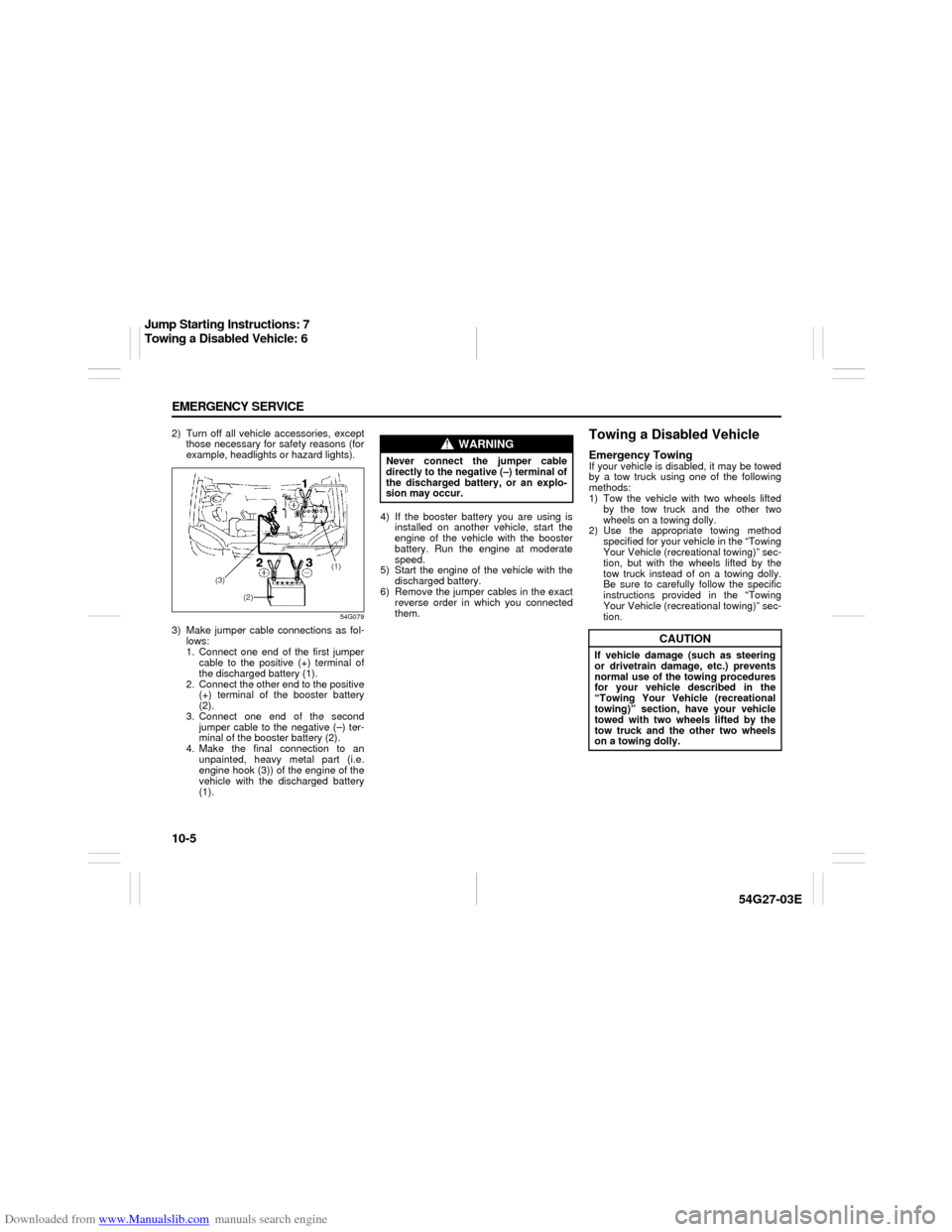
2) Turn off all vehicle accessories, except
those necessary for safety reasons (for
example, headlights or hazard lights).
54G079
3) Make jumper cable connections as fol-
lows:
1. Connect one end of the first jumper
cable to the positive (+) terminal of
the discharged battery (1).
2. Connect the other end to the positive
(+) terminal of the booster battery
(2).
3. Connect one end of the second
jumper cable to the negative (–) ter-
minal of the booster battery (2).
4. Make the final connection to an
unpainted, heavy metal part (i.e.
engine hook (3)) of the engine of the
vehicle with the discharged battery
(1).4) If the booster battery you are using is
installed on another vehicle, start the
engine of the vehicle with the booster
battery. Run the engine at moderate
speed.
5) Start the engine of the vehicle with the
discharged battery.
6) Remove the jumper cables in the exact
reverse order in which you connected
them.
Towing a Disabled VehicleEmergency TowingIf your vehicle is disabled, it may be towed
by a tow truck using one of the following
methods:
1) Tow the vehicle with two wheels lifted
by the tow truck and the other two
wheels on a towing dolly.
2) Use the appropriate towing method
specified for your vehicle in the “Towing
Your Vehicle (recreational towing)” sec-
tion, but with the wheels lifted by the
tow truck instead of on a towing dolly.
Be sure to carefully follow the specific
instructions provided in the “Towing
Your Vehicle (recreational towing)” sec-
tion.
(1)
(3)
(2)
WARNING
Never connect the jumper cable
directly to the negative (–) terminal of
the discharged battery, or an explo-
sion may occur.
CAUTION
If vehicle damage (such as steering
or drivetrain damage, etc.) prevents
normal use of the towing procedures
for your vehicle described in the
“Towing Your Vehicle (recreational
towing)” section, have your vehicle
towed with two wheels lifted by the
tow truck and the other two wheels
on a towing dolly.
Jump Starting Instructions: 7
Towing a Disabled Vehicle: 6
Page 226 of 232

Downloaded from www.Manualslib.com manuals search engine 14-4 SPECIFICATIONS
54G27-03E
ITEM: Wheel
Tire size, front and rear P185/65R14 or P195/55R15
Tire pressure For the specified tire pressure, see the Tire Information Label located
on the driver’s door lock pillar.
ITEM: Steering
Toe IN 1.0 ± 2 mm (0.04 ± 0.08 in.)
Camber angle –0° 10’ ± 1°
Caster angle 2° 11’
ITEM: Capacities
Coolant (including reserve tank) 7.0 L (14.8 US pt)
Fuel tank 50 L (13.2 US gal)
Engine oil (replaced with filter) 4.7 L (5.0 quarts)
Transaxle oil Manual transaxle: 2.3 L (4.9 US pt)
4-speed automatic transaxle: 7.7 L (16.3 US pt)
Rear differential oil 0.7 L (1.5 US pt)
Transfer gear box oil 0.75 L (1.6 US pt)
Specifications: 1, 2, 5, 6, 7, 10, 11
Page 230 of 232

Downloaded from www.Manualslib.com manuals search engine 15-4 INDEX
54G27-03E
Rear Window Defroster Switch
..........................................4-10
Rear Window Wiper/Washer Switch
..................................3-5
Refill with Oil and Check for Leaks ....................................9-13
Refilling
................................................................................9-12
Remote Audio Controls
.............................................. 3-8
, 4-43
Replace the Oil Filter
...........................................................9-13
Replacement of the transmitter battery
.............................2-4
Reporting Safety Defects
....................................................12-4
SSafety Certification Label
...................................................12-2
Seat Adjustment
..................................................................2-11
Seat Belt Extender ...............................................................2-30
Seat Belt Hanger
..................................................................2-21
Seat Belt Inspection
............................................................2-22
Seat Belt Pretensioner System
..........................................2-31
Seat Belt Reminder
..............................................................2-19
Seat Belts and Child Restraint Systems
...........................2-13
Selection of Coolant
............................................................9-17
Shoulder Anchor Height Adjuster
......................................2-21
Side Door Locks
..................................................................2-1
Snow Tires
...........................................................................9-31
Spark Plugs ..........................................................................9-21
SPECIFICATIONS
................................................................14-1
Specified Fluid
.....................................................................9-16
Specified Gear Oil ................................................................9-14
Specified Oil
.........................................................................9-11
Speedometer ........................................................................4-7
Spot Light
.............................................................................5-7
Starting the Engine
..............................................................6-2
Steering Wheel
.....................................................................9-24
Stowing Rear Center Lap-Shoulder Belt
...........................2-19Sun Visor
............................................................................. 5-6
Supplemental Restraint System (air bags)
....................... 2-32
TTachometer
.......................................................................... 4-9
Temperature Gauge
............................................................ 4-10
Thermometer
....................................................................... 4-13
Tilt Steering Lock Lever
..................................................... 3-6
Tire Chains
.......................................................................... 7-3
Tire Changing Tools
........................................................... 5-12
Tire Inflation Pressure ........................................................ 9-26
Tire Inspection
.................................................................... 9-27
Tire Rotation
........................................................................ 9-29
Tire Sidewall Labeling
........................................................ 9-25
Tire Size
............................................................................... 9-26
Tires
..................................................................................... 9-25
Towing a Disabled Vehicle
................................................. 10-5
Towing Your Vehicle (recreational towing)
...................... 8-2
Trailer Towing
..................................................................... 8-2
Trip meter
............................................................................ 4-7
Troubleshooting
.................................................................. 4-47
Trunk Lid
.............................................................................. 2-7
Trunk Light .......................................................................... 5-13
Turn Signal Indicators
........................................................ 4-6
Turn Signal Operation ........................................................ 3-4
UUniform Tire Quality Grading
............................................. 9-29
Unlatching and Latching Detachable Connector
............. 2-18
Using the Transaxle
............................................................ 6-4
VVehicle Cleaning
................................................................. 11-3
Vehicle Identification Number
........................................... 12-1