2007 SUZUKI AERIO service
[x] Cancel search: servicePage 53 of 232

Downloaded from www.Manualslib.com manuals search engine 2-40 BEFORE DRIVING
54G27-03E
Note that even though your vehicle may be
moderately damaged in a collision, the col-
lision may not have been severe enough to
trigger the front or side air bags to inflate. If
your car sustains ANY front-end or side
damage, have the air bag system
inspected by an authorized SUZUKI dealer
to ensure it is in proper working order.
Your vehicle is equipped with a diagnostic
module which records information about
the air bag system if the air bags deploy in
a crash. The module records informationabout overall system status, which sensors
activated the deployment, and whether the
front seat belts were in use.
Servicing the Air Bag SystemIf the air bags inflate, have the air bags and
related components replaced by an autho-
rized SUZUKI dealer as soon as possible.
If your vehicle ever gets in deep water and
the driver’s floor is submerged, the air bag
controller could be damaged. If this hap-
pens, have the air bag system inspected
by an authorized SUZUKI dealer as soon
as possible.
Special procedures are required for servic-
ing or replacing an air bag. For that reason,
only an authorized SUZUKI dealer should
be allowed to service or replace your air
bags. Please remind anyone who services
your vehicle that it has air bags.
Service on or around air bag components
or wiring must be performed only by an
authorized SUZUKI dealer. Improper ser-
vice could result in unintended air bag
deployment or could render the air bags
inoperative. Either of these two conditions
may result in severe injury.
To prevent damage or unintended inflation
of the air bag system, be sure the battery
is disconnected and the ignition switch has
been in the “LOCK” position for at least 90
seconds before performing any electrical
service work on your vehicle. Do not touch
air bag system components or wires. Thewires are wrapped with yellow tape or yel-
low tubing, and the couplers are yellow for
easy identification.
Scrapping a car that has an undeployed air
bag can be hazardous. Ask your dealer,
body repair shop or scrap yard for help
with disposal.
If it is necessary to modify the advanced
front air bag system to accommodate a
person with disabilities, owners in the con-
tinental United States can call American
Suzuki toll-free at 1-800-934-0934, or write
to:
American Suzuki Motor Corporation
Automotive Customer Relations
3251 East Imperial Highway
Brea, CA 92821-6795
If you purchased your SUZUKI in Canada
please contact the Suzuki Canada Cus-
tomer Relations Department by telephone
at 1-905-889-2677 extension 2254 or in
writing at:
Suzuki Canada Inc.
Customer Relations
100 East Beaver Creek Road
Richmond Hill, On
L4B 1J6
WARNING
(Continued)
Do not attach any objects to, or
place any objects over, the steering
wheel or dashboard. Do not place
any objects between the air bag
and the driver or front passenger.
These objects may interfere with air
bag operation or may be propelled
by the air bag in the event of a
crash. Either of these conditions
may cause severe injury.
Do not place seat covers on the
front seats, because seat covers
could restrict the side air bag’s
inflation. Also, do not place any
cup holders on the door, as the cup
holder could be propelled by the air
bag in the event of a crash. Either
of these conditions may cause
severe injury.
Supplemental Restraint System (advanced air bags):
3, 9, 12
Page 70 of 232

Downloaded from www.Manualslib.com manuals search engine 4-5 INSTRUMENT PANEL
54G27-03E
“AIR BAG” Light
60G300
The “AIR BAG” light monitors inflators,
crash sensors, seat belt pretensioners, the
front passenger sensing system, and cor-
responding electrical circuit.
This light blinks for several seconds when
the ignition switch is turned to the “ON”
position so you can check if the light is
working. The light will come on and stay on
if there is a problem in the air bag system
or the seat belt pretensioner system.
Malfunction Indicator Light
65D530
Your vehicle has a computer-controlled
emission control system. A malfunction
indicator light is provided on the instrument
panel to indicate when it is necessary to
have the emission control system serviced.
The malfunction indicator light comes on
when the ignition switch is turned to the
“ON” position to let you know the light is
working and goes out when the engine is
started.
If the malfunction indicator light comes on
or blinks when the engine is running, ser-
vice to the emission control system is nec-
essary. Bring the vehicle to your SUZUKI
dealer to have the emission control system
serviced right away and avoid hard accel-
eration until the service is performed.NOTE:
If the fuel filler cap is not installed fully, the
electrical system gets wet (such as by driv-
ing through a deep puddle of water) or the
fuel tank gets nearly empty, the malfunc-
tion indicator light may come on. If so, the
light will go off after driving a few times
after the fuel filler cap is installed fully, the
electrical system dries out or the fuel tank
is filled.
Low Fuel Warning Light
54G343
If this light comes on, fill the fuel tank
immediately.
NOTE:
The activation point of this light varies
depending on road conditions (for exam-
ple, slope or curve) and driving conditions
because of fuel moving in the tank.
WARNING
If the “AIR BAG” light does not blink
when the ignition switch is turned to
the “ON” position or stays on or
comes on when driving, the air bag
system or the seat belt pretensioner
system may not work properly. Have
both systems inspected by an autho-
rized SUZUKI dealer.
CAUTION
Continuing to drive the vehicle when
the malfunction indicator light is on
or blinking can cause permanent
damage to the vehicle’s emission
control system, and can affect fuel
economy and driveability.
Warning and Indicator Lights: 8
Page 73 of 232

Downloaded from www.Manualslib.com manuals search engine 4-8 INSTRUMENT PANEL
54G27-03E
54G488
The display shows three types of indica-
tion; odometer, trip meter A and trip meter
B. Push the selector knob (3) quickly to
switch the indication among the three. You
can use the two trip meters (A and B) inde-
pendently.
65D481
Hold in the indication selector knob (3) for
about 2 seconds to reset the trip meter to
zero.
Brightness Control
54G455
(1) Brightness control knob
When the lighting switch is turned to the
second or third position, you can control
the brightness of instrument panel lights.
To change the brightness, push the bright-
ness control knob (1) quickly. Each time
you push the knob (1), the instrument
panel lights get dimmer then return to the
brightest condition after the meter lights
become the dimmest and the other instru-
ment panel lights are turned off.
CAUTION
Keep track of your odometer reading
and check the maintenance schedule
regularly for required services.
Increased wear or damage to certain
parts can result from failure to per-
form required services at the proper
mileage intervals.
(3)
(3)
About 2 seconds
(1)
EXAMPLE
Speedometer/Odometer/Trip meter: 8
Meter Illumination Control:
Page 75 of 232

Downloaded from www.Manualslib.com manuals search engine 4-10 INSTRUMENT PANEL
54G27-03E
Temperature Gauge
54G458
When the ignition switch is in the “ON”
position, this gauge indicates the engine
coolant temperature. Under normal driving
conditions, the indicator should stay within
the normal, acceptable temperature range
between “H” and “C”. If the indicator
approaches “H”, overheating is indicated.
Follow the instructions for engine overheat-
ing in the “EMERGENCY SERVICE” sec-
tion.
Hazard Warning Switch
54G510
Push in the hazard warning switch to acti-
vate the hazard warning lights. All four turn
signal lights and both turn signal indicators
will flash simultaneously. To turn off the
lights, push the switch again.
Use the hazard warning lights to warn
other traffic during emergency parking or
when your vehicle could otherwise become
a traffic hazard.
Rear Window Defroster
Switch (if equipped)
54G610
When the rear window is fogged, push this
switch to clear the window. An indicator
light below the switch will be lit when the
defroster is on. The defroster will only work
when the ignition switch is in the “ON” posi-
tion. To turn off the defroster, push the
switch again.
CAUTION
The rear window defroster uses a
large amount of electricity. Be sure to
turn off the defroster after the win-
dow has become clear.
Temperature Gauge: 8
Hazard Warning Switch: 8
Rear Window Defroster Switch:
Page 126 of 232
Downloaded from www.Manualslib.com manuals search engine 5-11 OTHER CONTROLS AND EQUIPMENT
54G27-03E
Frame HooksFront (type A)
54G468
Front (type B)
54G532
Rear (type A)
54G646
Rear (type B)
54G534
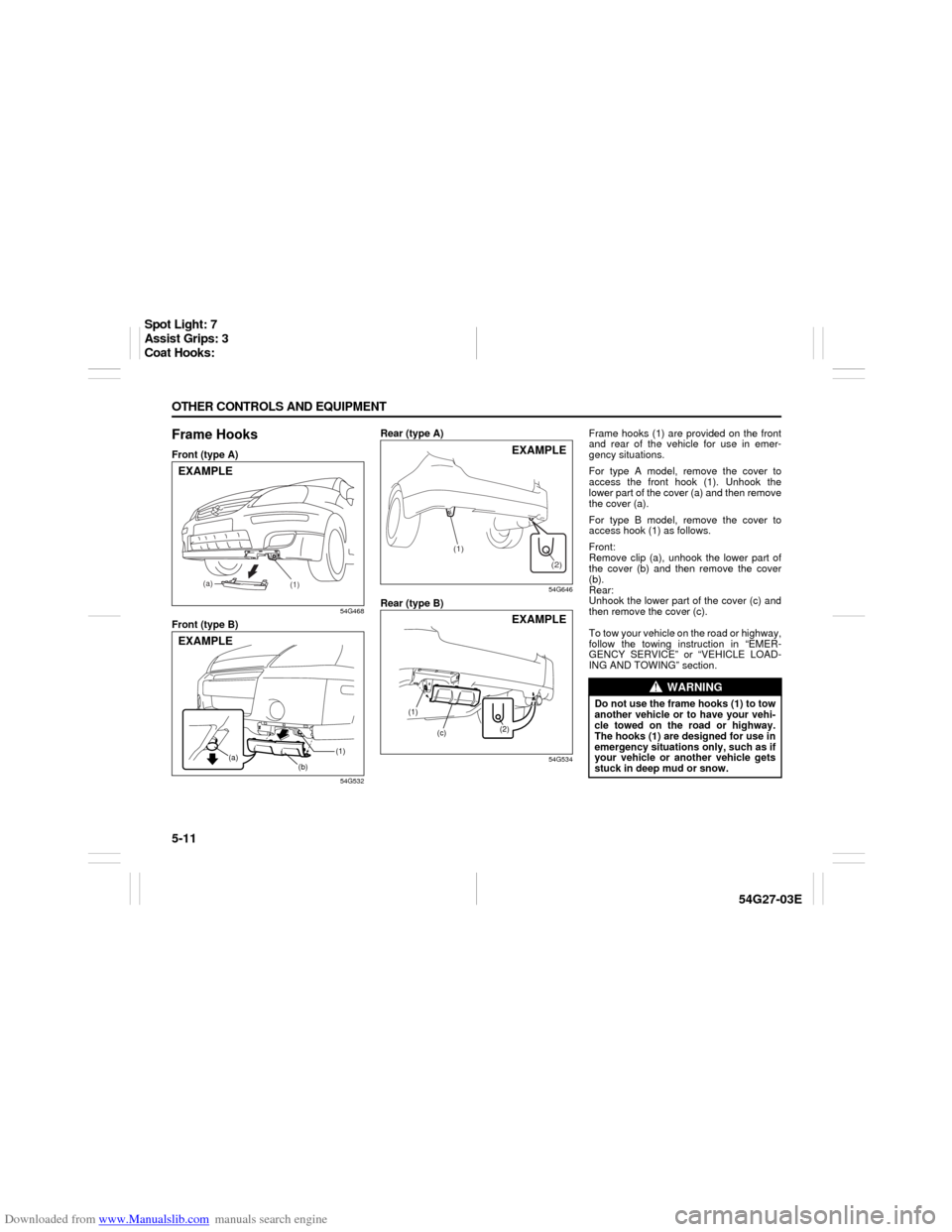
Frame hooks (1) are provided on the front
and rear of the vehicle for use in emer-
gency situations.
For type A model, remove the cover to
access the front hook (1). Unhook the
lower part of the cover (a) and then remove
the cover (a).
For type B model, remove the cover to
access hook (1) as follows.
Front:
Remove clip (a), unhook the lower part of
the cover (b) and then remove the cover
(b).
Rear:
Unhook the lower part of the cover (c) and
then remove the cover (c).
To tow your vehicle on the road or highway,
follow the towing instruction in “EMER-
GENCY SERVICE” or “VEHICLE LOAD-
ING AND TOWING” section.
(1)
(a)
EXAMPLE
(1)
(a)
(b)
EXAMPLE
(2)
(1)
EXAMPLE
(2) (1)
(c)
EXAMPLE
WARNING
Do not use the frame hooks (1) to tow
another vehicle or to have your vehi-
cle towed on the road or highway.
The hooks (1) are designed for use in
emergency situations only, such as if
your vehicle or another vehicle gets
stuck in deep mud or snow.
Spot Light: 7
Assist Grips: 3
Coat Hooks:
Page 128 of 232
Downloaded from www.Manualslib.com manuals search engine 5-13 OTHER CONTROLS AND EQUIPMENT
54G27-03E
Front Seat Back Pocket
(if equipped)
60B119
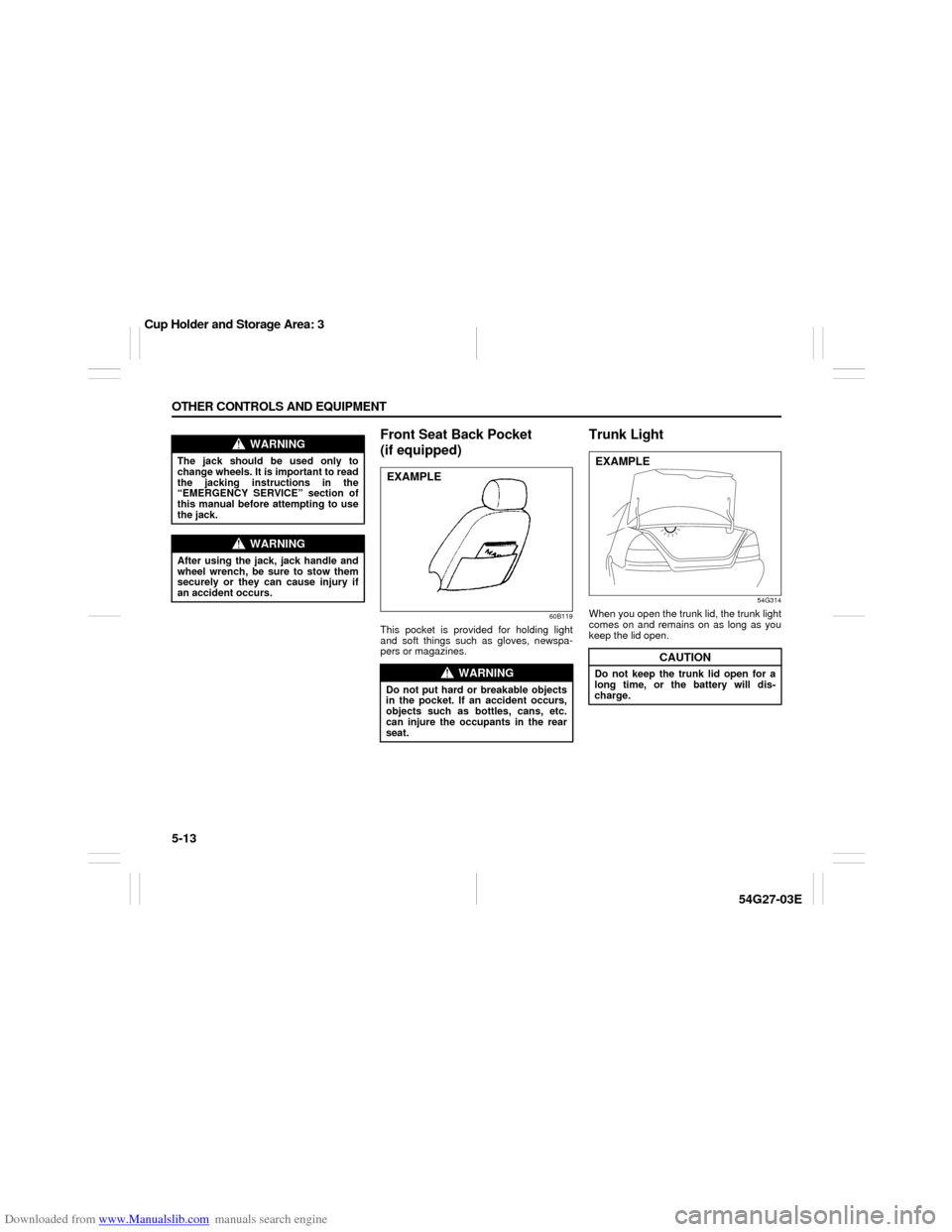
This pocket is provided for holding light
and soft things such as gloves, newspa-
pers or magazines.
Trunk Light
54G314
When you open the trunk lid, the trunk light
comes on and remains on as long as you
keep the lid open.
WARNING
The jack should be used only to
change wheels. It is important to read
the jacking instructions in the
“EMERGENCY SERVICE” section of
this manual before attempting to use
the jack.
WARNING
After using the jack, jack handle and
wheel wrench, be sure to stow them
securely or they can cause injury if
an accident occurs.
WARNING
Do not put hard or breakable objects
in the pocket. If an accident occurs,
objects such as bottles, cans, etc.
can injure the occupants in the rear
seat.EXAMPLE
CAUTION
Do not keep the trunk lid open for a
long time, or the battery will dis-
charge.EXAMPLE
Cup Holder and Storage Area: 3
Page 139 of 232

Downloaded from www.Manualslib.com manuals search engine 6-10 OPERATING YOUR VEHICLE
54G27-03E
54G584S
Improving Fuel EconomyThe following instructions will help you
improve fuel economy.
Avoid excessive idling
If you are to wait for more than a minute
while you are parked, stop the engine and
start it again later. When warming up a
cold engine, allow the engine to idle until
the temperature gauge pointer comes up
to the “C” position. In this position, the
engine is sufficiently warm for starting off.
Avoid “jackrabbit” starts
Fast starts away from lights or stop signs
will consume fuel unnecessarily and
shorten engine life. Start off slowly.
Avoid unnecessary stops
Avoid unnecessary deceleration and stop-
ping. Try to maintain a slow, steady speed
whenever possible. Slowing down and then
accelerating again uses more fuel.
Keep a steady cruising speed
Keep as constant a speed as road and traf-
fic conditions will permit.
CAUTION
To minimize the possibility of catalyst
or other vehicle damage:
Maintain the engine in the proper
operating condition.
In the event of an engine malfunc-
tion, particularly one involving
engine misfire or other apparent
loss of performance, have the vehi-
cle serviced promptly.
Do not shut off the engine or inter-
rupt the ignition when the transaxle
is in gear and the vehicle is in
motion.
Do not try to start the engine by
pushing or towing the vehicle or
coasting down a hill.
Do not idle the engine with any
spark plug wires disconnected or
removed, such as during diagnos-
tic testing.
Do not idle the vehicle for pro-
longed periods if idling seems
rough or there are other malfunc-
tions.
Do not allow the fuel tank to get
near the empty level.
WARNING
Be careful where you park and drive;
the catalytic converter and other
exhaust components can get very
hot. As with any vehicle, do not park
or operate this vehicle in areas where
combustible materials such as dry
grass or leaves can come in contact
with a hot exhaust system.
Catalytic Converter: NO
Improving Fuel Economy: NO
Page 154 of 232

Downloaded from www.Manualslib.com manuals search engine 9-1 INSPECTION AND MAINTENANCE
54G27-03E
60A187S
WARNING
You should take extreme care when
working on your vehicle to prevent
accidental injury. Here are a few pre-
cautions that you should be espe-
cially careful to observe:
To prevent damage or unintended
inflation of the air bag system, be
sure the battery is disconnected
and the ignition switch has been in
the “LOCK” position for at least 90
seconds before performing any
electrical service work on your
SUZUKI. Do not touch air bag sys-
tem components or wires. The
wires are wrapped with yellow tape
or yellow tubing, and the couplers
are yellow for easy identification.
(Continued)
WARNING
(Continued)
Do not leave the engine running in
garages or other confined areas.
When the engine is running, keep
hands, clothing, tools and other
objects away from the moving fan
and drive belt.
When it is necessary to do service
work with the engine running, make
sure that the parking brake is set
fully and the transaxle is in Neutral
(for manual transaxle vehicles) or
Park (for automatic transaxle vehi-
cles).
Do not touch ignition wires or other
ignition system parts when starting
the engine or when the engine is
running, or you could receive an
electric shock.
Be careful not to touch a hot
engine, exhaust manifold and
pipes, muffler, radiator and water
hoses.
Do not allow smoking, sparks or
flames around gasoline or the bat-
tery. Flammable fumes are present.
Do not get under your vehicle if it is
supported only with the portable
jack provided in your vehicle.
(Continued)
WARNING
(Continued)
Be careful not to cause accidental
short circuits between the positive
and negative battery terminals.
Keep used oil, engine coolant and
other fluids away from children and
pets. Dispose of used fluids prop-
erly; never pour them on the
ground, into sewers, etc.