2007 SUZUKI AERIO engine overheat
[x] Cancel search: engine overheatPage 180 of 232

Downloaded from www.Manualslib.com manuals search engine 9-27 INSPECTION AND MAINTENANCE
54G27-03E
54G307
The front and rear tire pressure specifica-
tions for your vehicle are shown below and
are listed on the Tire and Loading Informa-
tion Label, which is located on the driver’s
door lock pillar. The Tire and Loading
Information Label contains the following
information:
Seating Capacity
Maximum Allowed Combined Weight of
Occupants and Cargo
Original Tire Size
Recommended Cold Tire Inflation Pres-
sure of Original Tires
Size of Compact Spare Tire
Recommended Cold Tire Inflation Pres-
sure of Compact Spare TireMeasuring Air Pressure
Use the following steps to achieve proper
tire inflation:
1) Identify the recommended tire pressure
on the vehicle’s Tire and Loading Infor-
mation Label or in the owner’s manual.
2) Remove the valve cap from the tire
valve stem.
3) Using a reliable pressure gauge, mea-
sure the tire inflation pressure by press-
ing the tire gauge firmly onto the valve
to get a pressure measurement.
Remember that inflation pressures
should be checked when the tires are
“cold”, meaning before they have been
driven one mile or after sitting for three
hours or more allowing the tire to cool
to ambient air temperature.
4) If the air pressure is too high, slowly
release the air by pressing on the tire
valve stem with the edge of the tire
gauge until you reach the correct pres-
sure.5) If the air pressure is too low, fill the tire
with air at a service station until it
reaches the recommended pressure.
6) Make sure all tires have the same air
pressure (unless the owner’s manual
indicates otherwise).
Tire InspectionInspect your vehicle’s tires at least once a
month by performing the following checks:
1) Measure the air pressure with a tire
gauge. Adjust the pressure if neces-
Recommended Cold Tire Inflation
Pressures
Front Tires210 kPa
30 psi
Rear Tires210 kPa
30 psi
Compact Spare Tire420 kPa
60 psi
WARNING
Air pressures should be checked
when the tires are cold or you may
get inaccurate readings.
Check the inflation pressure from
time to time while inflating the tire
gradually, until the specified pres-
sure is obtained.
Never underinflate or overinflate
the tires.
Underinflation can cause unusual
handling characteristics or can
cause the rim to slip on the tire
bead, resulting in an accident or
damage to the tire or rim.
Underinflation can also cause tires
to overheat, leading to tire failure.
Overinflation can cause the tire to
burst, resulting in personal injury.
Overinflation can also cause
unusual handling characteristics
which may result in an accident.
Tires: 6
Page 191 of 232
Downloaded from www.Manualslib.com manuals search engine 9-38 INSPECTION AND MAINTENANCE
54G27-03E
Bulb ReplacementNOTE:
If it is difficult to replace headlight bulbs or
parking light bulbs due to under-hood com-
ponents trust this job to your dealer.
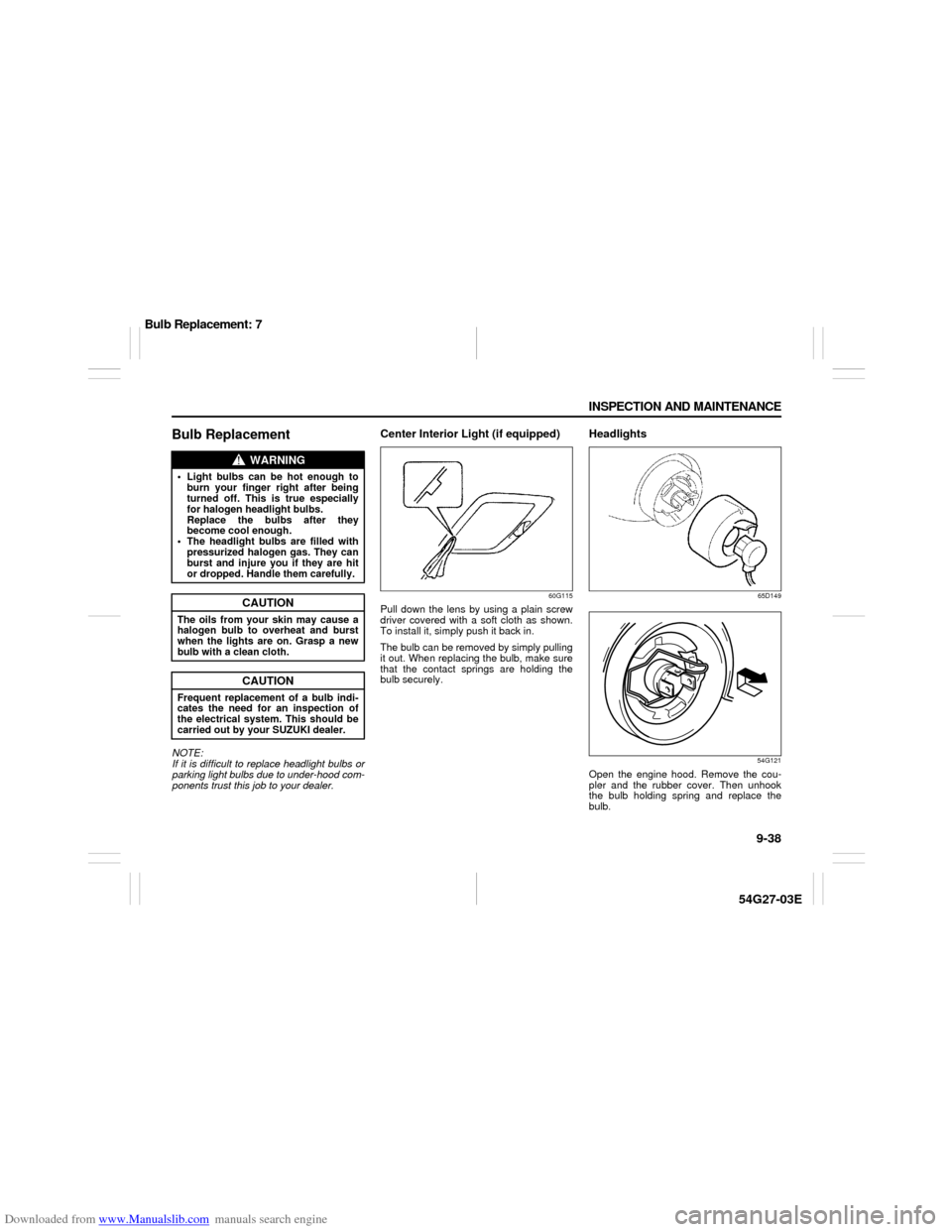
Center Interior Light (if equipped)
60G115
Pull down the lens by using a plain screw
driver covered with a soft cloth as shown.
To install it, simply push it back in.
The bulb can be removed by simply pulling
it out. When replacing the bulb, make sure
that the contact springs are holding the
bulb securely.
Headlights
65D149
54G121
Open the engine hood. Remove the cou-
pler and the rubber cover. Then unhook
the bulb holding spring and replace the
bulb.
WARNING
Light bulbs can be hot enough to
burn your finger right after being
turned off. This is true especially
for halogen headlight bulbs.
Replace the bulbs after they
become cool enough.
The headlight bulbs are filled with
pressurized halogen gas. They can
burst and injure you if they are hit
or dropped. Handle them carefully.
CAUTION
The oils from your skin may cause a
halogen bulb to overheat and burst
when the lights are on. Grasp a new
bulb with a clean cloth.
CAUTION
Frequent replacement of a bulb indi-
cates the need for an inspection of
the electrical system. This should be
carried out by your SUZUKI dealer.
Bulb Replacement: 7
Page 197 of 232

Downloaded from www.Manualslib.com manuals search engine EMERGENCY SERVICE
10
54G27-03E
60G411
EMERGENCY SERVICEJacking Instructions ........................................................... 10-1
Jump Starting Instructions ................................................ 10-4
Towing a Disabled Vehicle ................................................. 10-5
If the Starter Does Not Operate .......................................... 10-6
If the Engine is Flooded ...................................................... 10-6
If the Engine Overheats ...................................................... 10-6
If You Can Not Shift Automatic Transaxle Gearshift
Lever Out of “P” (PARK) .................................................... 10-8
Page 203 of 232

Downloaded from www.Manualslib.com manuals search engine 10-6 EMERGENCY SERVICE
54G27-03E
If the Starter Does Not
Operate1) Try turning the ignition switch to the
“START” position with the headlights
turned on to determine the battery con-
dition. If the headlights go excessively
dim or go off, it usually means that
either the battery has run down or bat-
tery terminal contact is poor. Recharge
the battery or correct battery terminal
contact if necessary.
2) If the headlights remain bright, check
the fuses. If the reason for failure of the
starter is not obvious, there may be a
major electrical problem. Have the vehi-
cle inspected by your authorized
SUZUKI dealer.
If the Engine is FloodedIf the engine is flooded with gasoline, it
may be hard to start. If this happens, press
the accelerator pedal all the way to the
floor and hold it there while cranking the
engine. (Do not operate the starter motor
for more than 15 seconds).
If the Engine OverheatsThe engine could overheat temporarily
under severe driving conditions. If the High
Engine Coolant Temperature Warning
Light in the instrument cluster glows red
during driving:
1) Turn off the air conditioner, if equipped.
2) Take the vehicle to a safe place and
park.
3) Let the engine run at the normal idle
speed for a few minutes until the engine
is cooled down to the normal tempera-
ture.
You can determine the engine tempera-
ture is normal by either condition below:
– Both High Engine Coolant Tempera-
ture Warning Light and Low Engine
Coolant Temperature Light have gone
off.
– Low Engine Coolant Temperature
Light is lit in blue, and High Engine
Coolant Temperature Warning Light
has gone off.
See “High Engine Coolant Temperature
Warning Light” and “Low Engine Coolant
Temperature Light” in the INDEX for further
information.
If the Starter Does Not Operate: 2, 9
If the Engine is Flooded: 2, 9
If the Engine Overheats: 2, 9
Page 204 of 232

Downloaded from www.Manualslib.com manuals search engine 10-7 EMERGENCY SERVICE
54G27-03E
If the temperature indication does not
return to the normal condition:
1) Turn off the engine and check that the
water pump belt and pulleys are not
damaged or slipping. If any abnormality
is found, correct it.
2) Check the coolant level in the reservoir.
If it is found to be lower than the “LOW”
line, look for leaks at the radiator, water
pump and radiator and heater hoses. If
you locate any leaks that may have
caused the overheating, do not run the
engine until these problems have been
corrected.
3) If you do not find a leak, carefully add
coolant to the reservoir and then the
radiator, if necessary. (Refer to “Engine
Coolant” in the “INSPECTION AND
MAINTENANCE” section.)
65D614
WARNING
If you see or hear escaping steam,
stop the vehicle in a safe place and
immediately turn off the engine to let
it cool. Do not open the hood when
steam is present. When the steam
can no longer be seen or heard, open
the hood to see if the coolant is still
boiling. If it is, you must wait until it
stops boiling before you proceed.
Also, be careful not to touch hot
engine parts (radiator, water hoses,
engine etc.).
WARNING
It is hazardous to remove the radia-
tor cap when the water temperature
is high, because scalding fluid and
steam may be blown out under
pressure. The cap should only be
taken off when the coolant temper-
ature has lowered.
To prevent personal injury, keep
hands, tools and clothing away
from the engine cooling fan and air-
conditioner fan (if equipped). These
electric fans can automatically turn
on without warning.
If the Engine Overheats: 2, 9
Page 209 of 232

Downloaded from www.Manualslib.com manuals search engine 11-2 APPEARANCE CARE
54G27-03E
Keep passenger and cargo compart-
ments clean
Moisture, dirt or mud can accumulate
under the floor mats and may cause corro-
sion. Occasionally, check under these
mats to ensure that this area is clean and
dry. More frequent checks are necessary if
the vehicle is used off road or in wet
weather.
Certain cargo such as chemicals, fertiliz-
ers, cleaners, salts, etc. are extremely cor-
rosive by nature. These products should
be transported in sealed containers. If a
spill or leak does occur, clean and dry the
area immediately.
Use the body trim
The use of the body trim will help protect
your vehicle, especially if you frequently
drive on gravel or salted roads. The fittings
for such guards should also be corrosion
resistant. Please check with your autho-
rized SUZUKI dealer for information on
these guards.
Store your vehicle in a dry, well-venti-
lated area
Do not park your vehicle in a damp, poorly
ventilated area. If you often wash your
vehicle in the garage or if you frequently
drive it in when wet, your garage may be
damp. The high humidity in the garage
may cause or accelerate corrosion. A wet
vehicle may corrode even in a heated
garage if the ventilation is poor.Cover your vehicle
50G203
If you can not regularly park your vehicle in
a garage, we recommend you use a vehi-
cle cover. Years of exposure to midday sun
can cause the colors in paint, plastic parts
and fabrics to fade. Covering your vehicle
with a high-quality, “breathable” vehicle
cover can help protect the finish from the
harmful UV rays in sunlight, and can
reduce the amount of dust and air pollutionreaching the surface. Your SUZUKI dealer
can help you select the right cover for your
vehicle.
WARNING
Do not apply additional undercoating
or rust preventive coating on or
around exhaust system components
such as the catalytic converter,
exhaust pipes, etc. A fire could be
started if the undercoating substance
becomes overheated.
Corrosion Prevention:
Page 228 of 232

Downloaded from www.Manualslib.com manuals search engine 15-2 INDEX
54G27-03E
Daytime Running Light (D.R.L.) Indicator Light
...............4-7
Daytime Running Light (D.R.L.) System
............................3-3
Door Locks
...........................................................................2-1
Driver’s Seat Belt Reminder Light
.....................................4-4
Driving on Hills
....................................................................7-1
Driving on Slippery Roads
..................................................7-2
EEmergency Locking Retractor (ELR)
.................................2-15
Emission Compliance Label (for U.S.A.)
...........................12-2
Engine Block Heater
............................................................6-3
Engine Coolant
....................................................................9-17
Engine Coolant Level Check
..............................................9-18
Engine Coolant Replacement .............................................9-18
Engine Hood
........................................................................5-8
Engine Oil and Filter
............................................................9-11
Engine Serial Number .........................................................12-1
Exhaust Gas Warning .........................................................6-1
Eyeglasses Holder
...............................................................5-8
FFluid Level Check
................................................................9-16
Fog Light Switch ..................................................................4-11
Folding Rear Seats ..............................................................5-4
Frame Hooks
........................................................................5-11
Front Passenger’s Seat Belt Reminder Light
...................4-13
Front Seat Back Pocket
......................................................5-13
Fuel Filler Cap
......................................................................5-3
Fuel Gauge
...........................................................................4-9
Fuel Pump Labeling
............................................................1-1
Fuel Recommendation ........................................................1-1
Fuses
....................................................................................9-35
FUSES AND PROTECTED CIRCUITS
.................................13-1Fuses in the Engine Compartment
.................................... 9-36
Fuses under the Dash Board
............................................. 9-36
GGasoline Containing MTBE
................................................ 1-1
Gasoline/Ethanol blends
.................................................... 1-1
Gasoline/Methanol blends ................................................. 1-1
Gear Oil
................................................................................ 9-14
Gear Oil Level Check
.......................................................... 9-15
Gear Oil Replacement ......................................................... 9-15
Gearshift Lever
.................................................................... 5-2
GLOSSARY OF TIRE TERMINOLOGY
............................... 9-32
Glove Box
............................................................................ 4-14
HHazard Warning Switch
...................................................... 4-10
Head Restraints
................................................................... 2-12
Headlight Aiming ................................................................ 9-37
Heating and Air Conditioning System
.............................. 4-15
Heating System
................................................................... 4-16
High Beam Indicator Light
................................................. 4-6
Highway Driving
.................................................................. 7-1
Horn
...................................................................................... 3-8
How the ABS Works
........................................................... 6-9
IIdentification Numbers
....................................................... 12-1
If the Engine is Flooded ..................................................... 10-6
If the Engine Overheats ...................................................... 10-6
If the Starter Does Not Operate
......................................... 10-6
If You Can Not Shift Automatic Transaxle Gearshift
Lever Out of “P” (PARK)
.................................................... 10-8
If Your Vehicle Gets Stuck ................................................. 7-2
Ignition Key Reminder
........................................................ 2-1