2007 SUZUKI AERIO car seat
[x] Cancel search: car seatPage 45 of 232
Downloaded from www.Manualslib.com manuals search engine 2-32 BEFORE DRIVING
54G27-03E
are not designed to activate in rear
impacts, side impacts, rollovers or minor
frontal collisions. The pretensioners can be
activated only once. If the pretensioners
are activated, have the pretensioner sys-
tem serviced by an authorized SUZUKI
dealer as soon as possible.
If the “AIR BAG” light on the instrument
cluster does not blink or come on briefly
when the ignition switch is turned to the
“ON” position, stays on for more than 10
seconds, or comes on while driving, the
pretensioner system or the air bag system
may not work properly. Have both systems
inspected by an authorized SUZUKI dealer
as soon as possible.
Service on or around the pretensioner sys-
tem components or wiring must be per-
formed only by an authorized SUZUKI
dealer who is specially trained. Improper
service could result in unintended activa-
tion of pretensioners or could render the
pretensioner inoperative. Either of these
two conditions may result in personal
injury.
To prevent damage or unintended activa-
tion of the pretensioners, be sure the bat-
tery is disconnected and the ignition switch
has been in the “LOCK” position for at least
90 seconds before performing any electri-
cal service work on your SUZUKI. Do not
touch pretensioner system components or
wiring. The wires are wrapped with yellow
tape or yellow tubing, and the couplers areyellow. When scrapping your SUZUKI, ask
your SUZUKI dealer, body repair shop or
scrap yard for assistance.
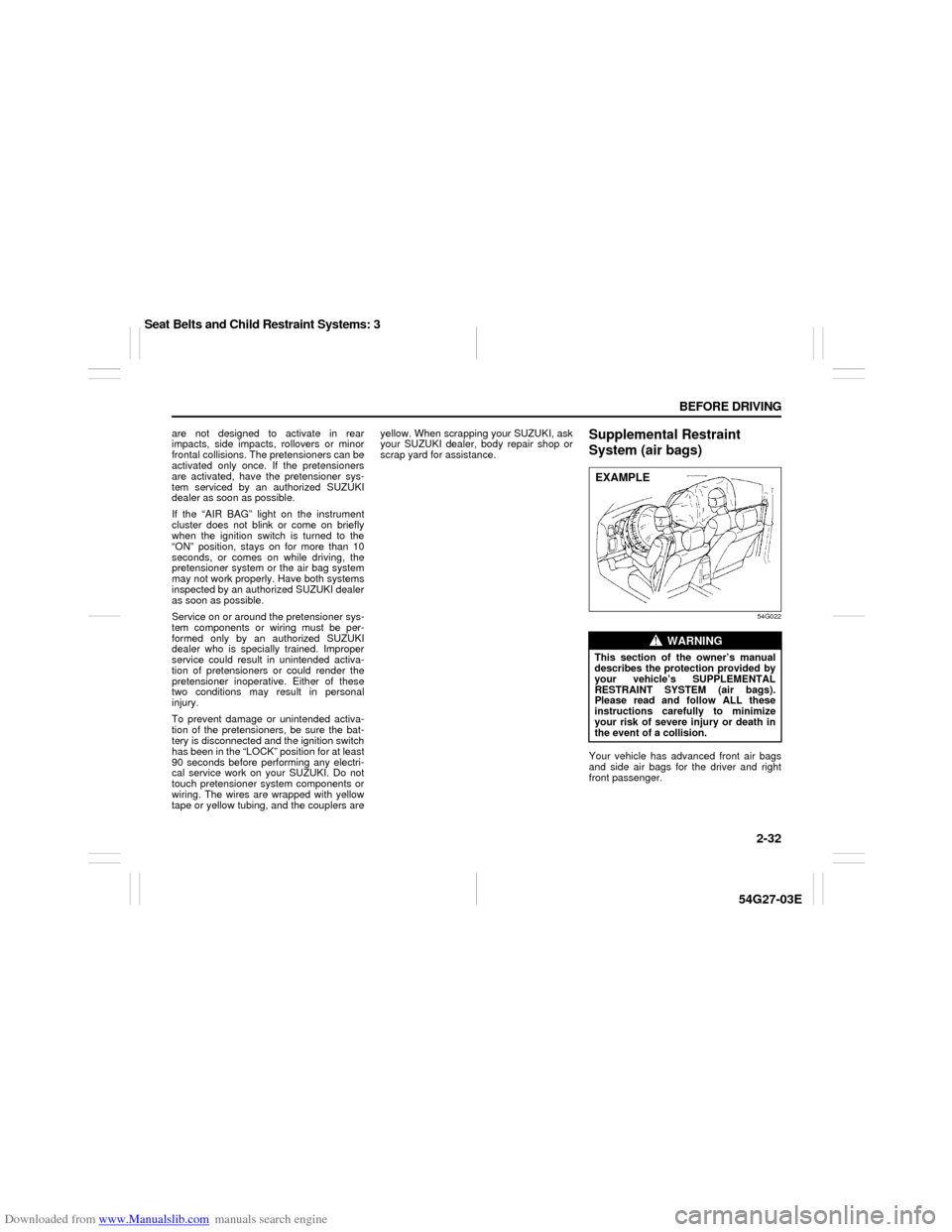
Supplemental Restraint
System (air bags)
54G022
Your vehicle has advanced front air bags
and side air bags for the driver and right
front passenger.
WARNING
This section of the owner’s manual
describes the protection provided by
your vehicle’s SUPPLEMENTAL
RESTRAINT SYSTEM (air bags).
Please read and follow ALL these
instructions carefully to minimize
your risk of severe injury or death in
the event of a collision.EXAMPLE
Seat Belts and Child Restraint Systems: 3
Page 49 of 232

Downloaded from www.Manualslib.com manuals search engine 2-36 BEFORE DRIVING
54G27-03E
Your vehicle has “dual stage” front air
bags, which adjust the air bag inflation
force according to crash severity, driver’s
seat fore/aft position and whether or not
the driver’s seat belt is fastened. Also, your
vehicle has a front passenger sensing sys-
tem, which turns off the front passenger’s
front air bag under certain conditions.Driver’s Seat Position SensorThe driver’s seat is equipped with a seat
position sensor to monitor the driver seat
fore/aft position. The seat position sensor
provides information which is used to
judge if the driver’s front air bag should
deploy at reduced power or at full power.
When the seat position sensor has a prob-
lem, the “AIR BAG” light on the instrument
cluster will turn on. If this happens, deploy-
ment of the driver’s front air bag will not
include consideration of seat fore/aft posi-
tion. Have the air bag system inspected by
an authorized SUZUKI dealer as soon as
possible.
Driver’s Seat Belt Buckle SensorThe driver’s seat belt buckle is equipped
with a sensor to monitor whether or not the
driver’s seat belt is fastened. The driver’s
seat belt buckle sensor provides informa-
tion which is used to judge if the driver’s
front air bag should deploy at reduced
power or at full power.
When the buckle sensor has a problem,
the “AIR BAG” light on the instrument clus-
ter will turn on. If this happens, deployment
of the driver’s front air bag will not include
consideration of whether the driver’s seat
belt is fastened or not. Have the air bag
system inspected by an authorized
SUZUKI dealer as soon as possible.Front Passenger Sensing SystemThe front passenger sensing system will
turn off the front passenger’s front air bag
under certain conditions. This system
works using weight sensors that are part of
the front passenger’s seat and a seat belt
sensor. The front passenger sensing sys-
tem is designed to detect whether an occu-
pant is present in the seat and, if an
occupant is present, to determine whether
the front passenger’s front air bag should
be enabled or disabled (turned off).
NOTE:
The front passenger’s side air bag is not
controlled by the front passenger sensing
system.
54G517
When the ignition switch is turned to the
“ON” position, the “PASS AIRBAG OFF”
indicator comes on for several seconds to
let you know the system is working. When
the front passenger sensing system has
turned off the front passenger’s front air
bag, the “PASS AIRBAG OFF” indicator
will come on and stay on to remind you
that the front passenger’s front air bag is
off.
The front passenger sensing system is
designed to turn off the front passenger’s
front air bag when the weight on the front
seat is 30 kg (65 lbs) or less. The front air
bag should be turned off in the following
situations:
There is no occupant in the front pas-
senger seat.
The occupant of the front passenger
seat leaves the seat for a period of time.
CAUTION
Do not put any cargo or metal objects
under the seat. The seat position sen-
sor may not work properly or may be
damaged if it is covered with some-
thing.
Seat Belts and Child Restraint Systems: 3
Supplemental Restraint System (advanced air bags):
3, 9, 12
Page 52 of 232

Downloaded from www.Manualslib.com manuals search engine 2-39 BEFORE DRIVING
54G27-03E
How the System WorksIn a frontal collision, the crash sensors will
detect rapid deceleration and send a signal
to the controller. If the controller judges
that the deceleration represents a severe
frontal crash, the controller will trigger the
inflators. The controller also judges:
Whether the air bags should deploy at
reduced power or at full power according
to crash severity, driver’s seat fore/aft
position and whether or not the driver’s
seat belt is fastened.
Whether the front passenger’s front air
bag should deploy or not based on clas-
sification of the occupant of the front
passenger’s seat.
Since your vehicle is equipped with side air
bags, crash sensors will detect a side colli-
sion, and if the controller judges that the
side collision is severe enough, it will trig-
ger a side inflator.
The inflators inflate the appropriate air
bags with nitrogen or argon gas. The
inflated air bags provide a cushion for your
head (front air bags only) and upper body.
The air bag inflates and deflates so quickly
that you may not even realize that it has
activated. The air bag will neither hinder
your view nor make it harder to exit the
vehicle.
Air bags must inflate quickly and forcefully
in order to reduce the chance of serious or
fatal injuries. However, an unavoidable
consequence of the quick inflation is thatthe air bag may irritate bare skin, such as
the facial area against a front air bag. Also,
upon inflation, a loud noise will occur and
some powder and smoke will be released.
These conditions are not harmful and do
not indicate a fire in the car. Be aware,
however, that some air bag components
may be hot for a while after inflation.
A seat belt helps keep you in the proper
position for maximum protection when an
air bag inflates. Adjust your seat as far
back as possible while still maintaining
control of the vehicle. Sit fully back in your
seat; sit up straight; do not lean over the
steering wheel or dashboard. Front occu-
pants should not lean on or sleep against
the door. Please refer to the “Seat Adjust-
ment” section and the “Seat Belts and
Child Restraint Systems” section in the
“BEFORE DRIVING” section for details on
proper seat and seat belt adjustments.
54G582
WARNING
The driver should not lean over the
steering wheel. The front passen-
ger should not rest his or her body
against the dashboard, or other-
wise get too close to the dash-
board. Front occupants should not
lean on or sleep against the door. In
these situations, the out-of-posi-
tion occupant would be too close to
an inflating air bag, and may suffer
severe injury.
(Continued)
Supplemental Restraint System (advanced air bags):
3, 9, 12
Page 53 of 232

Downloaded from www.Manualslib.com manuals search engine 2-40 BEFORE DRIVING
54G27-03E
Note that even though your vehicle may be
moderately damaged in a collision, the col-
lision may not have been severe enough to
trigger the front or side air bags to inflate. If
your car sustains ANY front-end or side
damage, have the air bag system
inspected by an authorized SUZUKI dealer
to ensure it is in proper working order.
Your vehicle is equipped with a diagnostic
module which records information about
the air bag system if the air bags deploy in
a crash. The module records informationabout overall system status, which sensors
activated the deployment, and whether the
front seat belts were in use.
Servicing the Air Bag SystemIf the air bags inflate, have the air bags and
related components replaced by an autho-
rized SUZUKI dealer as soon as possible.
If your vehicle ever gets in deep water and
the driver’s floor is submerged, the air bag
controller could be damaged. If this hap-
pens, have the air bag system inspected
by an authorized SUZUKI dealer as soon
as possible.
Special procedures are required for servic-
ing or replacing an air bag. For that reason,
only an authorized SUZUKI dealer should
be allowed to service or replace your air
bags. Please remind anyone who services
your vehicle that it has air bags.
Service on or around air bag components
or wiring must be performed only by an
authorized SUZUKI dealer. Improper ser-
vice could result in unintended air bag
deployment or could render the air bags
inoperative. Either of these two conditions
may result in severe injury.
To prevent damage or unintended inflation
of the air bag system, be sure the battery
is disconnected and the ignition switch has
been in the “LOCK” position for at least 90
seconds before performing any electrical
service work on your vehicle. Do not touch
air bag system components or wires. Thewires are wrapped with yellow tape or yel-
low tubing, and the couplers are yellow for
easy identification.
Scrapping a car that has an undeployed air
bag can be hazardous. Ask your dealer,
body repair shop or scrap yard for help
with disposal.
If it is necessary to modify the advanced
front air bag system to accommodate a
person with disabilities, owners in the con-
tinental United States can call American
Suzuki toll-free at 1-800-934-0934, or write
to:
American Suzuki Motor Corporation
Automotive Customer Relations
3251 East Imperial Highway
Brea, CA 92821-6795
If you purchased your SUZUKI in Canada
please contact the Suzuki Canada Cus-
tomer Relations Department by telephone
at 1-905-889-2677 extension 2254 or in
writing at:
Suzuki Canada Inc.
Customer Relations
100 East Beaver Creek Road
Richmond Hill, On
L4B 1J6
WARNING
(Continued)
Do not attach any objects to, or
place any objects over, the steering
wheel or dashboard. Do not place
any objects between the air bag
and the driver or front passenger.
These objects may interfere with air
bag operation or may be propelled
by the air bag in the event of a
crash. Either of these conditions
may cause severe injury.
Do not place seat covers on the
front seats, because seat covers
could restrict the side air bag’s
inflation. Also, do not place any
cup holders on the door, as the cup
holder could be propelled by the air
bag in the event of a crash. Either
of these conditions may cause
severe injury.
Supplemental Restraint System (advanced air bags):
3, 9, 12
Page 120 of 232
Downloaded from www.Manualslib.com manuals search engine 5-5 OTHER CONTROLS AND EQUIPMENT
54G27-03E
54G374
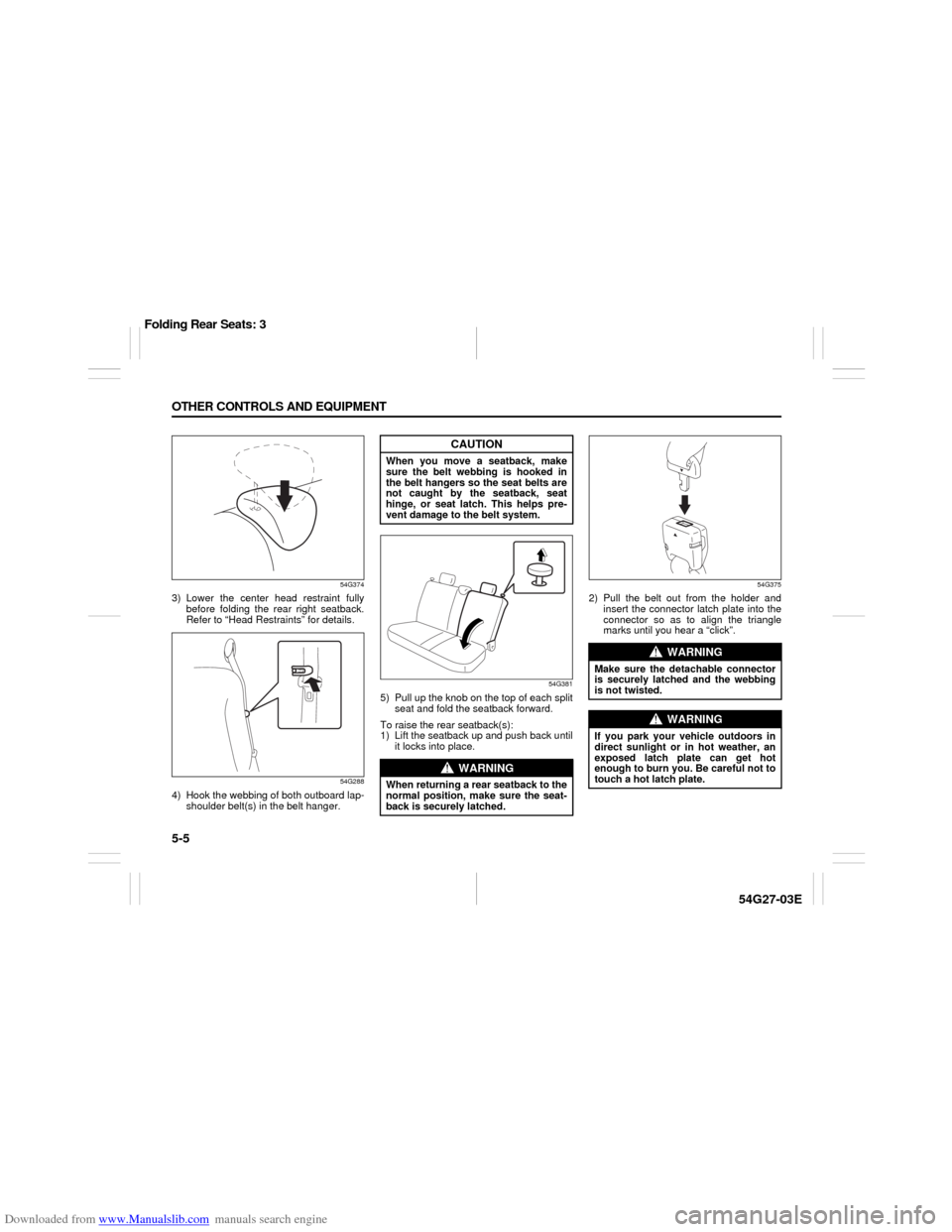
3) Lower the center head restraint fully
before folding the rear right seatback.
Refer to “Head Restraints” for details.
54G288
4) Hook the webbing of both outboard lap-
shoulder belt(s) in the belt hanger.
54G381
5) Pull up the knob on the top of each split
seat and fold the seatback forward.
To raise the rear seatback(s):
1) Lift the seatback up and push back until
it locks into place.
54G375
2) Pull the belt out from the holder and
insert the connector latch plate into the
connector so as to align the triangle
marks until you hear a “click”.
CAUTION
When you move a seatback, make
sure the belt webbing is hooked in
the belt hangers so the seat belts are
not caught by the seatback, seat
hinge, or seat latch. This helps pre-
vent damage to the belt system.
WARNING
When returning a rear seatback to the
normal position, make sure the seat-
back is securely latched.
WARNING
Make sure the detachable connector
is securely latched and the webbing
is not twisted.
WARNING
If you park your vehicle outdoors in
direct sunlight or in hot weather, an
exposed latch plate can get hot
enough to burn you. Be careful not to
touch a hot latch plate.
Folding Rear Seats: 3
Page 130 of 232

Downloaded from www.Manualslib.com manuals search engine 6-1 OPERATING YOUR VEHICLE
54G27-03E
Exhaust Gas Warning
52D334
Daily Inspection ChecklistBefore Driving1) Make sure that windows, mirrors, lights
and reflectors are clean and unob-
structed.
2) Visually check the tires for the following
points:
– the depth of the tread groove
– abnormal wear, cracks and damage
– loose wheel nuts
– existence of foreign material such as
nails, stones, etc.
Refer to “Tires” in “INSPECTION AND
MAINTENANCE” section for details.
3) Look for fluid, oil leaks.
NOTE:
It is normal for water to drip from the air
conditioning system after use.
4) Make sure the hood is fully closed and
latched.
5) Check the headlights, turn signal lights,
brake lights and horn for proper opera-
tion.
6) Lock all doors.
7) Adjust the seat and adjustable head
restraints (if equipped).
8) Check the brake pedal.
9) Adjust the mirrors.
10)Make sure that you and all passengers
have properly fastened your seat belts.
11)Make sure that all warning lights come
on as the key is turned to the “ON” or
“START” position.
WARNING
Avoid breathing exhaust gases.
Exhaust gases contain carbon mon-
oxide, a potentially lethal gas that is
colorless and odorless. Since carbon
monoxide is difficult to detect by
itself, be sure to take the following
precautions to help prevent carbon
monoxide from entering your vehicle.
Do not leave the engine running in
garages or other confined areas.
(Continued)
WARNING
(Continued)
Do not park with the engine run-
ning for a long period of time, even
in an open area. If it is necessary to
sit for a short time in a parked vehi-
cle with the engine running, make
sure the air intake selector is set to
“FRESH AIR” and the blower is at
high speed.
Avoid operating the vehicle with
the trunk open. If it is necessary to
operate the vehicle with the trunk
open, make sure the sunroof (if
equipped) and all windows are
closed, and the blower is at high
speed with the air intake selector
set to “FRESH AIR”.
To allow proper operation of your
vehicle’s ventilation system, keep
the air inlet grille in front of the
windshield clear of snow, leaves or
other obstructions at all times.
Keep the exhaust tailpipe area clear
of snow and other material to help
reduce the buildup of exhaust
gases under the vehicle. This is
particularly important when parked
in blizzard conditions.
Have the exhaust system inspected
periodically for damage and leaks.
Any damage or leaks should be
repaired immediately.
Exhaust Gas Warning: NO
Daily Inspection Checklist: NO
Page 142 of 232
Downloaded from www.Manualslib.com manuals search engine 7-1 DRIVING TIPS
54G27-03E
52D078S
Highway DrivingWhen driving at highway speeds, pay
attention to the following:
Stopping distance progressively
increases with vehicle speed. Apply the
brakes far enough ahead of the stopping
point to allow for the extra stopping dis-
tance.
On rainy days, “Hydroplaning” can occur.
“Hydroplaning” is the loss of direct con-
tact between the road surface and the
vehicle’s tires due to a water film forming
between them. Steering or braking the
vehicle while “Hydroplaning” can be very
difficult, and loss of control can occur.
Keep speed down when the road surface
is wet.
At high speeds, the vehicle may be
affected by side winds. Therefore,
reduce speed and be prepared for unex-
pected buffeting, which can occur at the
exits of tunnels, when passing by a cut of
a hill, or when being overtaken by large
vehicles, etc.
Driving on Hills
54G073S
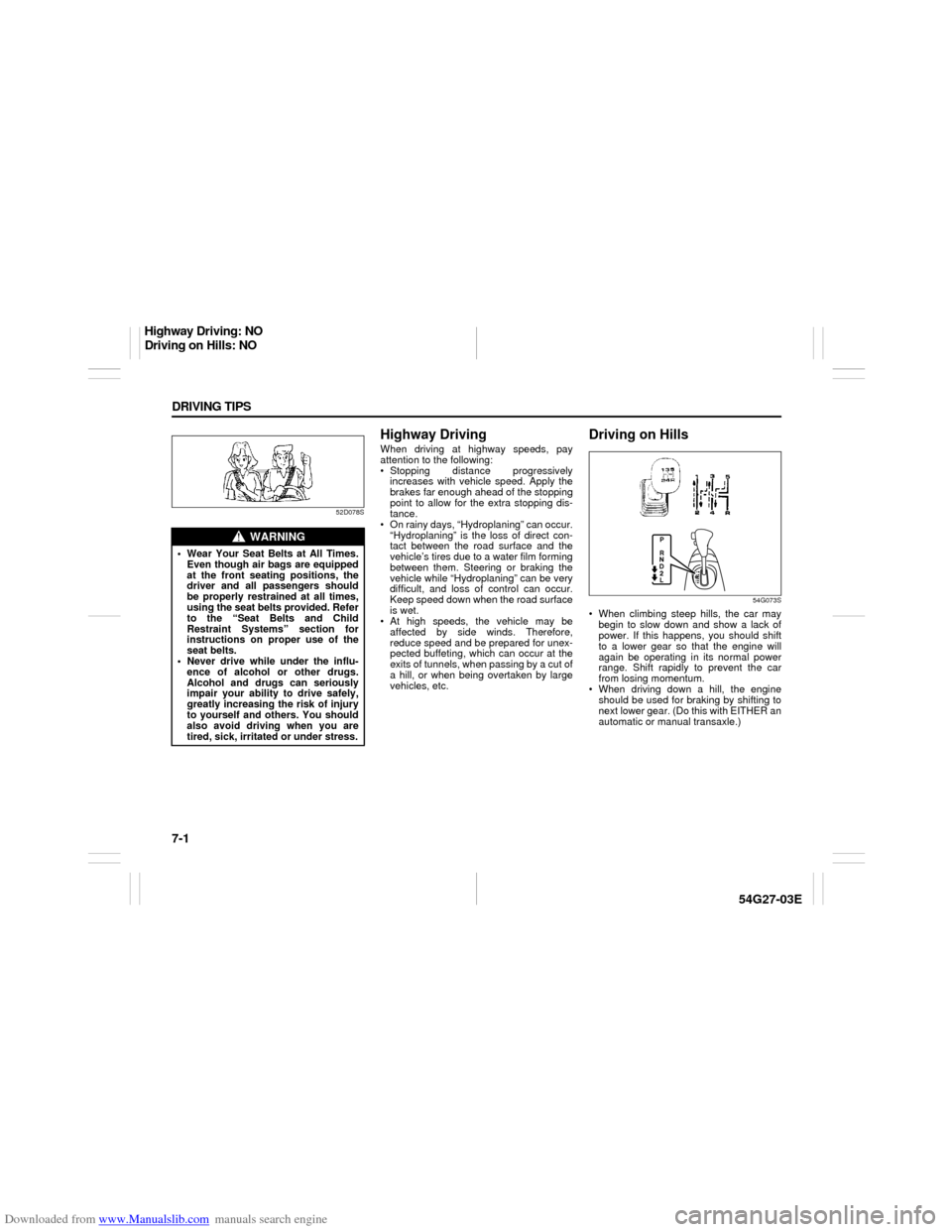
When climbing steep hills, the car may
begin to slow down and show a lack of
power. If this happens, you should shift
to a lower gear so that the engine will
again be operating in its normal power
range. Shift rapidly to prevent the car
from losing momentum.
When driving down a hill, the engine
should be used for braking by shifting to
next lower gear. (Do this with EITHER an
automatic or manual transaxle.)
WARNING
Wear Your Seat Belts at All Times.
Even though air bags are equipped
at the front seating positions, the
driver and all passengers should
be properly restrained at all times,
using the seat belts provided. Refer
to the “Seat Belts and Child
Restraint Systems” section for
instructions on proper use of the
seat belts.
Never drive while under the influ-
ence of alcohol or other drugs.
Alcohol and drugs can seriously
impair your ability to drive safely,
greatly increasing the risk of injury
to yourself and others. You should
also avoid driving when you are
tired, sick, irritated or under stress.
Highway Driving: NO
Driving on Hills: NO
Page 148 of 232
Downloaded from www.Manualslib.com manuals search engine 8-1 VEHICLE LOADING AND TOWING
54G27-03E
Vehicle Loading
54G307
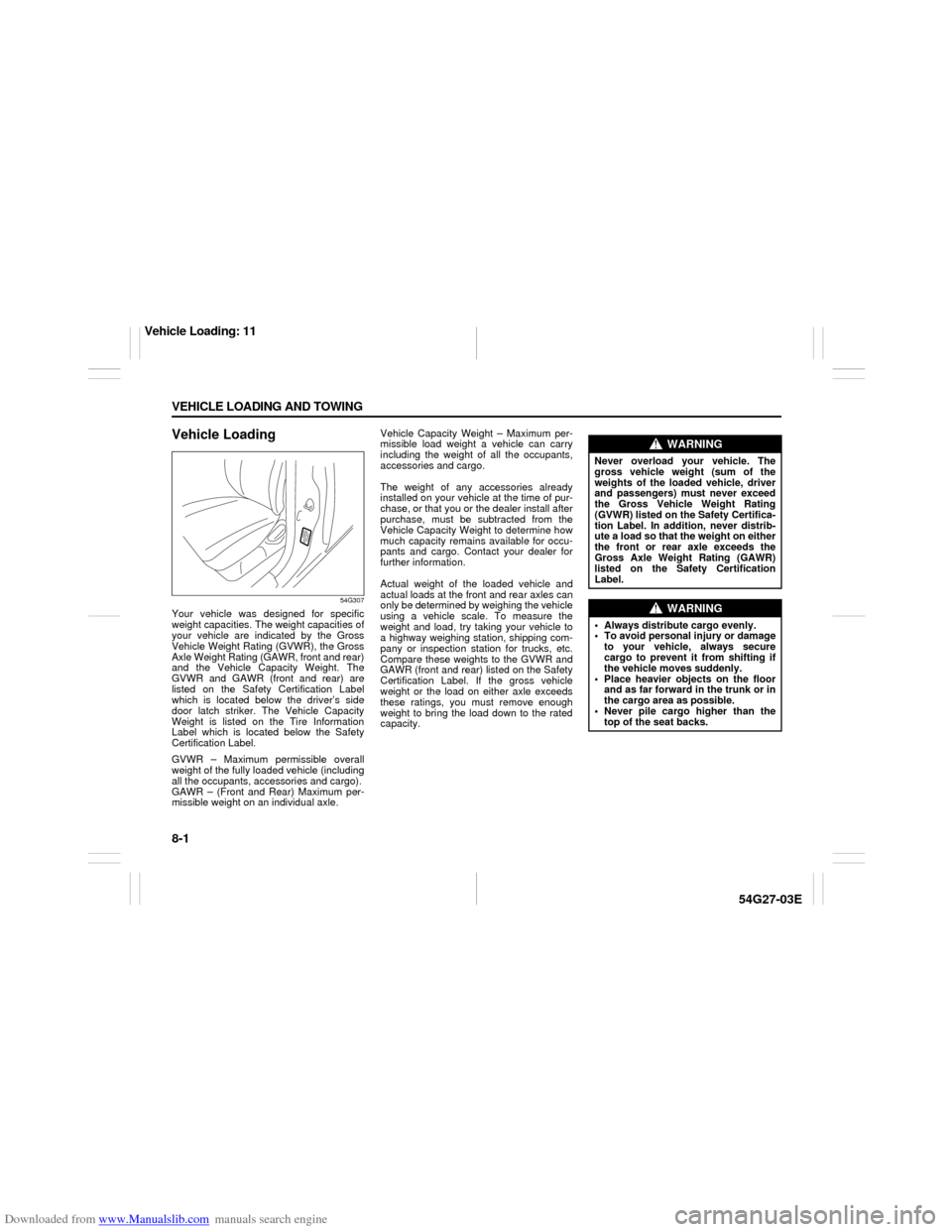
Your vehicle was designed for specific
weight capacities. The weight capacities of
your vehicle are indicated by the Gross
Vehicle Weight Rating (GVWR), the Gross
Axle Weight Rating (GAWR, front and rear)
and the Vehicle Capacity Weight. The
GVWR and GAWR (front and rear) are
listed on the Safety Certification Label
which is located below the driver’s side
door latch striker. The Vehicle Capacity
Weight is listed on the Tire Information
Label which is located below the Safety
Certification Label.
GVWR – Maximum permissible overall
weight of the fully loaded vehicle (including
all the occupants, accessories and cargo).
GAWR – (Front and Rear) Maximum per-
missible weight on an individual axle.Vehicle Capacity Weight – Maximum per-
missible load weight a vehicle can carry
including the weight of all the occupants,
accessories and cargo.
The weight of any accessories already
installed on your vehicle at the time of pur-
chase, or that you or the dealer install after
purchase, must be subtracted from the
Vehicle Capacity Weight to determine how
much capacity remains available for occu-
pants and cargo. Contact your dealer for
further information.
Actual weight of the loaded vehicle and
actual loads at the front and rear axles can
only be determined by weighing the vehicle
using a vehicle scale. To measure the
weight and load, try taking your vehicle to
a highway weighing station, shipping com-
pany or inspection station for trucks, etc.
Compare these weights to the GVWR and
GAWR (front and rear) listed on the Safety
Certification Label. If the gross vehicle
weight or the load on either axle exceeds
these ratings, you must remove enough
weight to bring the load down to the rated
capacity.
WARNING
Never overload your vehicle. The
gross vehicle weight (sum of the
weights of the loaded vehicle, driver
and passengers) must never exceed
the Gross Vehicle Weight Rating
(GVWR) listed on the Safety Certifica-
tion Label. In addition, never distrib-
ute a load so that the weight on either
the front or rear axle exceeds the
Gross Axle Weight Rating (GAWR)
listed on the Safety Certification
Label.
WARNING
Always distribute cargo evenly.
To avoid personal injury or damage
to your vehicle, always secure
cargo to prevent it from shifting if
the vehicle moves suddenly.
Place heavier objects on the floor
and as far forward in the trunk or in
the cargo area as possible.
Never pile cargo higher than the
top of the seat backs.
Vehicle Loading: 11