2007 SUBARU FORESTER door lock
[x] Cancel search: door lockPage 231 of 356
Driving tips 8-7
– CONTINUED –
thrown around in the vehicle and cause in-
jury. Do not pile heavy loads on the roof.
Those loads raise the vehicle’s center of
gravity and make it more prone to tip over. y
If you must rock the vehicle to free it
from sand or mud, depress the accelera-
tor pedal slightly and move the selector le-
ver back and forth between “D” and “R” re-
peatedly. Do not race the engine. For the
best possible traction, avoid spinning the
wheels when trying to free the vehicle.
When the road surface is extremely slip-
pery, you can obtain better traction by
starting the vehicle with the transmission
in 2nd than 1st (both for MT and AT). y Never equip your vehicle with tires larg-
er than those specified in this manual.y Frequent driving of an AWD vehicle un-
der hard-driving conditions such as rough
roads or off roads will necessitate more
frequent replacement of engine oil, brake
fluid and transmission oil than that speci-
fied in the maintenance schedule de-
scribed in the “Warranty and Maintenance
Booklet”.
Remember that damage done to your
SUBARU while operating it off-road and
not using common sense precautions
such as those listed above is not eligible
for warranty coverage.y Wash the vehicle’s underbody after off-
road driving. Suspension components are particularly prone to dirt buildup, so they
need to be washed thoroughly.
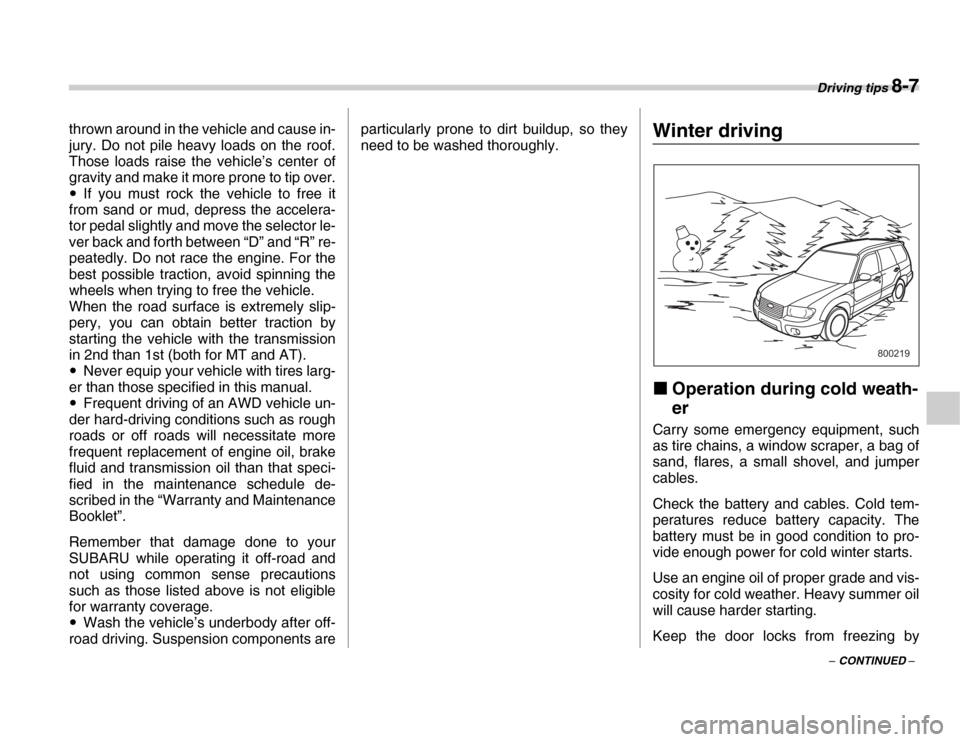
Winter driving „
Operation during cold weath- er
Carry some emergency equipment, such
as tire chains, a window scraper, a bag of
sand, flares, a small shovel, and jumper
cables.
Check the battery and cables. Cold tem-
peratures reduce battery capacity. The
battery must be in good condition to pro-
vide enough power for cold winter starts.
Use an engine oil of proper grade and vis-
cosity for cold weather. Heavy summer oil
will cause harder starting.
Keep the door locks from freezing by
800219
Page 232 of 356
8-8 Driving tips
squirting them with deicer or glycerin.
Forcing a frozen door open may damage
or separate the rubber weather strips
around the door. If the door is frozen, use
hot water to melt the ice, and afterwards
thoroughly wipe the water away.
Use a windshield washer fluid that con-
tains an antifreeze solution. Do not use
engine antifreeze or other substitutes be-
cause they may damage the paint of the
vehicle.
SUBARU Windshield Washer Fluid con-
tains 58.5% methyl alcohol and 41.5%
surfactant, by volume. Its freezing temper-
ature varies according to how much it is di-
luted, as indicated in the following table.
In order to prevent freezing of washer flu-
id, check the freezing temperatures in the
table above when adjusting the fluid con-
centration to the outside temperature.
If you fill the reservoir tank with a fluid with
a different concentration from the one
used previously, purge the old fluid fromthe piping between the reservoir tank and
washer nozzles by operating the washer
for a certain period of time. Otherwise, if
the concentration of the fluid remaining in
the piping is too low for the outside tem-
perature, it may freeze and block the noz-
zles.
T
Before driving your vehicle
Before entering the vehicle, remove any
snow or ice from your shoes because that
could make the pedals slippery and dan-
gerous.
While warming up the vehicle before driv-
ing, check that the accelerator pedal,
brake pedal, and all other controls operate
smoothly.
Clear away ice and snow that has accu-
mulated under the fenders to avoid mak-
ing steering difficult. During severe winter
driving, stop when and where it is safe to do so and check under the fenders period-
ically. T
Parking in cold weather
Do not use the parking brake when park-
ing for long periods in cold weather since
it could freeze in that position. Instead, ob-
serve the following.
1. Place the shift lever in “1” or “R” for
manual transmission vehicles, and in “P”
for automatic transmission vehicles.
2. Use tire stops under the tires to prevent
the vehicle from moving.
When the vehicle is parked in snow or
when it snows, raise the wiper blades off
the glass to prevent damage to them.
When the vehicle has been left parked af-
ter use on roads heavily covered with
snow, or has been left parked during a
snowstorm, icing may develop on the
brake system, which could cause poor
braking action. Check for snow or ice
Washer Fluid Con-
centration Freezing Tempera-
ture
30% 10.4 qF (–12 qC)
50% –4 qF (–20 qC)
100% –49 qF (–45 qC)
Adjust the washer fluid concentra-
tion appropriately for the outside
temperature. If the concentration is
inappropriate, sprayed washer fluid
may freeze on the windshield and
obstruct your view, and the fluid
may freeze in the reservoir tank.
Snow can trap dangerous exhaust
gases under your vehicle. Keep
snow clear of the exhaust pipe and
from around your vehicle if you park
the vehicle in snow with the engine
running.
Page 263 of 356
In case of emergency 9-13
– CONTINUED –
Rear gate – if the rear gate
cannot be unlocked
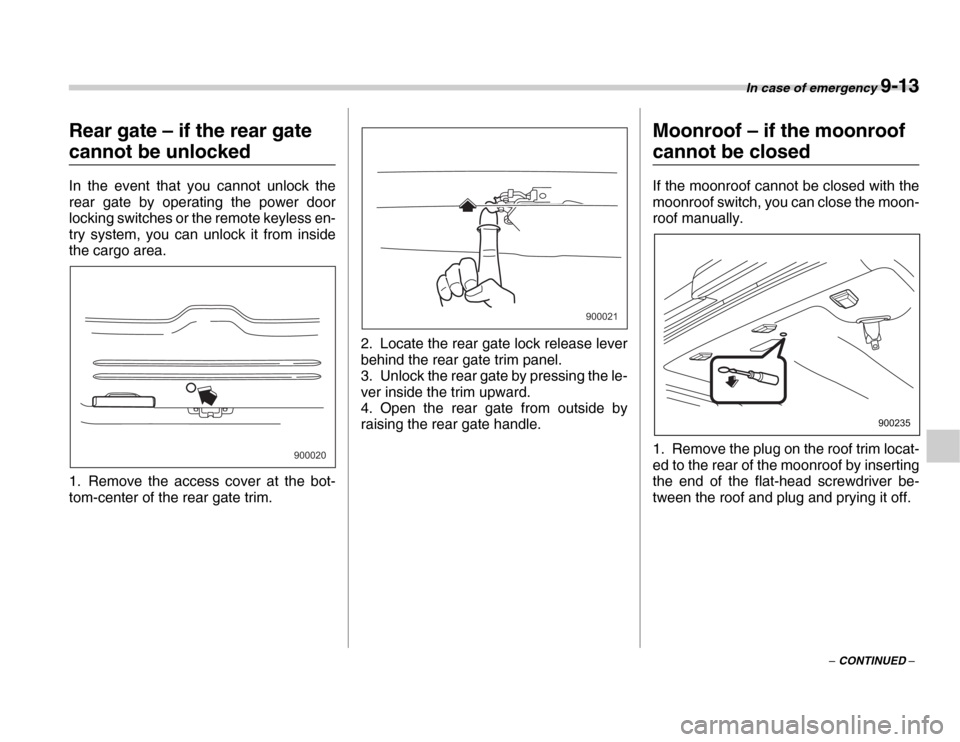
In the event that you cannot unlock the
rear gate by operating the power door
locking switches or the remote keyless en-
try system, you can unlock it from inside
the cargo area.
0
1. Remove the access cover at the bot-
tom-center of the rear gate trim.
2. Locate the rear gate lock release lever
behind the rear gate trim panel.
3. Unlock the rear gate by pressing the le-
ver inside the trim upward.
4. Open the rear gate from outside by
raising the rear gate handle. Moonroof – if the moonroof
cannot be closed
If the moonroof cannot be closed with the
moonroof switch, you can close the moon-
roof manually.
1. Remove the plug on the roof trim locat-
ed to the rear of the moonroof by inserting
the end of the flat-head screwdriver be-
tween the roof and plug and prying it off.
900020
900021
900235
Page 270 of 356
10-4 Appearance care
other parts of the vehicle may be dry.
4. High temperatures will cause corrosion
to parts of the vehicle which cannot dry
quickly due to lack of proper ventilation. „To help prevent corrosion
Wash the vehicle regularly to prevent cor-
rosion of the body and suspension com-
ponents. Also, wash the vehicle promptly
after driving on any of the following surfac-
es: y roads that have been salted to prevent
them from freezing in winter y mud, sand, or gravel
y coastal roads
After the winter has ended, it is recom-
mended that the underbody be given a
very thorough washing.
Before the beginning of winter, check the
condition of underbody components, such
as the exhaust system, fuel and brake
lines, brake cables, suspension, steering
system, floor pan, and fenders. If any of
them are found to be rusted, they should
be given an appropriate rust prevention
treatment or should be replaced. Contact
your SUBARU dealer to perform this kind
of maintenance and treatment if you need
assistance.
Repair chips and scratches in the paint as soon as you find them.
Check the interior of the vehicle for water
and dirt accumulation under the floor mats
because that could cause corrosion. Oc-
casionally check under the mats to make
sure the area is dry.
Keep your garage dry. Do not park your
vehicle in a damp, poorly ventilated ga-
rage. In such a garage, corrosion can be
caused by dampness. If you wash the ve-
hicle in the garage or put the vehicle into
the garage when wet or covered with
snow, that can cause dampness.
If your vehicle is operated in cold weather
and/or in areas where road salts and other
corrosive materials are used, the door
hinges and locks, trunk lid lock, and hood
latch should be inspected and lubricated
periodically.Cleaning the interior
Use a soft, damp cloth to clean the climate
control panel, audio equipment, instru-
ment panel, center console, combination
meter panel, and switches. (Do not use or-
ganic solvents.) „
Seat fabric
Remove loose dirt, dust or debris with a
vacuum cleaner. If the dirt is caked on the
fabric or hard to remove with a vacuum
cleaner, use a soft blush then vacuum it.
Wipe the fabric surface with a tightly
wrung cloth and dry the seat fabric thor-
oughly. If the fabric is still dirty, wipe using
a solution of mild soap and lukewarm wa-
ter then dry thoroughly.
If the stain does not come out, try a com-
mercially-available fabric cleaner. Use the
cleaner on a hidden place and make sure
it does not affect the fabric adversely. Use
the cleaner according to its instructions.
NOTE
When cleaning the seat, do not use
benzine, paint thinner, or any similar
materials.
Page 328 of 356

12-6 Specifications
Fuses and circuits „Fuse panel located behind the instrument pan- el
1 234 56
7891 01112
14
13 15 16 17 18 19
20 21 22 23
C00000
Fuse panelFuse ratingCircuit
115AyHeater fan
215AyHeater fan
315AyPower door lock
y Remote keyless entry
415AyPower outlet (front)
y Remote controlled rear view mirrors
510AyTail light
y Parking light
615AySRS airbag
715AyFog light
830AyABS
915AyRadio
1010A
Page 349 of 356

Index 14-3
ChimeKey ................................................................................ 3-5
Seatbelt ................................................................ 1-12, 3-9
Clock ................................................................................ 3-16
Clutch (MT) Fluid ........................................................................... 11-26
Pedal ......................................................................... 11-28
Coat hook ......................................................................... 6-12
Coolant ........................................................................... 11-12
Cooling system ............................................................... 11-11
Corrosion protection ................................................ 8-10, 10-3
Cruise control ................................................................... 7-22
Cruise control indicator light ............................................. 3-15
Cup holders ........................................................................ 6-7 D
Dashboard storage compartment ....................................... 6-6
Daytime running light system ........................................... 3-18
Differential gear oil Front (AT vehicles) .................................................... 11-21
Rear ........................................................................... 11-22
Dimensions ....................................................................... 12-2
Disarming the system ....................................................... 2-14
Disc brake pad wear warning indicators ........................... 7-16
Dome light .......................................................................... 6-2
Door locks .......................................................................... 2-4
Door open warning light ................................................... 3-14
Drive belt ........................................................................ 11-18
Driving Car phone/cell phone ....................................................... 7
Drinking ............................................................................ 6
Drugs ................................................................................ 6 Foreign countries ........................................................... 8-4
Pets ................................................................................... 7
Snowy and icy roads ...................................................... 8-9
Tired or sleepy .................................................................. 7
Driving tips ................................................................. 7-10, 8-5 E
Electronic Brake Force Distribution (EBD) system ........... 7-18
Emergency Locking Retractor (ELR) ................................ 1-11
Engine Compartment overview ................................................ 11-6
Coolant ....................................................................... 11-12
Exhaust gas (Carbon monoxide) ................................... 8-2
Hood ............................................................................ 11-4
Oil ................................................................................. 11-8
Overheating ................................................................. 9-10
Starting ........................................................................... 7-7
Stopping ......................................................................... 7-8
Exterior care ..................................................................... 10-2 F
Flat tires .............................................................................. 9-3
Floor mat ........................................................................... 6-12
Fluid level Automatic transmission .............................................. 11-20
Brake .......................................................................... 11-25
Clutch (MT vehicles) .................................................. 11-26
Power steering ........................................................... 11-23
Front differential gear oil (AT vehicles) ........................... 11-21
Front fog light button ......................................................... 3-20
Front seatbelt pretensioners ............................................. 1-21
Page 351 of 356

Index 14-5
M
Main fuse ........................................................................ 11-42
MaintenancePrecautions .................................................................. 11-3
Schedule ...................................................................... 11-3
Seatbelt ....................................................................... 1-19
Tools ............................................................................ 9-14
Malfunction indicator lamp ................................................ 3-11
Manual
Climate control system .................................................. 4-3
Seat ............................................................................... 1-3
Transmission ................................................................. 7-9
Transmission oil ......................................................... 11-18
Map lights ........................................................................... 6-3
Maximum load limits ......................................................... 8-18
Meters and gauges ............................................................. 3-6
Mirrors .............................................................................. 3-25
Moonroof ................................................................. 2-21, 9-13 N
New vehicle break-in driving ............................................... 8-2 O
Odometer/Trip meter .......................................................... 3-6
Off road driving ................................................................... 8-6
Oil filter ............................................................................. 11-8
Oil level
Engine ......................................................................... 11-8
Manual transmission .................................................. 11-18
Rear differential ......................................................... 11-22
Oil pressure warning light ................................................. 3-12 Outside mirrors ................................................................. 3-27
Outside temperature indicator ............................................ 3-8
Overhead console ............................................................... 6-6 P
Parking brake ......................................................... 7-20, 11-30
Stroke ......................................................................... 11-30
Parking light switch ........................................................... 3-20
Parking your vehicle ......................................................... 7-19
Periodic inspections ............................................................ 8-4
Pocket ................................................................................. 6-7 Power
Door locking switches .................................................... 2-6
Seat ................................................................................ 1-4
Steering ........................................................................ 7-15
Steering fluid level ...................................................... 11-23
Windows ...................................................................... 2-18
R
Rear Combination lights ..................................................... 11-47
Differential gear oil level ............................................. 11-22
Gate .................................................................... 2-20, 9-13
Seats .............................................................................. 1-7
Viscous limited slip differential (LSD) ........................... 7-15
Rear window
Defogger button ........................................................... 3-24
Wiper and washer switch ............................................. 3-23
Wiper blade ................................................................ 11-38
Remote keyless entry system ............................................. 2-6
Page 353 of 356

Index 14-7
TrailerConnecting .................................................................. 8-16
Hitch ................................................................... 8-16, 8-21
Towing ......................................................................... 8-18
Towing tips .................................................................. 8-23
Turn signal indicator lights ................................................ 3-15
Turn signal lever ............................................................... 3-19 U
Under-floor storage compartment ..................................... 6-15 V
Valet mode ....................................................................... 2-15
Vanity mirror ....................................................................... 6-3
Vehicle Capacity weight ........................................................... 8-12
Identification .............................................................. 12-10
Symbols ............................................................................ 3
Ventilator ............................................................................ 4-2 W
Warning and indicator lights ............................................... 3-9
Warning lights
ABS ............................................................................. 3-13
All-Wheel Drive ............................................................ 3-15
Anti-lock Brake system ................................................ 3-13
AT OIL TEMPerature ................................................... 3-12
Brake system ............................................................... 3-13
Charge ......................................................................... 3-12
CHECK ENGINE ......................................................... 3-11
Door open .................................................................... 3-14 Low fuel ........................................................................ 3-14
Oil pressure .................................................................. 3-12
Seatbelt ................................................................. 1-12, 3-9
SRS airbag system ...................................................... 3-10
Warranties and maintenance ............................................ 8-18
Washing ............................................................................ 10-2
Waxing and polishing ........................................................ 10-3
Wear indicators ............................................................... 11-33
Wheel Alignment ..................................................................... 12-5
Aluminum ................................................................... 11-35
Balance ...................................................................... 11-32
Replacement .............................................................. 11-35
Windows ........................................................................... 2-18
Windshield Washer fluid ............................................................... 11-35
Wiper and washer switches ......................................... 3-22
Wiper deicer ................................................................. 3-24
Windshield wiper blades
Replacement .............................................................. 11-37
Winter driving ...................................................................... 8-7
Wiper and washer ............................................................. 3-21