2007 SUBARU FORESTER ESP
[x] Cancel search: ESPPage 233 of 356

Driving tips 8-9
– CONTINUED –
buildup on the suspension, disc brakes
and brake hoses underneath the vehicle.
If there is caked snow or ice, remove it,
being careful not to damage the disc
brakes and brake hoses and ABS har-
ness. T
Refueling in cold weather
To help prevent moisture from forming in
the fuel system and the risk of its freezing,
use of an antifreeze additive in the fuel
tank is recommended during cold weath- er.
Use only additives that are specifically de-
signed for this purpose. When an anti-
freeze additive is used, its effect lasts
longer if the tank is refilled whenever the
fuel level reaches half empty.
If your SUBARU is not going to be used for
an extended period, it is best to have the
fuel tank filled to capacity. „ Driving on snowy and icy roads
To prevent skidding and slipping, avoid
sudden braking, abrupt acceleration, high-
speed driving, and sharp turning when
driving on snowy or icy roads.
Always maintain ample distance between
your vehicle and the vehicle ahead of you
to avoid the need for sudden braking.
To supplement the foot brake, use the en-
gine brake effectively to control the vehi-
cle speed. (Shift into a lower gear when
necessary.)
Avoid shifting down abruptly. Such behav-
ior can cause the wheels to lock, possibly
leading to loss of vehicle control.
An anti-lock brake system (ABS) enhanc-
es your vehicle’s braking performance on
snowy and icy roads. Refer to the “ABS
(Anti-lock Brake System)” section in chap-
ter 7 for information on braking on slippery
surfaces. TWiper operation when snowing
Before driving in cold weather, make sure the wiper blades are not frozen to the
windshield or rear window. If the wiper
blades are frozen to the windshield or rear
window, use the defroster with the airflow
control button/dial in the “ ” position
and the temperature control dial set for
maximum warmth until the wiper blades
are completely thawed out. If your vehicle
is equipped with a wiper deicer, it is helpful
to thaw the windshield wiper blades. To
thaw out the rear wiper blade, use the rear
window defogger.
When driving in snow, if frozen snow
starts to stick on the surface of the wind-
shield despite wiper operation, use the de-
froster with the airflow control button/dial
in “ ” and the temperature control dial
set for maximum warmth. After the wind-
shield gets warmed enough to melt the
frozen snow on it, wash it away using the
windshield washer.
Snow stuck on the wiper arm prevents the
wiper from working effectively. If snow is
stuck on the wiper arm, pull off the road to
a safe place, then remove it. If you stop
the vehicle at road side, use the hazard
warning flasher to alert other drivers.
We recommend use of non-freezing type
wiper blades (winter blades) during the
seasons you could have snow and sub-
Do not use the cruise control on
slippery roads such as snowy or icy
roads. This may cause loss of vehi-
cle control.
Avoid prolonged continuous driving
in snowstorms. Snow will enter the
engine’s intake system and may
hinder the air flow, which could re-
sult in engine shutdown or even
breakdown.
Page 242 of 356

8-18 Driving tips
Trailer towing
Your vehicle is designed and intended to
be used primarily as a passenger-carrying
vehicle. Towing a trailer puts additional
loads on your vehicle’s engine, drivetrain,
brakes, tires and suspension and has an
adverse effect on fuel economy.
If you do decide to tow a trailer, your safe-
ty and satisfaction depend upon proper
use of correct equipment and cautious op-
eration of your vehicle. Seek the advice of
your SUBARU dealer to assist you in pur-
chasing a hitch and other necessary tow-
ing equipment appropriate for your vehi-
cle. In addition, be sure to follow the in-
structions on correct installation and use
provided by the trailer and other towing
equipment manufacturers.
SUBARU assumes no responsibility for in-
juries or vehicle damage that result from
trailer towing equipment, or from any er-
rors or omissions in the instructions ac-
companying such equipment or for your
failure to follow the proper instructions. „Warranties and maintenance
SUBARU warranties do not apply to vehi-
cle damage or malfunction caused by trail-
er towing. If you use your vehicle to tow a
trailer, more frequent maintenance will be required due to the additional load. (Refer
to “Maintenance schedule under severe
driving conditions” in the “Warranty and
Maintenance Booklet”.)
Under no circumstances should a trailer
be towed with a new vehicle or a vehicle
with any new powertrain component (en-
gine, transmission, differential, wheel
bearings, etc.) for the first 1,000 miles
(1,600 km) of driving.
„ Maximum load limits
TTotal trailer weight
Total trailer weight
The total trailer weight (trailer weight plus
its cargo load) must never exceed the
maximum weight shown in the following
table.
Never exceed the maximum load
limits explained in the following. Ex-
ceeding the maximum load limits
could cause personal injury and/or
vehicle damage. y Adequate size trailer brakes are
required when the trailer and its
cargo exceed 1,000 lbs (453 kg)
total weight.
yBefore towing a trailer, check the
trailer total weight, GVW, GAWs
and tongue load. Make sure the
load and its distribution in your
vehicle and trailer are acceptable.
800211
Page 245 of 356
Driving tips 8-21
– CONTINUED –
F: Front of vehicle
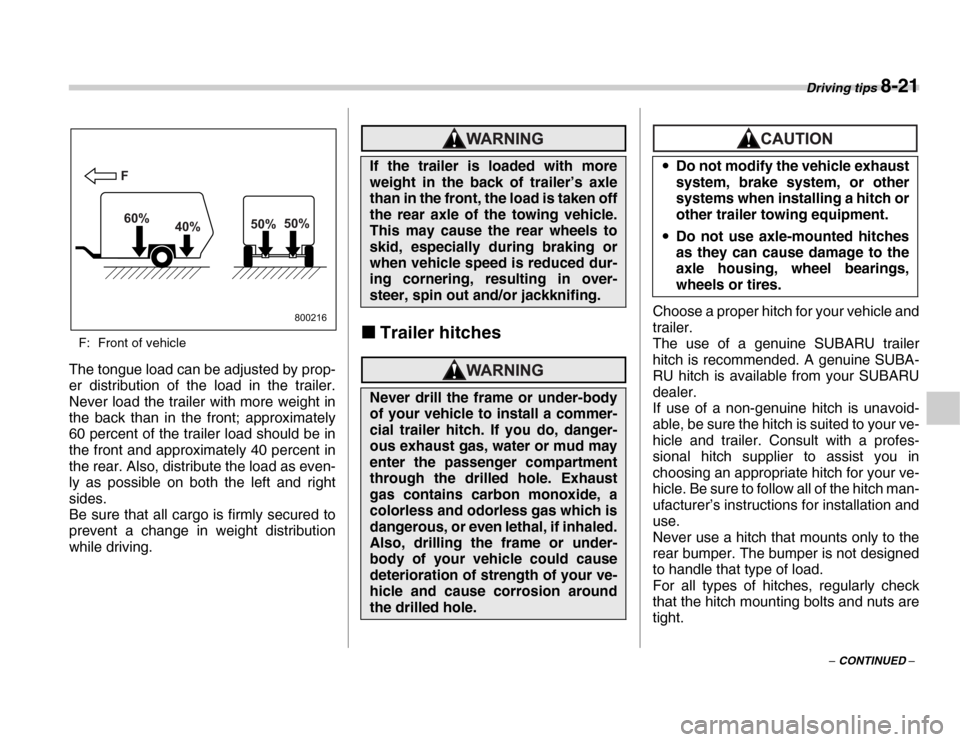
The tongue load can be adjusted by prop-
er distribution of the load in the trailer.
Never load the trailer with more weight in
the back than in the front; approximately
60 percent of the trailer load should be in
the front and approximately 40 percent in
the rear. Also, distribute the load as even-
ly as possible on both the left and right
sides.
Be sure that all cargo is firmly secured to
prevent a change in weight distribution
while driving.
„ Trailer hitches
Choose a proper hitch for your vehicle and
trailer.
The use of a genuine SUBARU trailer
hitch is recommended. A genuine SUBA-
RU hitch is available from your SUBARU
dealer.
If use of a non-genuine hitch is unavoid-
able, be sure the hitch is suited to your ve-
hicle and trailer. Consult with a profes-
sional hitch supplier to assist you in
choosing an appropriate hitch for your ve-
hicle. Be sure to follow all of the hitch man-
ufacturer’s instructions for installation and
use.
Never use a hitch that mounts only to the
rear bumper. The bumper is not designed
to handle that type of load.
For all types of hitches, regularly check
that the hitch mounting bolts and nuts are
tight.
F
60% 40% 50%
50%
800216
If the trailer is loaded with more
weight in the back of trailer’s axle
than in the front, the load is taken off
the rear axle of the towing vehicle.
This may cause the rear wheels to
skid, especially during braking or
when vehicle speed is reduced dur-
ing cornering, resulting in over-
steer, spin out and/or jackknifing.
Never drill the frame or under-body
of your vehicle to install a commer-
cial trailer hitch. If you do, danger-
ous exhaust gas, water or mud may
enter the passenger compartment
through the drilled hole. Exhaust
gas contains carbon monoxide, a
colorless and odorless gas which is
dangerous, or even lethal, if inhaled.
Also, drilling the frame or under-
body of your vehicle could cause
deterioration of strength of your ve-
hicle and cause corrosion around
the drilled hole.
y
Do not modify the vehicle exhaust
system, brake system, or other
systems when installing a hitch or
other trailer towing equipment.
y Do not use axle-mounted hitches
as they can cause damage to the
axle housing, wheel bearings,
wheels or tires.
Page 268 of 356
10-2 Appearance care
Appe arance ca reExterior care „WashingNOTE
When having your vehicle washed in
an automatic car wash, make sure be-
forehand that the car wash is of suit-
able type.
The best way to preserve your vehicle’s
beauty is frequent washing. Wash the ve-
hicle at least once a month to avoid con-
tamination by road grime.
Wash dirt off with a wet sponge and plenty
of lukewarm or cold water. Do not wash
the vehicle with hot water and in direct
sunlight.
Salt, chemicals, insects, tar, soot, tree sap
and bird droppings should be washed off
by using a light detergent, as required. If
you use a light detergent, make certain
that it is a neutral detergent. Do not use
strong soap or chemical detergents. All
cleaning agents should be promptly
flushed from the surface and not allowed
to dry there. Rinse the vehicle thoroughly
with plenty of lukewarm water. Wipe the
remaining water off with a chamois or soft
cloth. TWashing the underbody
Chemicals, salts and gravel used for deic-
ing road surfaces are extremely corrosive,
accelerating the corrosion of underbody components, such as the exhaust system,
fuel and brake lines, brake cables, floor
pan and fenders, and suspension.
Thoroughly flush the underbody and in-
side of the fenders with lukewarm or cold
water at frequent intervals to reduce the
harmful effects of such agents.
Mud and sand adhering to the underbody
components may accelerate their corro-
sion.
After driving off-road or muddy or sandy
roads, wash the mud and sand off the un-
derbody.
Carefully flush the suspension and axle
parts, as they are particularly prone to
mud and sand buildup. Do not use a
sharp-edged tool to remove caked mud.
NOTE
Be careful not to damage brake hoses,
sensor harnesses, and other parts
when washing suspension compo-
nents. T
Using a warm water washer
y Keep a good distance of 12 in (30 cm)
or more between the washer nozzle and
the vehicle. y Do not wash the same area continuous-
ly. y If a stain will not come out easily, wash
by hand. Some warm water washers are
y
When washing the vehicle, the
brakes may get wet. As a result,
the brake stopping distance will
be longer. To dry the brakes, drive
the vehicle at a safe speed while
lightly pressing the brake pedal to
heat up the brakes.
y Do not wash the engine compart-
ment and area adjacent to it. If wa-
ter enters the engine air intake,
electrical parts or the power steer-
ing fluid reservoir, it will cause en-
gine trouble or faulty power steer-
ing respectively.
y Since your vehicle is equipped
with a rear wiper, automatic car-
wash brushes could become tan-
gled around it, damaging the wip-
er arm and other components.
Ask the automatic car-wash oper-
ator not to let the brushes touch
the wiper arm or to fix the wiper
arm on the rear window glass with
adhesive tape before operating
the machine.
Page 301 of 356
Maintenance and service 11 - 29
Replacement of brake pad
and lining
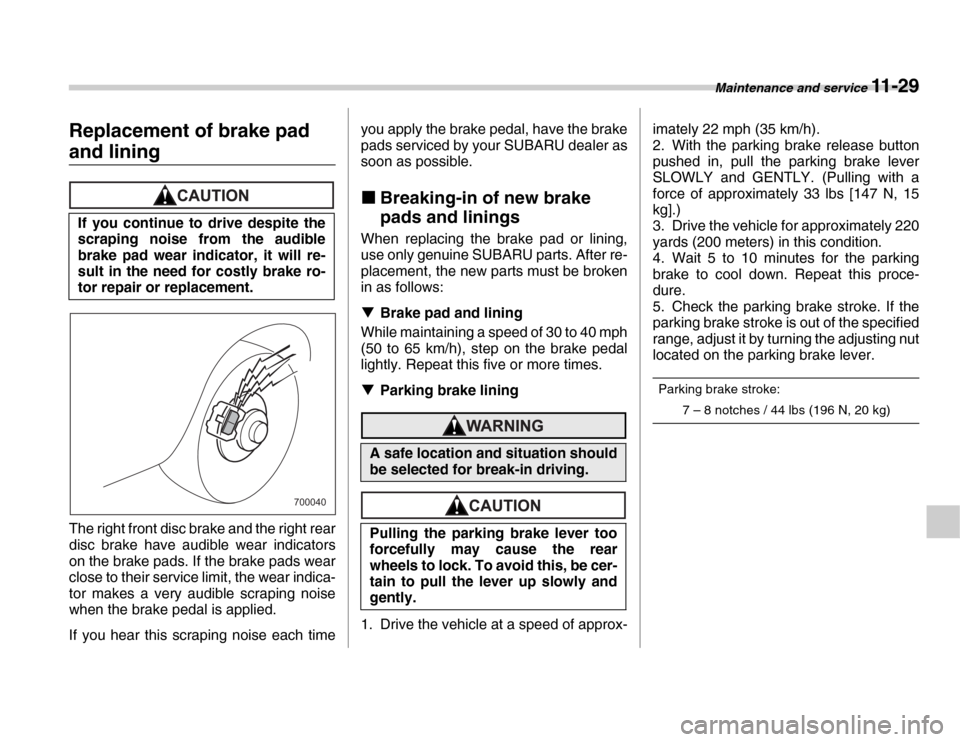
The right front disc brake and the right rear
disc brake have audible wear indicators
on the brake pads. If the brake pads wear
close to their service limit, the wear indica-
tor makes a very audible scraping noise
when the brake pedal is applied.
If you hear this scraping noise each timeyou apply the brake pedal, have the brake
pads serviced by your SUBARU dealer as
soon as possible.
„ Breaking-in of new brake
pads and linings
When replacing the brake pad or lining,
use only genuine SUBARU parts. After re-
placement, the new parts must be broken
in as follows: T Brake pad and lining
While maintaining a speed of 30 to 40 mph
(50 to 65 km/h), step on the brake pedal
lightly. Repeat this five or more times. T Parking brake lining
1. Drive the vehicle at a speed of approx- imately 22 mph (35 km/h).
2. With the parking brake release button
pushed in, pull the parking brake lever
SLOWLY and GENTLY. (Pulling with a
force of approximately 33 lbs [147 N, 15
kg].)
3. Drive the vehicle for approximately 220
yards (200 meters) in this condition.
4. Wait 5 to 10 minutes for the parking
brake to cool down. Repeat this proce-
dure.
5. Check the parking brake stroke. If the
parking brake stroke is out of the specified
range, adjust it by turning the adjusting nut
located on the parking brake lever.
Parking brake stroke:
7 – 8 notches / 44 lbs (196 N, 20 kg)
If you continue to drive despite the
scraping noise from the audible
brake pad wear indicator, it will re-
sult in the need for costly brake ro-
tor repair or replacement.
700040
A safe location and situation should
be selected for break-in driving.
Pulling the parking brake lever too
forcefully may cause the rear
wheels to lock. To avoid this, be cer-
tain to pull the lever up slowly and
gently.
Page 314 of 356

11 - 4 2 Maintenance and service
in the main fuse box cover in the engine
compartment.1) Good
2) Blown
If any lights, accessories or other electri-
cal controls do not operate, inspect the
corresponding fuse. If a fuse has blown,
replace it.
1. Turn the ignition switch to the “LOCK”
position and turn off all electrical accesso-
ries.
2. Remove the cover.
3. Determine which fuse may be blown.
The back side of each fuse box cover and
the “Fuses and circuits” section in chapter
12 in this manual show the circuit for each
fuse. 4. Pull out the fuse with the fuse puller.
5. Inspect the fuse. If it has blown, re-
place it with a spare fuse of the same rat-
ing.
6. If the same fuse blows again, this indi-
cates that its system has a problem. Con-
tact your SUBARU dealer for repairs.Main fuse
Main fuse box
The main fuses are designed to melt dur-
ing an overload to prevent damage to the
wiring harness and electrical equipment.
Check the main fuses if any electrical
component fails to operate (except the
starter motor) and other fuses are good. A
melted main fuse must be replaced. Use
only replacements with the same speci-
fied rating as the melted main fuse. If a
main fuse blows after it is replaced, have
the electrical system checked by your
nearest SUBARU dealer.
12
B00338
600160
600444