2007 SUBARU FORESTER turn signal
[x] Cancel search: turn signalPage 247 of 356

Driving tips 8-23
– CONTINUED –
Connection of trailer lights to your vehi-
cle’s electrical system requires modifica-
tions to the vehicle’s lighting circuit to in-
crease its capacity and accommodate wir-
ing changes. To ensure the trailer lights
are connected properly, please consult
your SUBARU dealer. Check for proper
operation of the turn signals, the brake
lights and parking lights each time you
hitch up. T
Tires
Make sure that all the tires on your vehicle
are properly inflated to the pressure spec-
ified on the tire placard located on the driv-
er’s side center pillar.
Trailer tire condition, size, load rating and
proper inflation pressure should be in ac-
cordance with the trailer manufacturer’s
specifications. „
Trailer towing tips
TBefore starting out on a trip
y Check that the vehicle and vehicle-to-
hitch mounting are in good condition. If
any problems are apparent, do not tow the
trailer. y Check that the vehicle sits horizontally
with the trailer attached. If the vehicle is
tipped sharply up at the front and down at
the rear, check the total trailer weight,
GVW, GAWs and tongue load again, then
confirm that the load and its distribution
are acceptable. y Check that the tire pressures are cor-
rect. y Check that the vehicle and trailer are connected properly. Confirm that
– the trailer tongue is connected prop-
erly to the hitch ball.
– the trailer lights connector is connect-
ed properly and trailer’s brake lights illu-
minate when the vehicle’s brake pedal
is pressed, and that the trailer’s turn sig-
nal lights flash when the vehicle’s turn
signal lever is operated.
– the safety chains are connected prop-
erly.
– all cargo in the trailer is secured safe-
ty in position.
– the side mirrors provide a good rear-
ward field of view without a significant
blind spot.
y Sufficient time should be taken to learn
the “feel” of the vehicle/trailer combination
before starting out on a trip. In an area free
of traffic, practice turning, stopping and
backing up. T Driving with a trailer
y You should allow for considerably more
stopping distance when towing a trailer.
Avoid sudden braking because it may re-
sult in skidding or jackknifing and loss of
control. y Avoid abrupt starts and sudden acceler-
ations. If your vehicle has a manual trans-
mission, always start out in first gear and
release the clutch at moderate engine rev-
Never tow a trailer when the tempo-
rary spare tire is used. The tempo-
rary spare tire is not designed to
sustain the towing load. Use of the
temporary spare tire when towing
can result in failure of the spare tire
and/or less stability of the vehicle.
y Never exceed 45 mph (72 km/h)
when towing a trailer in hilly coun-
try on hot days.
y When towing a trailer, steering,
stability, stopping distance and
braking performance will be dif-
ferent from normal operation. For
safety’s sake, you should employ
extra caution when towing a trail-
er and you should never speed.
You should also keep the follow-
ing tips in mind:
Page 252 of 356

9-2 In case of emergency
In c ase of e me rge ncyIf you park your vehicle in
case of an emergency
The hazard warning flasher should be
used in day or night to warn other drivers
when you have to park your vehicle under
emergency conditions.
Avoid stopping on the road. It is best to
safely pull off the road if a problem occurs.
The hazard warning flasher can be acti-
vated regardless of the ignition switch po-
sition.
Turn on the hazard warning by pushing
the hazard warning flasher switch. Turn it
off by pushing the switch again.
NOTE
When the hazard warning flasher is on, the turn signals do not work.
Temporary spare tire (if
equipped)
The temporary spare tire is smaller and
lighter than a conventional tire and is de-
signed for emergency use only. Remove
the temporary spare tire and re-install the
conventional tire as soon as possible be-
cause the spare tire is designed only for
temporary use.
Check the inflation pressure of the tempo-
rary spare tire periodically to keep the tire
300117
Never tow a trailer when the tempo-
rary spare tire is used. The tempo-
rary spare tire is not designed to
sustain the towing load. Use of the
temporary spare tire when towing
can result in failure of the spare tire
and/or less stability of the vehicle
and may lead to an accident.
Never use any temporary spare tire
other than the original. Using other
sizes may result in severe mechani-
cal damage to the drive train of your
vehicle.
Page 317 of 356
Maintenance and service 11 - 45
– CONTINUED –
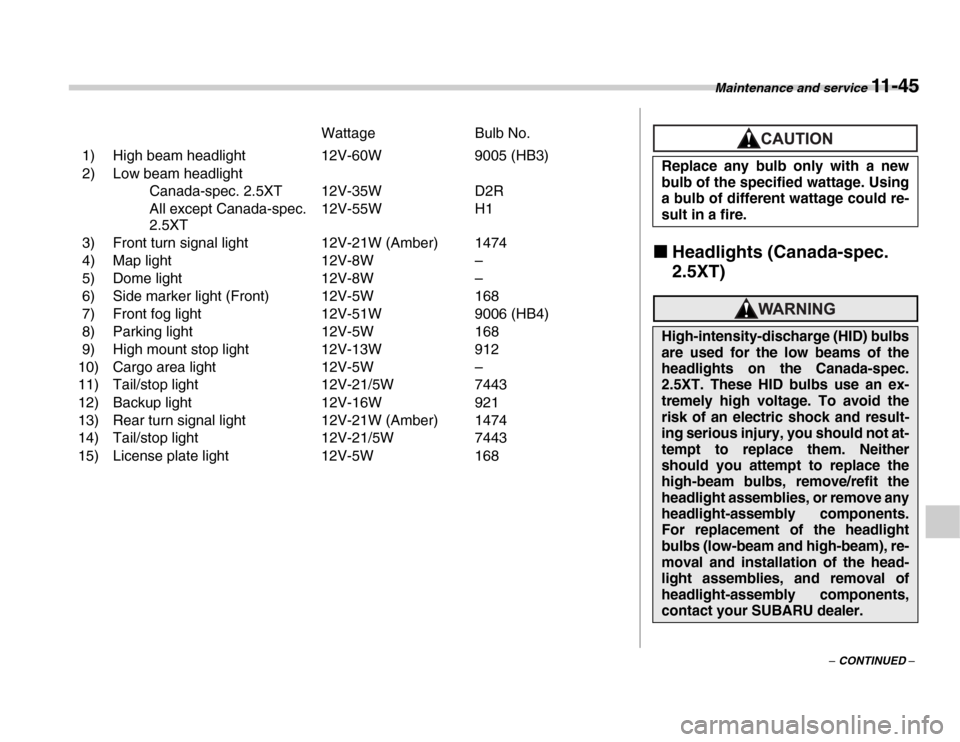
Wattage Bulb No.
1) High beam headlight 12V-60W 9005 (HB3)
2) Low beam headlight Canada-spec. 2.5XT 12V-35W D2R
All except Canada-spec.
2.5XT 12V-55W H1
3) Front turn signal light 12V-21W (Amber) 1474
4) Map light 12V-8W –
5) Dome light 12V-8W –
6) Side marker light (Front) 12V-5W 168
7) Front fog light 12V-51W 9006 (HB4)
8) Parking light 12V-5W 168
9) High mount stop light 12V-13W 912
10) Cargo area light 12V-5W –
11) Tail/stop light 12V-21/5W 7443
12) Backup light 12V-16W 921
13) Rear turn signal light 12V-21W (Amber) 1474
14) Tail/stop light 12V-21/5W 7443
15) License plate light 12V-5W 168
„ Headlights (Canada-spec.
2.5XT)
Replace any bulb only with a new
bulb of the specified wattage. Using
a bulb of different wattage could re-
sult in a fire.
High-intensity-discharge (HID) bulbs
are used for the low beams of the
headlights on the Canada-spec.
2.5XT. These HID bulbs use an ex-
tremely high voltage. To avoid the
risk of an electric shock and result-
ing serious injury, you should not at-
tempt to replace them. Neither
should you attempt to replace the
high-beam bulbs, remove/refit the
headlight assemblies, or remove any
headlight-assembly components.
For replacement of the headlight
bulbs (low-beam and high-beam), re-
moval and installation of the head-
light assemblies, and removal of
headlight-assembly components,
contact your SUBARU dealer.
Page 320 of 356
11 - 4 8 Maintenance and service
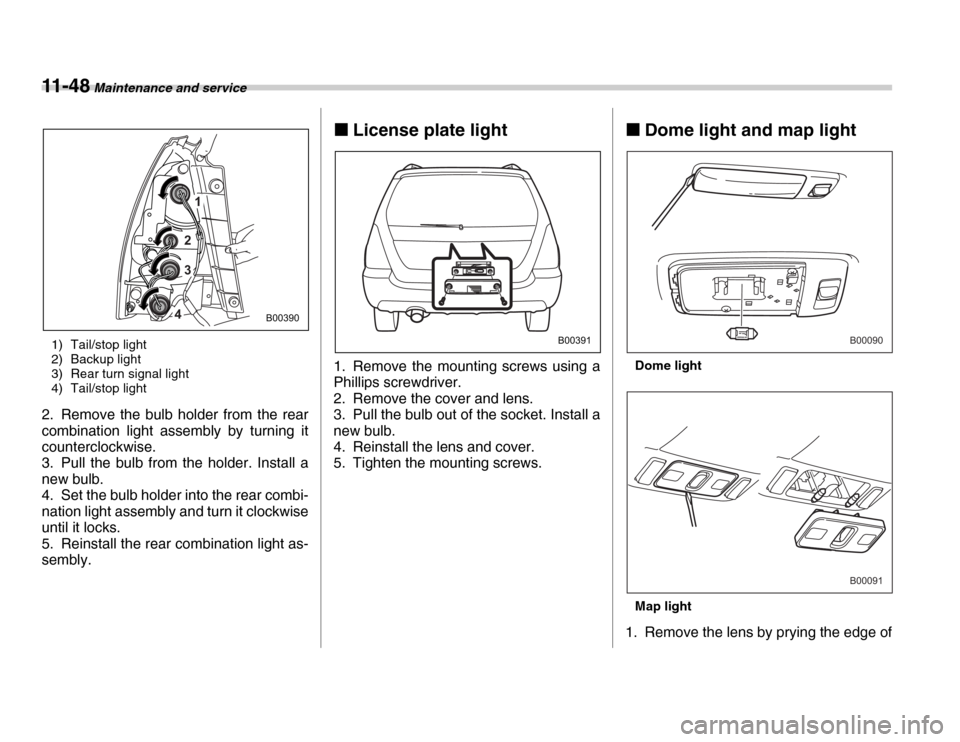
1) Tail/stop light
2) Backup light
3) Rear turn signal light
4) Tail/stop light
2. Remove the bulb holder from the rear
combination light assembly by turning it
counterclockwise.
3. Pull the bulb from the holder. Install a
new bulb.
4. Set the bulb holder into the rear combi-
nation light assembly and turn it clockwise
until it locks.
5. Reinstall the rear combination light as-
sembly. „
License plate light
0
1. Remove the mounting screws using a
Phillips screwdriver.
2. Remove the cover and lens.
3. Pull the bulb out of the socket. Install a
new bulb.
4. Reinstall the lens and cover.
5. Tighten the mounting screws. „
Dome light and map light
Dome light
Map light
1. Remove the lens by prying the edge of
1
2
3
4B00390
B00391B00090
B00091
Page 330 of 356

12-8 Specifications
„Fuse panel located in the engine compartment
A) FWD socket
B) Main fuse
A 12 4
3 B
5
6 789
10 11 12 13
C00105
14
Fuse panelFuse ratingCircuit
130Ay
Radiator cooling fan (Main)
230AyRadiator cooling fan (Sub)
330AyABS motor
430AyEngine sensor (Non-turbo models only)
520AyRear window defogger
615AyHazard warning flasher
y Horn
715AyTurn signal lights
810AyAutomatic transmission control unit
910AyAlternator
1015AyHeadlight (right side)
1115AyHeadlight (left side)
1220AyLighting switch
1315AyClock
y Interior light
1410AySecondary air combination valve
(Turbo models only)
Page 331 of 356

Specifications 12-9
Bulb chart
Description Wattage Bulb type
Headlight
High beam 12V-60W 9005 (HB3)
Low beamCanada-spec. 2.5XT 12V-35W D2R
All except Canada-
spec. 2.5XT 12V-55W H1
Front fog light 12V-51W 9006 (HB4)
Front turn signal light 12V-21W 1474
Parking light 12V-5W 168
Side marker light (Front) 12V-5W 168
Rear combination light Tail/stop light 12V-21/5W 7443
Turn signal light 12V-21W (Amber) 1474
Tail/stop light 12V-21/5W 7443
Backup light 12V-16W 921
High mount stop light 12V-13W 912
License plate light 12V-5W 168
Cargo area light 12V-15W –
Dome light 12V-8W –
Map light 12V-8W –
Page 353 of 356

Index 14-7
TrailerConnecting .................................................................. 8-16
Hitch ................................................................... 8-16, 8-21
Towing ......................................................................... 8-18
Towing tips .................................................................. 8-23
Turn signal indicator lights ................................................ 3-15
Turn signal lever ............................................................... 3-19 U
Under-floor storage compartment ..................................... 6-15 V
Valet mode ....................................................................... 2-15
Vanity mirror ....................................................................... 6-3
Vehicle Capacity weight ........................................................... 8-12
Identification .............................................................. 12-10
Symbols ............................................................................ 3
Ventilator ............................................................................ 4-2 W
Warning and indicator lights ............................................... 3-9
Warning lights
ABS ............................................................................. 3-13
All-Wheel Drive ............................................................ 3-15
Anti-lock Brake system ................................................ 3-13
AT OIL TEMPerature ................................................... 3-12
Brake system ............................................................... 3-13
Charge ......................................................................... 3-12
CHECK ENGINE ......................................................... 3-11
Door open .................................................................... 3-14 Low fuel ........................................................................ 3-14
Oil pressure .................................................................. 3-12
Seatbelt ................................................................. 1-12, 3-9
SRS airbag system ...................................................... 3-10
Warranties and maintenance ............................................ 8-18
Washing ............................................................................ 10-2
Waxing and polishing ........................................................ 10-3
Wear indicators ............................................................... 11-33
Wheel Alignment ..................................................................... 12-5
Aluminum ................................................................... 11-35
Balance ...................................................................... 11-32
Replacement .............................................................. 11-35
Windows ........................................................................... 2-18
Windshield Washer fluid ............................................................... 11-35
Wiper and washer switches ......................................... 3-22
Wiper deicer ................................................................. 3-24
Windshield wiper blades
Replacement .............................................................. 11-37
Winter driving ...................................................................... 8-7
Wiper and washer ............................................................. 3-21