2007 SUBARU FORESTER engine
[x] Cancel search: enginePage 308 of 356
11 - 3 6 Maintenance and service
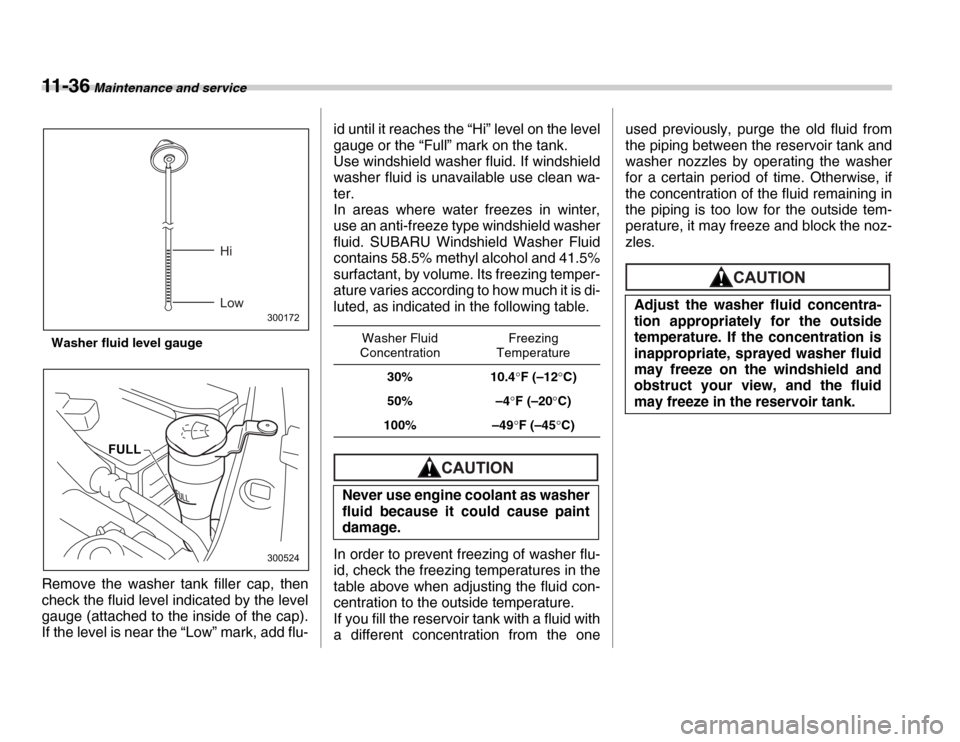
Washer fluid level gauge
Remove the washer tank filler cap, then
check the fluid level indicated by the level
gauge (attached to the inside of the cap).
If the level is near the “Low” mark, add flu- id until it reaches the “Hi” level on the level
gauge or the “Full” mark on the tank.
Use windshield washer fluid. If windshield
washer fluid is unavailable use clean wa- ter.
In areas where water freezes in winter,
use an anti-freeze type windshield washer
fluid. SUBARU Windshield Washer Fluid
contains 58.5% methyl alcohol and 41.5%
surfactant, by volume. Its freezing temper-
ature varies according to how much it is di-
luted, as indicated in the following table.
In order to prevent freezing of washer flu-
id, check the freezing temperatures in the
table above when adjusting the fluid con-
centration to the outside temperature.
If you fill the reservoir tank with a fluid with
a different concentration from the oneused previously, purge the old fluid from
the piping between the reservoir tank and
washer nozzles by operating the washer
for a certain period of time. Otherwise, if
the concentration of the fluid remaining in
the piping is too low for the outside tem-
perature, it may freeze and block the noz-
zles.
Hi Low
300172
FULL
300524
Washer Fluid
Concentration Freezing
Temperature
30% 10.4 qF (–12 qC)
50% –4 qF (–20 qC)
100% –49 qF (–45 qC)
Never use engine coolant as washer
fluid because it could cause paint
damage.
Adjust the washer fluid concentra-
tion appropriately for the outside
temperature. If the concentration is
inappropriate, sprayed washer fluid
may freeze on the windshield and
obstruct your view, and the fluid
may freeze in the reservoir tank.
Page 313 of 356

Maintenance and service 11 - 41
– CONTINUED –
1) Cap
2) Upper level
3) Lower level
It is unnecessary to periodically check the
battery fluid level or periodically refill with
distilled water.
However, if the battery fluid level is below
the lower level, remove the cap. Fill to the
upper level with distilled water.
Fuses
The fuses are designed to melt during an
overload to prevent damage to the wiring
harness and electrical equipment. The
fuses are located in two fuse boxes.
One is located under the instrument panel
behind the cover on the driver’s seat side.
To remove the cover, pull it out. The other one is housed in the engine
compartment.
1) Fuse puller
2) Spare fuse
The fuse puller and spare fuses are stored
UPPER LEVELUPPER LEVEL
LOWER LEVEL
1
2 3
B00382 Never replace a fuse with one hav-
ing a higher rating or with material
other than a fuse because serious
damage or a fire could result.
B00069
600444
1
2
B00383
Page 314 of 356

11 - 4 2 Maintenance and service
in the main fuse box cover in the engine
compartment.1) Good
2) Blown
If any lights, accessories or other electri-
cal controls do not operate, inspect the
corresponding fuse. If a fuse has blown,
replace it.
1. Turn the ignition switch to the “LOCK”
position and turn off all electrical accesso-
ries.
2. Remove the cover.
3. Determine which fuse may be blown.
The back side of each fuse box cover and
the “Fuses and circuits” section in chapter
12 in this manual show the circuit for each
fuse. 4. Pull out the fuse with the fuse puller.
5. Inspect the fuse. If it has blown, re-
place it with a spare fuse of the same rat-
ing.
6. If the same fuse blows again, this indi-
cates that its system has a problem. Con-
tact your SUBARU dealer for repairs.Main fuse
Main fuse box
The main fuses are designed to melt dur-
ing an overload to prevent damage to the
wiring harness and electrical equipment.
Check the main fuses if any electrical
component fails to operate (except the
starter motor) and other fuses are good. A
melted main fuse must be replaced. Use
only replacements with the same speci-
fied rating as the melted main fuse. If a
main fuse blows after it is replaced, have
the electrical system checked by your
nearest SUBARU dealer.
12
B00338
600160
600444
Page 323 of 356

12
Specifications
Specifications ..................................................... 12-2Dimensions ............................................................. 12-2
Engine ...................................................................... 12-3
Electrical system .................................................... 12-3
Capacities ................................................................ 12-4
Tires ......................................................................... 12-5
Wheel alignment ..................................................... 12-5
Fuses and circuits .............................................. 12-6 Fuse panel located behind the instrument
panel ........................................................................ 12-6
Fuse panel located in the engine
compartment ........................................................... 12-8
Bulb chart ............................................................ 12-9
Vehicle identification ......................................... 12-10
Page 325 of 356

Specifications 12-3
–
CONTINUED –
„ Engine
„ Electrical system
Engine modelEJ253 (2.5-liter, SOHC, non-turbo)EJ255 (2.5-liter, DOHC, turbo)
Engine typeHorizontally opposed, liquid cooled 4 cylinder, 4-stroke gasoline engine
Displacement cc (cu-in)2,457 (150)
Bore u Stroke in (mm)3.92 u 3.11 (99.5 u 79.0)
Compression ratio10.0 : 18.4 : 1
Firing order1 – 3 – 2 – 4
Battery type and capacity (5HR)Manual transmission12V-48AH (55D23L)
Automatic transmission12V-52AH (75D23L)
Alternator2.5-liter turbo models12V-110A
2.5-liter non-turbo models12V-90A
Spark plugs2.5-liter non-turbo modelsFR5AP-11 (NGK)
2.5-liter turbo modelsILFR6B (NGK)
Page 326 of 356
12-4 Specifications
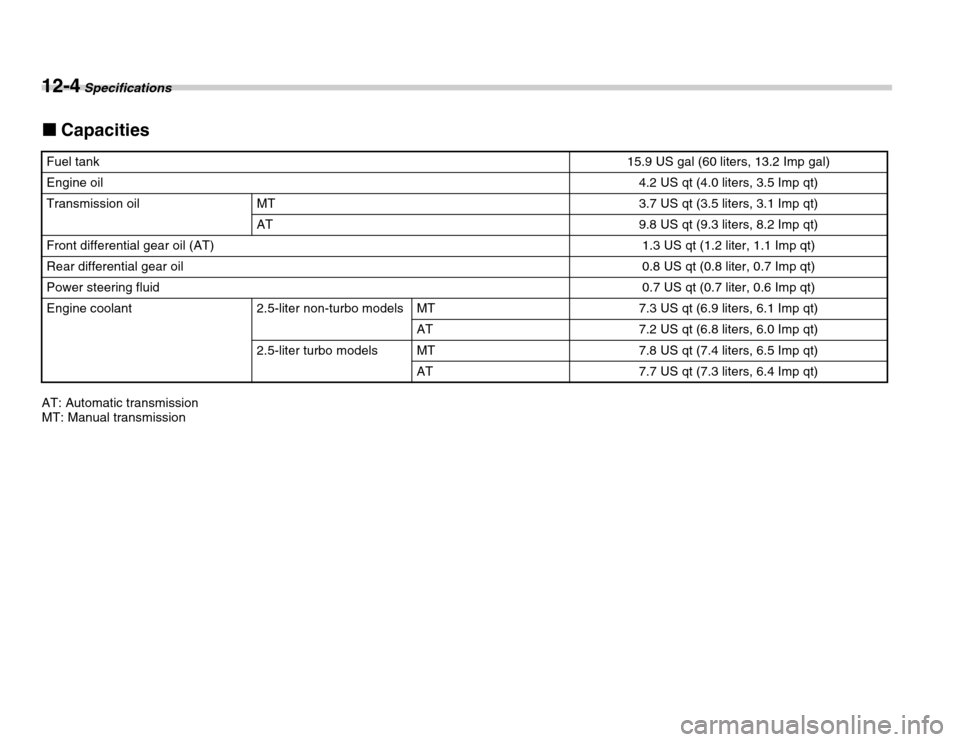
„Capacities
AT: Automatic transmission
MT: Manual transmission
Fuel tank15.9 US gal (60 liters, 13.2 Imp gal)
Engine oil4.2 US qt (4.0 liters, 3.5 Imp qt)
Transmission oilMT3.7 US qt (3.5 liters, 3.1 Imp qt)
AT9.8 US qt (9.3 liters, 8.2 Imp qt)
Front differential gear oil (AT)1.3 US qt (1.2 liter, 1.1 Imp qt)
Rear differential gear oil0.8 US qt (0.8 liter, 0.7 Imp qt)
Power steering fluid0.7 US qt (0.7 liter, 0.6 Imp qt)
Engine coolant2.5-liter non-turbo modelsMT7.3 US qt (6.9 liters, 6.1 Imp qt)
AT7.2 US qt (6.8 liters, 6.0 Imp qt)
2.5-liter turbo modelsMT7.8 US qt (7.4 liters, 6.5 Imp qt)
AT7.7 US qt (7.3 liters, 6.4 Imp qt)
Page 330 of 356

12-8 Specifications
„Fuse panel located in the engine compartment
A) FWD socket
B) Main fuse
A 12 4
3 B
5
6 789
10 11 12 13
C00105
14
Fuse panelFuse ratingCircuit
130Ay
Radiator cooling fan (Main)
230AyRadiator cooling fan (Sub)
330AyABS motor
430AyEngine sensor (Non-turbo models only)
520AyRear window defogger
615AyHazard warning flasher
y Horn
715AyTurn signal lights
810AyAutomatic transmission control unit
910AyAlternator
1015AyHeadlight (right side)
1115AyHeadlight (left side)
1220AyLighting switch
1315AyClock
y Interior light
1410AySecondary air combination valve
(Turbo models only)
Page 348 of 356

14-2 Index
A
ABS .................................................................................. 7-16Warning light ....................................................... 3-13, 7-17
Accessory power outlets .................................................... 6-8
Active head restraint ........................................................... 1-6
Air cleaner element ........................................................ 11-15
Air filtration system ........................................................... 4-12
Alarm system .................................................................... 2-12
All-Wheel Drive warning light (AT vehicles) ..................... 3-15
Aluminum wheel ............................................................. 11-35
Aluminum wheel cleaning ................................................. 10-3
Antenna system ................................................................. 5-2
Anti-lock brake system warning light (ABS) ............ 3-13, 7-16
Arming the system ............................................................ 2-13
Armrest ...................................................................... 1-10, 6-4
Ashtray (Canada only, if equipped) ......................... 6-11, 10-5
Audio set ............................................................................ 5-3
Auto-dimming mirror/compass ......................................... 3-26
Automatic climate control system ....................................... 4-8
Automatic transmission .................................................... 7-10
Capacities .................................................................... 12-4
Fluid ........................................................................... 11-20
Selector lever ............................................................... 7-11
Shift lock release ......................................................... 7-14
Temperature warning (AT OIL TEMP) ......................... 3-12
Automatic/Emergency Locking Retractor (A/ELR) ........... 1-12 B
Battery ............................................................................ 11-40 Jump starting ................................................................. 9-7
Replacing (remote keyless entry) .................................. 2-8 Brake
Booster ...................................................................... 11-27
Fluid ........................................................................... 11-25
Pad and lining ............................................................ 11-29
Parking ....................................................................... 11-30
Pedal .......................................................................... 11-27
System ......................................................................... 7-16
Warning light ................................................................ 3-13
Brake pedal .................................................................... 11-27 Free play .................................................................... 11-27
Reserve distance ....................................................... 11-27
Braking ............................................................................. 7-15
Braking tips ....................................................................... 7-15
Breaking-in of new brake pads and linings ..................... 11-29
Bulb Chart ............................................................................ 12-9
Replacing ................................................................... 11-44
C
Capacities ......................................................................... 12-4
Cargo area cover (if equipped) ......................................... 6-13
Cargo area light .................................................................. 6-2
Cargo tie-down hooks ....................................................... 6-14
Center console ................................................................... 6-4
Charge warning light ......................................................... 3-12
CHECK ENGINE warning light/Malfunction indicator lamp 3-11
Child restraint systems ..................................................... 1-24 Installation with seatbelt ............................................... 1-27
Top tether anchorages ................................................. 1-34
Child safety ............................................................................ 5
Child safety locks .............................................................. 2-17