2007 SKODA FABIA lock
[x] Cancel search: lockPage 142 of 242
Transporting children safely141
Using the systemSafetyDriving TipsGeneral MaintenanceBreakdown assistanceTechnical Data
WARNING
•The locking eyes have just been developed for child safety seats which use the “ISOFIX” system. You should therefore never attach other child safety seats, seat belts or objects to the locking eyes - hazard!
•Ask a Škoda Service Partner whether a child seat which you bought for another vehicle is recommended for use in a Škoda before using an “ISOFIX” system.
•Certain child seats which use the “ISO FIX” system can be attached with standard three-point seat belts. Please pay close attention to instructions from the manufacturer of the child safety seat when installing and removing the seat.
Note
•Child seats which use the “ISOFIX” system are currently available for children weighing up to about 18 kg. This corres ponds to an age range up to 4 years.
•The child seats can also be fitted with the “Top Tether” system ⇒page 141.
Attaching child seat using the “Top Tether” system
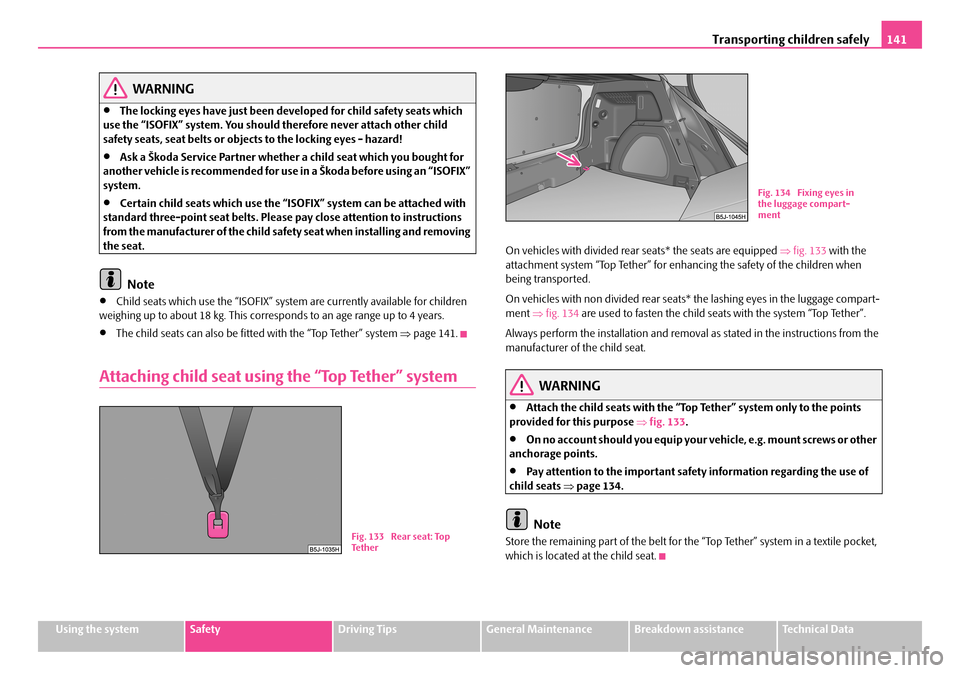
On vehicles with divided rear seats* the seats are equipped ⇒fig. 133 with the attachment system “Top Tether” for enhancing the safety of the children when being transported.
On vehicles with non divide d rear seats* the lashing eyes in the luggage compart- ment ⇒fig. 134 are used to fasten the child seats with the system “Top Tether”.
Always perform the installation and removal as stated in the instructions from the manufacturer of the child seat.
WARNING
•Attach the child seats with the “Top Tether” system only to the points provided for this purpose ⇒fig. 133.
•On no account should you equip your vehicle, e.g. mount screws or other anchorage points.
•Pay attention to the important safety information regarding the use of child seats ⇒page 134.
Note
Store the remaining part of the belt for the “Top Tether” system in a textile pocket, which is located at the child seat.
Fig. 133 Rear seat: Top Te t h e r
Fig. 134 Fixing eyes in the luggage compart-ment
NKO A05F 20 MR08.book Page 141 Thursday, April 19, 2007 11:34 AM
Page 144 of 242

Intelligent Technology143
Using the systemSafetyDriving TipsGeneral MaintenanceBreakdown assistanceTechnical Data
Driving Tips
Intelligent Technology
Electronic stability programme (ESP)*
General
General
The ESP aids you maintain control of your vehicle in situations in borderline driving situations such as when negotiating a curve too fast. The risk of skidding is reduced and your car thus offers greater driving stability depending on the conditions of the road surface. This occurs at all speeds.
The following systems are integrated into the electronic stability programme:
•electronic Differential Lock (EDL),
•traction control system (TCS),
•antilock brake system (ABS),
•brake Assist.
Operating principle
The ESP switches on automatically when the engine is started and then conducts a self-test. The ESP control unit processes data from the individual systems. It also processes additional measurement data which are supplied by highly sensitive sensors: the rotational velocity of the vehi cle about its vertical axis, the lateral accel- eration of the vehicle, the brakin g pressure and the steering angle.
The direction which the driver wishes to ta ke is determined based on the steering angle and the speed of the vehicle and is constantly compared with the actual behaviour of the vehicle. If differences exis t, such as the car beginning to skid, the ESP will automatically brake the appropriate wheel.
The car is stabilised again by the forces which take effect when the wheel is braked. Intervention into the brake system takes place primarily on the outer front wheel of a vehicle which tends to oversteer (tendency for the rear of the vehicle to break away) while occurs this is on the inner re ar wheel of a vehicle which tends to under- steer (tendency to shift out of the curve). This braking control cycle is accompanied by noises.
The ESP operates in combination with the ABS ⇒page 147, “Antilock brake system (ABS)*”. If there is a fault in the ABS system, the ESP also does not operate.
The ESP warning light ⇒page 27 lights up in the instrument cluster when there is a fault on the ESP.
Switching off
You can switch the ESP off and on again as you wish, by pressing the button ⇒ fig. 135. The ESP warning light ⇒page 27 lights up in the instrument cluster when the ESP is switched off.
The ESP should normally always be switched on. It may be good practice in certain exceptional cases, such as when you wish to have wheel slip, to switch off the system.
Examples:
Fig. 135 ESP switch
NKO A05F 20 MR08.book Page 143 Thursday, April 19, 2007 11:34 AM
Page 145 of 242

Intelligent Technology144
•when driving with snow chains,
•when driving in deep snow or on a loose surface,
•when it is necessary to rock a car free when it has become stuck.
Then you should switch on the ESP again.
WARNING
It is also not possible for the ESP to overcome the physical limits of the vehicle. Even if a vehicle fitted with ESP you should still always adapt your style of driving to the condition of the road surface and the traffic situation. This particularly applies when driving on slippery and wet roads. The increased safety offered must not tempt you to take greater risks than other- wise - risk of an accident!
Note
•All four wheels must be fitted with the same tyres in order to achieve problem-free operation of the ESP. Differing rolling circumferences of the tyres can lead to an undesirable reduction in the engine output.
•Changes to vehicle (e.g. on engine, on the brakes, on chassis or other assign- ment of tyres and wheels) can influence the function of the ESP ⇒page 192, “Accessories, changes and replacement of parts”.
Traction control system (TCS)*
The traction control system prevents the driven wheels from spinning
when accelerating.
General
The TCS makes it much easier, and sometimes at all possible, to start off, accelerate and climb a steep hill when the conditions of the road surface are unfavourable.
Operating principle
The TCS switches on automatically when th e engine is started and then conducts a self-test. The system monitors the speeds of the driven wheels with the aid of the ABS sensors. If the wheels ar e spinning, the force transmitted to the road surface is automatically adapted by reducing the engi ne speed. This occurs at all speeds.
The TCS operates in combination with the ABS ⇒page 147, “Antilock brake system (ABS)*”. The TCS will not function if a fault exists in the ABS system.
The TCS warning light ⇒page 26 lights up in the instrument cluster when there is a fault on the TCS.
Switching off
You can switch the TCS off and on again as you wish by pressing the button ⇒ fig. 136. The TCS warning light ⇒page 26 lights up in the instrument cluster when the TCS is switched off.
Fig. 136 TCS switch
NKO A05F 20 MR08.book Page 144 Thursday, April 19, 2007 11:34 AM
Page 146 of 242

Intelligent Technology145
Using the systemSafetyDriving TipsGeneral MaintenanceBreakdown assistanceTechnical Data
The TCS should normally always be switched on. It may be good practice in certain exceptional cases, such as when you wish to have wheel slip, to switch off the system.
Examples:
•when driving with snow chains,
•when driving in deep snow or on a loose surface,
•when it is necessary to rock a car free when it has become stuck.
Then you should switch on the TCS again.
WARNING
You should always adjust your style of driving to the conditions of the road surface and the traffic situation. The increased safety offered must not tempt you to take greater risks than otherwise - risk of an accident!
Note
•All four wheels must be fitted with the same tyres in order to achieve problem- free operation of the TCS. Differing rollin g circumferences of the tyres can lead to an undesirable reduction in the engine output.
•Changes to vehicle (e.g. on engine, on the brakes, on chassis or other assign- ment of tyres and wheels) can in fluence the function of the TCS ⇒page 192, “Accessories, changes and replacement of parts”.
Electronic Differential Lock (EDL)*
The electronic differential lock pr events an individual wheel from
slipping.
Models fitted with ESP are equipped with electronic differential lock (EDL).
General
The EDL makes it much easier, and sometimes at all possible, to start off, accelerate and climb a steep hill when the conditio ns of the road surface are unfavourable.
Operating principle
The EDL is activated automatically, that is without any action on the part of the driver. It monitors the speeds of the driven wheels with the aid of the ABS sensors. Should only one drive wheel begin spinning on a slippery surface there will be an appreciable difference in the speed of the driven wheels. The EDL function brakes the slipping wheel and the differential transmits a greater driving force to the other driven wheel. This control proce ss is also accompanied by noises.
Overheating of the brakes
The EDL switches off automatically if unus ually severe stresses exist in order to avoid excessive heat generation in the disc brake on the wheel which is being braked. The vehicle can continue to be driven and has the same characteristics as a vehicle not fitted with EDL.
The EDL switches on again automatically as soon as the brake has cooled down.
WARNING
•Depress the accelerator carefully when accelerating on uniformly slip- pery road surfaces, such as ice and sn ow. The driven wheels might still spin despite the EDL and affect the stability of the vehicle - risk of an accident!
•You should always adapt your style of driving to the condition of road surface and to the traffic situation even when your vehicle is fitted with EDL. The increased safety offered must not tempt you to take greater risks than otherwise - risk of an accident!
Note
•If the ABS or TCS or ESP warning light comes on, this may also indicate a fault in the EDL. Please have the car inspected as soon as possible by a specialist garage.
•Changes to vehicle (e.g. on engine, on the brakes, on chassis or other assign- ment of tyres and wheels) can in fluence the function of the EDL ⇒page 192, “Accessories, changes and replacement of parts”.
NKO A05F 20 MR08.book Page 145 Thursday, April 19, 2007 11:34 AM
Page 148 of 242

Intelligent Technology147
Using the systemSafetyDriving TipsGeneral MaintenanceBreakdown assistanceTechnical Data
WARNING
•Never switch off the engine before the vehicle is stationary.
•The brake booster only operates when the engine is running. Greater physical effort for braking is required when engine is switched off. Because if you do not stop as normal, this can cause an accident and severe injuries.
Antilock brake system (ABS)*
ABS prevents the wheels locking when braking.
General
The ABS contributes significan tly to enhancing the active safety of your vehicle. Compared to a car not fitted with the ABS brake system, you are able to retain optimal steering ability even during a fu ll brake application on a slippery road surface because the wheels do not lock up.
You must not expect, however, that the br aking distance will be shorter under all circumstances as a result of the ABS. Th e braking distance for example on gravel and fresh snow, when you should anyway be driving slowly and cautiously, will be longer.
Operating principle
As soon as the vehicle speed has increase d to about 20 km/hour an automatic test procedure is conducted during which you wi ll be able to hear a pumping noise for about 1 second.
The brake pressure will be reduced on a wheel which is rotating at a speed which is too low for the speed of the vehicle and tend ing to lock. This control cycle is notice- able from a pulsating movement of the brake pedal which is accompanied by noises. This is consciously intended to pr ovide the driver with the information that the wheels are tending to lock (ABS control range). You must always keep the brake pedal depressed to enable the ABS to optima lly control the brake application in this braking range. Never interrupt the application of the brakes!
WARNING
•The ABS can also not overcome the physic al limits of your vehicle. Please do not forget this, particularly when driv ing on icy or wet road surfaces. If the ABS is operating within the control ra nge, adapt your speed immediately to the conditions of the road surface and the traffic situation. The increased safety offered by the ABS must not tempt you to take greater risks than otherwise - risk of an accident!
•The normal braking system is still fully functional if there is an ABS fault. Visit a specialist garage as quickly as po ssible and adjust your style of driving to take account of the ABS fault in the meantime since you will not know how great the damage is.
Note
•A warning light comes on if a fault occurs in the ABS system ⇒page 27.
•Changes to vehicle (e.g. on engine, on the brakes, on chassis or other assign- ment of tyres and wheels) can in fluence the function of the ABS ⇒page 192, “Accessories, changes and replacement of parts”.
Brake Assist*
During a severe brake application (e.g. if a hazard exists), the Brake Assist increases the braking force and thus makes it possible to rapidly produce the pressure required in the brake system.
The majority of drivers do apply the brakes in good time in dangerous situations, but do not depress the brake pedal with suff icient pressure. Consequently, it is not possible for the car to achieve its maxi mum deceleration and the car covers a greater distance than necessary.
The Brake Assist is activated by the very quick operation of the brake pedal. In such cases, a much greater braking pressure ex ists than during a normal brake applica- tion. This makes it possible, even with a relatively low resistance of the brake pedal, to produce an adequate pressure in the brake system in the shortest possible time, which is required for maximum deceleration of the car. You must apply the brake
NKO A05F 20 MR08.book Page 147 Thursday, April 19, 2007 11:34 AM
Page 149 of 242

Intelligent Technology148
pedal firmly and hold it in this position in order to achieve the shortest possible braking distance.
The Brake Assist is able to help you achieve a shorter braking distance in emergency situations by rapidly producing the pressure required in the brake system. It fully exploits the attributes of the ABS. After you release the brake pedal, the function of the Brake Assist is automatically switched off and the brakes operate in the normal way.
The Brake Assist is part of the ESP system. If a fault occurs in the ESP, the Brake Assist function is also not available. Further information on the ESP ⇒page 143.
WARNING
•The Brake Assist is also not able to overcome the physical limits of your car in terms of the braking distance required.
•Adapt your speed to the conditions of the road surface and to the traffic situation.
•The increased safety offered by the Brake Assist must not tempt you to take a greater safety risk than otherwise.
Electrohydraulic power steering
The power steering enables you to steer the vehicle with less physical force.
The steering characteristics can be changed by a specialist garage.
You will place great stresses on the power st eering system if the steering is turned to full lock when the vehicle is stationary. Turning the steering to full lock in such a situation will be acco mpanied by noises.
It is still possible to fully steer the vehicle if the power steering fails or if the engine is not running (vehicle being towed in). The only difference is that greater physical effort is required.
It is possible that the hydraulic pump of the power steering will not run due to the low vehicle network voltage if the battery has gone flat and the engine must started with the help off jump leads. This conditio n will be indicated by lighting up of the warning light.
The power steering operates again if the battery is charged to a specific range when engine is running. It also operates again, if the engine can be started with its own battery.
Caution
Do not leave the steering at full lock fo r more than 15 seconds when the engine is running - risk of damagi ng the power steering!
Note
Have the steering inspected as soon as possible by a specialist garage if there is a leak or fault in the system.
Tyre inflation pressure-control system*
The tyre inflation pressure-control system compares with the aid of the ABS sensors the speed and also the rolling circumference of the individual wheels. If the infla- tion pressure and therefore the rolling circumference of a wheel has changed signif- icantly, the warning light lights up in the dash panel ⇒page 26. The tyre inflation pressure-control system function s late or too sensitively if:
•the structure of the tyre is damaged,
•the vehicle is loaded to one side or with a load on the roof,
Fig. 137 Button for setting the tyre inflation pressure control value
NKO A05F 20 MR08.book Page 148 Thursday, April 19, 2007 11:34 AM
Page 160 of 242

Towing a trailer159
Using the systemSafetyDriving TipsGeneral MaintenanceBreakdown assistanceTechnical Data
should be attached to folding arms. Adjust the mirrors so that they provide you with an adequate field of view to the rear.
Headlights
Before starting off with a hitched trailer, also check the setting of the headlights. Alter the setting as necessary with th e aid of the headlight beam adjuster ⇒ page 47.
Detachable ball head
The ball rod is detachable on vehicles with towing device and suppliable from Škoda original accessories. It is stowed together with separate fitting instructions in the spare wheel well in the luggage compartment of the vehicle.
Note
•We recommend that you also have yo ur vehicle inspected between service intervals if you tow a trailer frequently.
•The handbrake on the towing vehicle must be put on when coupling and decoupling the trailer.
•Keep the mechanism of the ball head of the towing device clean and take proper care of it with a suitable preservative.
Driving Tips
Particular caution is required when towing a trailer.
– Do not, as far as possible, drive with your vehicle unladen and the
trailer laden.
– Do not make full use of the legal maximum speeds. This applies in
particular to downhill sections.
– Apply the brakes in good time.
– Keep a check on the coolant temper ature gauge if the outside temper-
ature is high.
Distribution of weight
The distribution of the weight is very poor if your vehicle is unladen and the trailer is laden. Maintain a particularly low speed if you cannot avoid driving with this combination.
Driving speed
Do not drive faster than 80 km/hour for safety reasons. This also applies for coun- tries in which higher speeds are allowed.
The fact that the driving stability of the vehicle + trailer combination reduces with increasing speed means that the legally allowed speed should not be used when there are unfavourable road, weather or wind conditions, particularly near accident black spots.
You must always reduce your speed immedi ately as soon as you detect even just the slightest swaying of the trailer. On no account attempt to stop the trailer from “swaying” by accelerating.
Apply the brakes in good time! If the trailer is fitted with a trailer brake, apply the brakes gently at first and then brake firmly . This will avoid brake jolts resulting from the trailer wheels locking. Shift down gears in good time before negotiating a down- hill section to allow the engine to also act as a brake.
Engine overheating
Please keep a check on the coolant temperature gauge if you have to negotiate a lengthy slope in a low gear at a high engine speed when the outside temperature is very high ⇒page 10.
If the needle of the coolant temperature gauge moves into the right-hand area or even the red area of the scale, reduce yo ur speed immediately. Stop and switch off the engine if the warning light in the instrument cluste r begins flashing. Wait a few minutes and check the level of coolant in the coolant expansion bottle ⇒ page 178, “Inspecting the coolant level”.
Please refer to the following guidelines ⇒page 24, “Coolant temperature/coolant level ”.
The coolant temperature can be reduced by switching on the heating.
Any increase in the cooling effect of the coolant fan through shifting down a gear and increasing the engine speed is not possible since the fan speed is independent
NKO A05F 20 MR08.book Page 159 Thursday, April 19, 2007 11:34 AM
Page 163 of 242

Taking care of your vehicle and cleaning the vehicle162
Automatic vehicle wash systems
The paintwork of the vehicle is sufficiently resistant that the vehicle can be washed normally in automatic vehicle wash plants without any problem. The actual stress to which the paintwork is subjected, howeve r, depends primarily on the design of the vehicle wash system, the filtering of th e water and the type of washing and care products used. If the paintwork of your vehicle appears mat after being washed or even has scratches, point this out to the operator of the vehicle wash plant. Use a different vehicle wash plant, if necessary.
There are no particular points to note be fore washing your vehicle in such a plant other than the usual precautionary meas ures (closing windows, moving any factory-fitted aerials down flat against the bodywork, etc.).
If you have any particular atta ch e d p a r t s f i t te d t o y o u r c a r - s u ch a s s p o i l e r, ro o f ra ck system, two-way radio aerial - it is best to first of all consult the operator of the car wash plant.
It is important to degrease the lips of the windscreen wiper rubbers after passing through the automatic vehicle wash system.
Caution
Do not screw the swivelling down roof aeri al tight before washing the vehicle in an automatic vehicle wash sy stem - risk of damage!
Washing vehicle by hand
It is important to first soften the dirt with plenty of water and rinse it off as thor- oughly as possible before wa shing your vehicle by hand.
One should then clean the vehicle using a soft washing sponge, washing glove or a washing brush and only slight pressure. Work from the top to the bottom - beginning with the roof. Only place slight pressure on the vehicle paintwork during cleaning Only use a car shampoo for stubborn dirt.
Wash out the sponge or washing glove thoroughly at short intervals.
Clean wheels, door sills and similar parts last. Use a second sponge for such areas.
Rinse off the vehicle well after giving it a wash and dry it off using a chamois leather.
WARNING
•The ignition should always be switched off when you wash your vehicle - risk of accident!
•Protect your hands and arms from sharp-edged metal parts when you are cleaning the underfloor, the inside of the wheel housings or the wheel trims - risk of cuts.
Caution
•Do not wash your vehicle in bright sunlight - risk of paint damage.
•Ensure that the jet of water is not aimed directly at the locks or at the door and panel joints if you spray your vehicle in winter down with a hose - risk of freezing.
•Do not use any insect sponges, rough kitchen sponges or similar cleaning prod- ucts - risk of damage to the surface of paintwork.
For the sake of the environment
Only wash your vehicle at washing bays specifically reserved for this purpose. This ensures that no water which may be cont aminated by oil flows into the sewage system. It is not even permitted to wash your vehicle in certain areas except at such specific washing bays.
Washing with a high-pressure cleaner
When you wash your vehicle with a high-pre ssure cleaner, it is essential to comply with the instructions for use of the cleaning equipment. This applies in particular to the pressure used and to the spraying distance. Maintain a sufficiently large distance to soft materials such as rubber hoses or insulation material.
On no account use circular spray nozzles or so-called dirt cutters!
NKO A05F 20 MR08.book Page 162 Thursday, April 19, 2007 11:34 AM