2007 SKODA FABIA lock
[x] Cancel search: lockPage 55 of 242
Lights and Visibility54
WARNING
•If the windscreen wipers are handled carelessly, there is a risk of damage to the windscreen.
•You should clean the wiper blades regularly with a windscreen cleaner in order to avoid any smears. Clean a wiper bl ade with a sponge or cloth if it is very dirty, for example from insect residues.
•Replace the wiper blades once or twice a year for safety reasons. The wiper blades are available from Škoda Service Partners.
Replacing the wiper blade on the rear window wiper
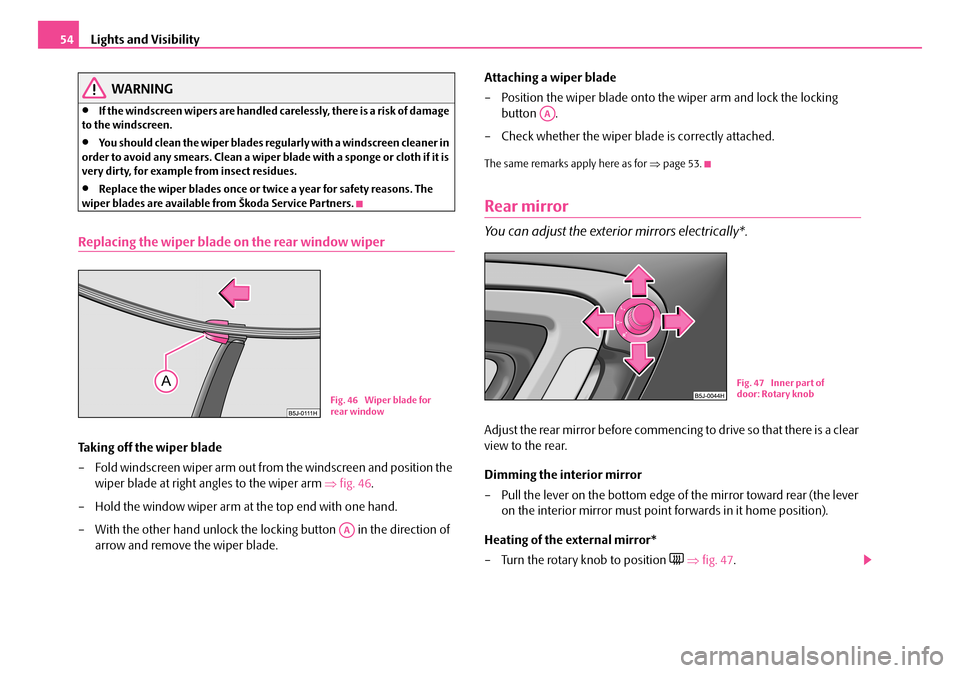
Taking off the wiper blade
– Fold windscreen wiper arm out from the windscreen and position the
wiper blade at right angles to the wiper arm ⇒fig. 46.
– Hold the window wiper arm at the top end with one hand.
– With the other hand unlock the locking button in the direction of
arrow and remove the wiper blade.
Attaching a wiper blade
– Position the wiper blade onto the wiper arm and lock the locking
button .
– Check whether the wiper blade is correctly attached.
The same remarks apply here as for ⇒page 53.
Rear mirror
You can adjust the exterior mirrors electrically*.
Adjust the rear mirror before commencing to drive so that there is a clear
view to the rear.
Dimming the interior mirror
– Pull the lever on the bottom edge of the mirror toward rear (the lever
on the interior mirror must point forwards in it home position).
Heating of the external mirror*
– Turn the rotary knob to position ⇒fig. 47.
Fig. 46 Wiper blade for rear window
AA
AA
Fig. 47 Inner part of door: Rotary knob
NKO A05F 20 MR08.book Page 54 Thursday, April 19, 2007 11:34 AM
Page 57 of 242

Seats and Stowage56
Seats and Stowage
Front seats
Basic information
The front seats have a wide range of different settings and can thus be matched to the physical characteristics of the driver and front passenger. Correct adjustment of the seats is particularly important for
•safely and quickly reaching the controls,
•a relaxed, fatigue-free body position,
•achieving the maximum protection offere d by the seat belts and the airbag system.
The chapters which follow describe the procedure which you should adopt for adjusting the seats.
WARNING
•Never transport more occupants than the maximum seating in the vehicle.
•Each occupant must correctly fasten the seat belt belonging to the seat. Children must be fastened ⇒page 134, “Transporting children safely” with a suitable restraint system.
•The front seats and the head restraints must always be adjusted to match the body size of the seat occupant as well as the seat belts must always be correctly fastened in order to provide an optimal protection for you and your occupants.
•Always keep your feet in the footwell when the car is being driven - never place your feet on the instrument panel, out of the window or on the surfaces of the seats. This is particularly important for the front seat passenger. You will be exposed to increased risk of injury if it becomes necessary to apply the brake or in the event of an accident. If an airbag is deployed, you may suffer fatal injuries when adopting an incorrect seated position!
•It is important for the driver and front passenger to maintain a distance of at least 25 cm from th e steering wheel or dash panel. Not maintaining this minimum distance will mean that the airbag system will not be able to prop- erly protect you - hazard! The front seats and the head restraints must always also be correctly adjusted to match the body size of the occupant.
•Ensure that there are no objects in the footwell as any objects may get behind the pedals during a driving or braking manoeuvre. You would then no longer be able to operate the clutch, to brake or accelerate.
Adjusting the front seats
Adjusting a seat in a forward/back direction
– Pull the lever ⇒fig. 48 up and push the seat into the desired posi-
tion.
– Release the lever and push the seat further until the lock is heard
to engage.
WARNING (continued)
Fig. 48 Controls at seat
A1
A1
NKO A05F 20 MR08.book Page 56 Thursday, April 19, 2007 11:34 AM
Page 59 of 242

Seats and Stowage58
– Move the head restraint downwards if required by pressing the locking
button ⇒fig. 50 and by pressing with the other hand the head
restraint downwards.
Removing and installing a head restraint
– Pull the head restraint out of the backrest of the seat as far as the stop.
– Press the locking button in the direction of arrow ⇒fig. 50 and pull
the head restraint out.
– To re-insert the head restraint, push it down into the backrest of the
seat far enough until you hear the locking button engage.
The position of the front, rear outer head restraints and the rear middle head restraint* is adjustable for height.
The head restraints must be adjusted to match the size of the seat occupant. Correctly adjusted head restraints togeth er with the seat belts offer effective protection for the occupants ⇒page 115.
WARNING
•The head restraints must be correctly adjusted in order to offer effective protection for the occupants in the event of an accident.
•Do not drive under any circumstance with removed head restraints - risk of injury!
Heating the front seats*
The seating and leaning surfaces of the driver and front passenger seat
can be heated when the ignition is switched on.
Front seats
– By pressing the rocker switch in the position or switch on the
front seat heating to 25 % or 100 % of its power output ⇒fig. 51.
– To switch off the heating shift the rocker switch into the horizontal
position.
WARNING
If you have a subdued pain and/or temperature sensitivity, e.g. through medication, paralysis or because of ch ronic illness (e.g. diabetes), we recommend not to use the seat heating of the driver or front passenger seat. This can lead to burns on the back, th e posterior and the legs which are diffi- cult to heal. If the seat heating is used, we recommend to make regular breaks in your journey when driving long distances, so that the body can recuperate from the stress of the journey. Please consult your doctor, who can evaluate your specific condition.
Fig. 51 Rocker switch: Front seat heating
A1A2
NKO A05F 20 MR08.book Page 58 Thursday, April 19, 2007 11:34 AM
Page 60 of 242
Seats and Stowage59
Using the systemSafetyDriving TipsGeneral MaintenanceBreakdown assistanceTechnical Data
Caution
•You should not kneel on the seats or otherwise apply pressure at specific points in order to avoid damaging the heating elements of the seat heaters.
•Do not clean the seats moist ⇒page 166.
Note
The seat heating should only be switched on when the engine is running. This has a significant effect of saving on the battery capacity.
Rear seats
Folding the rear seats forwards
To enlarge the luggage compartment, the rear seats can be folded
forwards or the rear seats can be removed ⇒page 60. The rear seats can
be folded forward individually on vehicles with divided rear seats*.
Folding the rear seats forwards
– Before folding the rear seats forward adjust the front seats in such a
way that they are not damaged when folding forward the rear seats.
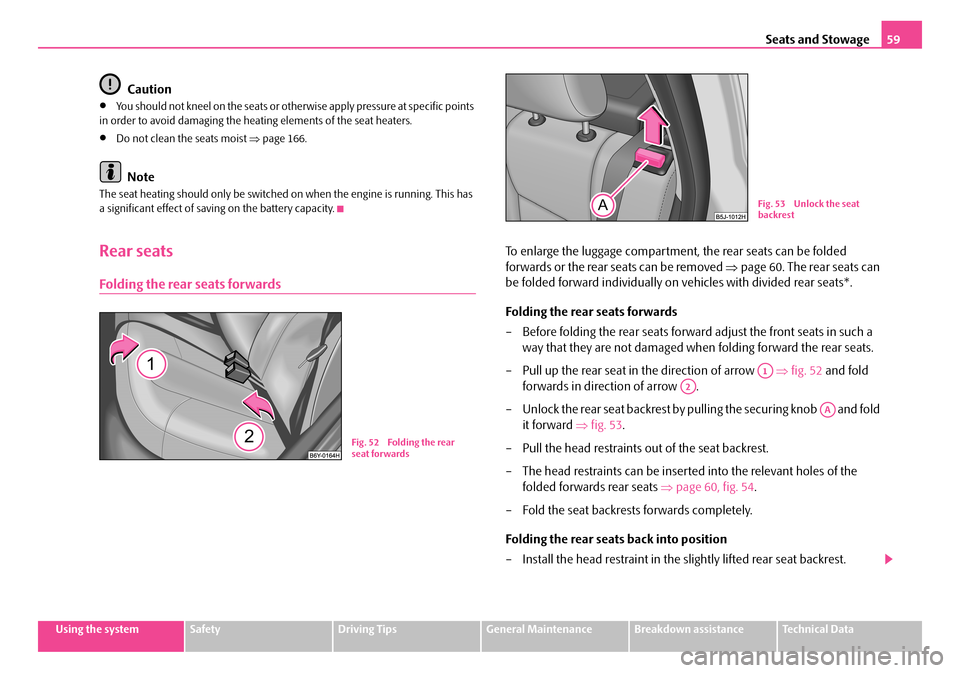
– Pull up the rear seat in the direction of arrow ⇒fig. 52 and fold
forwards in direction of arrow .
– Unlock the rear seat backrest by pulling the securing knob and fold
it forward ⇒fig. 53.
– Pull the head restraints out of the seat backrest.
– The head restraints can be inserted into the relevant holes of the
folded forwards rear seats ⇒page 60, fig. 54.
– Fold the seat backrests forwards completely.
Folding the rear seats back into position
– Install the head restraint in the slightly lifted rear seat backrest.
Fig. 52 Folding the rear seat forwards
Fig. 53 Unlock the seat backrest
A1
A2
AA
NKO A05F 20 MR08.book Page 59 Thursday, April 19, 2007 11:34 AM
Page 61 of 242

Seats and Stowage60
– Then push the seat backrest back into the upright position until the
securing knob clicks into place - check by pulling on the rear seat
backrest.
– Make sure that the red surface of the securing knob is not visible
⇒ fig. 53.
– Fold the rear seat back into its original position.
WARNING
•Ensure that the seat belts are not damaged when operating the rear seat backrests. Under no circumstances must the rear seat belts be jammed by the folded back rear seat backrest.
•The belts and the belt locks must be in their original position after folding back the rear seats and seat backre sts - they must be ready to use.
•Pay attention that the rear seat backrest is correctly interlocked. It is only then that the three-point seat belt can reliably fulfil its function.
•The seat backrests must be securely interlocked in position so that no objects in the luggage compartment ca n slide into the passenger compart- ment if there is sudden braking - risk of injury!
Inserting head restraints in the rear seats
– The rear head restraints can be inserted into the relevant holes of the
folded forwards rear seats.
Remove the rear seat
The luggage compartment can be increased in size by removing the rear
seat.
Removing
– Fold the rear seat forwards.
– Press the wire clamps in the direction of the arrow ⇒fig. 55 and
remove the rear seat from its holder.
Installing
– Press the wire clamp in the direct ion of the arrow and place the seat
upholstery in its holder.
– Fold the rear seat back into its original position.
AA
Fig. 54 Rear seats: Head restraints in rear seats
Fig. 55 Remove the rear seats
NKO A05F 20 MR08.book Page 60 Thursday, April 19, 2007 11:34 AM
Page 70 of 242

Seats and Stowage69
Using the systemSafetyDriving TipsGeneral MaintenanceBreakdown assistanceTechnical Data
Opening and closing the storage compartments on the front
passenger side
– Pull or press the handle of the lid in the direction of arrow ⇒page 68,
fig. 68 and fold open the lid.
– Raise the lid until it is heard to engage.
A pin holder is located inside the lid.
WARNING
The storage compartment must always be closed when driving for safety reasons.
Cooling of storage compartment on front passenger side*
The storage compartment can be fitted for vehicles with an air-
conditioning system with a closable inlet for cooled air.
– You can switch the cooling system on or off using the control dial
⇒ fig. 69.
Opening the air inlet when the air conditioning system is on causes fresh or interior air to flow into the storage compartment.
The storage compartment is only cooled in the cooling mode. We recommend that you switch off the cooling (opening concealed) if it is operating in the heating mode or if you are not using the cooling system for the storage compartment.
Storage compartment on the driver's side
Unlockable compartment below the steering wheel on the left.
Stowage compartment for spectacles*
Fig. 69 Storage compartment: Using cooling system
Fig. 70 Dash panel: Storage compartment on the driver's side
Fig. 71 Detail of the headliner: Stowage compartment for specta-cles
NKO A05F 20 MR08.book Page 69 Thursday, April 19, 2007 11:34 AM
Page 71 of 242

Seats and Stowage70
– Press on the lid of the stowage compartment, the stowage compart-
ment opens downwards ⇒page 69, fig. 71.
WARNING
The storage compartment must always be closed when driving for safety reasons - risk of head injury.
Stowage compartment in centre console
Unlocable compartment in the centre console.
Storage compartment in the front seat*
The storage compartment is foreseen for storing small objects of up to 1
kg. in weight.
– Tilt the lock to open the flap and pull out the flap ⇒fig. 73.
– Tilt the lock to close the flap and press flap close.
Fig. 72 Centre console: Storage compartment
Fig. 73 Front seat: Storage compartment
NKO A05F 20 MR08.book Page 70 Thursday, April 19, 2007 11:34 AM
Page 72 of 242

Seats and Stowage71
Using the systemSafetyDriving TipsGeneral MaintenanceBreakdown assistanceTechnical Data
Front seat armrest with storage compartment*
Fold the armrest
– Press the lower button on the end face of the armrest ⇒fig. 74 in
order to fold the armrest. Fold th e armrest forwards and release the
button.
Opening stowage compartment
– The armrest includes a stowage compartment. The storage compart-
ment is unlocked by pressing the upper button and then can be
opened to the top.
Note
The moving space of the arms can be restricted if the armrest is folded down. In city traffic the armrest should not be folded down.
Storage compartment in the front doors
A bottle holder is located in the area of the storage compartment for the front doors.
WARNING
Use the area ⇒fig. 76 of the storage compartment only for storing objects which do not project so that the effectiveness of the side airbag is not impaired.
Fig. 74 Armrest: Storage compartment
Fig. 75 Opening stowage compartment
Fig. 76 Stowage compartment in door panel
AB
AA
NKO A05F 20 MR08.book Page 71 Thursday, April 19, 2007 11:34 AM