2007 Seat Leon 5D fuel
[x] Cancel search: fuelPage 198 of 302

Cleaning and caring for your vehicle
196Underbody sealant
The underside of the vehicle is coated to protect it from corro-
sion and damage.The protective coating could be damaged when driving. We recommend that
the protective coating under the body and on the running gear should be
checked, and reinstated if necessary, before and after the winter season.
We recommend that repair work and addi tional anti-corrosion work is carried
out by your Authorised Service Centre.
WARNING
Do not apply underseal or anti-corros ion coatings to the exhaust pipes,
catalytic converter or the heat shield s on the exhaust system. The heat of
the exhaust system or the engine could cause them to ignite! This is a fire
hazard.Cleaning the engine compartment
Take special care when cleaning the engine compartment.Anti-corrosion treatment
The engine compartment and the surface of the power unit are given anti-
corrosion treatment at the factory.
Good corrosion protection is particularl y important in winter when the car is
frequently driven on salted roads. To prevent the salt corroding the vehicle,
the entire engine compartment should be thoroughly cleaned before and
after the salting period.
Your Authorised Service Centre is able to provide the correct cleaning and
preserving products and has the necessary equipment. For this reason, we
recommend having this work performed by them. The anti-corrosion protection is usually removed if the engine compartment
is cleaned with grease removing solutions, or if you have the engine cleaned.
If this job is carried out, you should ensure that all surfaces, seams, joints and
components in the engine compartmen
t are given anti-corrosion treatment
afterwards.
WARNING
•
When working in the engine compartment, always observe the safety
wa rnin
gs ⇒ page 204.•
Switch off the engine, apply the parking brake firmly and always
remove the key from the ignition before you open the bonnet.
•
Allow the engine to cool before you clean the engine compartment.
•
Do not clean the underside of vehicle, wheel arches without protecting
your hands and arms. You may cut your self on sharp-edged metal parts.
Failure to comply could result in injury.
•
Moisture, ice and salt on the brakes may affect braking efficiency. Risk
of accident. If possible, avoid sudden braking immediately after washing
the vehicle.
•
Never touch the radiator fan. It is temperature-controlled and could
start automatically, even when the key is removed from the ignition!For the sake of the environment
Fuel, grease and oil deposits could be removed when the engine is washed.
The polluted water must be cleaned in an oil separator. For this reason,
engine washing should be carried out only by a qualified workshop or a suit-
able filling station.
leon ingles.book Seite 196 Dienst ag, 11. September 2007 1:47 13
Page 203 of 302

Checking and refilling levels201
Safety First
Operating instructions
Tips and Maintenance
Te c h n i c a l D a t a
Checking and refilling levelsRefuellingThe fuel cap cover opens automatically with the central
locking system. The tank holds approximately 55 litres.Unscrewing the tank cap
– Lift the lid.
– Unscrew the cap, turning it anti-clockwise.
Closing the tank cap
– Screw the tank cap to the right, until the point of feeling a “click”.
– Close the drawer. Make sure you hear it click into place. The tank
cap is secured with an anti-loss attachment.
The tank flap is at the rear of the vehicle on the right.
If the automatic filler nozzle is operated correctly, it will switch itself off as
soon as the tank is “full”. Never attempt to fill beyond this point, as this will
fill the expansion chamber. Fuel may le ak out if ambient conditions are warm.
The correct fuel grade for your vehicle is given on a sticker on the inside of the
fuel tank flap. where further notes on fuel can be found.
Releasing the fuel tank flap by hand
If the central locking system fails, the fuel tank flap can be opened manually
as follows:•
Open the tailgate.
•
Remove the cover from the right side trim in the luggage compartment.
•
Insert a hand and pull the locking device back.
•
Open the cap and take out the plug.
WARNING
•
Fuel is highly inflammable and can cause serious burns and other inju-
ries.
−Never smoke or use any naked flame when filling the fuel tank of the
vehicle, or a spare fuel canister, with fuel. This is an explosion hazard.
− Follow legal requirements for the use of spare fuel canisters.
− For safety reasons we do not recommend carrying a spare fuel
canister in the vehicle. The canister could be damaged in an accident
and leak.
•
If, in exceptional circumstances, you have to carry a spare fuel canister,
please observe the following points:
Fig. 140 Tank flap open
leon ingles.book Seite 201 Dienst ag, 11. September 2007 1:47 13
Page 204 of 302

Checking and refilling levels
202
− Never fill the spare fuel canister inside the vehicle or on it. An elec-
trostatic charge could build up during filling, causing the fuel fumes to
ignite. This may be fatally explosive. Always place the canister on the
ground to fill it.
− Insert the fuel nozzle into the mouth of the canister as far as
possible.
− If the spare fuel canister is made of metal, the filling nozzle must be
in contact with the canister during filling. This helps prevent an electro-
static charge building up.
− Never spill fuel in the vehicle or in the luggage compartment. Fuel
vapours are explosive. Danger of death.Caution
•
Fuel spills should be removed from the paintwork immediately.
•
Never run the tank completely dry. An irregular fuel supply could cause
misfiring. As a result, unburnt fuel could enter the catalytic converter and
cause damage.For the sake of the environment
Do not try to put in more fuel after the automatic filler nozzle has switched off;
this may cause the fuel to overflow if it becomes warm.
PetrolPetrol types
The correct petrol types are listed on a sticker inside the fuel
tank flap.Only unleaded petrol, corresponding to the standard DIN EN 228, may be
used for vehicles with catalytic converters (EN = “European Standard”).
Fuel types are differentiated by the octane rating, e.g: 91, 95, 98 RON (RON
= “Regulation Octane Number, unit for determining the knock resistance of
petrol”). You may use petrol with a higher octane number than the one recom-
mended for your engine. However, this has no advantage in terms of fuel
consumption and engine power. If, in exceptional circumstances, the correct
octane rating is not available:•
For engines which require Premium unleaded petrol (95 RON) the
following is valid: Regula r unleaded fuel with 91 RON can also be used. This
can, however, result in a slight loss of power under certain driving conditions.
•
For engines which require Premium unleaded petrol (98 RON) the
following is valid: Premium unleaded fuel with 95 RON can also be used. This
can, however, result in a slight loss of power under certain driving conditions.
– If premium unleaded petrol is not available, the engine can be run on
regular unleaded petrol with 91 RON as an “emergency measure”. In this
case only use moderate engine speeds and a light throttle. Avoid using full
throttle. Fill up with premium petrol as soon as possible.Caution
•
Petrol that follows EN 228 may be mixed with small quantities of ethanol.
However, the so-called “bioethanol fuels” available at commercial establish-
ments with reference E50 or E85, which contain a high percentage of ethanol,
may not be used, as they will damage the fuel system.
WARNING (continued)
leon ingles.book Seite 202 Dienst ag, 11. September 2007 1:47 13
Page 205 of 302

Checking and refilling levels203
Safety First
Operating instructions
Tips and Maintenance
Te c h n i c a l D a t a
•
Even one tankfull of leaded fuel would permanently impair the efficiency
of the catalytic converter.
•
High engine speed and f ull throttle can damage the engine when using
petrol with an octane rating lower th an the correct grade for the engine.For the sake of the environment
Just one full tank of leaded fuel would seriously impair the efficiency of the
catalytic converter.Petrol additives
Petrol additives improve the quality of the petrol.The quality of the petrol influences running behaviour, performance and
service life of the engine. For this reason you should use good quality petrol
containing additives. These additives will help to prevent corrosion, keep the
fuel system clean and prevent deposits from building up in the engine.
If good quality petrol with additives is not available or engine problems occur,
the required additives must be added during refuelling.DieselDiesel*Diesel fuel must correspond to DIN EN 590 (EN = “European standard”). It
must have a cetane number (CN) of at least 51. The cetane number indicates
the ignition quality of the diesel fuel.
Notes on filling with fuel ⇒page 201.
RME fuel*
Only those vehicles fitted with special equipment (number PR
2G0 for biodiesel use) may use biodiesel corresponding to
the standard DIN EN 14214.The biodiesel fuel must comply wi th the DIN EN 14.214 (FAME) Standard.•
Biodiesel is a methylester obtained from rapeseed oil.
•
DIN is a German abbreviation for “ Deutsches Institut für Normung e.V.”,
the German standards institute.
•
EN means European Norm.
•
FAME is the English abbreviation “ Fatty Acid Methyl E ster”.
If the date sticker of the vehicle in cludes the number PR 2G0 optional equip-
ment) this means that that vehicle has been prepared for biodiesel use.
Your Authorised Service Centre or automobile association will be able to
advise on where you can obtain RME biodiesel fuel.
Your Authorised Service Centre can also be consulted to know if the vehicle
has been prepared for biodiesel use.
Things to note about RME fuel (biodiesel)
•
The performance of a vehicle using biodiesel maybe somewhat reduced.
•
Fuel consumption of a vehicle using biodiesel may be slightly higher.
•
RME fuel can be used in winter at temperatures down to approx. -10°C.
•
At outside temperatures below -10°C, we recommend using winter diesel
fuel.Caution
•
RME fuel can damage the fuel system in vehicles which are not suitably
adjusted.
leon ingles.book Seite 203 Dienst ag, 11. September 2007 1:47 13
Page 206 of 302

Checking and refilling levels
204•
If you decide to use biodiesel in your vehicle, please use only RME fuel
which is DIN E 14,214 compliant.
•
If you use biodiesel that does not m eet the required standard, the fuel
filter could become clogged.Note
•
In case of low exterior temperatures and a fuel biodiesel percentage of
higher than 50%, an increase in gas em ission may occur during operation of
the independent heating.
•
The fuel filter may become clogged when fuel is changed to biodiesel. For
this reason, we recommend that, about every 300 or 400 km, following a fuel
change, also change the fuel filter. Also note the instructions in the Inspec-
tion and Maintenance plan.
•
If the vehicle is to remain parked for more than about two weeks, we
recommend filling the fuel tank with biodiesel and driving about 50 km in
order to avoid damage to the injection system.
Winter driving
Diesel can thicken in winter.Winter-grade diesel
When using “summer-grade diesel fuel”, difficulties may be experienced at
sub-zero temperatures because the fuel thickens due to wax separation. For
this reason, “winter-grade diesel fuel” is available in some countries during
the cold months. It can be used at temperatures as low as -22°C.
In countries with different climatic conditions the diesel fuel sold generally
has different temperature characteristics. Check with an Authorised Service
Centre or filling stations in the country concerned regarding the type of diesel
fuels available. Filter pre-heater
Your vehicle is fitted with a fuel filter pre-heater, making it well equipped for
operation in winter. This ensures that the fuel system remains operational to
approx. -24°C, provided you use winter-grade diesel which is safe to -15°C.
However, if the fuel has waxed to such an extent that the engine will not start
at temperatures of under -24°C, simply place the vehicle in a warm place for
a while.
Caution
Do not mix fuel additives (“thinners”, or similar additives) with diesel fuel.Working in the engine compartmentSafety instructions on working in the engine compartment
Any work carried out in the engine compartment or on the
engine must be carried out cautiously.Before starting any work on the engine or in the engine compart-
ment:
1. Switch off the engine and remove the key from the ignition.
2. Apply the handbrake.
3. Move the gear stick to neutral or the selector lever to position P.
4. Wait for the engine to cool down.
5. Keep children away from the vehicle.
leon ingles.book Seite 204 Dienst
ag, 11. September 2007 1:47 13
Page 207 of 302

Checking and refilling levels205
Safety First
Operating instructions
Tips and Maintenance
Te c h n i c a l D a t a
6. Raise the bonnet ⇒page 206.You should not do any work in the engine compartment unless you know
exactly how to carry out the jobs and have the correct tools! Have the work
carried out by a qualified workshop if you are uncertain.
All service fluids and consumables, e.g. coolant, engine oil, spark plugs and
batteries, are being constantly developed. SEAT provides a constant flow of
information to the Authorised Service Centres concerning modifications. For
this reason we recommend that you have service fluids and consumables
replaced by an Authorised Service Centre. Please observe the relevant
instructions ⇒page 199. The engine compartment of any motor vehicle is a
hazardous area ⇒.
WARNING
All work on the engine or in the engine compartment, e.g. checking and
refilling fluids, involves the danger of injury and scalding as well as the risk
of accident or fire.•
Never open the bonnet if you see steam, smoke or coolant escaping
from the engine compartment. Otherwis e, there is a risk of sustaining
burns. Wait until no more steam or coolant is emitted, then allow the
engine to cool before carefully opening the bonnet.
•
Switch off the engine and remove the key from the ignition.
•
Apply the handbrake and move the gear stick to neutral or selector
lever to position P.
•
Keep children away from the vehicle.
•
Never touch hot engine parts. There is a risk of burns.
•
Never spill liquids on a hot engine or on a hot exhaust gas system. This
is a fire hazard.
•
Avoid causing short-circuits in the electrical system, particularly at the
points where the jump leads are attached ⇒page 256. The battery could
explode.
•
Never touch the radiator fan. It is temperature controlled and could
start automatically, even when the engine has been switched off and the
key removed from the ignition!
•
Do not unscrew the cap on the expansion tank when the engine is hot.
If the coolant is hot, the cooling system will be pressurised!
•
Protect face, hands and arms by covering the cap with a large, thick
cloth to protect against escaping coolant and steam.
•
Always make sure you have not left any objects, such as cleaning cloths
and tools, in the engine compartment.
•
If you have to work underneath the vehicle, you must use suitable
stands additionally to support the vehicle, there is a risk of accident!. A
hydraulic jack is insufficient for securi ng the vehicle and there is a risk of
injury.
•
If any work has to be performed when the engine is started or with the
engine running, there is an additional, potentially fatal, safety risk from the
rotating parts, such as the drive belts, alternator, radiator fan, etc., and
from the high-voltage ignition system. You should also observe the
following points:
−Never touch the electrical wiring of the ignition system.
− Ensure that jewellery, loose cl othing and long hair do not get
trapped in rotating engine parts. Danger of death. Before starting any
work remove jewellery, tie back and cover hair, and wear tight-fitting
clothes.
− Always think carefully about pressing the accelerator if a gear is
engaged in either an automatic or manual gearbox. The vehicle could
move, even if the handbrake is applied. Danger of death.
•
If work has to be carried out on the fuel system or on electrical compo-
nents, you must observe the following sa fety notes in addition to the above
warnings:
−Always disconnect the battery. The vehicle must be unlocked when
this is done, otherwise the alarm will be triggered.WARNING (continued)
leon ingles.book Seite 205 Dienst ag, 11. September 2007 1:47 13
Page 217 of 302
Checking and refilling levels215
Safety First
Operating instructions
Tips and Maintenance
Te c h n i c a l D a t a
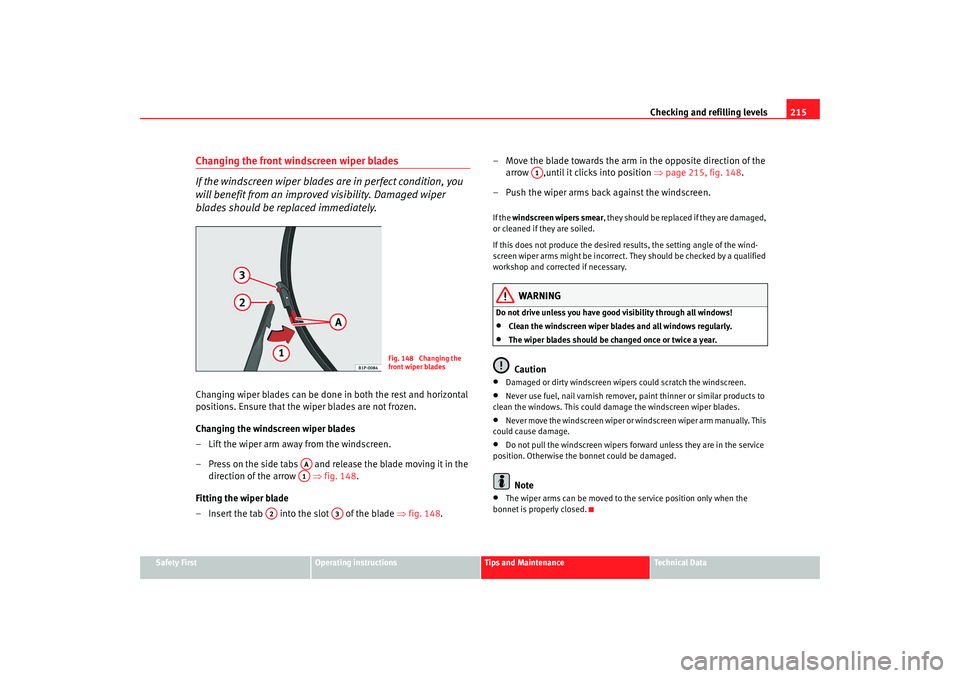
Changing the front windscreen wiper blades
If the windscreen wiper blades are in perfect condition, you
will benefit from an improved visibility. Damaged wiper
blades should be replaced immediately.Changing wiper blades can be done in both the rest and horizontal
positions. Ensure that the wiper blades are not frozen.
Changing the windscreen wiper blades
– Lift the wiper arm away from the windscreen.
– Press on the side tabs and release the blade moving it in the direction of the arrow ⇒ fig. 148.
Fitting the wiper blade
– Insert the tab into the slot of the blade ⇒fig. 148. – Move the blade towards the arm in the opposite direction of the
arrow ,until it clicks into position ⇒page 215, fig. 148 .
– Push the wiper arms back against the windscreen.
If the windscreen wipers smear , they should be replaced if they are damaged,
or cleaned if they are soiled.
If this does not produce the desired results, the setting angle of the wind-
screen wiper arms might be incorrect. Th ey should be checked by a qualified
workshop and corrected if necessary.
WARNING
Do not drive unless you have good visibility through all windows!•
Clean the windscreen wiper blades and all windows regularly.
•
The wiper blades should be changed once or twice a year.Caution
•
Damaged or dirty windscreen wipers could scratch the windscreen.
•
Never use fuel, nail varnish remover, paint thinner or similar products to
clean the windows. This could damage the windscreen wiper blades.
•
Never move the windscreen wiper or wi ndscreen wiper arm manually. This
could cause damage.
•
Do not pull the windscreen wipers forw ard unless they are in the service
position. Otherwise the bonnet could be damaged.Note
•
The wiper arms can be moved to the service position only when the
bonnet is properly closed.
Fig. 148 Changing the
front wiper blades
AAA1
A2
A3
A1
leon ingles.book Seite 215 Dienst ag, 11. September 2007 1:47 13
Page 218 of 302

Checking and refilling levels
216Changing the rear wiper blade
A good rear wiper blade is essential for clear rear vision.
Damaged wiper blades should be replaced immediately.Removing the wiper blade
– Lift the wiper arm away from the glass ⇒fig. 149 .
– Unclip the wiper blade and pull ⇒fig. 149 .
Fitting the wiper blade
– With one hand, hold the top end of the wiper arm.
– With the other hand, press the wiper blade into the retainer.Check the condition of the wiper blade regularly. Change as required.
If the windscreen wiper scrapes , it should be replaced if damaged, or cleaned
if soiled. If this is not sufficient, refer to a qualified workshop.
WARNING
Do not drive unless you have good visibility through all windows!•
Clean the windscreen wiper blades and all windows regularly.
•
The wiper blades should be changed once or twice a year.Caution
•
A damaged or dirty window wiper could scratch the rear window.
•
Never use fuel, nail varnish remover,
paint thinner or similar products to
clean the window.
•
Never move the windscreen wiper by hand. This could cause damage.
Fig. 149 Changing the
rear window wiper blade
A1
A2
leon ingles.book Seite 216 Dienst ag, 11. September 2007 1:47 13