2007 Seat Alhambra radiator
[x] Cancel search: radiatorPage 80 of 291

Cockpit
78Coolant Level* / temperature
The warning lamp lights up if the coolant temperature is too
high or if the coolant level is too low.There is a fault if:•
The warning symbol does not go out again after a few seconds.
•
The warning lamp lights up or flashes while the vehicle is moving, while
three acoustic warning signals ⇒ are emitted.
This means that either the coolant level is too low or the coolant temperature
is too high.
Coolant temperature too high
First look at the coolant temperature gauge. The coolant temperature is too
high if the needle is over the warning area on the dial. Stop the vehicle,
switch off the engine and wait for it to cool down. Check the coolant level.
If the coolant level is correct, the overheating may be caused by a malfunction
of the radiator fan. Check the radiator fan fuse and have it replaced if neces-
sary ⇒page 241.
If the warning lamp lights up again after driving on for a short distance, stop
the vehicle and switch off the engine. Contact an Authorised Service Centre
or a qualified workshop.
Coolant level too low
The following information text is displ ayed in the instrument panel display:
First look at the coolant temperature gauge. If the needle is in the normal
range, top up with coolant at the earliest opportunity ⇒ .
WARNING
•
If your vehicle is immobilised for any technical reasons, move it to a
safe distance from traffic. Turn off the engine, turn on the hazard lights and
place the warning triangle.
•
Never open the bonnet if you can see or hear steam or coolant escaping
from the engine compartment. Risk of scalding. Wait until you can no
longer see or hear escaping steam or coolant.
•
The engine compartment of any motor vehicle is a dangerous area!
Before carrying out any work in th e engine compartment, switch off the
engine and allow it to cool down. Alwa ys note the corresponding warnings
⇒ page 209.WARNING (continued)
alhambra ingles.book Seite 78 Donnerstag, 19. April 2007 4:04 16
Page 83 of 291

Cockpit81
Safety First
Operating instructions
Tips and Maintenance
Te c h n i c a l D a t a
An audible signal is also given if the ca
r is driven faster than 6 km/h (approx.
4 km/h) with the handbrake applied.
Coolant temperature/level gauge
The corresponding warning is:
STOP CHECK LEVEL COOLANT
SERVICE MANUAL.
If the symbol flashes while driving, this means that either the coolant temper-
ature is too high or the coolant level is too low. Stop immediately, switch off
the engine and check the level. Top up coolant if necessary.
If the coolant level is correct, the overheating may be caused by a malfunction
of the radiator fan. In this case, check the radiator fan fuse, and replace if
necessary.
If the warning light does not go out, although the coolant level is correct and
the fan fuse is correct, do not continue driving. Obtain technical assistance.
If the fault is only in the radiator fan, it is possible to continue driving as far
as the nearest Technical Service Centre, as long as the coolant level is correct
and the display light is off.
Alternator
The corresponding warning is:
ALTERNATOR WORKSHOP!
The warning lamp lights up when the igni tion is switched on. It should go out
when the engine is started.
The alternator is operated by a long-lasting drive belt.
If the warning light lights up while driving, stop , switch off the engine and
check the drive belt. If the belt is loose or broken, do not continue driving, as
the coolant pump will not be driven. Th e belt should be checked or replaced. If the warning light comes on even
though the belt is neither loose nor
broken, it is usually possible to cont inue driving to the nearest Technical
Service Centre.
As the vehicle battery will discharge, it is advisable to switch off all non-vital
electrical consumers.
Seat belt warning lamp
The corresponding warning is:
FASTEN SEAT BELT
This warning light (only in some coun tries) lights up for approximately 6
seconds when the ignition is switched on to remind occupants to fasten seat-
belts. If the seat belts are not fastened, a sound signal is emitted when the
ignition is switched on which will stop when the seat belts are fastened or
after approximately 6 seconds.
WARNING
•
If the brake fluid level is below th e “MIN” mark, you should wait for
assistance from specialised personnel before contiuning to drive.
•
If the fluid level is correct, the fault may lie in the ABS. If the ABS control
system fails, the rear wheels may block rapidly on braking. This, in certain
cirumstances, could cause the vehicle to skid.
•
Never open the bonnet if you see steam or coolant escaping from the
engine compartment. Risk of burns. Wait until you can no longer see or
hear escaping steam or coolant.
•
Do not touch the fan, as it could sudde nly start to operate, even if the
ignition is switched off.
•
To prevent burns from boiling coolant, the following should be
observed.
•
Take care when opening the coolant expansion tank!. When the engine
is warm or hot, the system is pressurised! Therefore wait until the engine
cools before opening the cap.
alhambra ingles.book Seite 81 Donnerstag, 19. April 2007 4:04 16
Page 167 of 291
Driving165
Safety First
Operating instructions
Tips and Maintenance
Te c h n i c a l D a t a
After the engine is switched off the radiator fan may run on for up to 10
minutes, even if the ignition is switched off. The radiator fan can start auto-
matically if the hot engine causes the coolant temperature to rise, or if the sun
heats the engine compartment.
WARNING
•
Never switch off the engine until the vehicle is stationary.
•
The brake servo and the power assisted steering work only when the
engine is running. You need more strength to steer and brake the vehicle
when the engine is switched off. As you cannot steer and brake in the
normal manner, there is a greater risk of accidents and serious injury.
•
The steering lock can engage immediately when the key is removed
from the ignition lock. The vehicle cannot be steered. Risk of accident.Caution
If the engine has been driven hard for a long period, the engine could over-
heat when it is switched off. Risk of engine damage. For this reason, you
should idle the engine for approx. 2 minutes before you switch it off.
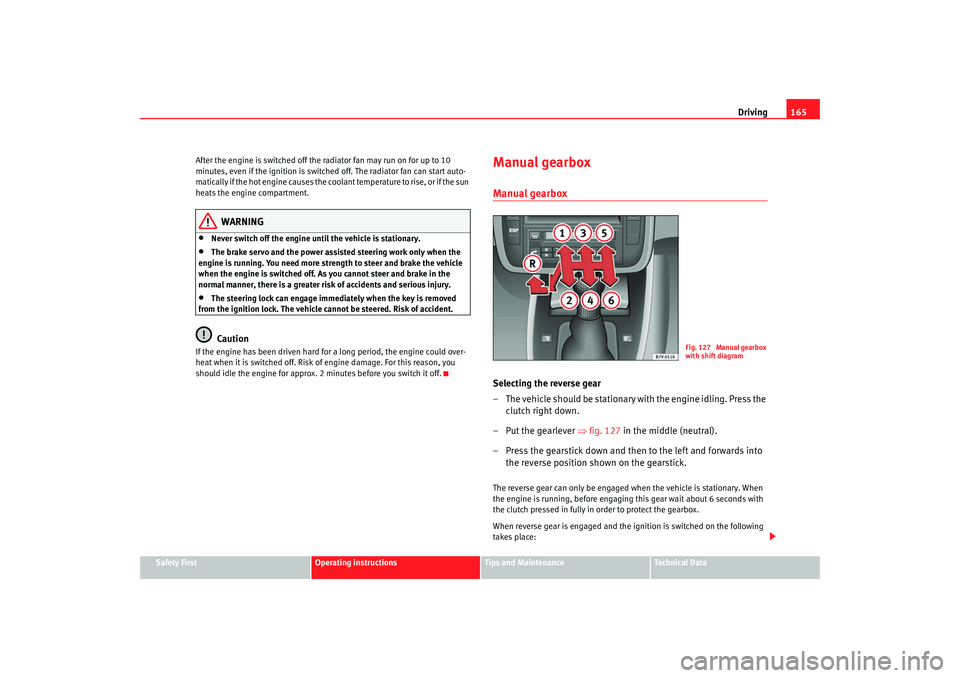
Manual gearboxManual gearboxSelecting the reverse gear
– T h e v e h i c l e s h o u l d b e s t a t i o n a r y with the engine idling. Press the
clutch right down.
–Put the gearlever ⇒fig. 127 in the middle (neutral).
– Press the gearstick down and then to the left and forwards into the reverse position shown on the gearstick.The reverse gear can only be engaged when the vehicle is stationary. When
the engine is running, before engaging this gear wait about 6 seconds with
the clutch pressed in fully in order to protect the gearbox.
When reverse gear is engaged and the ignition is switched on the following
takes place:
Fig. 127 Manual gearbox
with shift diagram
alhambra ingles.book Seite 165 Donnerstag, 19. April 2007 4:04 16
Page 201 of 291

Cleaning and caring for your vehicle199
Safety First
Operating instructions
Tips and Maintenance
Te c h n i c a l D a t a
Cleaning the engine compartment
Take special care when cleaning the engine compartment.Anti-corrosion treatment
The engine compartment and the surface of the power unit are given anti-
corrosion treatment at the factory.
Good corrosion protection is particularly important in winter when the car is
frequently driven on salted roads. To prevent the salt corroding the vehicle,
the entire engine compartment should be thoroughly cleaned before and
after the salting period.
Your Authorised Service Centre is able to provide the correct cleaning and
preserving products and has the necessary equipment. For this reason, we
recommend having this work performed by them.
The anti-corrosion protection is usua lly removed if the engine compartment
is cleaned with grease removing solution s, or if you have the engine cleaned.
If this job is carried out, you should ensure that all surfaces, seams, joints and
components in the engine compartmen t are given anti-corrosion treatment
afterwards.
WARNING
•
When working in the engine compartment, always observe the safety
warnings ⇒ page 209
•
Switch off the engine, apply the parking brake firmly and always
remove the key from the ignition before you open the bonnet.
•
Allow the engine to cool before you clean the engine compartment.
•
Do not clean the underside of vehicle, wheel arches without protecting
your hands and arms. You may cut your self on sharp-edged metal parts.
Failure to comply could result in injury.
•
Moisture, ice and salt on the brakes may affect braking efficiency. Risk
of accident. If possible, avoid sudden braking immediately after washing
the vehicle.
•
Never touch the radiator fan. It is temperature-controlled and could
start automatically, even when the key is removed from the ignition!For the sake of the environment
Fuel, grease and oil deposits could be removed when the engine is washed.
The polluted water must be cleaned in an oil separator. For this reason,
engine washing should be carried out only by a qualified workshop or a suit-
able filling station.Care of the vehicle interiorCleaning plastic parts and the dash panel– Use a clean, damp cloth to clean plastic parts and the dash panel.
– If this does not provide satisfactory results, use a special solvent-free plastic cleaning product.
WARNING
Never clean the dash panel and surface of the airbag module with cleansers
containing solvents. Solvents cause the surface to become porous. If the
airbag inflates, disintegrating plastic parts can cause substantial injuries.
WARNING (continued)
alhambra ingles.book Seite 199 Donnerstag, 19. April 2007 4:04 16
Page 212 of 291

Checking and refilling levels
210
WARNING
All work on the engine or in the engine compartment, e.g. checking and
refilling fluids, involves the danger of injury and scalding as well as the risk
of accident or fire.•
Never open the bonnet if you see steam, smoke or coolant escaping
from the engine compartment. Otherwise, there is a risk of sustaining
burns. Wait until no more steam or coolant is emitted, then allow the
engine to cool before carefully opening the bonnet.
•
Switch off the engine and remove the key from the ignition.
•
Apply the handbrake and move the gea r stick to neutral or selector
lever to position P.
•
Keep children away from the vehicle.
•
Never touch hot engine parts. There is a risk of burns.
•
Never spill liquids on a hot engine or on a hot exhaust gas system. This
is a fire hazard.
•
Avoid causing short-circuits in the electrical system, particularly at the
points where the jump leads are attached ⇒page 250. The battery could
explode.
•
Never touch the radiator fan. It is temperature controlled and could
start automatically, even when the engine has been switched off and the
key removed from the ignition!
•
Do not unscrew the cap on the expansion tank when the engine is hot.
If the coolant is hot, the cooling system will be pressurised!
•
Protect face, hands and arms by covering the cap with a large, thick
cloth to protect against escaping coolant and steam.
•
Always make sure you have not left any objects, such as cleaning cloths
and tools, in the engine compartment.
•
If you have to work underneath the vehicle, you must use suitable
stands additionally to support the vehicle, there is a risk of accident!. A
hydraulic jack is insufficient for securing the vehicle and there is a risk of
injury.
•
If any work has to be performed when the engine is started or with the
engine running, there is an additional, potentially fatal, safety risk from the
rotating parts, such as the drive belt s, alternator, radiator fan, etc., and
from the high-voltage ignition system. You should also observe the
following points:
−Never touch the electrical wiring of the ignition system.
− Ensure that jewellery, loose clothing and long hair do not get
trapped in rotating engine parts. Danger of death. Before starting any
work remove jewellery, tie back and cover hair, and wear tight-fitting
clothes.
− Always think carefully about pressing the accelerator if a gear is
engaged in either an automatic or manual gearbox. The vehicle could
move, even if the handbrake is applied. Danger of death.
•
If work has to be carried out on the fuel system or on electrical compo-
nents, you must observe the following safety notes in addition to the above
warnings:
−Always disconnect the battery. The vehicle must be unlocked when
this is done, otherwise the alarm will be triggered.
− Do not smoke.
− Never work near naked flames.
− Always have a fire extinguisher on hand.Caution
When changing or topping up service fluids, make absolutely certain that you
fill the fluids into the correct reservoirs. Failure to observe this point will result
in serious malfunctions and engine damage!
WARNING (continued)
alhambra ingles.book Seite 210 Donnerstag, 19. April 2007 4:04 16
Page 213 of 291

Checking and refilling levels211
Safety First
Operating instructions
Tips and Maintenance
Te c h n i c a l D a t a
For the sake of the environment
Service fluids leaks are harmful to the environment. For this reason you
should make regular checks on the ground underneath your vehicle. If you
find spots of oil or other fluids, have your vehicle inspected in a qualified
workshop.Opening the bonnet
The bonnet is released from inside the vehicle.
Before you open the bonnet, make sure that the windscreen wiper
arms are in contact with the windscreen. Failure to do so could
damage the paintwork.
Opening the bonnet
– To release the bonnet, pull the lever under the dashboard ⇒fig. 139 in the direction indicated (arrow). The bonnet is
unlocked by a spring ⇒.
– Gently lift the bonnet and press the unlock button ⇒fig. 140 in
the direction of the arrow.
– Open the bonnet to the point where it is held open by the gas struts.
WARNING
Hot coolant can scald!
Fig. 139 Detail of the
footwell: The release lever
for the bonnet is located
in the driver side footwell
Fig. 140 Detail of the
radiator grille: opening
the bonnet
alhambra ingles.book Seite 211 Donnerstag, 19. April 2007 4:04 16
Page 221 of 291

Checking and refilling levels219
Safety First
Operating instructions
Tips and Maintenance
Te c h n i c a l D a t a
WARNING
Any work carried out in the engine compartment or on the engine must be
carried out cautiously.•
When working in the engine compartment, always observe the safety
warnings ⇒ page 209.Caution
•
Never put radiator anti-freeze or other additives into the windscreen
washer fluid.
•
Always use approved windscreen cleansing products diluted as per
instructions. If you use other washer fluids or soap solutions, the tiny holes
in the fan-shaped nozzles could become blocked.
Changing the front windscreen wiper blades
Damaged wiper blades should be replaced immediately.
Check the condition of the wiper bl ades regularly. Change them as
required.
Change the windscreen wiper blades
– Lift the wiper arm away from the glass. Do not pull the arm by the
blade.
– Turn the wiper blade as shown by arrow ⇒fig. 146 as far as
it will go and then pull it off as shown by arrow ⇒fig. 147 .
–Push a new wiper blade of the same length and version onto the
wiper arm and turn the wiper blade to the stop against the direc-
tion shown by arrow .
– Place the wiper arm in the starting position.These are available from SEAT Service
®.
If the wipers scrape they must be changed if they are damaged, or cleaned if
they are dirty.
Fig. 146 Windscreen
wipers raised
Fig. 147 Removing front
wipers
A1
A2
A1
alhambra ingles.book Seite 219 Donnerstag, 19. April 2007 4:04 16