2007 Seat Alhambra airbag
[x] Cancel search: airbagPage 137 of 291
Seats and stowage135
Safety First
Operating instructions
Tips and Maintenance
Te c h n i c a l D a t a
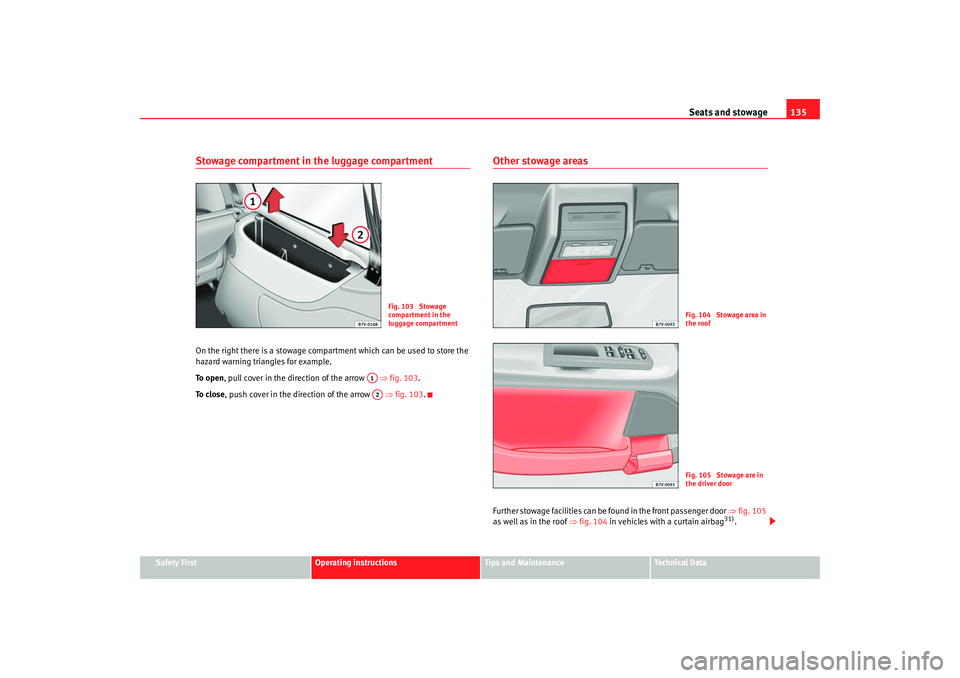
Stowage compartment in the luggage compartmentOn the right there is a stowage compartment which can be used to store the
hazard warning triangles for example.
To o p e n, pull cover in the direction of the arrow ⇒fig. 103 .
To c l o s e , push cover in the di rection of the arrow ⇒fig. 103 .
Other stowage areasFurther stowage facilities can be found in the front passenger door ⇒fig. 105
as well as in the roof ⇒fig. 104 in vehicles with a curtain airbag
31).
Fig. 103 Stowage
compartment in the
luggage compartment
A1A2
Fig. 104 Stowage area in
the roofFig. 105 Stowage are in
the driver door
alhambra ingles.book Seite 135 Donnerstag, 19. April 2007 4:04 16
Page 138 of 291

Seats and stowage
136Coat hooks are located in the roof. They are integrated in the grab handles in
the passenger compartment.
Location of CD changer
31)
The CD changer, which can be factory fitted, is located either in the dash
panel or in the right-hand stowage compartment in the luggage compart-
ment.
WARNING
•
Ensure that no objects can fall fr om the dash panel or other stowage
areas into the driver footwell while the vehicle is moving. In the event of a
sudden braking manoeuvre, you will not be able to use the brake, clutch or
accelerator. Risk of accident.
•
Clothing hung on the coat hooks must not restrict the driver's view.
Risk of accident. The coat hooks are intended only for use with light arti-
cles of clothing. Do not leave any ha rd, sharp or heavy objects in hanging
articles of clothing. During sudden braking manoeuvres or accidents, espe-
cially those involving airbag deployment, these objects could injure the
vehicle occupants.
Cup holders
In the centre console: there are two cup holdersOpening cup holder
– Press the symbol on the cup holder briefly. The spring mecha- nism will release the holder.
Closing the cup holder
– Push the cup holder up in the direction of the arrow ⇒ fig. 106
until it engages.
WARNING
Improper use of the cup holders can cause injury.•
For reasons of safety, the cup holders should be used only for standard
drinks cans and bottles with a maximum capacity of 0.5 litres.
31)Optional equipment
Fig. 106 Cup holder in
the centre console
alhambra ingles.book Seite 136 Donnerstag, 19. April 2007 4:04 16
Page 145 of 291

Seats and stowage143
Safety First
Operating instructions
Tips and Maintenance
Te c h n i c a l D a t a
WARNING
Loose luggage and other objects in the luggage compartment can cause
serious injuries.•
Always stow objects in the luggage compartment and secure them on
the fastening rings.
•
Use suitable specialist straps to secure heavy objects.
•
During sudden manoeuvres or accidents, loose objects can be thrown
forward, injuring vehicle occupants or passers-by. This increased risk of
injury will be further increased if a loose object is struck by an inflating
airbag. If this happens, objects can be transformed into “missiles”. Risk of
fatal injury.
•
Remember that transporting heavy objects modifies the driving condi-
tions as the centre of gravity has been altered. There is a risk of accident.
Therefore, it is essential to adjust your speed and driving style accordingly,
to avoid accidents.
•
Never exceed the allowed axle loads or allowed maximum weight. If the
allowed axle load or the allowed total weight is exceeded, the driving char-
acteristics of the vehicle may change, leading to accidents, injuries and
damage to the vehicle.
•
Never leave the vehicle unattended, especially when the tailgate is
open. Children could climb into the luggage compartment closing the door
behind them; they will remain trapped without help and there is a mortal
risk.
•
Never allow children to play in or around the vehicle. Close and lock
both the tailgate and all the doors wh en you leave the vehicle. Before you
lock the vehicle, make sure that there are no adults or children in the
vehicle.
•
Never transport passengers in the luggage compartment. Every
passenger must be properly belted in.
Caution
•
Avoid overloading small areas by placing heavy objects on the vehicle
floor.
•
The wires of the heating element in the rear window and the window aerial
in the rear side windows could be damaged if objects on the luggage
compartment cover rub against them.
•
If you have removed the seats from the passenger compartment, you
should place a large, robust covering over the floor anchorings to prevent
damage.Note
•
Air circulation in the vehicle helps reduce fogging of the windows. Used
air escapes through ventilation slits in the side trim of the luggage compart-
ment. Ensure that the ventil ation slits are never covered.
•
Straps for securing the load to the fastening rings are commercially
available.
Fastening rings
There are fastening rings in the luggage compartment which
can be used to secure luggage and other objects.– Always use suitable undamaged belts for fastening the luggage
or any other object tot he anchorage rings ⇒ in “Loading the
luggage compartment” on page 142.The retainers for the detachable seat belts for the third row of seats and the
floor anchorings for the seats can be used as fastening rings for items of
luggage.
alhambra ingles.book Seite 143 Donnerstag, 19. April 2007 4:04 16
Page 146 of 291
Seats and stowage
144During a collision or an accident, even small and light objects can build up so
much energy that they can cause very severe injuries. The amount of “kinetic
energy” depends on the speed of the vehicle and the weight of the object.
The most significant factor, however, is the speed of the vehicle.
For example: an object weighing 4.5 kg is lying unsecured in the vehicle.
During a frontal collision at a speed of 50 km/h, this object generates a force
corresponding to 20 times its weight. That means that the effective weight of
the object increases to about 90 kg. You can imagine the severity of the inju-
ries which might be sustaine d if this “projectile” strikes an occupant as it flies
through the passenger compartment. This increased risk of injury will be
further increased if a loose object is struck by an inflating airbag.
WARNING
If pieces of baggage or other objects are secured to the fastening rings with
inappropriate or damaged retaining cords, injuries could result in the event
of braking manoeuvres or accidents.•
To prevent pieces of luggage or other objects from flying forward,
always use appropriate retaining cords which are secured to the fastening
rings.
•
Never secure a child seat on the fastening rings.
Loading heavy objects
Special care is required when loading heavy objects and
when driving a vehicle which contains heavy objects.Observe the following points to prevent damage and accidents:
– If necessary, remove the seats to increase the load area. –
Before loading the vehicle place a sturdy mat or similar cover
flush on floor of the vehicle.
– Where necessary, do not cover protruding parts of the vehicle floor.
– Protect the seat anchor points from damage.
– Avoid overloading small areas - spread the load.
– Use suitable straps to secure the objects to retaining rings.
– Drive particularly carefully and think ahead.
– If possible, avoid sudden braking and driving manoeuvres.
WARNING
For safety reasons, you should read and observe all information on loading
the vehicle ⇒ page 144.
Caution
•
If you have removed the seats from the passenger compartment, you
should place a large, robust covering over the seat rails to prevent damage.
•
Avoid overloading small areas - spread the load.
Safety notes on loading the vehicle
WARNING
Loose luggage and other objects in the luggage compartment can cause
serious injuries.
alhambra ingles.book Seite 144 Donnerstag, 19. April 2007 4:04 16
Page 147 of 291

Seats and stowage145
Safety First
Operating instructions
Tips and Maintenance
Te c h n i c a l D a t a
•
Always stow objects safely in the vehicle and secure them on the
fastening rings if necessary.
•
Use suitable specialist straps to secure heavy objects.
•
Loose objects in the vehicle can move suddenly. As the centre of gravity
moves, safety is impaired and the vehicle becomes difficult to handle.
•
During sudden manoeuvres or accidents, loose objects can be thrown
forward, injuring vehicle occupants or passers-by. This increased risk of
injury will be further increased if a loose object is struck by an inflating
airbag. If this happens, objects can be transformed into “missiles”. Risk of
fatal injury.
•
Remember that transporting heavy objects modifies the driving condi-
tions as the centre of gravity has been altered. There is a risk of accident.
Therefore, it is essential to adjust your speed and driving style accordingly,
to avoid accidents.
•
Never exceed the allowed axle loads or allowed maximum weight. If the
allowed axle load or the allowed total weight is exceeded, the driving char-
acteristics of the vehicle may change, leading to accidents, injuries and
damage to the vehicle.
•
Never leave the vehicle unattended, especially when the tailgate is
open. Children could climb into the inte rior of the vehicle closing the door
behind them; they will remain trapped without help and there is a mortal
risk.
•
Never allow children to play in or around the vehicle. Close and lock all
windows, the tailgate and all doors when you leave the vehicle.
•
Never transport passengers in the luggage compartment. Every
passenger must be properly belted in.
Luggage compartment cover
The luggage compartment cover protects your luggage from
prying eyes.
WARNING (continued)
Fig. 114 Luggage
compartment: holders on
the rightFig. 115 Luggage
compartment: holders on
the left
alhambra ingles.book Seite 145 Donnerstag, 19. April 2007 4:04 16
Page 162 of 291

Driving
160•
Adjust the driver seat or steering wheel so that there is a distance of at
least 25 cm between the steering wheel and your breast bone ⇒page 159,
fig. 124. If you fail to observe the minimum distance, the airbag will not
protect you. Risk of fatal injury.
•
If your physical constitution prevents you from maintaining the
minimum distance of 25 cm, contact an Authorised Service Centre. The
Authorised Service Centre will help you decide if special specific modifica-
tions are necessary.
•
If you adjust the steering wheel so tha t it points towards your face, the
driver airbag will not protect you properly in the event of an accident. Make
sure that the steering wheel points towards your chest.
•
When driving, always hold the steer ing wheel with both hands on the
outside of the ring at the 9 o'clock and 3 o'clock positions. Never hold the
steering wheel at the 12 o'clock positi on, or in any other manner (e.g. in
the centre of the steering wheel, or on the inside of the rim). In such cases,
you could receive severe injuries to the arms, hands and head.
SafetyElectronic stabilisation programme (ESP)
ESP helps make driving safer in certain situations.The Electronic Stabilisation Programme (ESP) contains the electronic differ-
ential lock (EDL) and the traction control system (TCS). The ESP works
together with the anti-locking brake system (ABS). Both warning lamps will
light up if the ESP or ABS systems are faulty.
The ESP is started automatically when the engine is started.
In specific circumstances where you require less traction, you can switch off
the ESP by pressing button ⇒fig. 125 .
For example:•
when driving with snow chains,
•
when driving in deep snow or on loose surfaces,
WARNING (continued)
Fig. 125 Section of the
dash panel: switch for ESP
alhambra ingles.book Seite 160 Donnerstag, 19. April 2007 4:04 16
Page 201 of 291

Cleaning and caring for your vehicle199
Safety First
Operating instructions
Tips and Maintenance
Te c h n i c a l D a t a
Cleaning the engine compartment
Take special care when cleaning the engine compartment.Anti-corrosion treatment
The engine compartment and the surface of the power unit are given anti-
corrosion treatment at the factory.
Good corrosion protection is particularly important in winter when the car is
frequently driven on salted roads. To prevent the salt corroding the vehicle,
the entire engine compartment should be thoroughly cleaned before and
after the salting period.
Your Authorised Service Centre is able to provide the correct cleaning and
preserving products and has the necessary equipment. For this reason, we
recommend having this work performed by them.
The anti-corrosion protection is usua lly removed if the engine compartment
is cleaned with grease removing solution s, or if you have the engine cleaned.
If this job is carried out, you should ensure that all surfaces, seams, joints and
components in the engine compartmen t are given anti-corrosion treatment
afterwards.
WARNING
•
When working in the engine compartment, always observe the safety
warnings ⇒ page 209
•
Switch off the engine, apply the parking brake firmly and always
remove the key from the ignition before you open the bonnet.
•
Allow the engine to cool before you clean the engine compartment.
•
Do not clean the underside of vehicle, wheel arches without protecting
your hands and arms. You may cut your self on sharp-edged metal parts.
Failure to comply could result in injury.
•
Moisture, ice and salt on the brakes may affect braking efficiency. Risk
of accident. If possible, avoid sudden braking immediately after washing
the vehicle.
•
Never touch the radiator fan. It is temperature-controlled and could
start automatically, even when the key is removed from the ignition!For the sake of the environment
Fuel, grease and oil deposits could be removed when the engine is washed.
The polluted water must be cleaned in an oil separator. For this reason,
engine washing should be carried out only by a qualified workshop or a suit-
able filling station.Care of the vehicle interiorCleaning plastic parts and the dash panel– Use a clean, damp cloth to clean plastic parts and the dash panel.
– If this does not provide satisfactory results, use a special solvent-free plastic cleaning product.
WARNING
Never clean the dash panel and surface of the airbag module with cleansers
containing solvents. Solvents cause the surface to become porous. If the
airbag inflates, disintegrating plastic parts can cause substantial injuries.
WARNING (continued)
alhambra ingles.book Seite 199 Donnerstag, 19. April 2007 4:04 16
Page 204 of 291

Accessories, parts replacement and modifications
202Accessories, parts replacement and modificationsAccessories and partsAlways consult an Authorised Service Centre before
purchasing accessories and parts.Your vehicle is designed to offer a high standard of active and passive safety.
Before purchasing accessories and parts, and before making technical
changes to your car, we recommend that you consult your Authorised Service
Centre.
SEAT dealerships will be happy to provide you with the latest information
about the use, legal requirements and recommendations from the manufac-
turer regarding accessories and parts.
We recommend you use only SEAT Approved Accessories
® and SEAT
Approved Spare Parts
®. This way, SEAT can guarantee that the product in
question is suitable, reliable and safe. Authorised Service Centres have the
necessary experience and facilities to ensure that parts are installed correctly
and professionally.
Despite continuous observation of the market, SEAT is not able to assess the
reliability, safety and suitability of parts not approved by SEAT. For this reason
SEAT cannot assume responsibility for any non-genuine parts used, even if
these parts have been approved by an official testing agency or are covered
by an official approval certificate.
Any equipment subsequently installed which has a direct effect on the
vehicle and/or the way it is driven (e.g. cruise control system or electronically-
controlled suspension) must be approved by SEAT for use in your vehicle and
bear the e mark (the European Union's authorisation symbol).
If any additional electrical components are fitted which do not serve to
control the vehicle itself (for instance a refrigerator box, laptop or ventilator fan, etc.), these must bear the
CE mark (European Union manufacturer
conformity declaration).
WARNING
Accessories, for example telephone holders or drink holders, should never
be fitted on the covers of, or within the working range of, the airbags. If
they are, there is a danger of resulting injury if the airbag is triggered in an
accident.ModificationsModifications must always be carried out according to our
specifications.Unauthorised modifications to the electr onic components or software in the
vehicle may cause malfunctions. Due to the way the electronic components
are linked together in networks, other systems may be affected by the faults.
This can seriously impair safety, lead to excessive wear of components, and
also invalidate your vehic le registration documents.
SEAT Authorised Service Centres cannot be held liable for any damage
caused by modifications and/or work performed incorrectly.
For this reason, we reco mmend that all work should be performed by an
Authorised Service Centre using Genuine SEAT
® approved parts and accesso-
ries.
alhambra ingles.book Seite 202 Donnerstag, 19. April 2007 4:04 16