2007 SATURN OUTLOOK towing
[x] Cancel search: towingPage 402 of 538

Overheated Engine Protection
Operating Mode
This emergency operating mode lets your vehicle
be driven to a safe place in an emergency
situation. If an overheated engine condition exists,
an overheat protection mode which alternates
ring groups of cylinders helps prevent engine
damage. In this mode, there is a signicant loss in
power and engine performance. The temperature
gage indicates an overheat condition exists.
Driving extended distances and/or towing a trailer
in the overheat protection mode should be
avoided.
Notice:After driving in the overheated engine
protection operating mode, to avoid engine
damage, allow the engine to cool before
attempting any repair. The engine oil will be
severely degraded. Repair the cause of coolant
loss, change the oil and reset the oil life
system. SeeEngine Oil on page 387.
Cooling System
When you decide it is safe to lift the hood, here is
what you will see:
A. Engine Coolant Reservoir
B. Radiator Pressure Cap (covered)
C. Engine Cooling Fans
402
ProCarManuals.com
Page 493 of 538

(g)A fluid loss in any vehicle system could
indicate a problem. Have the system inspected
and repaired and the fluid level checked. Add fluid
if needed.
(h)Change automatic transmission fluid if the
vehicle is mainly driven under one or more
of these conditions:
In heavy city traffic where the outside
temperature regularly reaches 90°F (32°C)
or higher.
In hilly or mountainous terrain.
When doing frequent trailer towing.
Uses such as found in taxi, police, or delivery
service.
(i)Drain, flush, and refill cooling system.
This service can be complex; you should have
your dealer/retailer perform this service. See
Engine Coolant on page 396 for what to use.
Inspect hoses. Clean radiator, condenser,
pressure cap, and filler neck. Pressure test
the cooling system and pressure cap.(j)Check system for interference or binding and
for damaged or missing parts. Replace parts
as needed. Replace any components that have
high effort or excessive wear. Do not lubricate
accelerator or cruise control cables.
(k)Visually inspect belt for fraying, excessive
cracks, or obvious damage. Replace belt if
necessary.
(l)If you drive regularly under dusty conditions,
inspect the filter at each engine oil change.
Owner Checks and Services
These owner checks and services should be
performed at the intervals specied to help ensure
the safety, dependability, and emission control
performance of your vehicle. Your dealer/retailer
can assist you with these checks and services.
Be sure any necessary repairs are completed at
once. Whenever any uids or lubricants are added
to your vehicle, make sure they are the proper
ones, as shown inRecommended Fluids and
Lubricants on page 497.
493
ProCarManuals.com
Page 512 of 538

Calling for Assistance
For prompt and efficient assistance when calling,
please provide the following to the Roadside
Assistance Representatives:
Your name, home address, and home
telephone number
Telephone number of your location
Location of the vehicle
Model, year, color, and license plate number
of the vehicle
Odometer reading, Vehicle Identication
Number (VIN) and delivery date of the vehicle
Description of the problem
Towing and Road Service Exclusions
Specically excluded from Roadside Assistance
coverage are towing or services for vehicles
operated on a non-public roadway or highway,
nes, impound towing caused by a violation
of local, Municipal, State, Provincial or Federal
law, and mounting, dismounting or changing
of snow tires, chains, or other traction devices.
Roadside Assistance is not part of or included
in the coverage provided by the New Vehicle
Limited Warranty. Saturn and General Motors of
Canada Limited reserve the right to make any
changes or discontinue the Roadside Assistance
program at any time without notication.
512
ProCarManuals.com
Page 515 of 538

If your vehicle cannot be driven, know where
the towing service is taking it. Get a card from
the tow truck operator or write down the driver’s
name, the service’s name, and the phone
number.
Remove any valuables from your vehicle before
it is towed away. Make sure this includes your
insurance information and registration if you
keep these items in your vehicle.
Gather the important information you need from
the other driver. Things like name, address,
phone number, driver’s license number, vehicle
license plate, vehicle make, model and model
year, Vehicle Identication Number (VIN),
insurance company and policy number, and a
general description of the damage to the other
vehicle.
If possible, call your insurance company from
the scene of the accident. They will walk you
through the information they need. If they ask
for a police report, phone or go to the police
department headquarters the next day and you
can get a copy of the report for a nominal fee. In
some states/provinces with “no fault” insurance
laws, a report may not be necessary. This is
especially true if there are no injuries and both
vehicles are driveable.
Choose a reputable collision repair facility for
your vehicle. Whether you select a Saturn
retailer or a private collision repair facility to x
the damage, make sure you are comfortable
with them. Remember, you will have to feel
comfortable with their work for a long time.
Once you have an estimate, read it carefully
and make sure you understand what work will
be performed on your vehicle. If you have a
question, ask for an explanation. Reputable
shops welcome this opportunity.
515
ProCarManuals.com
Page 534 of 538

Rear Door Security Locks........................... 108
Rear Safety Belt Comfort Guides.................. 43
Rear Seat Armrest...................................... 163
Rear Seat Audio (RSA)............................... 315
Rear Seat Entertainment System................. 305
Rear Seat Operation..................................... 18
Rear Seat Passengers, Safety Belts.............. 40
Rear Windshield Washer/Wiper.................... 178
Rearview Mirror, Automatic Dimming
with OnStar
®and Compass..................... 139
Rearview Mirror with OnStar®...................... 139
Reclining Seatbacks...................................... 15
Recommended Fluids and Lubricants.......... 497
Recreational Vehicle Towing........................ 358
Remote Keyless Entry (RKE) System............ 98
Remote Keyless Entry (RKE) System,
Operation................................................. 100
Removing the Flat Tire and Installing
the Spare Tire.......................................... 451
Removing the Spare Tire and Tools............ 448
Replacement Bulbs..................................... 423
Reporting Safety Defects
Canadian Government............................. 517
Saturn...................................................... 517
United States Government....................... 516Restraint System Check
Checking the Restraint Systems................. 93
Replacing Restraint System Parts
After a Crash......................................... 94
Retained Accessory Power (RAP)................ 125
Right Front Passenger Position,
Safety Belts............................................... 39
Roadside
Assistance Program................................. 509
Rocking Your Vehicle to Get it Out.............. 352
Routing, Engine Drive Belt.......................... 499
Running the Engine While Parked............... 138
S
Safety Belt
Passenger Reminder Light....................... 212
Pretensioners............................................. 47
Reminder Light........................................ 211
Safety Belts
Care of.................................................... 467
Driver Position........................................... 30
How to Wear Safety Belts Properly............ 29
Questions and Answers About
Safety Belts............................................ 28
534
ProCarManuals.com
Page 537 of 538
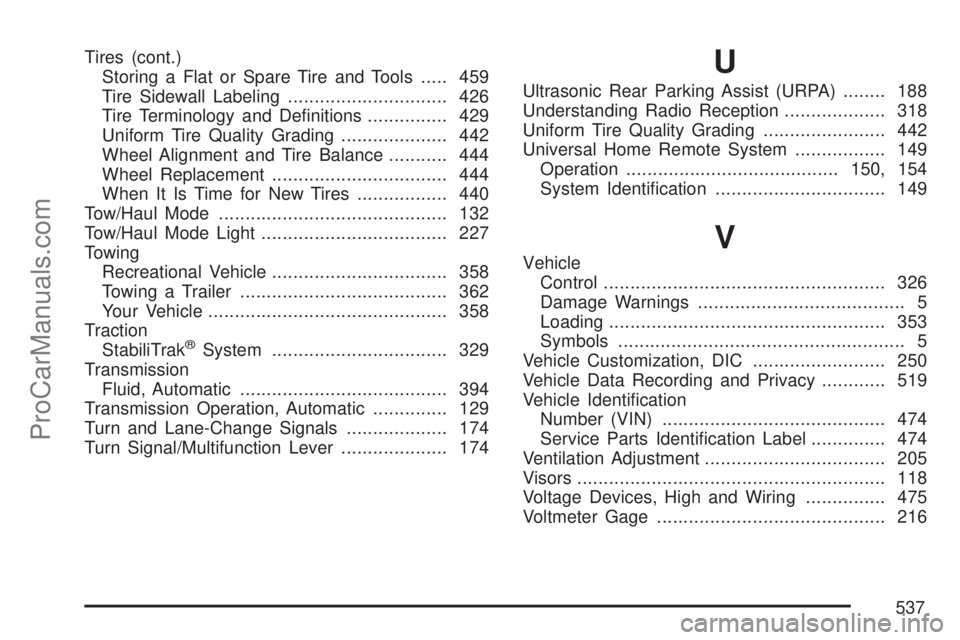
Tires (cont.)
Storing a Flat or Spare Tire and Tools..... 459
Tire Sidewall Labeling.............................. 426
Tire Terminology and Denitions............... 429
Uniform Tire Quality Grading.................... 442
Wheel Alignment and Tire Balance........... 444
Wheel Replacement................................. 444
When It Is Time for New Tires................. 440
Tow/Haul Mode........................................... 132
Tow/Haul Mode Light................................... 227
Towing
Recreational Vehicle................................. 358
Towing a Trailer....................................... 362
Your Vehicle............................................. 358
Traction
StabiliTrak
®System................................. 329
Transmission
Fluid, Automatic....................................... 394
Transmission Operation, Automatic.............. 129
Turn and Lane-Change Signals................... 174
Turn Signal/Multifunction Lever.................... 174
U
Ultrasonic Rear Parking Assist (URPA)........ 188
Understanding Radio Reception................... 318
Uniform Tire Quality Grading....................... 442
Universal Home Remote System................. 149
Operation........................................150, 154
System Identication................................ 149
V
Vehicle
Control..................................................... 326
Damage Warnings....................................... 5
Loading.................................................... 353
Symbols...................................................... 5
Vehicle Customization, DIC......................... 250
Vehicle Data Recording and Privacy............ 519
Vehicle Identication
Number (VIN).......................................... 474
Service Parts Identication Label.............. 474
Ventilation Adjustment.................................. 205
Visors.......................................................... 118
Voltage Devices, High and Wiring............... 475
Voltmeter Gage........................................... 216
537
ProCarManuals.com