2007 SAAB 9-3 brake
[x] Cancel search: brakePage 219 of 304

219 Car careChanging bulbs
Autochecking of lightsThe bulbs that are most important from the
point of view of traffic safety are monitored
by the car’s electrical system. If one of these
bulbs should fail, a message will be dis-
played on the SID.
Example of SID message:
The following bulbs are not checked: park-
ing lights, front fog lights, reversing lights,
license plate lighting, side marker lights and
side direction indicators.
SportCombi
The tail lights and brake lights consist of
LEDs. If approx. 3/4 of the LEDs on one side
are broken then this is indicated in the SID.
If a stop light bulb fails
Sport Sedan: If a stop light bulb fails, the
adjacent taillight will act as a stop light to
ensure traffic safety. Change the broken
bulb when possible.
All rear light bulbs are of the same type and
rated 21 W, with the exception of the license
plate lighting which is rated 5 W.Wrong bulb fitted
If a low or main beam bulb of too high a
rating is fitted, a bulb failure message will be
shown on the SID (a too high wattage bulb
can damage the reflector).
If the following message is displayed but the
bulb shines, it is most likely that an incorrect
bulb has been fitted.
Note:
When changing bulbs, fit the same type
of bulb (e.g. Long-Life) as that removed.
Headlight aiming, page 269.
WARNING
Before changing a bulb in the engine
bay, switch off the engine to avoid the
danger of fingers and hands being
injured by moving parts.
The radiator fan can cut in even when the
engine is switched off.NOTICESwitch off the ignition before changing a
bulb, to avoid possible short-circuiting.
Left low beam failure.
Right high beam failure.
93_U S _M 07.book Page 219 W ednesday, April 12, 2006 9:30 AM
ProCarManuals.com
Page 233 of 304

233 Car care
Bulb tableNo. Designation Watt-
age
1 H7 55 Headlight
2 H3 55 Front fog lights3
3 P21W 21 Taillights; rear fog light; brake lights;
reversing lights
4 PY21W 21 Direction indicator, front/rear
5 R10W 10 Rear dome lighting; courtesy
lighting3; glove box lighting; trunk
lighting, Convertible
6 R5W 5 License plate lighting; trunk lighting,
Sport Sedan
7 T4W 4 Reading light, rear
8 WY5W/W5W 5 Side-mounted turn signal (yellow);
parking lights; front dome lightingNOTICEOnly fit lamps of the specified rating. Lamps of the wrong wattage
could damage the wiring harness and electronics.
93_U S _M 07.book Page 233 W ednesday, April 12, 2006 9:30 AM
ProCarManuals.com
Page 236 of 304
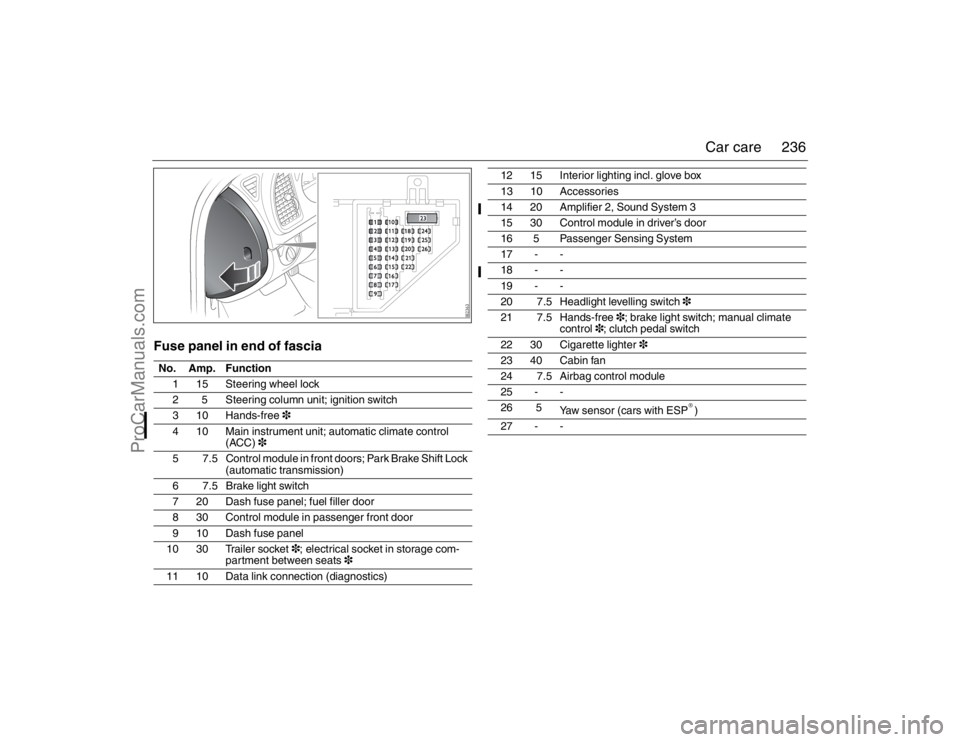
236 Car care
Fuse panel in end of fasciaNo. Amp. Function
1 15 Steering wheel lock
2 5 Steering column unit; ignition switch
3 10 Hands-free3
4 10 Main instrument unit; automatic climate control
(ACC)3
5 7.5 Control module in front doors; Park Brake Shift Lock
(automatic transmission)
6 7.5 Brake light switch
7 20 Dash fuse panel; fuel filler door
8 30 Control module in passenger front door
9 10 Dash fuse panel
10 30 Trailer socket3; electrical socket in storage com-
partment between seats3
11 10 Data link connection (diagnostics)
12 15 Interior lighting incl. glove box
13 10 Accessories
14 20 Amplifier 2, Sound System 3
15 30 Control module in driver’s door
16 5 Passenger Sensing System
17 - -
18 - -
19 - -
20 7.5 Headlight levelling switch3
21 7.5 Hands-free3; brake light switch; manual climate
control3; clutch pedal switch
22 30 Cigarette lighter3
23 40 Cabin fan
24 7.5 Airbag control module
25 - -
26 5
Yaw sensor (cars with ESP
®)
27 - -
93_U S _M 07.book Page 236 W ednesday, April 12, 2006 9:30 AM
ProCarManuals.com
Page 237 of 304

237 Car care
Trunk fuse panel, left-hand sideNo. Amp. Function
1–5 MAXI -
6 30 Control module in left rear door
7 30 Control module in right rear door
820Trailer3
9--
10 30 Left-hand brake light; rear right turn signal; right tail-
light; right reversing light; high-mounted brake light;
trailer lights
11 - -
12 - -
13 - -
14 - -
15 15 Seat heating, left seat3
16 15 Seat heating, right seat3
17 7.5 Autodimming rearview mirror3; rain sensor3
18 15 Moonroof3
19 - -
20 7.5 XM-radio3, TMC-tuner3
21 7.5 Saab Parking Assistance (SPA)3; control module in
rear doors; dome light (Convertible)
22 30 Radio3; navigation3
23 - -
24 10 Movement sensor3; tilt sensor3; dome light (Con-
ver tible)
25 30 Electrically adjustable driver’s seat with memory3
Trunk fuse panel, Sport Sedan93_U S _M 07.book Page 237 W ednesday, April 12, 2006 9:30 AM
ProCarManuals.com
Page 239 of 304

239 Car careFuse panel in engine bayNo. Amp. Function
1--
2 10 Engine control module; automatic transmission con-
trol module3
320Horn
4 10 Engine control module; battery disconnect switch3
5--
6 10 Selector lever, automatic transmission3; clutch pedal
switch
7--
8 5 Relay for vacuumpump (brake system)3
9--
10 - -
11 - -
12 10 Washer fluid pump, rear window3
13 - -
14 - -
15 30 Washer fluid pump, headlights3
16 30 Front right parking light; front right turn signal; left and
right side turn signal; right high beam; left low beam;
front left fog light3
17 30 Windshield wiper motor, low speed
18 30 Windshield wiper motor, high speed
19 20 Parking heater; auxiliary heater3
20 10 Headlight levelling3
21 - -
22 30 Washer fluid pump, windshield
23 - -
24 20 Flash-to-pass
25 20 Amplifier, sound system II3
26 30 Front left turn signal; front left parking light; front right
fog light3; right low beam; left high beam
27
–37MAXI
93_U S _M 07.book Page 239 W ednesday, April 12, 2006 9:30 AM
ProCarManuals.com
Page 247 of 304

247 Car care
Wheel ReplacementReplace any wheel that is bent, cracked or
badly rusted or corroded. If wheel nuts keep
coming loose, the wheel, wheel bolts and
wheel nuts should be replaced. If the wheel
leaks air, replace it (except some aluminum
wheels, which can sometimes be repaired).
See your dealer if any of these conditions
exist.
Your dealer will know the kind of wheel you
need.
Each new wheel should have the same
load-carrying capacity, diameter, width,
offset and be mounted the same way as the
one it replaces.
If you need to replace any of your wheels,
wheel bolts or wheel nuts, replace them only
with new Saab original equipment parts.
This way, you will be sure to have the right
wheel, wheel bolts and wheel nuts for your
vehicle.
Notice:
The wrong wheel can also cause
problems with bearing life, brake cool-
ing, speedometer or odometer calibra-
tion, headlamp aim, bumper height, vehi-
cle ground clearance and tire or tire
chain clearance to the body and chassis.
See “Changing a tire” on page 257.Used Replacement Wheels
WARNING
Using the wrong replacement wheels,
wheel bolts or wheel nuts on your vehicle
can be dangerous. It could affect the
braking and handling of your vehicle,
make your tires lose air and make you
lose control. You could have a collision in
which you or others could be injured.
Always use the correct wheel, wheel bolts
and wheel nuts for replacement.
WARNING
When fitting just one new pair of tires,
these should be fitted to the rear wheels,
as these are more critical to the direc-
tional stability of the car (e.g. on braking
or in a skid). The existing rear wheels
should therefore be moved to the front.
WARNING
Putting a used wheel on your vehicle is
dangerous. You can’t know how it’s been
used or how far it’s been driven. It could
fail suddenly and cause a crash. If you
have to replace a wheel, use a new GM
original equipment wheel.
93_U S _M 07.book Page 247 W ednesday, April 12, 2006 9:30 AM
ProCarManuals.com
Page 248 of 304

248 Car careTire Chains
Notice:
If your vehicle does not have
235/45R17 size tires, use tire chains only
where legal and only when you must.
Contact your Saab dealer regarding suit-
able snow chains. Install them on the
front tires and tighten them as tightly as
possible with the ends securely
fastened. Drive slowly and follow the
chain manufacturer’s instructions. If you
can hear the chains contacting your
vehicle, stop and retighten them. If the
contact continues, slow down until it
stops. Driving too fast or spinning the
wheels with chains on will damage your
vehicle.
If a Tire Goes FlatIt’s unusual for a tire to “blowout” while
you’re driving, especially if you maintain
your tires properly. If air goes out of a tire,
it’s much more likely to leak out slowly. But
if you should ever have a “blowout”, here are
a few tips about what to expect and what to
do:
If a front tire fails, the flat tire will create a
drag that pulls the vehicle toward that side.
Take your foot off the accelerator pedal and
grip the steering wheel firmly. Steer to main-
tain lane position, and then gently brake to
a stop well out of the traffic lane.
A rear blowout, particularly on a curve, acts
much like a skid and may require the same
correction you’d use in a skid. In any rear
blowout, remove your foot from the acceler-
ator pedal. Get the vehicle under control by
steering the way you want the vehicle to go.
It may be very bumpy and noisy, but you can
still steer. Gently brake to a stop – well off
the road if possible.
If a tire goes flat, the next part shows how to
use your jacking equipment to change a flat
tire safely.
WARNING
If your vehicle has 235/45 R17 size tires,
don’t use tire chains, there’s not enough
clearance.
Tire chains used on a vehicle without the
proper amount of clearance can cause
damage to the brakes, suspension or
other vehicle parts. The area damaged by
the tire chains could cause you to lose
control of your vehicle and you or others
may be injured in a crash.
Use another type of traction device only if
its manufacturer recommends it for use
on your vehicle and tire size combination
and road conditions. Follow that manu-
facturer’s instructions. To help avoid
damage to your vehicle, drive slowly,
readjust or remove the device if it’s
contacting your vehicle, and don’t spin
your wheels.
If you do find traction devices that will fit,
install them on the front tires.93_U S _M 07.book Page 248 W ednesday, April 12, 2006 9:30 AM
ProCarManuals.com
Page 251 of 304

251 Car care
Loading Your VehicleThis is an example of what your vehicle´s
Tire-Loading Information/Certification label
might look like. It is located on the B-pillar
and shows how much weight your vehicle
may properly carry. The label tells you the
proper size, and recommended inflation
pressures for the tires on your vehicle. It
also gives you important information about
the number of people that can be in your
vehicle and the total weight that you can
carry. This weight is called the Vehicle
Capacity Weight, and includes the weight of
all occupants, cargo and all nonfactory-
installed options.
Tire Terminology and DefinitionsAir Pressure: The amount of air inside the
tire pressing outward on each square inch of
the tire. Air pressure is expressed in pounds
per square inch (psi) or kilopascal (kPa).
Accessory Weight: This means the com-
bined weight of optional accessories, for
example, automatic transmission, power
steering, power brakes, power windows,
power seats, radio and air conditioning.
Aspect Ratio: The relationship of a tire´s
height to its width.
Belt: A rubber coated layer of cords that is
located between the plies and the tread.
Cords may be made from steel or other rein-
forcing materials.
Bias Ply Tire: A pneumatic tire in which the
ply cords that extend to the beads are laid at
alternate angles substantially less than 90
degrees to the centerline of the tread.
Cold Inflation Pressure: The amount of air
pressure in a tire, measured in pounds per
square inch (psi) or kilopascal (kPa), before
a tire has built up heat from driving. See
“Inflation - Tire Pressure” on page 241.
Curb weight: This means the weight of a
motor vehicle with standard and optional
equipment including the maximum capacity
of fuel, oil and coolant, without passengers
and cargo.
This label can only be found on vehicles
sold in the U.S.
Vehicles sold in Canada have the tire
information label in the glove box, see
page 293.
TIN-codea Manufacturer´s Identification Mark
b Tire Size
c Tire Type Code
d Date of Manufacture93_U S _M 07.book Page 251 W ednesday, April 12, 2006 9:30 AM
ProCarManuals.com