Page 197 of 304

197 Starting and driving
Always try to keep the towrope taut by
gently applying the brake of the car on tow,
as necessary. This will avoid the towrope
being jerked violently.
Cars with automatic transmission:
Always observe the speed limit for vehicles
on tow. Whatever the speed limit, the car
must not be towed at speeds exceeding
30 mph (50 km/h) nor for a distance of more
than 30 miles (50 km). If the car needs to be
transported over a longer distance, a tow
truck or flatbed truck must be called out.
The engine cannot be started by towing or
pushing the car. In an emergency, the
engine can be started as described under
"Jump starting" on page 198.
Vehicle recoveryIf the car has to be transported on a flatbed
truck, or similar, it must be securely
strapped down. There are attachment
points for this purpose on the underside of
the car. The attachment points are oblong
hole that have been reinforced to cope with
the stresses that arise during this type of
transport.
Transporting the car
NOTICE The car must be towed front first.
If the car is to be towed with the front
wheels off the ground, make sure the
parking brake is off, as this acts on the
rear wheels.
NOTICEIf a car with sports (lowered) chassis is
transported, for example on a flat bed
truck, take extra care not to damage the
spoiler and/or underbody.
Attachment points for anchorage straps
93_U S _M 07.book Page 197 W ednesday, April 12, 2006 9:30 AM
ProCarManuals.com
Page 198 of 304

198 Starting and drivingJump starting
It is essential when a donor battery is to be
used to jump start the car that the jump
leads be connected correctly to prevent
arcing.
To jump start your vehicle:
1 Check the other vehicle. It must have a
12-volt battery with a negative ground
system.2 Get the vehicles close enough so the
jumper cables can reach, but be sure the
vehicles are not touching each other. If
a poor connection on the negative
jumper cable should exist, it is possible
for damage to be caused to electrical
systems/components of either vehicle
should inadvertent contact be made.
You would not be able to start your car
and bad grounding could damage the
electrical systems.
3 Turn off the ignition on both vehicles.
Turn off lights that are not needed, and
radios. This will avoid sparks and help
save both batteries and it could save
your radio.
WARNING
When working on the battery, highly
explosive gas can build up. A spark
could ignite this gas that collects
around the battery. Therefore, always
avoid sparks and open flames in the
vicinity of the battery.
The battery contains corrosive sulphu-
ric acid. Always wear a face mask or
goggles when working on the battery.
If battery acid gets into the eyes or
splashes onto skin or clothing, wash
the affected area liberally with water. If
acid gets into the eyes or a large quan-
tity makes contact with the skin, seek
medical help.
NOTICEIgnoring these steps could result in costly
damage to your vehicle that would not be
covered by your warranty.
Trying to start your car by pushing or pull-
ing it could damage your vehicle, even if
you have a manual transmission. If you
have an automatic transmission, your
vehicle cannot be started by pushing or
pulling it.
NOTICEIf the other system is not a 12-volt system
with a negative ground, both vehicles can
be damaged.
WARNING
You could be injured if the vehicles roll.
Set the parking brake firmly on each vehi-
cle. Put an automatic transmission in P
(Park) or a manual transmission in
Neutral.
93_U S _M 07.book Page 198 W ednesday, April 12, 2006 9:30 AM
ProCarManuals.com
Page 200 of 304

200 Starting and drivingUsing a battery charger3/starter
unitTo avoid damaging the car’s electrical
system and electronics, the following rules
must be followed when charging the battery
or jump starting the car.
If the charger or starter unit can be set to
different voltages (6V/12V/18V/24V), 12V
must be selected.
Follow the manufacturer’s instructions
supplied with the charger or starter unit.
No other apparatus that are grounded or
connected to the mains must be
connected to the car during charging or
jump starting.
The charger or starter unit must under no
conditions produce a voltage greater
than:
16V continuous
18V for 60 min.
If you are unsure about the charge rating of
the unit, disconnect the battery clamp from
the positive terminal before connecting the
unit to the battery.
For long tripsBefore starting off on a long journey, it is
advisable to have your car inspected by
your Saab dealer.
Obtain a few important items to take along
on your journey, such as spare bulbs, wiper
blades, fuses, a drive belt (poly-V-belt) and
the like.
You can check some points yourself before-
hand:
Check that no oil or fuel leaks out of the
engine or gearbox/transmission.
Check the coolant and power steering
fluid levels. Check also for leaks.
Inspect the drive belt (poly-V-belt) and
replace if it shows any signs of wear.
Check the battery charge.
Check the tires for tread pattern and air
pressure, including the compact spare
tire.
Take an extra remote control and keep it
separate.
Check the brakes.
Check all bulbs.
Check for the presence of the tool kit and
jack in the car.
93_U S _M 07.book Page 200 W ednesday, April 12, 2006 9:30 AM
ProCarManuals.com
Page 201 of 304

201 Car care
Hood ________________ 202
Engine ______________ 202
Engine bay, 4-cyl engine 205
Engine bay, V6 engine _ 206
Engine oil ____________ 207
Air filter______________ 209
Transmission fluid ____ 209
Coolant ______________ 209
Brake/clutch fluid and
brake pads__________ 211
Power steering________ 212
Battery ______________ 213
Drive belt ____________ 216
Wipers and washers ___ 217
Wiper blades _________ 217
Changing bulbs _______ 219 Fuses ________________ 234
Tires _________________ 241
Compact spare ________ 254
Changing a tire ________ 257
Safety belts ___________ 260
Upholstery and trim ____ 260
Textile carpeting _______ 261
Engine bay ____________ 261
Washing ______________ 261
Waxing and polishing ___ 264
Touching up the paint___ 264
Anti-corrosion treatment 265
Recovery and/or
recycling of automotive
materials ____________ 267
Air conditioning (A/C) ___ 268
Car care
3Asterisk means: equipment not fitted in all cars
(can depend on model variant, engine variant,
market specification, options or accessories).93_U S _M 07.book Page 201 W ednesday, April 12, 2006 9:30 AM
ProCarManuals.com
Page 205 of 304
205 Car care
1 Oil filler cap
2 Coolant reservoir
3 Brake and clutch fluid reservoir
4Battery
5 Fuse box
6 Washer-fluid reservoir
7 Power-steering fluid reservoir
8 Engine-oil dipstick
Engine bay, 4-cyl engine93_U S _M 07.book Page 205 W ednesday, April 12, 2006 9:30 AM
ProCarManuals.com
Page 206 of 304
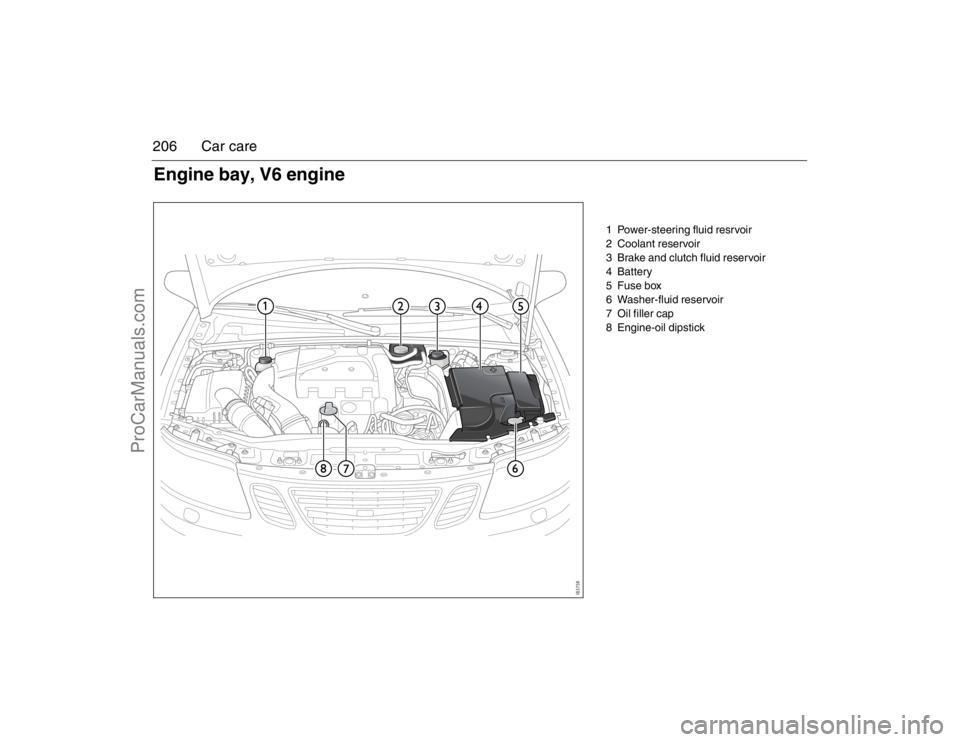
206 Car care
1 Power-steering fluid resrvoir
2 Coolant reservoir
3 Brake and clutch fluid reservoir
4Battery
5 Fuse box
6 Washer-fluid reservoir
7 Oil filler cap
8 Engine-oil dipstick
Engine bay, V6 engine93_U S _M 07.book Page 206 W ednesday, April 12, 2006 9:30 AM
ProCarManuals.com
Page 211 of 304

211 Car care
Brake/clutch fluid and
brake padsCheckingBrake fluid should be changed according to
the service program. Refer to the Warranty
and Service Book.
The brake and clutch fluid reservoir is trans-
parent to facilitate checking of the fluid level.
The fluid level should lie between the MAX
and MIN marks.If the level drops too low, the following
message appears on the SID:
Top up as necessary with DOT 4 brake
fluid. Do not use DOT 5 fluid.
Use only new brake fluid from a sealed
container.
The brake fluid level will fall somewhat as
the brake pads wear. The MAX level in the
reservoir corresponds to the amount of
brake fluid required with new brake pads. If
the fall in fluid level is moderate, due to
normal brake pad wear, topping up is not
necessary.
If the brake fluid should require chang-
ing, this must be carried out at a Saab
dealer. We recommend that you contact
a Saab dealer.
The foot brake and parking brake are self-
adjusting.
It is not possible to detect, through abnormal
pedal or parking brake lever travel, whether
the brake pads are worn and need replac-
ing. It is therefore essential that brake pads
be checked regularly, as specified in the
service program.Brake pads should only be changed at a
workshop. We recommend that you con-
tact a Saab dealer.
WARNING
Brake fluid deteriorates as it becomes
old. Because it is hygroscopic, it absorbs
water from the air and, in time, could allow
vapor to form in the brake system, thus
reducing its performance. It is therefore
important that brake fluid be changed
regularly, as specified in the service
program.
Brake fluid level low.
Make a safe stop.
NOTICEAvoid spilling brake fluid onto paintwork,
since it can cause the paint to bubble and
lift. If any brake fluid is spilled, the area
should be flushed with large quantities of
water as quickly as possible.Brake fluid reservoir
93_U S _M 07.book Page 211 W ednesday, April 12, 2006 9:30 AM
ProCarManuals.com
Page 217 of 304
217 Car care
Wipers and washersWiper bladesCheck and clean all wiper blades regularly.
If poor wiper performance is experienced,
clean the windshield with washer fluid. This
is particularly important if the car has been
through an automatic car wash, as these
sometimes leave a wax coating on the wind-
shield.
If wiper performance is still unsatisfactory,
fit new blades.
Windshield1 Press in the catch (1).
2 Pull the complete wiper blade down-
wards so that it comes away from the
wiper arm. Slide the entire blade out
from the arm.
Rear window, SportCombi1 Detach the blade from the arm by press-
ing on the mounting for the blade from
below.
2 Fit the new blade by pressing the shaft
of the blade into the arm's mounting.
The washer jet, which is located next to the
high-mounted brake light, is not adjustable.
Change of wiper blades, windshield
Change of wiper blades, rear window,
SportCombi
93_U S _M 07.book Page 217 W ednesday, April 12, 2006 9:30 AM
ProCarManuals.com