2007 SAAB 9-3 automatic transmission
[x] Cancel search: automatic transmissionPage 196 of 304

196 Starting and drivingThe front towing eye is stowed by the spare
wheel. On the left-hand side of the bumper
is a cover concealing the attachment point
(tapped hole) for the towing eye.
1 Press the knob on the upper section of
this cover at the same time as pulling out
the lower edge.
2 Screw in the towing eye. The towing
eye has a left-hand thread!
3 Insert the wheel wrench into the eye to
tighten it properly.
To refit the cover: Start by inserting the top
edge of the cover. Then click in the lower
edge, one corner at a time.
Rear towing eyeThe car has a permanent towing eye at the
rear under the bumper.
If the car is equipped with a towbar, this can
be used instead of the towing eye.
Towing the carEngage neutral (automatic transmission:
move the selector lever to N). Turn on the
parking lights.
Drive carefully and do not exceed the
speed limit for vehicles on tow.NOTICENever use the towing eyes to pull the car
unstuck.
Front towing eye fitted.
The towing eye has a left-hand thread!
Rear towing eye
Never use the towing eyes to pull the car
unstuck.
93_U S _M 07.book Page 196 W ednesday, April 12, 2006 9:30 AM
ProCarManuals.com
Page 197 of 304

197 Starting and driving
Always try to keep the towrope taut by
gently applying the brake of the car on tow,
as necessary. This will avoid the towrope
being jerked violently.
Cars with automatic transmission:
Always observe the speed limit for vehicles
on tow. Whatever the speed limit, the car
must not be towed at speeds exceeding
30 mph (50 km/h) nor for a distance of more
than 30 miles (50 km). If the car needs to be
transported over a longer distance, a tow
truck or flatbed truck must be called out.
The engine cannot be started by towing or
pushing the car. In an emergency, the
engine can be started as described under
"Jump starting" on page 198.
Vehicle recoveryIf the car has to be transported on a flatbed
truck, or similar, it must be securely
strapped down. There are attachment
points for this purpose on the underside of
the car. The attachment points are oblong
hole that have been reinforced to cope with
the stresses that arise during this type of
transport.
Transporting the car
NOTICE The car must be towed front first.
If the car is to be towed with the front
wheels off the ground, make sure the
parking brake is off, as this acts on the
rear wheels.
NOTICEIf a car with sports (lowered) chassis is
transported, for example on a flat bed
truck, take extra care not to damage the
spoiler and/or underbody.
Attachment points for anchorage straps
93_U S _M 07.book Page 197 W ednesday, April 12, 2006 9:30 AM
ProCarManuals.com
Page 198 of 304

198 Starting and drivingJump starting
It is essential when a donor battery is to be
used to jump start the car that the jump
leads be connected correctly to prevent
arcing.
To jump start your vehicle:
1 Check the other vehicle. It must have a
12-volt battery with a negative ground
system.2 Get the vehicles close enough so the
jumper cables can reach, but be sure the
vehicles are not touching each other. If
a poor connection on the negative
jumper cable should exist, it is possible
for damage to be caused to electrical
systems/components of either vehicle
should inadvertent contact be made.
You would not be able to start your car
and bad grounding could damage the
electrical systems.
3 Turn off the ignition on both vehicles.
Turn off lights that are not needed, and
radios. This will avoid sparks and help
save both batteries and it could save
your radio.
WARNING
When working on the battery, highly
explosive gas can build up. A spark
could ignite this gas that collects
around the battery. Therefore, always
avoid sparks and open flames in the
vicinity of the battery.
The battery contains corrosive sulphu-
ric acid. Always wear a face mask or
goggles when working on the battery.
If battery acid gets into the eyes or
splashes onto skin or clothing, wash
the affected area liberally with water. If
acid gets into the eyes or a large quan-
tity makes contact with the skin, seek
medical help.
NOTICEIgnoring these steps could result in costly
damage to your vehicle that would not be
covered by your warranty.
Trying to start your car by pushing or pull-
ing it could damage your vehicle, even if
you have a manual transmission. If you
have an automatic transmission, your
vehicle cannot be started by pushing or
pulling it.
NOTICEIf the other system is not a 12-volt system
with a negative ground, both vehicles can
be damaged.
WARNING
You could be injured if the vehicles roll.
Set the parking brake firmly on each vehi-
cle. Put an automatic transmission in P
(Park) or a manual transmission in
Neutral.
93_U S _M 07.book Page 198 W ednesday, April 12, 2006 9:30 AM
ProCarManuals.com
Page 209 of 304

209 Car care
Air filter
Transmission fluidManual transmission
Check and top up the oil in accordance with
the service program.
Automatic transmission
Check and top up the oil in accordance with
the service program.
CoolantThere is an overpressure in the cooling sys-
tem. Coolant temperatures can sometimes
exceed 212° F (100° C).
If the coolant level drops too low, the follow-
ing message appears on the SID:
The properties of the coolant are retained
for the entire service life of the car. There-
fore, it is not necessary to change the cool-
ant.The coolant contains 45 % antifreeze and
anti-corrosion fluid. This ratio gives the best
cooling effect. Lower concentrations should
be avoided, in view of the corrosion risk.
Coolants of a different brand could damage
the engine or cooling system. We therefore
recommend strict use of coolants that have
been approved by Saab.
Note:
If incorrect coolant is used or added, the life-
time properties will be affected. Even if the
coolant is flushed from the system and
replaced with life-time coolant, life-time
properties are no longer retained and the
coolant must then be drained and replaced
at regular intervals.
WARNING
To ensure reliable operation, only use
an air filter recommended by Saab
Automobile AB.
WARNING
Proceed with caution if the radiator is
boiling when you open the hood.
Never remove the expansion-tank
filler cap when the radiator is boiling.
The cooling system is pressurized –
hot coolant and vapor can escape
when the filler cap is released. These
can cause injury to your eyes and
burns. Loosen the cap carefully, and
let the engine cool before removing
the cap.
Exercise care when adding coolant.
Coolant on hot surfaces constitutes a
fire risk.
Coolant level low.
Refill.
NOTICEIf the cooling system needs topping up,
mix the antifreeze with the appropriate
quantity of drinking water or distilled
water before adding it to the system.
If undiluted antifreeze is added, the
engine could still freeze and be damaged.
This is because the antifreeze will not mix
properly with the coolant before the ther-
mostat has opened to allow full circula-
tion.
93_U S _M 07.book Page 209 W ednesday, April 12, 2006 9:30 AM
ProCarManuals.com
Page 236 of 304
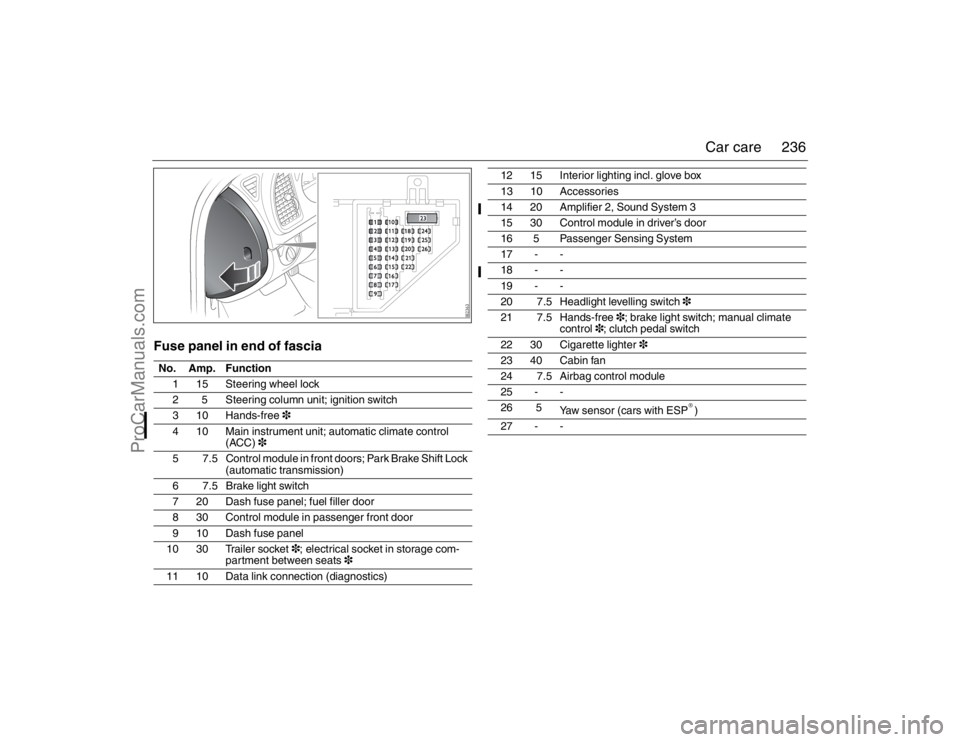
236 Car care
Fuse panel in end of fasciaNo. Amp. Function
1 15 Steering wheel lock
2 5 Steering column unit; ignition switch
3 10 Hands-free3
4 10 Main instrument unit; automatic climate control
(ACC)3
5 7.5 Control module in front doors; Park Brake Shift Lock
(automatic transmission)
6 7.5 Brake light switch
7 20 Dash fuse panel; fuel filler door
8 30 Control module in passenger front door
9 10 Dash fuse panel
10 30 Trailer socket3; electrical socket in storage com-
partment between seats3
11 10 Data link connection (diagnostics)
12 15 Interior lighting incl. glove box
13 10 Accessories
14 20 Amplifier 2, Sound System 3
15 30 Control module in driver’s door
16 5 Passenger Sensing System
17 - -
18 - -
19 - -
20 7.5 Headlight levelling switch3
21 7.5 Hands-free3; brake light switch; manual climate
control3; clutch pedal switch
22 30 Cigarette lighter3
23 40 Cabin fan
24 7.5 Airbag control module
25 - -
26 5
Yaw sensor (cars with ESP
®)
27 - -
93_U S _M 07.book Page 236 W ednesday, April 12, 2006 9:30 AM
ProCarManuals.com
Page 239 of 304

239 Car careFuse panel in engine bayNo. Amp. Function
1--
2 10 Engine control module; automatic transmission con-
trol module3
320Horn
4 10 Engine control module; battery disconnect switch3
5--
6 10 Selector lever, automatic transmission3; clutch pedal
switch
7--
8 5 Relay for vacuumpump (brake system)3
9--
10 - -
11 - -
12 10 Washer fluid pump, rear window3
13 - -
14 - -
15 30 Washer fluid pump, headlights3
16 30 Front right parking light; front right turn signal; left and
right side turn signal; right high beam; left low beam;
front left fog light3
17 30 Windshield wiper motor, low speed
18 30 Windshield wiper motor, high speed
19 20 Parking heater; auxiliary heater3
20 10 Headlight levelling3
21 - -
22 30 Washer fluid pump, windshield
23 - -
24 20 Flash-to-pass
25 20 Amplifier, sound system II3
26 30 Front left turn signal; front left parking light; front right
fog light3; right low beam; left high beam
27
–37MAXI
93_U S _M 07.book Page 239 W ednesday, April 12, 2006 9:30 AM
ProCarManuals.com
Page 251 of 304

251 Car care
Loading Your VehicleThis is an example of what your vehicle´s
Tire-Loading Information/Certification label
might look like. It is located on the B-pillar
and shows how much weight your vehicle
may properly carry. The label tells you the
proper size, and recommended inflation
pressures for the tires on your vehicle. It
also gives you important information about
the number of people that can be in your
vehicle and the total weight that you can
carry. This weight is called the Vehicle
Capacity Weight, and includes the weight of
all occupants, cargo and all nonfactory-
installed options.
Tire Terminology and DefinitionsAir Pressure: The amount of air inside the
tire pressing outward on each square inch of
the tire. Air pressure is expressed in pounds
per square inch (psi) or kilopascal (kPa).
Accessory Weight: This means the com-
bined weight of optional accessories, for
example, automatic transmission, power
steering, power brakes, power windows,
power seats, radio and air conditioning.
Aspect Ratio: The relationship of a tire´s
height to its width.
Belt: A rubber coated layer of cords that is
located between the plies and the tread.
Cords may be made from steel or other rein-
forcing materials.
Bias Ply Tire: A pneumatic tire in which the
ply cords that extend to the beads are laid at
alternate angles substantially less than 90
degrees to the centerline of the tread.
Cold Inflation Pressure: The amount of air
pressure in a tire, measured in pounds per
square inch (psi) or kilopascal (kPa), before
a tire has built up heat from driving. See
“Inflation - Tire Pressure” on page 241.
Curb weight: This means the weight of a
motor vehicle with standard and optional
equipment including the maximum capacity
of fuel, oil and coolant, without passengers
and cargo.
This label can only be found on vehicles
sold in the U.S.
Vehicles sold in Canada have the tire
information label in the glove box, see
page 293.
TIN-codea Manufacturer´s Identification Mark
b Tire Size
c Tire Type Code
d Date of Manufacture93_U S _M 07.book Page 251 W ednesday, April 12, 2006 9:30 AM
ProCarManuals.com
Page 257 of 304

257 Car care
Changing a tire
WARNING
Lifting a vehicle and getting under it to do
maintenance or repairs is dangerous
without the appropriate safety equipment
and training. The jack provided with your
vehicle is designed only for changing a
flat tire. If it is used for anything else, you
or others could be badly injured or killed if
the vehicle slips off the jack. Use the jack
provided with your vehicle only for chang-
ing a flat tire.
Changing a tire can be dangerous. The
vehicle can slip off the jack and roll over
or fall on you or other people. You and
they could be badly injured or even killed.
Find a level place to change your tire. To
help prevent the vehicle from moving:
1 Set the parking brake firmly.
2 If you have an automatic transmis-
sion, put the shift lever in PARK (P).
For a manual transmission, leave the
car in gear (1st or REVERSE (R)).
3 Turn off the engine and do not restart
while the vehicle is raised.
4 Do not allow passengers to remain in
the vehicle.
To be even more certain the vehicle won't
move, you should put blocks at the front
and rear of the tire farthest away from the
one being changed. That would be the
tire, on the other side, at the opposite end
of the vehicle.
The car jack is designed solely for use
in changing a tire or fitting snow
chains. It must not be used to
support the car during repair work
or servicing.
Never crawl under a car that is
supported only by a jack. Always use
axle stands.
Raising your vehicle too high or with
the jack improperly positioned can
damage the vehicle and even make
the vehicle fall. To help avoid personal
injury and vehicle damage, be sure to
fit the jack lift head into the proper
location before raising the vehicle, and
raise the vehicle only far enough off
the ground so there is enough room for
the spare tire to fit (no more than
25 mm or 1 inch clearance between
the ground and the bottom of the tire).
Switch on the hazard warning lights if
the car is on a road.
The jack should be stored correctly
under the carpeting in the trunk. If it
lies loose in the car, it could thrown
forward and cause personal injury in
the event of a crash or if the car rolls
over.
Grit, salt and rust can clog the inner
threads of the wheel bolts if the car has
been driven for several years exclu-
sively with alloy wheels.
If steel wheels are being installed, the
bolt hole threads in the brake hubs
should be cleaned before the thinner
steel wheels are fitted. It may other-
wise not be possible to achieve the
correct clamping force, despite tight-
ening the wheel bolts to the correct
torque.
93_U S _M 07.book Page 257 W ednesday, April 12, 2006 9:30 AM
ProCarManuals.com