Page 243 of 532
STARTING AND OPERATINGCONTENTS � Starting Procedures – Gas Engines ...........248
▫ Manual Transmission – If Equipped ........248
▫ Automatic Transmission – If Equipped ......248
▫ Normal Starting ......................249
▫ If Engine Fails To Start .................249
▫ After Starting ........................251
� Starting Procedures – Diesel Engines .........251
▫ Manual Transmission – If Equipped ........252
▫ Automatic Transmission – If Equipped ......252 ▫ Normal Starting Procedure — Engine Manifold
Airtemperature Above 66°F (19°C) .........252
▫ Starting Procedure — Engine Manifold Air
Temperature Below 66°F (19°C) ...........253
▫ Starting Fluids .......................257
� Normal Operation – Diesel Engine ..........257
▫ Cold Weather Precautions ...............258
▫ Engine Idling — In Cold Weather ..........261
▫ Stopping The Engine ...................262
▫ Engine Speed Control ..................2635
Page 244 of 532
▫ Operating Precautions ..................263
▫ Cooling System Tips — Automatic Transmission 263
� Engine Block Heater — If Equipped .........265
� Diesel Exhaust Brake (Engine Braking) – If
Equipped ............................265
� Automatic Transmission ..................266
▫ Automatic Transmission With Overdrive (5 Speed
545RFE) — If Equipped .................267
▫ Automatic Transmission (6 Speed AS68RC) — If
Equipped ...........................273
� Manual Transmission ....................279
▫ Manual Transmission — 6 Speed (G56) ......280
▫ Recommended Vehicle Shift Speeds ........280
▫ Downshifting – Gas Engine ..............281 ▫ Downshifting – Diesel Engine ............282
� Four-Wheel- Drive Operation — If Equipped . . . 283
▫ Manually Shifted Transfer Case Operating
Information/Precautions ................283
▫ Shifting Procedure - Manually Shifted Transfer
Case ..............................286
▫ Transfer Case Reminder Light ............287
▫ Electronically Shifted Transfer Case Operating
Information/Precautions (4 Position Switch)—If
Equipped ...........................288
▫ Shifting Procedure - Electronically Shifted Transfer
Case ..............................292
� Limited-Slip Differential — If Equipped .......295
� Power Take Off Operation – If Equipped ......296
▫ Stationary Mode ......................296244 STARTING AND OPERATING
Page 248 of 532

STARTING PROCEDURES – GAS ENGINES
The starter should not be operated for more than 15-
second intervals. Waiting a few seconds between such
intervals will protect the starter from overheating.
WARNING!Be sure to turn off the engine if you want to rest or
sleep in your car. Accidents can be caused by inad-
vertently moving the gear selection lever or by
pressing the accelerator pedal. This may cause exces-
sive heat in the exhaust system, resulting in over-
heating and vehicle fire which may cause serious or
fatal injuries. WARNING!Do not leave children or animals inside parked
vehicles in hot weather. Interior heat build up may
cause serious injury or death.
Manual Transmission – If Equipped
Apply the parking brake, place the gearshift control lever
in NEUTRAL and depress the clutch pedal to the floor
before starting the vehicle. This vehicle is equipped with
a clutch interlocking ignition system. It will not start
unless the clutch is fully depressed.
Automatic Transmission – If Equipped
Start the engine with the selector lever in NEUTRAL or
PARK position. Apply the brake before shifting to any
driving range.248 STARTING AND OPERATING
Page 252 of 532

Manual Transmission – If Equipped
Apply the parking brake, place the gearshift control lever
in NEUTRAL and depress the clutch pedal to the floor
before starting the vehicle. This vehicle is equipped with
a clutch interlocking ignition system. It will not start
unless the clutch is fully depressed.
Automatic Transmission – If Equipped
Start the engine with the selector lever in NEUTRAL or
PARK position. Apply the brake before shifting to any
driving range.
The Cummins Diesel engine is equipped with several
features designed to assist cold weather starting and
operation:
• The engine block heater is a resistance heater installed
in the water jacket of the engine just above and behind
the oil filter. It requires a 110–115 volt AC electrical
outlet with a grounded, three-wire extension cord. NOTE: The engine block heater cord is a factory in-
stalled option. If your vehicle is not equipped, heater
cords are available from your authorized Mopar � dealer.
• A 12–volt heater built into the fuel filter housing aids
in preventing fuel gelling. It is controlled by a built-in
thermostat.
• A heated intake air system both improves engine
starting and reduces the amount of white smoke
generated by a warming engine.
Normal Starting Procedure — Engine Manifold
AirTemperature Above 66°F (19°C)
Observe the Instrument Panel Cluster lights when start-
ing the engine.
1. Always apply the parking brake.
2. Shift into PARK for an automatic transmission. Fully
depress and hold the clutch and shift into NEUTRAL for252 STARTING AND OPERATING
Page 253 of 532

a manual transmission. Models with manual transmis-
sion are equipped with a clutch interlocking cranking
system. The clutch must be fully depressed to start the
vehicle.
3. Turn the ignition key to the ON position and look at
the instrument panel cluster lamps.
CAUTION!If WATER IN FUEL indicator light remains on DO
NOT START engine before you drain water from the
fuel filter to avoid engine damage. See Section 7 —
Maintaining Your Vehicle, for water drain proce-
dures.
4. Turn the ignition key to START and crank the engine.
Do not press the accelerator during starting. CAUTION!Do not crank engine for more than 15 seconds at a
time as starter motor damage may result. Turn key to
OFF and wait at least two minutes before trying
again.
5. When the engine starts, release the key.
6. Check to see that there is oil pressure.
7. Release the parking brake.
Starting Procedure — Engine Manifold Air
Temperature Below 66°F (19°C)
NOTE: The temperature displayed on the overhead
console (if equipped) does not necessarily reflect the
engine manifold air temperature. When certain engine
temperatures fall below 66°F (19°C) the lamp will remain
on indicating the intake manifold heater system is active. STARTING AND OPERATING 253
5
Page 262 of 532
Stopping The Engine
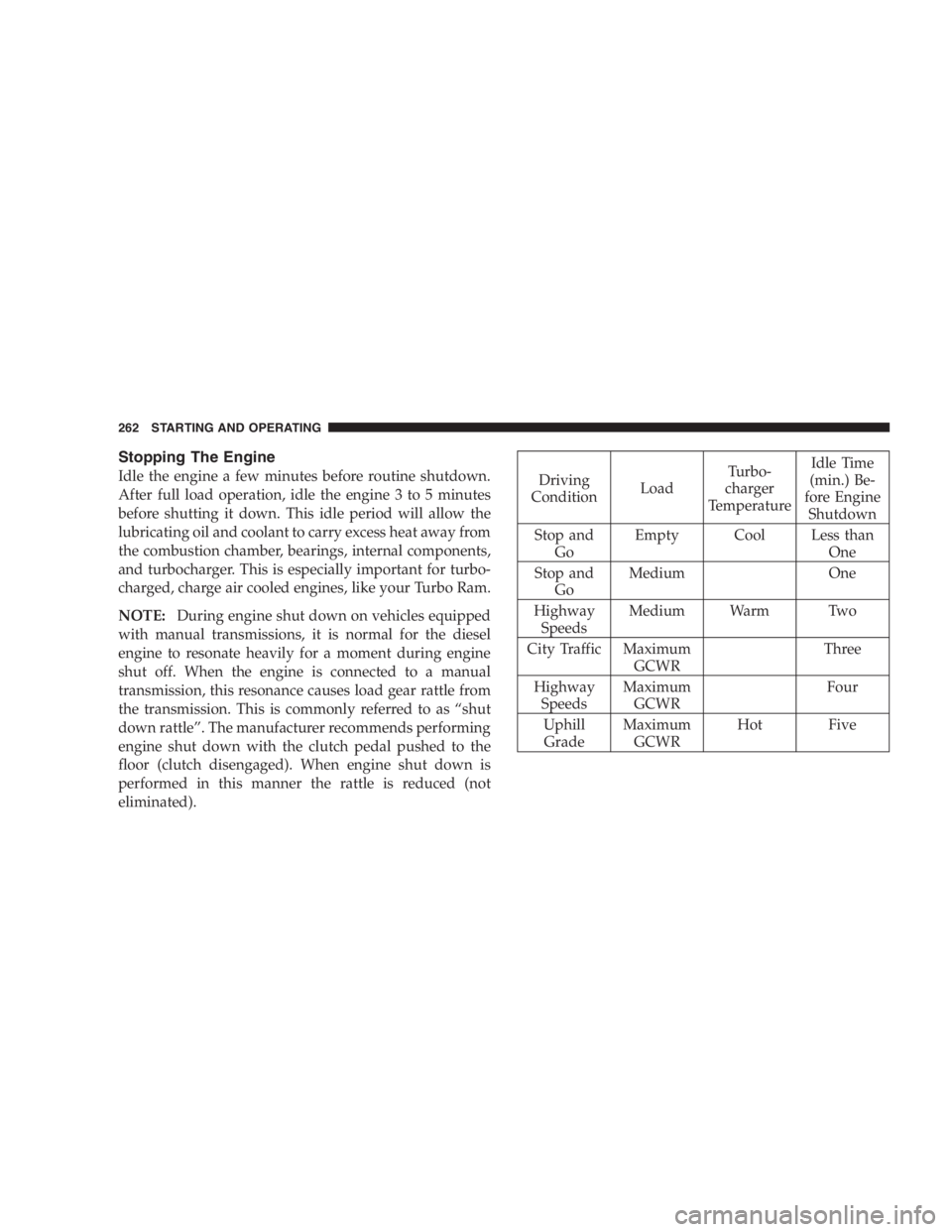
Idle the engine a few minutes before routine shutdown.
After full load operation, idle the engine 3 to 5 minutes
before shutting it down. This idle period will allow the
lubricating oil and coolant to carry excess heat away from
the combustion chamber, bearings, internal components,
and turbocharger. This is especially important for turbo-
charged, charge air cooled engines, like your Turbo Ram.
NOTE: During engine shut down on vehicles equipped
with manual transmissions, it is normal for the diesel
engine to resonate heavily for a moment during engine
shut off. When the engine is connected to a manual
transmission, this resonance causes load gear rattle from
the transmission. This is commonly referred to as “shut
down rattle”. The manufacturer recommends performing
engine shut down with the clutch pedal pushed to the
floor (clutch disengaged). When engine shut down is
performed in this manner the rattle is reduced (not
eliminated). Driving
Condition Load Turbo-
charger
Temperature Idle Time
(min.) Be-
fore Engine
Shutdown
Stop and
Go Empty Cool Less than
One
Stop and
Go Medium One
Highway
Speeds Medium Warm Two
City Traffic Maximum
GCWR Three
Highway
Speeds Maximum
GCWR Four
Uphill
Grade Maximum
GCWR Hot Five262 STARTING AND OPERATING
Page 279 of 532

NOTE: If the vehicle has not been driven in several
days, the first few seconds of operation after shifting the
transmission into gear may seem sluggish. This is due to
the fluid partially draining from the torque converter into
the transmission. This condition is normal and will not
cause damage to the transmission. The torque converter
will refill within five seconds of shifting from Park into
any other gear position.
MANUAL TRANSMISSION
WARNING!You or others could be injured if you leave the
vehicle unattended without having the parking
brake fully applied. The parking brake should al-
ways be applied when the driver is not in the
vehicle, especially on an incline. Truck models with manual transmission are equipped
with a clutch interlocking ignition system. The clutch
pedal must be fully depressed to start the vehicle.
Fully depress the clutch pedal before shifting gears. As
you release the clutch pedal, lightly depress the accelera-
tor pedal.
To shift into Reverse, come to a complete stop. Depress
the clutch and pause briefly to allow the gear train to
stop. Move the shift lever from the Neutral position
straight across and back into Reverse.
Never drive with your foot resting on the clutch pedal, or
attempt to hold the vehicle on a hill with the clutch pedal
partially engaged, as this will cause abnormal wear on
the clutch. STARTING AND OPERATING 279
5
Page 280 of 532

Manual Transmission — 6 Speed (G56)
Your vehicle may be equipped with the G56 manual
transmission. This transmission has a “creeper” 1st gear
which should be used to start from a standing position
when carrying a payload or towing a trailer. Damage to
the clutch can result from starting in 2nd or 3rd gear with
a loaded vehicle. An unloaded vehicle may be launched
in 2nd gear. Use each gear in numerical order – do not
skip a gear.
For most city driving you may find it easier to use only
1st through 5th gear ranges. For steady highway driving
with light accelerations, 6th gear is recommended. To
shift into 5th gear, move the shift lever to the right
beyond the spring pressure point and push it forward.
When shifting from 5th to 4th gear, pull the lever down
toward you in one motion. Do not pull the lever sharply left as you may shift accidentally into 2nd gear and
damage the transmission.
To shift into Reverse, come to a complete stop. Depress
the clutch and pause briefly to allow the gear train to
stop. Reverse has a “crash-through” lockout feature.
Move the shift lever from the Neutral position straight
across, in one swift motion, and down into Reverse.
Recommended Vehicle Shift Speeds
To utilize your manual transmission efficiently for both
fuel economy and performance, it should be upshifted as
listed in recommended shift speed chart. Shift at the
vehicle speeds listed for acceleration. Earlier upshifts
during cruise conditions (steady speeds) will result in
increased fuel economy, and may be used as indicated.280 STARTING AND OPERATING
