Page 326 of 490
If you put things inside your vehicle — like
suitcases, tools, packages, or anything else — they
will go as fast as the vehicle goes. If you have to
stop or turn quickly, or if there is a crash, they will
keep going.
{CAUTION:
Things you put inside your vehicle can
strike and injure people in a sudden stop
or turn, or in a crash.
Put things in the cargo area of your
vehicle. Try to spread the weight
evenly.
Never stack heavier things, like
suitcases, inside the vehicle so that
some of them are above the tops of
the seats.
Do not leave an unsecured child
restraint in your vehicle.
When you carry something inside the
vehicle, secure it whenever you can.
Do not leave a seat folded down
unless you need to.
Towing
Towing Your Vehicle
Consult your dealer or a professional towing
service if you need to have your disabled vehicle
towed. SeeRoadside Assistance Program on
page 462.
If you want to tow your vehicle behind another
vehicle for recreational purposes (such as behind
a motorhome), see “Recreational Vehicle
Towing” following.
Recreational Vehicle Towing
Recreational vehicle towing means towing your
vehicle behind another vehicle – such as behind a
motorhome. The two most common types of
recreational vehicle towing are known as “dinghy
towing” (towing your vehicle with all four wheels
on the ground) and “dolly towing” (towing
your vehicle with two wheels on the ground and
two wheels up on a device known as a “dolly”).
With the proper preparation and equipment, many
vehicles can be towed in these ways. See
“Dinghy Towing” and “Dolly Towing,” following.
326
Page 329 of 490
If You Do Decide To Pull A Trailer
If you do, here are some important points:
There are many different laws, including speed
limit restrictions, having to do with trailering.
Make sure your rig will be legal, not only where
you live but also where you will be driving.
A good source for this information can be state
or provincial police.
Consider using a sway control. See “Hitches”
later in this section.
Do not tow a trailer at all during the rst
500 miles (800 km) your new vehicle is driven.
Your engine, axle or other parts could be
damaged.
During the rst 500 miles (800 km) that you
tow a trailer, do not drive over 50 mph
(80 km/h) and do not make starts at full
throttle. This helps your engine and other parts
of your vehicle wear in at the heavier loads.
Three important considerations have to do with
weight:
Weight of the trailer
Weight of the trailer tongue
Weight on your vehicle’s tires
Weight of the Trailer
How heavy can a trailer safely be?
Your vehicle can tow up to 3,500 lbs (1 575 kg).
But even that can be too heavy.
It depends on how you plan to use your rig. For
example, speed, altitude, road grades, outside
temperature and how much your vehicle is used to
pull a trailer are all important. It can also depend
on any special equipment that you have on
your vehicle, and the amount of tongue weight the
vehicle can carry. See “Weight of the Trailer
Tongue” later in this section for more information.
Maximum trailer weight is calculated assuming
only the driver is in the tow vehicle and it has all
the required trailering equipment. The weight
of additional optional equipment, passengers and
cargo in the tow vehicle must be subtracted
from the maximum trailer weight.
You can ask your dealer for our trailering
information or advice, or you can write us at our
Customer Assistance Offices. SeeCustomer
Assistance Offices on page 460for more
information.
329
Page 333 of 490

Before you start, check all trailer hitch parts and
attachments, safety chains, electrical connector,
lamps, tires and mirror adjustment. If the trailer has
electric brakes, start your vehicle and trailer
moving and then apply the trailer brake controller
by hand to be sure the brakes are working.
This lets you check your electrical connection at
the same time.
During your trip, check occasionally to be sure
that the load is secure, and that the lamps and any
trailer brakes are still working.
Following Distance
Stay at least twice as far behind the vehicle ahead
as you would when driving your vehicle without
a trailer. This can help you avoid situations
that require heavy braking and sudden turns.
Passing
You will need more passing distance up ahead
when you are towing a trailer. And, because
you are a good deal longer, you will need to go
much farther beyond the passed vehicle
before you can return to your lane.
Backing Up
Hold the bottom of the steering wheel with one
hand. Then, to move the trailer to the left,
just move that hand to the left. To move the trailer
to the right, move your hand to the right. Always
back up slowly and, if possible, have someone
guide you.
Making Turns
Notice:Making very sharp turns while
trailering could cause the trailer to come in
contact with the vehicle. Your vehicle could be
damaged. Avoid making very sharp turns
while trailering.
When you are turning with a trailer, make wider
turns than normal. Do this so your trailer will
not strike soft shoulders, curbs, road signs, trees
or other objects. Avoid jerky or sudden
maneuvers. Signal well in advance.
333
Page 383 of 490
5. Turn the bulb socket counterclockwise to
disconnect it from the taillamp assembly.
6. Pull the bulb out of the bulb socket.
7. Push the new bulb into the bulb socket.
8. Insert the bulb socket into the taillamp
assembly and turn it clockwise to secure.
9. Reverse Steps 1 through 3 to reinstall the
taillamp assembly. When reinstalling the
screws, do not overtighten.
License Plate Lamp
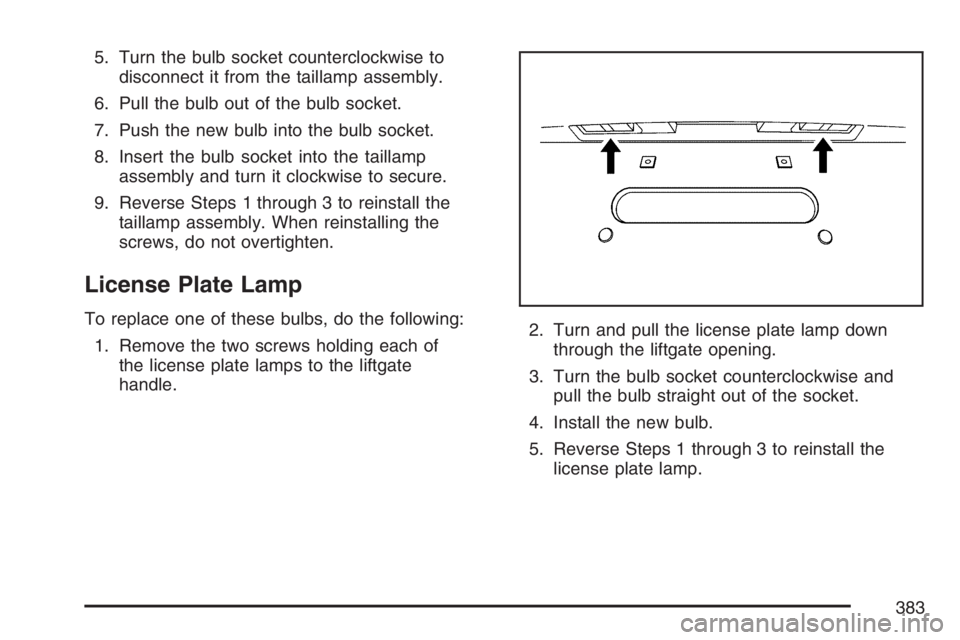
To replace one of these bulbs, do the following:
1. Remove the two screws holding each of
the license plate lamps to the liftgate
handle.2. Turn and pull the license plate lamp down
through the liftgate opening.
3. Turn the bulb socket counterclockwise and
pull the bulb straight out of the socket.
4. Install the new bulb.
5. Reverse Steps 1 through 3 to reinstall the
license plate lamp.
383
Page 385 of 490
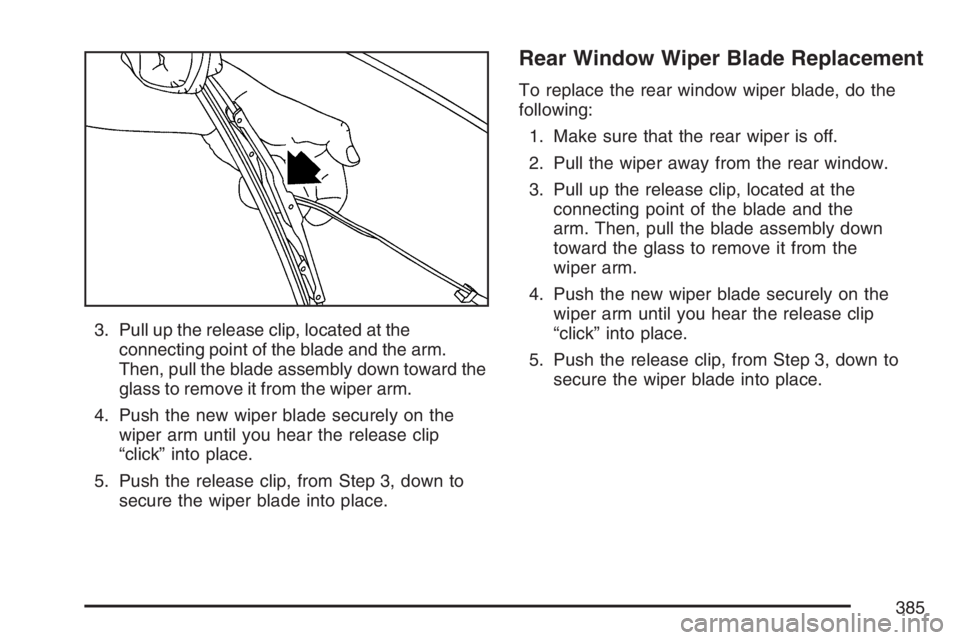
3. Pull up the release clip, located at the
connecting point of the blade and the arm.
Then, pull the blade assembly down toward the
glass to remove it from the wiper arm.
4. Push the new wiper blade securely on the
wiper arm until you hear the release clip
“click” into place.
5. Push the release clip, from Step 3, down to
secure the wiper blade into place.
Rear Window Wiper Blade Replacement
To replace the rear window wiper blade, do the
following:
1. Make sure that the rear wiper is off.
2. Pull the wiper away from the rear window.
3. Pull up the release clip, located at the
connecting point of the blade and the
arm. Then, pull the blade assembly down
toward the glass to remove it from the
wiper arm.
4. Push the new wiper blade securely on the
wiper arm until you hear the release clip
“click” into place.
5. Push the release clip, from Step 3, down to
secure the wiper blade into place.
385
Page 418 of 490
Notice:Wheelcovers will not t on your
compact spare. If you try to put a wheel cover
on the compact spare, you could damage
the cover or the spare.
Do not try to put a wheel cover on your compact
spare tire. It will not t. Store the wheel cover in the
cargo area until you have the at tire repaired or
replaced.
Storing a Flat or Spare Tire and
Tools
{CAUTION:
Storing a jack, a tire, or other equipment
in the passenger compartment of the
vehicle could cause injury. In a sudden
stop or collision, loose equipment could
strike someone. Store all these in the
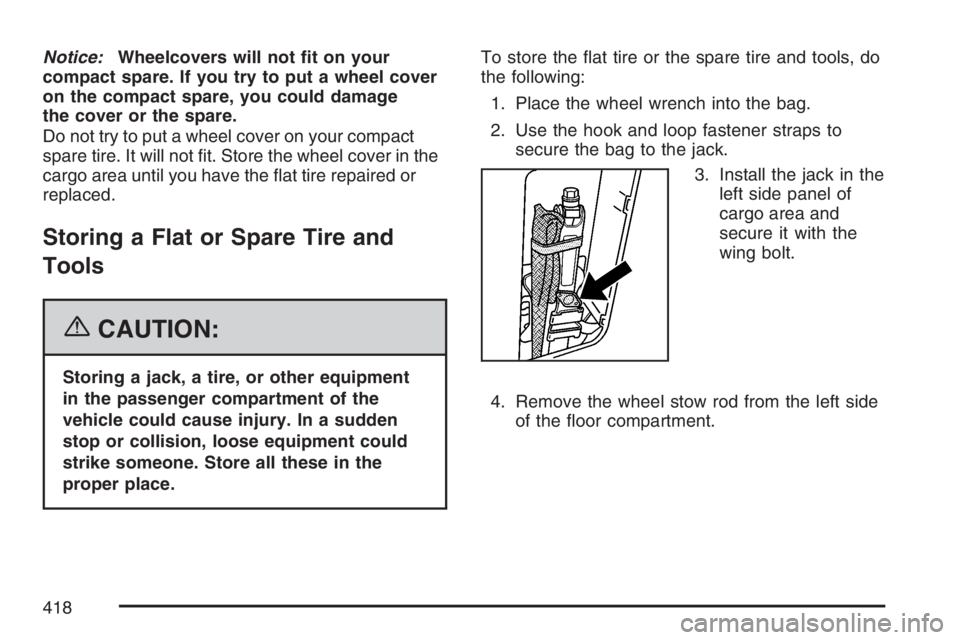
proper place.To store the at tire or the spare tire and tools, do
the following:
1. Place the wheel wrench into the bag.
2. Use the hook and loop fastener straps to
secure the bag to the jack.
3. Install the jack in the
left side panel of
cargo area and
secure it with the
wing bolt.
4. Remove the wheel stow rod from the left side
of the oor compartment.
418
Page 446 of 490

At Each Fuel Fill
It is important to perform these underhood checks
at each fuel ll.
Engine Oil Level Check
Check the engine oil level and add the proper oil if
necessary. SeeEngine Oil on page 349for
further details.
Notice:It is important to check your oil
regularly and keep it at the proper level. Failure
to keep your engine oil at the proper level
can cause damage to your engine not covered
by your warranty.
Engine Coolant Level Check
Check the engine coolant level and add
DEX-COOL®coolant mixture if necessary. See
Engine Coolant on page 357for further details.
Windshield Washer Fluid Level Check
Check the windshield washer uid level in
the windshield washer uid reservoir and add the
proper uid if necessary.
At Least Once a Month
Tire Ination Check
Visually inspect your vehicle’s tires and make sure
they are inated to the correct pressures. Do not
forget to check the spare tire. SeeInation - Tire
Pressure on page 393. Check to make sure the
spare tire is stored securely. SeeChanging a Flat
Tire on page 408.
Tire Wear Inspection
Tire rotation may be required for high mileage
highway drivers prior to the Engine Oil Life System
service notication. Check the tires for wear
and, if necessary, rotate the tires. SeeTire
Inspection and Rotation on page 399.
446
Page 462 of 490
Roadside Assistance Program
In the U.S., call1-800-ROADSIDE (762-3743)
In Canada, call1-800-268-6800
Service available 24 hours a day, 365 days a year.
As the owner of a new Pontiac vehicle, you are
automatically enrolled in the Pontiac Roadside
Assistance program. This value-added service is
intended to provide you with peace of mind as you
drive in the city or travel the open road.
Who is Covered?
Roadside Assistance coverage is for the vehicle
operator, regardless of ownership. A person driving
this vehicle without the consent of the owner is
not eligible for coverage.The following services are provided in the U.S.
during the Bumper-to-Bumper warranty period and,
in Canada, during the Base Warranty coverage
period of the New Vehicle Limited Warranty, up to
a maximum coverage of $100.
Fuel Delivery:Delivery of enough fuel for the
customer to get to the nearest service station
(approximately $5 in the U.S. and 10 litres
in Canada). Service to provide diesel may be
restricted. For safety reasons, propane
and other alternative fuels will not be provided
through this service.
Lock-out Service:To ensure security, the
driver must present the vehicle registration and
personal ID before lock-out service is provided.
Lock-out service is covered at no charge if you
are unable to gain entry into your vehicle.
If your vehicle does not start, Roadside
Assistance will arrange to have your vehicle
towed to the nearest authorized dealership.
In the U.S., replacement keys made at the
customer’s expense will be covered within
10 miles (16 km).
462