2007 PONTIAC TORRENT ECU
[x] Cancel search: ECUPage 87 of 490
{CAUTION:
If the airbag readiness light in the
instrument panel cluster ever comes on
and stays on, it means that something
may be wrong with the airbag system. If
this ever happens, have the vehicle
serviced promptly, because an adult-size
person sitting in the right front
passenger’s seat may not have the
protection of the frontal airbag. See
Airbag Readiness Light on page 176for
more on this, including important safety
information.
A thick layer of additional material such as a
blanket, or aftermarket equipment such as seat
covers, seat heaters, and seat massagers
can affect how well the passenger sensing system
operates. Remove any additional material from
the seat cushion before reinstalling or securing the
child restraint and before a small occupant,
including a small adult, sits in the passenger
position.You may want to consider not using seat covers
or other aftermarket equipment if your vehicle
has the passenger sensing system. SeeAdding
Equipment to Your Airbag-Equipped Vehicle
on page 89for more information about
modications that can affect how the system
operates.
{CAUTION:
Stowing of articles under the passenger’s
seat or between the passenger’s seat
cushion and seatback may interfere with
the proper operation of the passenger
sensing system.
87
Page 89 of 490

Adding Equipment to Your
Airbag-Equipped Vehicle
Q:Is there anything I might add to the front
or sides of the vehicle that could keep the
airbags from working properly?
A:Yes. If you add things that change your
vehicle’s frame, bumper system, height,
front end or side sheet metal, they may keep
the airbag system from working properly.
Also, the airbag system may not work properly
if you relocate any of the airbag sensors. If
you have any questions about this, you should
contact Customer Assistance before you
modify your vehicle. The phone numbers and
addresses for Customer Assistance are in
Step Two of the Customer Satisfaction
Procedure in this manual. SeeCustomer
Satisfaction Procedure on page 456.
Q:Because I have a disability, I have to get
my vehicle modied. How can I nd out
whether this will affect my airbag system?
A:Changing or moving any parts of the
front seats, safety belts, the airbag sensing
and diagnostic module, rollover sensor
module, instrument panel, steering wheel,
ceiling headliner, ceiling and pillar garnish trim,
roof-mounted rollover airbag modules, or
airbag wiring can affect the operation of the
airbag system. If you have questions, call
Customer Assistance. The phone numbers
and addresses for Customer Assistance are in
Step Two of the Customer Satisfaction
Procedure in this manual. SeeCustomer
Satisfaction Procedure on page 456.
89
Page 93 of 490

Keys.............................................................. 95
Remote Keyless Entry (RKE) System.......... 96
Remote Keyless Entry (RKE) System
Operation................................................. 97
Doors and Locks........................................ 104
Door Locks................................................ 104
Power Door Locks..................................... 105
Delayed Locking........................................ 105
Programmable Automatic Door Locks........ 105
Rear Door Security Locks......................... 106
Lockout Protection..................................... 106
Liftgate...................................................... 107
Windows...................................................... 109
Power Windows........................................ 110
Sun Visors................................................ 110
Theft-Deterrent Systems............................. 111
Content Theft-Deterrent............................. 111
PASS-Key
®III+......................................... 112
PASS-Key®III+ Operation......................... 113Starting and Operating Your Vehicle......... 114
New Vehicle Break-In................................ 114
Ignition Positions....................................... 115
Retained Accessory Power (RAP)............. 116
Starting the Engine.................................... 116
Engine Coolant Heater.............................. 118
Automatic Transaxle Operation.................. 119
Parking Brake........................................... 122
Shifting Into Park (P) ................................. 123
Shifting Out of Park (P)............................. 125
Parking Over Things That Burn................. 126
Engine Exhaust......................................... 127
Running the Engine While Parked............. 128
Mirrors......................................................... 129
Manual Rearview Mirror............................. 129
Manual Rearview Mirror with OnStar
®....... 129
Automatic Dimming Rearview Mirror with
OnStar
®and Compass........................... 129
Automatic Dimming Rearview Mirror with
Compass............................................... 131
Outside Power Mirrors............................... 132
Outside Convex Mirrors............................. 133
Section 2 Features and Controls
93
Page 106 of 490
Rear Door Security Locks
Your vehicle has rear door security locks that
prevent passengers from opening the rear doors
from the inside.
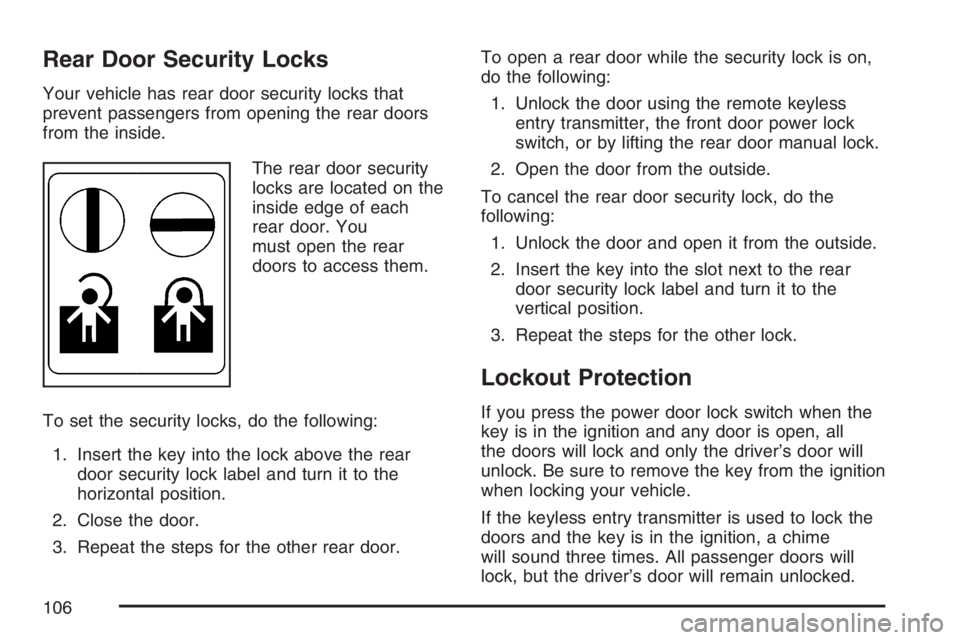
The rear door security
locks are located on the
inside edge of each
rear door. You
must open the rear
doors to access them.
To set the security locks, do the following:
1. Insert the key into the lock above the rear
door security lock label and turn it to the
horizontal position.
2. Close the door.
3. Repeat the steps for the other rear door.To open a rear door while the security lock is on,
do the following:
1. Unlock the door using the remote keyless
entry transmitter, the front door power lock
switch, or by lifting the rear door manual lock.
2. Open the door from the outside.
To cancel the rear door security lock, do the
following:
1. Unlock the door and open it from the outside.
2. Insert the key into the slot next to the rear
door security lock label and turn it to the
vertical position.
3. Repeat the steps for the other lock.
Lockout Protection
If you press the power door lock switch when the
key is in the ignition and any door is open, all
the doors will lock and only the driver’s door will
unlock. Be sure to remove the key from the ignition
when locking your vehicle.
If the keyless entry transmitter is used to lock the
doors and the key is in the ignition, a chime
will sound three times. All passenger doors will
lock, but the driver’s door will remain unlocked.
106
Page 113 of 490

PASS-Key®III+ Operation
Your vehicle has PASS-Key®III+ (Personalized
Automotive Security System) theft-deterrent
system. PASS-Key
®III+ is a passive
theft-deterrent system. This means you do not
have to do anything special to arm or disarm the
system. It works when you transition the key
to RUN, ACC or START from the LOCK position.
When the PASS-Key
®III+ system senses that
someone is using the wrong key, it prevents the
vehicle from starting. Anyone using a trial-and-error
method to start the vehicle will be discouraged
because of the high number of electrical key codes.
If the engine does not start and the security light
on the instrument panel comes on when trying
to start the vehicle, the key may have a damaged
transponder. Turn the ignition off and try again.If the engine still does not start, and the key
appears to be undamaged, try another ignition
key. At this time, you may also want to check the
fuse, seeFuses and Circuit Breakers on
page 431. If the engine still does not start with the
other key, your vehicle needs service. If your
vehicle does start, the rst key may be faulty. See
your dealer who can service the PASS-Key
®III+
to have a new key made. In an emergency,
contact Roadside Assistance.
It is possible for the PASS-Key
®III+ decoder to
“learn” the transponder value of a new or
replacement key. Up to nine additional keys may
be programmed for the vehicle. The following
procedure is for programming additional keys only.
If all the currently programmed keys are lost or
do not operate, you must see your dealer or
a locksmith who can service PASS-Key
®III+ to
have keys made and programmed to the system.
See your dealer or a locksmith who can service
PASS-Key
®III+ to get a new key blank that is cut
exactly as the ignition key that operates the
system.
113
Page 114 of 490

To program the new additional key do the
following:
1. Verify that the new key has a
1stamped on it.
2. Insert the original, already programmed, key
in the ignition and start the engine. If the
engine will not start, see your dealer
for service.
3. After the engine has started, turn the key to
LOCK, and remove the key.
4. Insert the new key to be programmed and turn
it to the RUN position within ve seconds of
removing the original key.
5. The security light will turn off once the key
has been programmed.
6. Repeat Steps 1 through 5 if additional keys
are to be programmed.
If you are driving and the security light comes on
and stays on, you may be able to restart your
engine. Your PASS-Key
®III+ system, however,
may not be working properly and must be serviced
by your dealer.
If you lose or damage your PASS-Key
®III+ key,
see your dealer or a locksmith who can service
PASS-Key
®III+ to have a new key made.
Starting and Operating Your
Vehicle
New Vehicle Break-In
Notice:Your vehicle does not need an
elaborate break-in. But it will perform better in
the long run if you follow these guidelines:
Do not drive at any one constant speed, fast
or slow, for the rst 500 miles (805 km). Do
not make full-throttle starts. Avoid
downshifting to brake, or slow, the vehicle.
Avoid making hard stops for the rst
200 miles (322 km) or so. During this time
your new brake linings are not yet broken
in. Hard stops with new linings can mean
premature wear and earlier replacement.
Follow this breaking-in guideline every time
you get new brake linings.
Do not tow a trailer during break-in. See
Towing a Trailer on page 328for the trailer
towing capabilities of your vehicle and more
information.
Following break-in, engine speed and load can
be gradually increased.
114
Page 133 of 490

Outside Convex Mirrors
The passenger’s side mirror is convex. A convex
mirror’s surface is curved, creating a wider
area of vision for the driver.
{CAUTION:
A convex mirror can make things (like
other vehicles) look farther away than
they really are. If you cut too sharply into
the right lane, you could hit a vehicle on
your right. Check your inside mirror or
glance over your shoulder before
changing lanes.
OnStar®System
OnStar®uses several innovative technologies and
live advisors to provide you with a wide range
of safety, security, information, and convenience
services. If your airbags deploy, the system is
designed to make an automatic call to OnStar
®
Emergency advisors who can request emergency
services be sent to your location. If you lock
your keys in the vehicle, call OnStar
®at
1-888-4-ONSTAR and they can send a signal to
unlock your doors. If you need roadside
assistance, press the OnStar
®button and they
can contact Roadside Service for you.
133
Page 139 of 490
Press the levers down until the locking
mechanisms fully engage to the side rail. Make
sure each lever is in the down position. The
crossrail will not slide when properly engaged.
To move the crossrail, pull up on the end levers on
each side of the crossrail to the upright position.
This will release the locking mechanism from
the siderail. Lift and place the crossrail into the
new position. Press the levers down until the
locking mechanisms fully engage to the side rail.
Make sure each lever is in the down position.
The crossrail will not slide when properly engaged.
Notice:Loading cargo on the luggage
carrier that weighs more than 150 lbs (68 kg)
or hangs over the rear or sides of the vehicle
may damage your vehicle. When loading
cargo, tie it to the crossrail and against the
siderail. Lock the crossrails to the far forward
and backward location to make sure the
load is evenly distributed on the luggage
carrier.Do not stand on the plastic lower body panel
when loading cargo on the luggage carrier.
Loading cargo on the luggage carrier will make
the center of vehicle gravity higher. Avoid
high speeds, sudden starts, sharp turns, sudden
braking or abrupt maneuvers. This could result
in loss of control of the vehicle.
Do not exceed the maximum vehicle capacity
when loading your vehicle. For more information
on vehicle capacity and loading, seeLoading Your
Vehicle on page 321
To prevent damage or loss of cargo as you are
driving, check now and then to make sure
the luggage carrier crossrails are locked and
cargo is still securely fastened.
When the luggage carrier is not in use, store the
crossrail inside the vehicle. If not possible,
lock one crossrail at the rear most position on the
siderails and lock the other crossrail above the
opening of the rear door to reduce wind noise.
139